

The Oval Solitaire: How to Choose the Perfect Elongated Diamond Ring
What You Should Know Before Buying an Oval Solitaire Engagement Ring

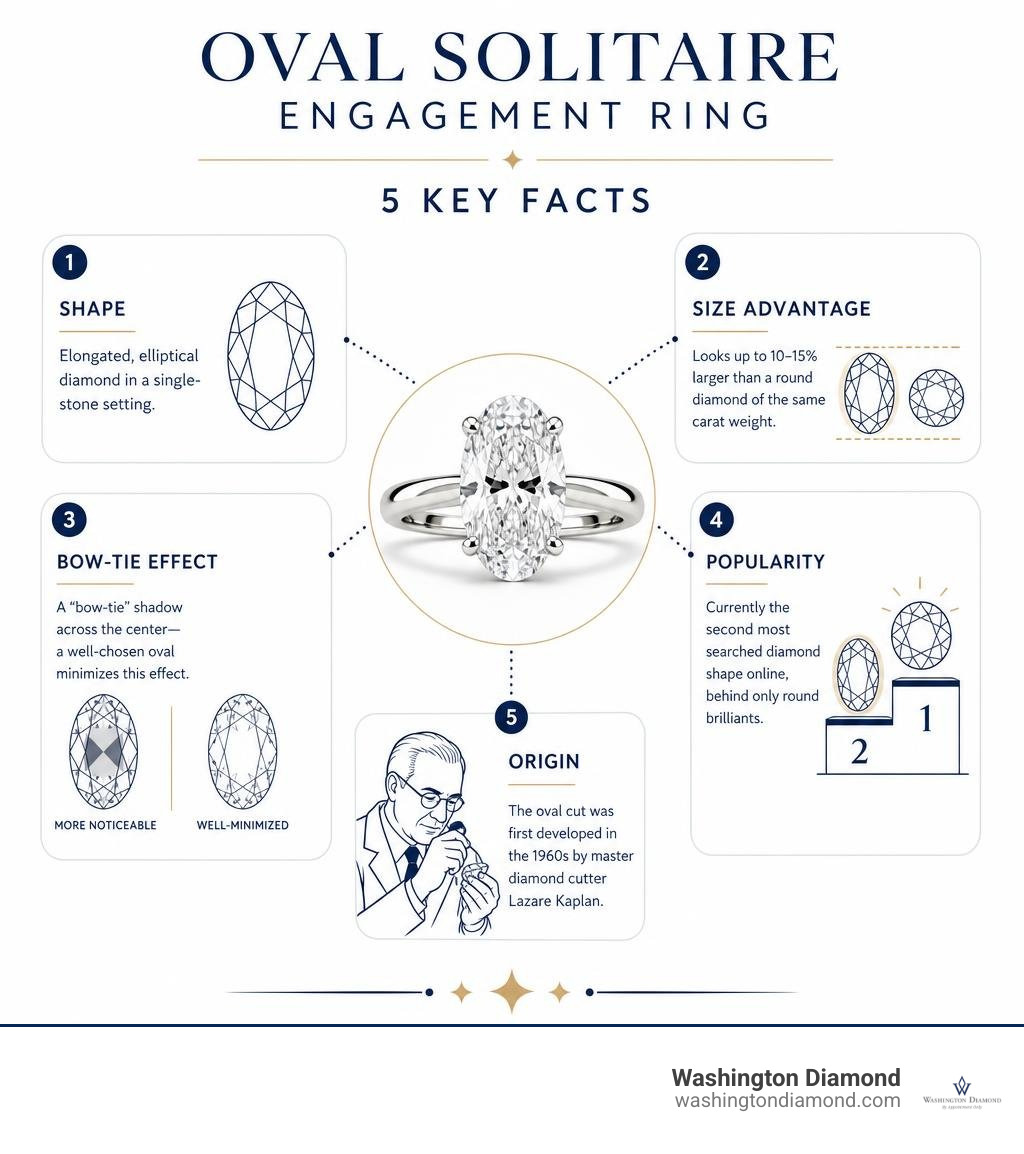
Oval solitaire engagement rings are one of the most popular and flattering choices available today. Here's a quick overview of what makes them special:
- Shape: An elongated, elliptical diamond in a single-stone setting
- Appearance: Looks up to 10-15% larger than a round diamond of the same carat weight
- Finger effect: The elongated shape makes fingers appear longer and more slender
- Popularity: Currently the second most searched diamond shape online, behind only round brilliants
- Origin: The oval cut was first developed in the 1960s by master diamond cutter Lazare Kaplan
- Key watch-out: A "bow-tie" shadow across the center — a well-chosen oval minimizes this effect
For a deeper dive into everything oval diamonds, see our Oval Diamond Engagement Ring Ultimate Guide.
The oval cut has been around for over six decades, but its appeal has never been stronger. It sits in a rare sweet spot: classic enough to feel timeless, yet distinctive enough to stand out. Whether you're drawn to its elegant shape, its ability to maximize perceived size, or simply the way it looks on the hand — there's a lot to love here.
I'm Tom Daube, a GIA-certified diamond specialist and jewelry designer with decades of experience helping clients find the ideal oval solitaire engagement ring for their most important moments. In this guide, I'll walk you through everything you need to know — from proportions and cut quality to settings, metals, and pricing — so you can choose with total confidence.
Why Oval Solitaire Engagement Rings Are the Ultimate Modern Classic
When you begin searching for the perfect symbol of your commitment, you will quickly find that the options are vast. Yet, oval solitaire engagement rings consistently rise to the top of many wish lists. Why has this particular cut captured the hearts of so many modern couples?
The answer lies in a masterful blend of optical physics and visual illusion.
First and foremost, the oval cut is incredibly flattering. Because of its elongated silhouette, an oval diamond draws the eye along the length of the finger, creating a slenderizing, lengthening effect. It is a shape that looks remarkably elegant on hands of all shapes and sizes. If you are trying to match a ring to a specific aesthetic, you can explore how different cuts align with individual style profiles in our guide on The Perfect Diamond Shape for Every Personality.
Beyond its flattering proportions on the hand, the oval cut offers a practical advantage that is hard to ignore: it maximizes your investment. Due to its shallow cut and spread-out surface area, an oval diamond can appear up to 10% to 15% larger than a round brilliant diamond of the exact same carat weight. This means you get more visual presence on the finger without necessarily paying the premium price tag associated with higher carat weights.
For those trying to decide which silhouette truly speaks to them, evaluating how the oval stacks up against other shapes is a great place to start. You can find more inspiration in our article on Which Engagement Ring Rocks Your World.
Comparing Oval Solitaire Rings to Round and Cushion Cuts
To truly appreciate the value of an oval solitaire, it helps to compare it to its closest rivals: the classic round brilliant and the soft, romantic cushion cut.
| Feature | Oval Cut | Round Brilliant | Cushion Cut |
|---|---|---|---|
| Visual Size (Face-up) | Appears 10-15% larger than actual carat weight | Standard visual size | Appears slightly smaller than actual carat weight |
| Brilliance & Fire | High (modified brilliant facet pattern) | Maximum (the gold standard of sparkle) | High (chunky, romantic flashes of light) |
| Finger Flattering Effect | Excellent (slenderizes and elongates) | Neutral (classic, balanced look) | Soft (best for wider or shorter fingers) |
| Bow-Tie Effect Risk | Yes (requires careful visual inspection) | None | Low (some cushion cuts have a mild shadow) |
| Price per Carat | Generally 10-25% lower than round | Highest premium | Generally 15-25% lower than round |
While the round brilliant remains the most popular cut due to its unmatched light return, the oval cut is a "modified brilliant," meaning it shares a similar faceting structure. You get a massive amount of that coveted sparkle, but with a unique shape and a lower cost per carat.
On the other hand, cushion cuts offer a vintage, pillow-like charm, but they carry much of their weight in their "belly" (the bottom of the stone). This means a cushion cut will look visually smaller from the top than an oval of the same weight. If you are torn between these distinct styles, our Engagement Ring Comparison Help resource can help you weigh the pros and cons of each.
Anatomy of the Perfect Oval Cut Diamond
Unlike round diamonds, which have a standardized grading scale established by the GIA (Gemological Institute of America) to determine cut quality, fancy shapes like the oval do not have an official, single "cut grade" on their laboratory certificates. This means you cannot simply look at a grading report, see "Excellent," and walk away happy. You have to understand the proportions and look at the stone yourself.
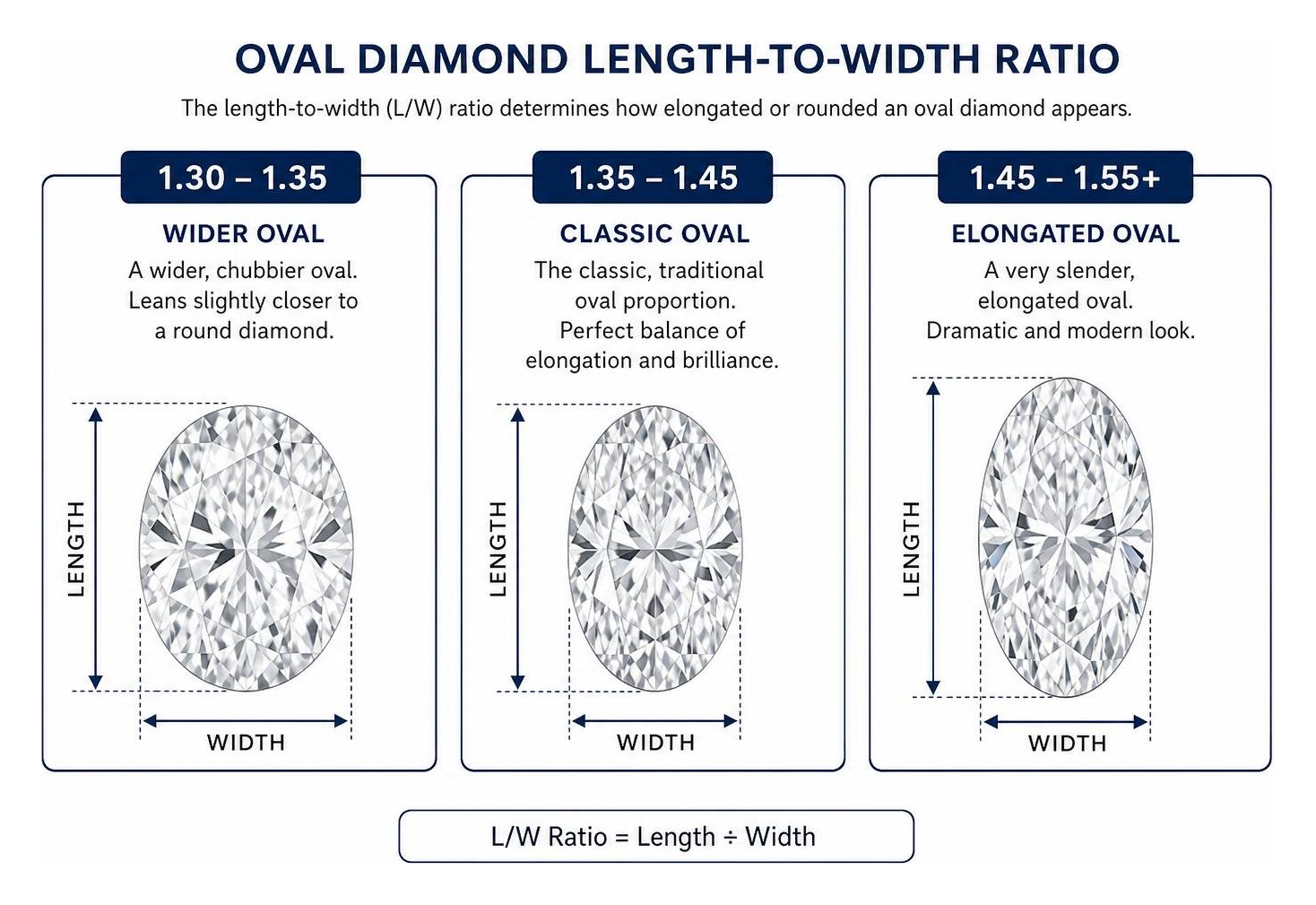
The most critical dimension to look at is the length-to-width (L/W) ratio. This ratio determines how elongated or rounded the oval will appear.
- 1.30 to 1.35: A wider, chubbier oval. This is ideal if you prefer a look that leans slightly closer to a round diamond.
- 1.35 to 1.45: The classic, traditional oval proportion. This range provides the perfect balance of elongation and brilliance.
- 1.45 to 1.55+: A very slender, elongated oval. This look is highly dramatic and modern, though it requires careful setting to protect the tips.
Another term you will hear when shopping for ovals is the "crushed ice" look versus a distinct facet pattern. Some ovals are cut with extra pavilion facets that create a glittering, needle-like sparkle reminiscent of crushed ice. Others have larger, more defined facets that mimic the clean flashes of a round brilliant. Neither is objectively better; it is entirely a matter of personal preference.
To master the technical details before making your purchase, take a look at our Oval Cut Diamond Complete Guide. For a broader understanding of how to evaluate a stone beyond the standard grading report, check out our guide on Beyond the 4Cs How to Choose Your Perfect Certified Loose Diamond.
How to Avoid the Bow-Tie Effect in Oval Solitaire Engagement Rings
If there is one term that strikes fear into the hearts of oval diamond shoppers, it is the bow-tie effect.
Because of the elongated shape of an oval cut, light passing through the center of the stone can cast a dark, bow-tie-shaped shadow across the middle of the diamond. This is a natural optical characteristic of all elongated brilliant cuts, including marquise and pear shapes.
The secret to finding a beautiful oval is not finding a stone with zero bow-tie—because a completely absent bow-tie often means the stone was cut too shallowly, sacrificing overall brilliance. Instead, the goal is to find a diamond where the bow-tie is minimal, well-dispersed, and blends naturally into the stone's overall sparkle when viewed under different lighting conditions.
Because laboratory certificates do not grade or even mention the bow-tie effect, you cannot rely on paperwork alone to avoid it. You must perform a visual inspection. This is why we strongly advise against buying an oval diamond blindly online.
Instead, look at the stone in person under natural light, office light, and spotlighting. If you want to explore how to source and inspect raw stones directly, our Loose Diamonds Complete Guide is an invaluable resource.
Choosing the Perfect Setting and Metal for Your Solitaire
Once you have selected a stunning oval diamond, the next step is choosing the stage it will perform on. The beauty of a solitaire setting is its simplicity; it lets the diamond do all the talking. However, "simple" does not mean "one-size-fits-all."
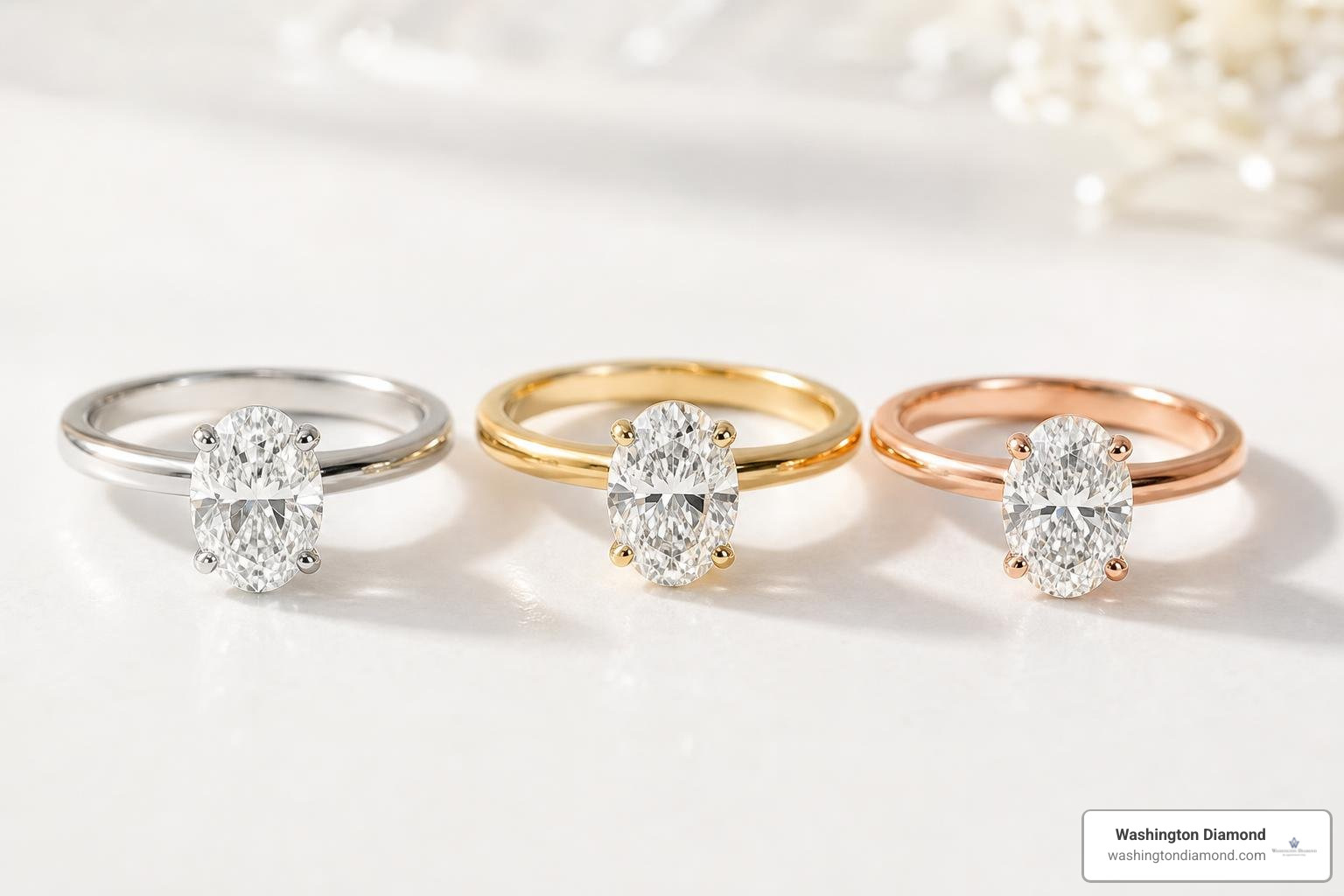
The metal you choose for your band sets the entire tone of the ring:
- Platinum: The ultimate in durability and security. Its naturally white sheen will never fade or change color, and it perfectly highlights the icy white brilliance of a high-color diamond.
- Yellow Gold (14k or 18k): A warm, classic choice that has seen a massive resurgence in recent years. An oval diamond set on a slender yellow gold band offers a beautiful contrast. (Pro-tip: If you choose a yellow gold band, consider using platinum prongs to keep the diamond itself looking bright and white).
- Rose Gold: A romantic, vintage-inspired choice that looks incredibly soft and beautiful against all skin tones.
Beyond the metal, you must decide on the structure of the setting itself. The debate between a 4-prong and a 6-prong setting is particularly important for ovals. A 4-prong setting maximizes the exposure of the diamond, allowing more light to enter and exit, which can make the stone look larger. However, a 6-prong setting offers superior security and can help round out the shape of the oval, giving it a beautifully symmetrical frame.
For a comprehensive overview of how different structures impact your ring, check out Engagement Ring Settings 101. Additionally, if you love a setting that lifts the diamond elegantly off the finger, you will want to read about the Cathedral Engagement Setting and the highly secure, stunning 6 Prong Cathedral Setting.
Customizing Your Oval Solitaire with Pave or Hidden Halos
While a classic, plain metal band is the traditional definition of a solitaire, modern design allows for subtle, stunning customizations that keep the focus on the center stone while adding a touch of personal flair.
One of the most popular additions to oval solitaire engagement rings is the hidden halo. Unlike a traditional halo that circles the perimeter of the diamond and makes the entire ring look larger from above, a hidden halo sits just beneath the girdle of the stone. It is only visible from the profile view, catching the light and adding a secret, sparkling detail that only you and those looking closely will notice.
You can also opt for a micro pave band, where incredibly tiny diamonds are set along the shank of the ring. This adds a delicate, continuous shimmer that contrasts beautifully with the large, central oval.
If you have a very specific vision in mind, opting for a custom build is often the best route to ensure every detail is executed flawlessly. To learn more about this creative process, explore our Custom Engagement Rings Ultimate Guide. You can also dive into the specifics of delicate metalwork through our guides on the Micro Pave Setting, the Pave Engagement Setting Complete Guide, and the Halo Engagement Rings Guide 2026.
Pros, Cons, and Pricing of Oval Solitaire Rings
To make an informed decision, it is essential to weigh the practical advantages and potential drawbacks of choosing an oval solitaire.
The Pros:
- Outstanding Value: You get a larger-looking diamond for a lower price per carat compared to round cuts.
- Flattering Shape: The elongated silhouette visually lengthens and slenders the finger.
- Timeless Appeal: It bridges the gap between classic vintage charm and modern sophistication.
- No Sharp Corners: Unlike pear, marquise, or princess cuts, the rounded edges of an oval do not have sharp points that are prone to chipping.
The Cons:
- The Bow-Tie Risk: Finding a stone with a minimal, acceptable bow-tie requires careful, expert curation.
- Color Retention: Because they are shallower, oval cuts tend to show color slightly more than round diamonds. If you want a perfectly white look, you may need to look at slightly higher color grades (typically G or higher, though H can still look beautiful when set in yellow gold).
When it comes to sourcing your diamond, you also have the choice between natural and lab-grown stones. Lab-grown diamonds are chemically, physically, and optically identical to natural diamonds, but they come at a fraction of the cost, allowing you to maximize your budget. To weigh these options, see our article on Lab Grown Diamond Engagement Rings Ethical Elegance for Your Big Day. For more clever budgeting strategies, read our tips on Affordable Bling Top Tips for Best Value Engagement Rings.
Key Factors Influencing the Cost of Oval Solitaire Engagement Rings
When budgeting for an oval solitaire, several variables will dictate the final price tag:
- Carat Weight: Because diamond pricing increases exponentially with carat weight, choosing a slightly lower carat weight (like a 1.90ct instead of a 2.0ct) can save you thousands of dollars while offering virtually the same visual impact.
- Color and Clarity: Since ovals show color in their tips, finding the right balance is key. Similarly, look for "eye-clean" diamonds where inclusions are not visible to the naked eye, rather than paying a massive premium for a flawless clarity grade that looks identical without a microscope.
- Cut Quality: A poorly cut oval will look dull and may have an aggressive bow-tie. Investing in a high-quality cut is always worth it.
For detailed pricing breakdowns and buying strategies, refer to our 1 Carat Oval Diamond Guide 2026 and our 1 Carat Oval Diamond Price Guide.
Frequently Asked Questions about Oval Solitaires
Do oval diamonds chip easily?
No, oval diamonds do not chip easily. Because they lack the sharp, pointed corners of marquise, pear, or princess cuts, they are much more durable for daily wear. However, like all diamonds, they should still be protected with a high-quality prong setting—ideally with four or six sturdy prongs—to keep the stone secure.
What is the best length-to-width ratio for an oval solitaire?
The traditional "sweet spot" for an oval diamond is a length-to-width ratio of 1.35 to 1.45. This offers the classic, elegant look that most people associate with oval cuts. However, if you prefer a wider, rounder shape, look for a ratio closer to 1.30. If you love a dramatic, elongated look, look for 1.45 to 1.55.
How do I make my oval solitaire look larger?
To maximize the visual presence of your oval diamond, pair it with a very slender band (around 1.5mm to 1.8mm). This contrast makes the center stone pop. You can also opt for a high-set cathedral setting or add a hidden halo, which elevates the stone and catches more light from the sides.
Conclusion
Choosing an oval solitaire engagement ring is a beautiful way to celebrate your love with a piece of jewelry that is as elegant as it is timeless. With its finger-flattering silhouette, remarkable sparkle, and incredible value, the oval cut remains a premier choice for modern proposals.
If you are planning your big moment and want to make sure everything goes off without a hitch, don't miss The Essential Guide for a Perfect Proposal.
At Washington Diamond, we believe that choosing an engagement ring should be an intimate, stress-free, and deeply personal experience. Located in Northern Virginia, our private, appointment-only studio is designed to give you our undivided attention. We don't believe in high-pressure sales pitches; instead, we sit down with you, educate you on the nuances of loose diamonds, and help you design a piece that fits your exact vision and budget.
Ready to find the perfect stone and setting? We invite you to explore our curated collection of Solitaire Diamond Ring designs and schedule your private consultation with us today. Let’s bring your dream ring to life!
Have a question about your jewelry?
We've been helping clients with diamonds, custom design, repairs, appraisals, and more since 1969. Book a private appointment at our Falls Church studio.
Book an AppointmentTrusted since 1969 · Falls Church, VA · 703-536-3600
From the blog
View all


