

A Practical Guide to Princess Cut Diamonds
Princess Cut Diamonds: What to Know Before You Buy

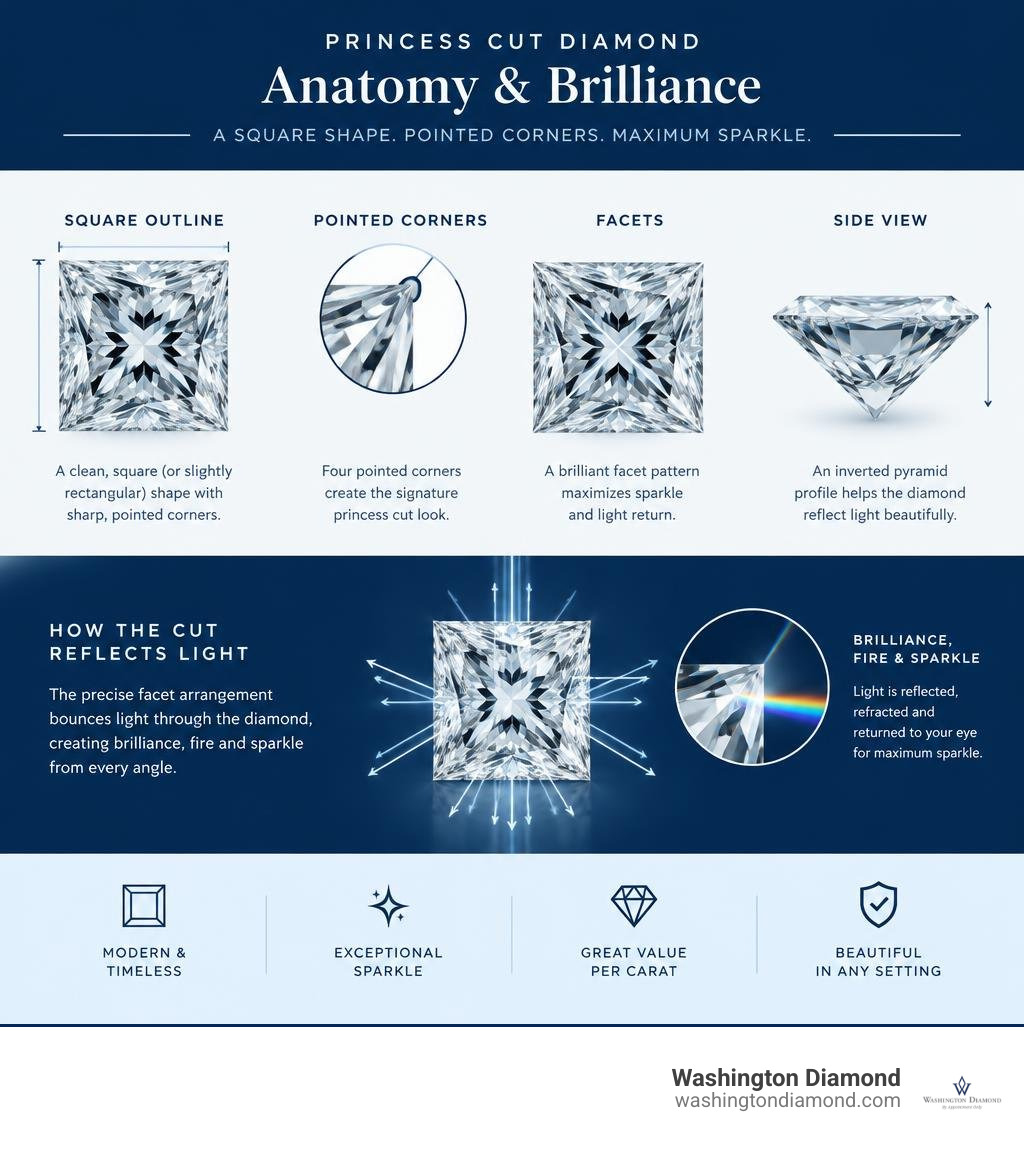
Princess cut diamonds are square or slightly rectangular stones with pointed corners and a brilliant facet pattern. They offer a clean, modern look with plenty of sparkle, often at a lower price per carat than a comparable round diamond. For an engagement ring, look at the stone's face-up size as well as its carat weight, compare its color and clarity, and choose a setting that shields all four corners.
I'm Tom Daube. My work with GIA-graded diamonds, jewelry design, and diamond recutting has taught me what to look for in princess cut diamonds; this guide will help you weigh the choices without getting lost in grading terms. The Gemological Institute of America offers a useful princess cut diamond buying guide for additional background on this shape.
What Makes Princess Cut Diamonds Unique: Shape, History, and Value
When exploring engagement rings, you quickly realize how distinctive the princess cut truly is. Technically known as a "square modified brilliant," this cut blends the crisp, contemporary geometry of a square outline with the dazzling light return traditionally reserved for round stones. Although round gems remain the historic standard, princess cut diamonds hold their own as the second most popular shape on the market, representing roughly 15% of all diamond purchases.
The secret behind the cut's remarkable value lies in its geometry. Natural rough diamond crystals often form as eight-sided octahedrons (resembling two pyramids joined at the base). When diamond cutters shape a round brilliant diamond, they must shave away significant portions of the rough crystal, retaining only about 40% to 50% of the original stone. By contrast, the inverted pyramid profile of a princess cut mirrors the natural shape of the rough octahedron crystal.
Because cutters can preserve 80% or more of the rough material, yield improves drastically. This cutting efficiency means less waste and lower production costs, allowing you to secure a larger stone for the same investment. Shoppers evaluating certified loose diamonds will find that this efficiency translates directly into better value per carat.
Unlike step-cut options such as the emerald cut diamond, which emphasizes mirror-like clarity and vintage broad flashes, the modified brilliant facet arrangement of a princess cut breaks light into thousands of shimmering sparkles.
| Feature | Princess Cut | Round Brilliant Cut |
|---|---|---|
| Rough Crystal Yield | ~80% retained | ~40% to 50% retained |
| Face-Up Outline | Square (90° pointed corners) | Circular |
| Table Surface Proportion | Broad, expansive table | Balanced table |
| Price per Carat | Significantly lower | Industry premium |
| Light Performance Style | Vibrant scintillation and dispersion | Classic symmetrical brilliance |
Understanding Size and Table Proportions in Princess Cut Diamonds
One of the most pleasant surprises when viewing a princess cut in person is how substantial it appears on the finger. Princess cuts feature large tables—the flat top surface of the gem—giving them an expansive face-up footprint.
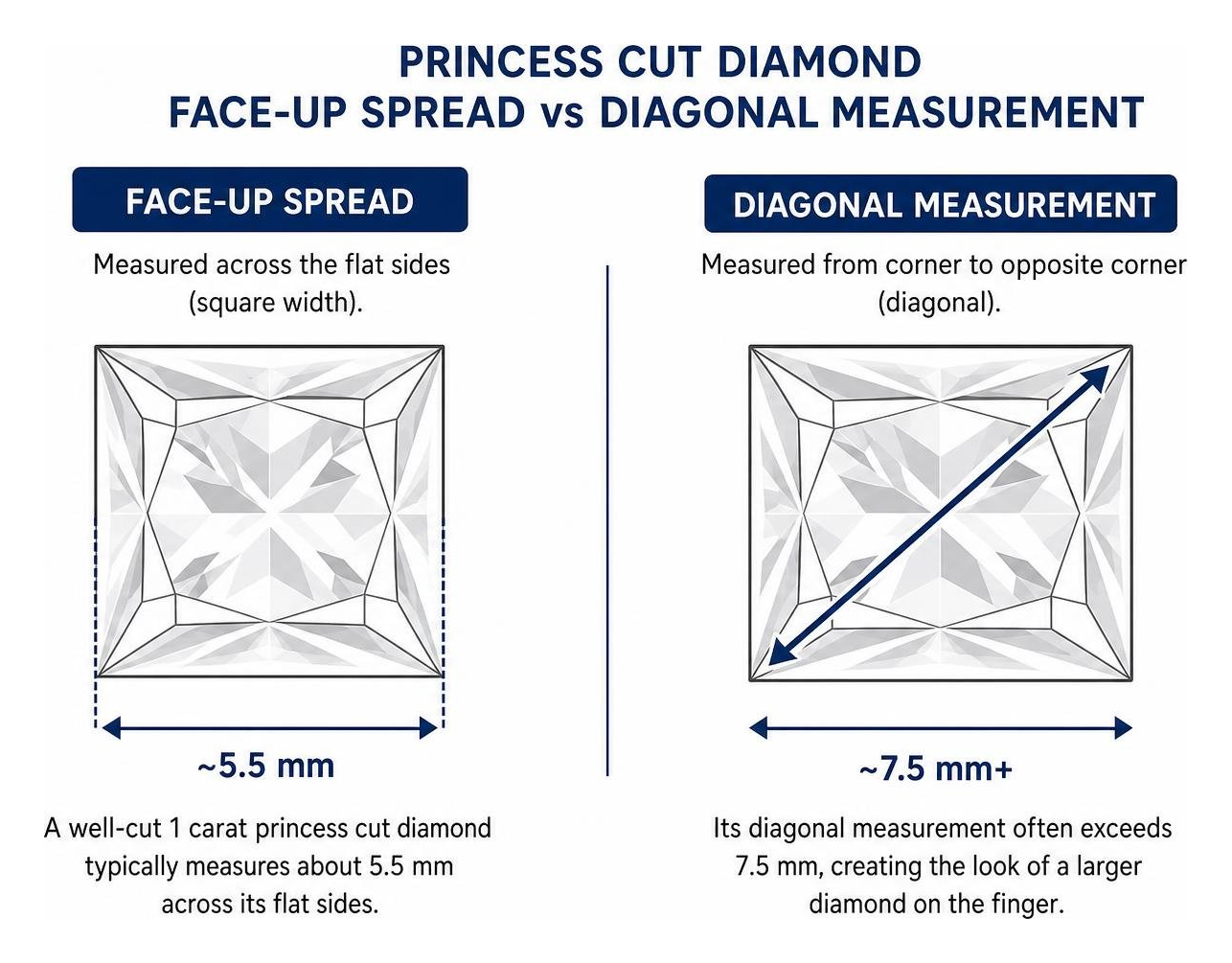
A common misconception is that carat weight alone dictates how big a stone looks. While a 1 carat round diamond measures around 6.5 millimeters in diameter, a well-cut 1 carat square stone might measure roughly 5.5 millimeters along its flat sides. However, its diagonal corner-to-corner measurement often exceeds 7.5 millimeters. Because the human eye perceives length from point to point, the sharp corners and broad table create the visual illusion of a larger diamond.
Evaluating the 4Cs in Princess Cut Diamonds
Selecting the perfect diamond requires balancing the 4Cs: Cut, Color, Clarity, and Carat weight. Navigating these factors helps you spend where it counts and save where differences are invisible to the naked eye.
1. Cut Quality
Unlike round diamonds, the Gemological Institute of America (GIA) does not assign an overall "Cut Grade" (such as Excellent or Very Good) to fancy shapes like the princess cut on standard reports. Instead, you must assess cut quality by evaluating polish, symmetry, depth percentage, and table percentage:
- Total Depth Percentage: Aim for 65% to 75%. Stones that are too shallow leak light out the sides, while overly deep stones hide carat weight at the bottom where nobody can see it.
- Table Percentage: Ideal tables generally fall between 68% and 75%.
- Length-to-Width Ratio: For a classic square profile, seek a ratio between 1.00 and 1.05. Ratios above 1.10 lean noticeably rectangular.
A stone graded with a "Fair Cut" by non-standard labs typically features disproportionate depth or excessive table spread, leading to a dull or glassy center with minimal fire. For an in-depth breakdown of these metrics, explore our comprehensive diamond education resources.
2. Color Grading
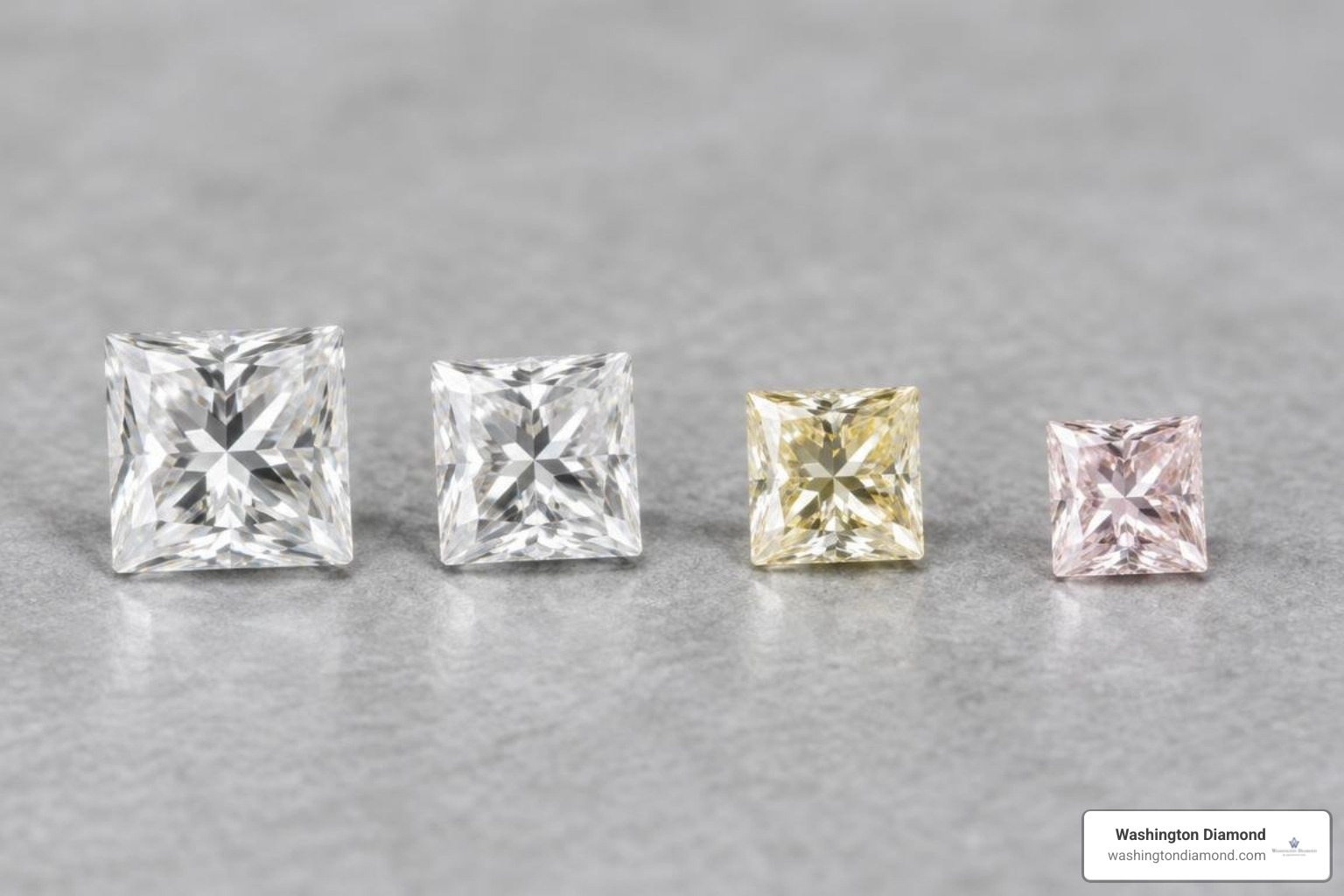
Diamond color is graded alphabetically from D (completely colorless) down to Z (light tint). In a princess cut, color can slightly concentrate in the four pointed corners because the material thins out toward the edges.
- D through F: Truly colorless and icy white.
- G through I: Near colorless; provides exceptional real-world value when set in white gold or platinum, appearing bright white to the unaided eye.
- J through K: Stones graded K or lower may exhibit a "Faint Yellow" or warm tint, which can look gorgeous when paired with yellow gold or rose gold bands.
3. Clarity Considerations
Clarity measures internal inclusions and surface blemishes. Because the modified brilliant faceting pattern creates intense light scatter, princess cuts disguise minor inclusions remarkably well.
- VVS1–VS2: Eye-clean stones with zero visible flaws to the naked eye.
- SI1–SI2 (Slightly Included): Stones categorized as "Slightly Included 2" (SI2) possess inclusions noticeable under 10x magnification. In many cases, these inclusions remain invisible face-up unless located dead center beneath the table. When shopping, always verify that inclusions are not located directly near the pointed corners, as severe structural flaws in those corners can increase the risk of chipping.
Knowing how to balance these aspects helps you master evaluating certified loose diamonds without overpaying for characteristics you cannot see.
Choosing Between Natural and Lab-Grown Stones
As modern fine jewelry evolves, lab-grown diamonds have become an increasingly popular choice for couples seeking beauty, size, and sustainability. Lab-grown diamonds possess the exact same chemical, optical, and physical properties as earth-mined diamonds—they are pure crystallized carbon, graded by identical standards.
Beyond their lower pricing, lab-created diamonds offer documented environmental benefits. Choosing a lab-grown diamond preserves natural landscapes and reduces overall carbon impact:
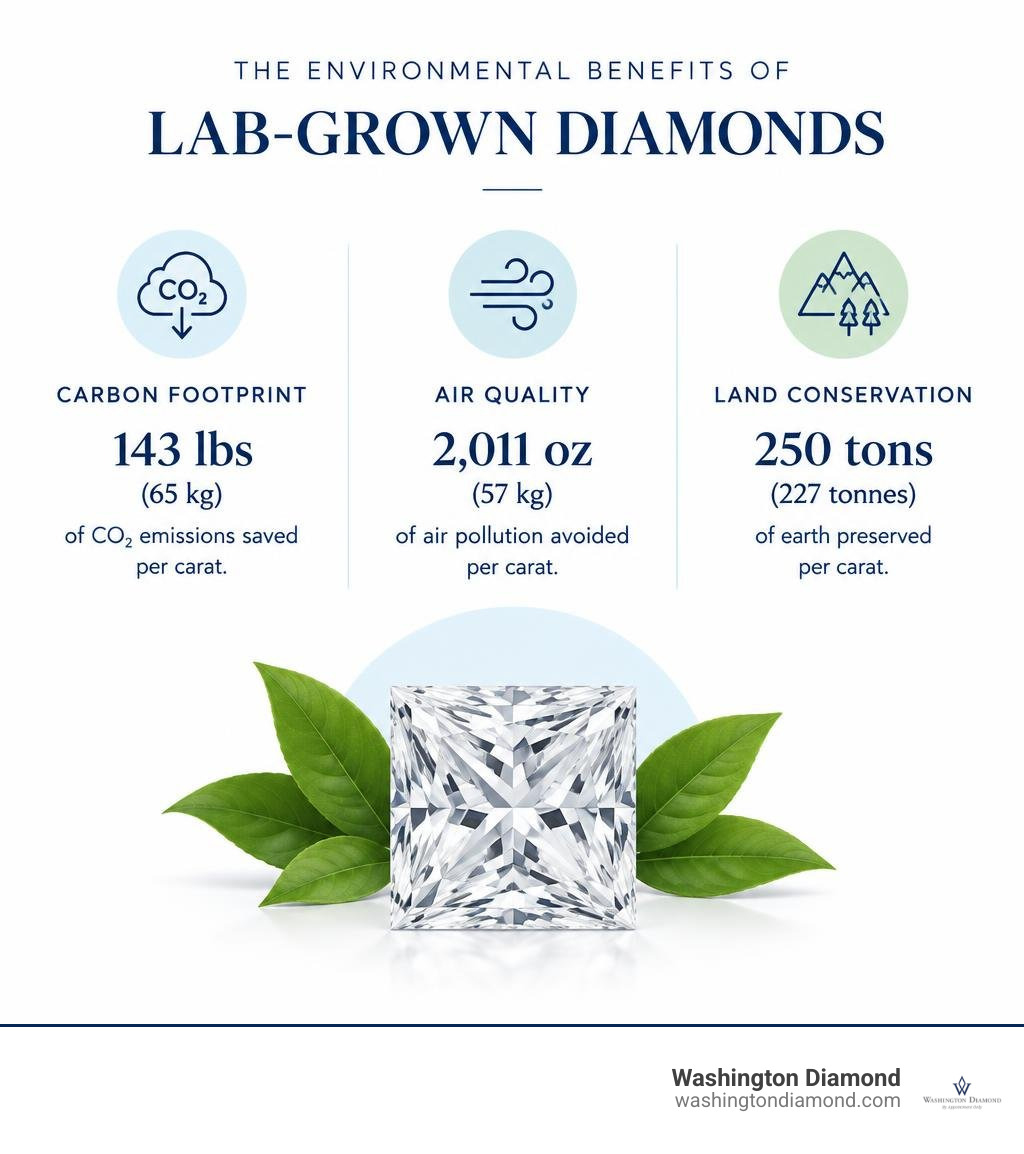
- Carbon Footprint: Each carat of lab-grown diamond saves approximately 143 lbs (65 kg) of CO2 emissions.
- Air Quality: Manufacturing lab diamonds avoids producing roughly 2,011 ounces (57 kg) of air pollution per carat compared to heavy mining machinery.
- Land Conservation: Opting for lab creation preserves up to 250 tons (227 tonnes) of earth per carat that would otherwise be displaced during open-pit or underground extraction.
For those interested in exploring modern options, our custom lab-grown engagement rings allow you to maximize your budget. Reviewing the average cost of a 2 carat lab-grown diamond alongside our lab-grown diamonds price guide illustrates just how accessible larger carat weights have become.
Popular Setting Styles and Essential Corner Protection
Because a princess cut features sharp, 90-degree corners, setting design is not merely a stylistic decision—it is a structural necessity. The pointed tips are the most vulnerable parts of the stone, prone to chipping if struck against hard surfaces.
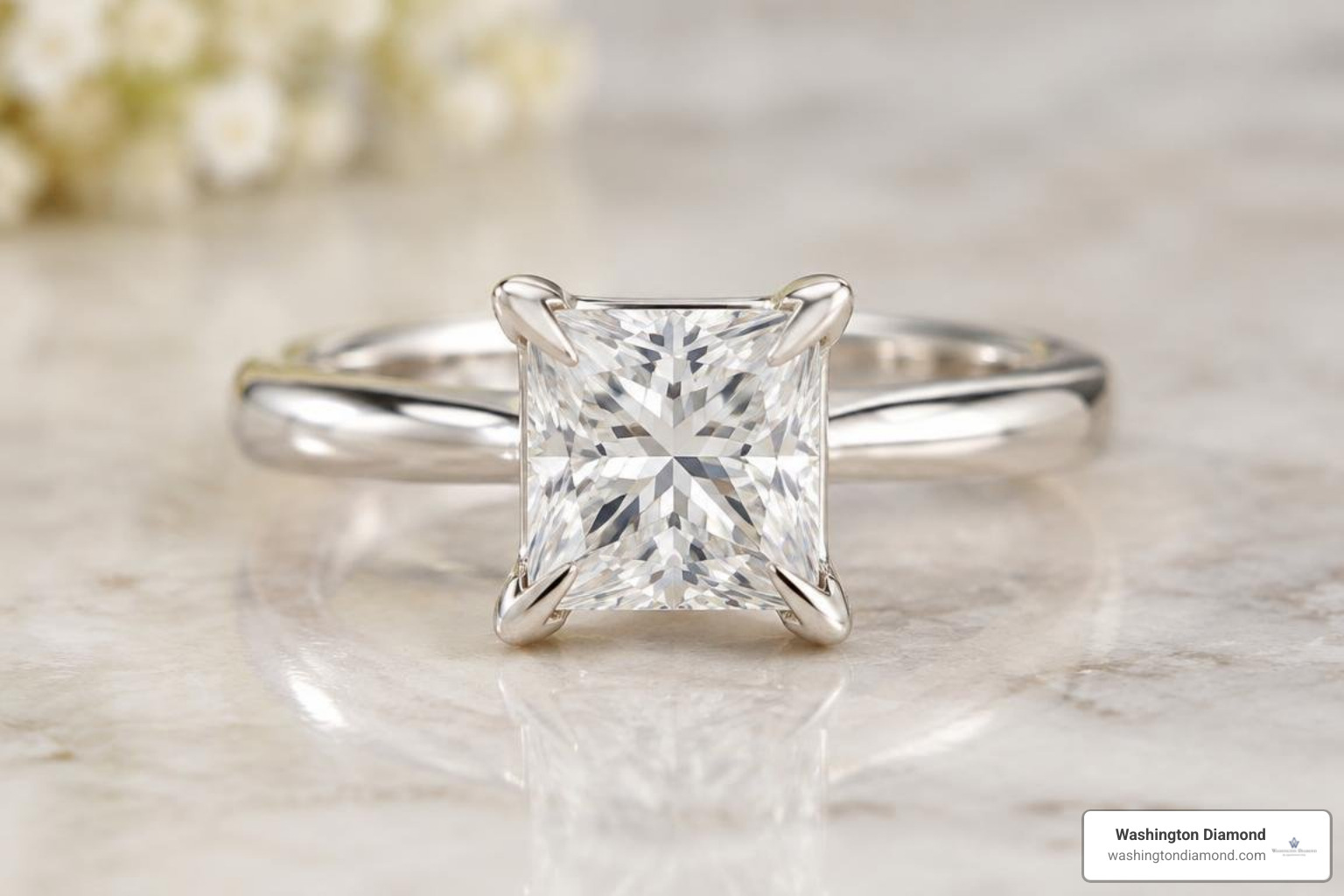
To protect the corners, fine jewelers use specialized settings:
- Chevron (V-Prongs): The industry standard for princess cuts. These metal prongs wrap securely around the angular tips, safeguarding them from daily bumps while framing the square outline.
- Bezel Settings: A full or semi-bezel wraps a collar of precious metal around the perimeter, offering maximum security for active lifestyles.
- Channel Settings: Ideal for side stones along the band, channel settings sandwich stones between parallel metal walls with no exposed corners.
Selecting the right mounting transforms your center stone into a cohesive work of art. You can browse classic engagement ring setting styles or consider the sweeping arches of a cathedral engagement ring setting, which elevates the stone while bracing the head against everyday wear.
Setting and Protecting Princess Cut Diamonds
Whether you prefer a delicate micro pavé band setting that lines the shank with tiny shimmering diamonds or the ornate millgrain metalwork found in vintage engagement rings, proper prong alignment is critical.
Our master jewelers ensure each prong sits flush against the stone without exerting uneven pressure that could fracture a corner during setting. You can explore curated options across our complete engagement ring designs to find the perfect pairing of safety and elegance.
Frequently Asked Questions About Princess Cut Diamonds
Why are princess cut diamonds less expensive than round diamonds?
Princess cut diamonds are generally 20% to 40% less expensive than round brilliant diamonds of equivalent carat weight and quality. This price advantage stems entirely from cutting yield. Natural diamond crystals frequently form in octahedral shapes that mirror the princess cut's pyramid-like base. Diamond cutters preserve roughly 80% of the raw stone when cutting a princess diamond, compared to only 40% to 50% for a round diamond. Less wasted rough translates into lower production costs and savings passed directly to you.
What certification should I look for when buying a princess cut diamond?
Always insist on an independent grading certificate from a globally recognized laboratory, with the Gemological Institute of America (GIA) serving as the industry benchmark. A GIA report confirms whether the stone is natural or laboratory grown and provides an objective breakdown of color, clarity, polish, symmetry, and proportions. Furthermore, ensure the stone features a microscopic laser inscription on the girdle matching the report number for foolproof identification.
How do I care for and maintain a square cut diamond?
Caring for a princess cut diamond involves simple everyday mindfulness:
- Regular Professional Checks: Have your ring checked twice a year to verify that the V-prongs have not bent or loosened.
- Safe Cleaning: Clean your ring at home using warm water, mild dish soap, and a soft-bristled toothbrush. Ultrasonic cleaners are generally safe for untreated stones, provided the prongs are tight.
- Professional Care: Schedule regular professional cleaning and inspection to keep metal prongs secure. If your finger size fluctuates, utilize expert ring resizing to maintain structural integrity, and keep updated documentation through our jewelry appraisal services.
Conclusion
With their crisp geometric lines, brilliant sparkle, and exceptional value per carat, princess cut diamonds remain a stunning choice for heirloom-quality engagement rings. Whether you select a classic earth-mined gem or a sustainable lab-grown diamond, choosing a well-proportioned stone and a protective setting ensures your ring will shine brightly for generations.
At Washington Diamond, we believe choosing an engagement ring should be an intimate, stress-free experience. In our private, appointment-only studio in Northern Virginia, we provide dedicated, one-on-one guidance to help you examine stones under magnification and craft bespoke custom jewelry design tailored to your vision.
Ready to begin? Plan your budget and compare stone specifications using our interactive diamond price calculator, or book an appointment with our team today.
Have a question about your jewelry?
We've been helping clients with diamonds, custom design, repairs, appraisals, and more since 1969. Book a private appointment at our Falls Church studio.
Book an AppointmentTrusted since 1969 · Falls Church, VA · 703-536-3600
From the blog
View all


