

The Ultimate Guide to Oval Cut Diamonds and Engagement Rings
Why the Oval Cut Diamond Is One of the Best Choices for an Engagement Ring
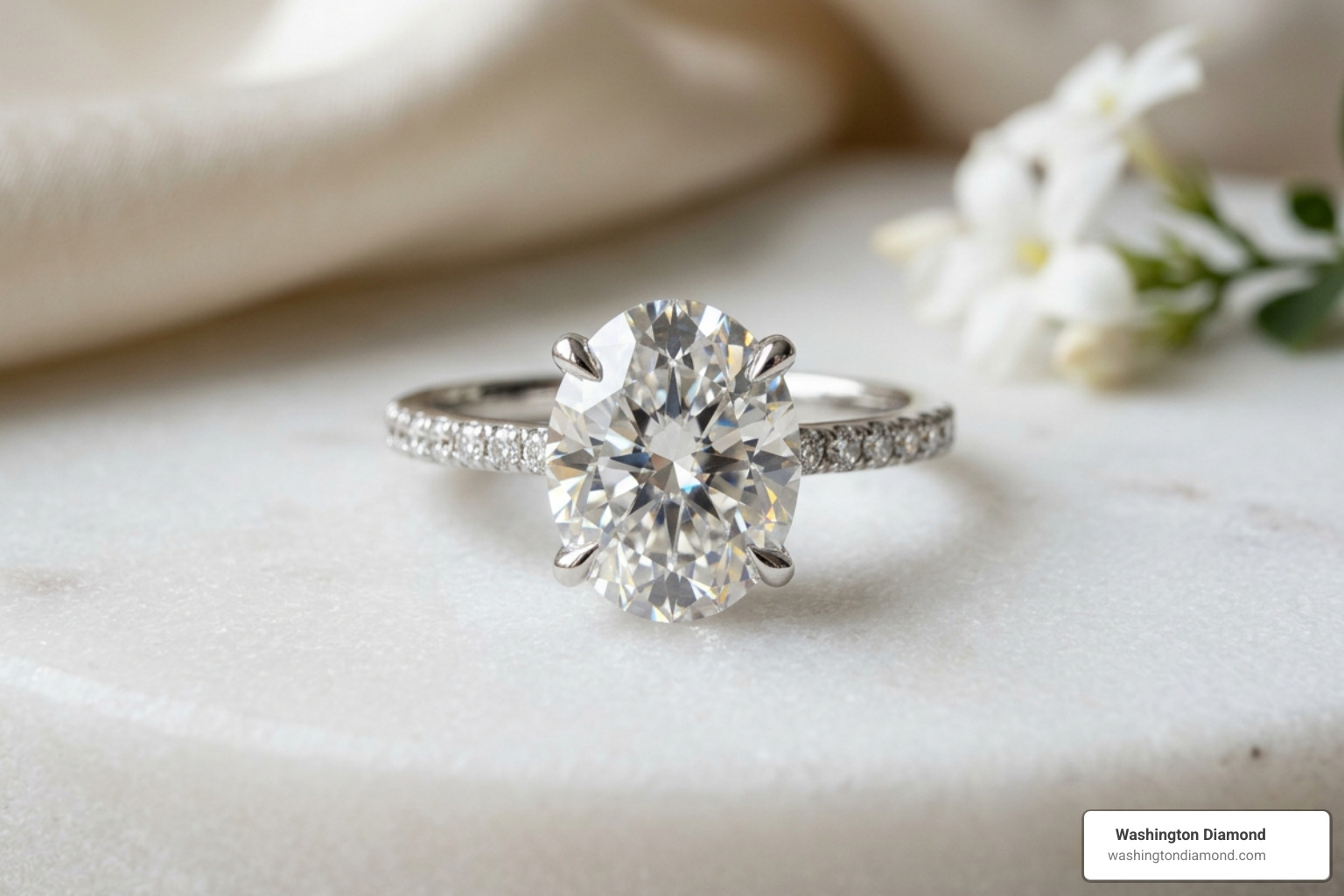
Oval cut diamonds are elongated, brilliant-cut gems that combine the sparkle of a round diamond with a unique, finger-flattering shape — and they typically cost around 20% less than a comparable round brilliant.
Here's a quick snapshot of what makes them stand out:
- Shape: Elongated ellipse with smooth, rounded edges
- Facets: 57–58, identical to a round brilliant
- Sparkle: Near-equal to round diamonds — second only in brilliance
- Size appearance: Looks larger than a round diamond of the same carat weight
- Price: Roughly 20% less than round brilliants with similar grades
- Best for: Engagement rings, pendants, earrings, and everyday fine jewelry
- Popularity: Accounted for 23% of all engagement rings purchased in 2023, according to The Knot's Real Wedding Study
Oval diamonds have surged in popularity in recent years — and for good reason. They offer the brilliance buyers love in a round diamond, with a shape that feels both timeless and distinctly personal. Whether you're drawn to their elegant silhouette, their finger-lengthening effect, or simply the value they offer, there's a lot to love here.
I'm Tom Daube, a GIA-certified diamond expert and jewelry designer with decades of experience helping people find the perfect oval cut diamond for their most important moments. In this guide, I'll walk you through everything you need to know — from cut quality and proportions to settings and pricing — so you can make a confident, informed choice.
Glossary for Oval cut diamond:
What is an Oval Cut Diamond?
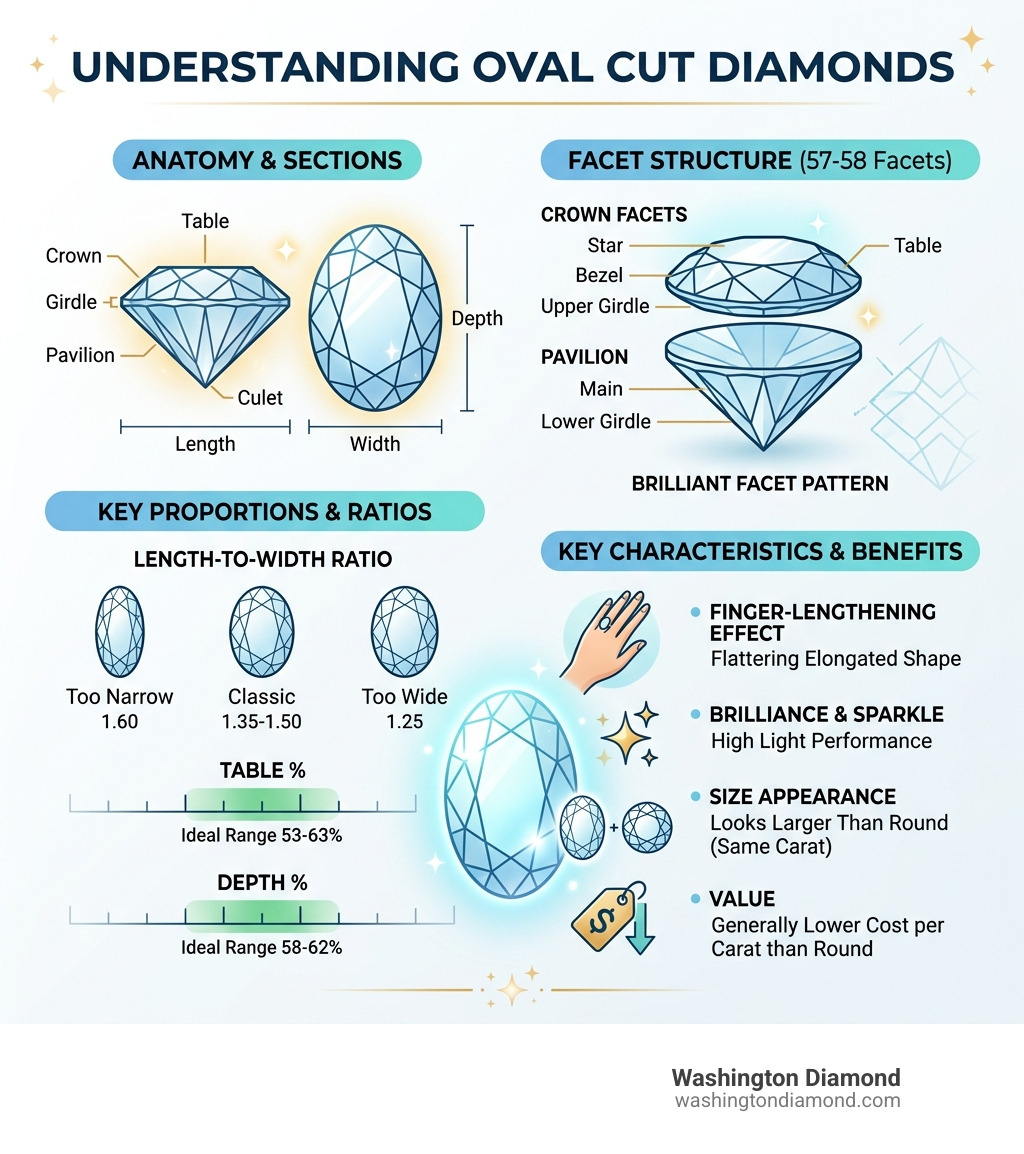
At its core, an Oval cut diamond is what we call a "modified brilliant." This means it belongs to the same family as the round brilliant cut, sharing a similar faceting structure designed to bounce light around like crazy. Most ovals feature 57 or 58 facets, which is why they possess such incredible brilliance and fire. For a detailed look at how these stones are evaluated, you can refer to the Oval Cut Diamond Buying Guide | Key Factors & Things to Consider | GIA 4Cs.
While the shape might feel modern, it is actually a masterful blend of the round brilliant and the marquise cut. It offers the soft, romantic curves of a round stone but with an elongated silhouette that provides a "slenderizing" effect on the wearer's finger. Because it lacks the sharp points of a marquise or a pear, it is also incredibly durable. For a deeper look at how different shapes reflect different spirits, you might enjoy our guide on The Perfect Diamond Shape For Every Personality.
The History and Origin of the Modern Oval Cut Diamond
Oval-shaped diamonds have actually been around for centuries, though they didn't always look the way they do today. In the 1700s, diamond cutters began experimenting with the "brilliant" faceting style, and early versions of the oval appeared in royal collections across the globe.
One of the most legendary examples is the Koh-i-Noor, a massive oval diamond weighing 105.60 carats that eventually made its way into the British Crown Jewels. More recently, the CTF Pink Star, a stunning 59.60-carat oval, made headlines when it sold for a record-breaking $71.2 million in 2017.
However, the Oval cut diamond we know and love today was perfected in 1957 by Lazare Kaplan. Kaplan was a cousin of Abraham Tolkowsky (the man who mathematically defined the "Ideal" round cut), and he used his expertise to create a modern oval that maximized light performance. His invention allowed cutters to take oddly shaped rough stones—which might have been wasted if cut into rounds—and turn them into spectacular, fiery gems.
Comparing the Oval Cut Diamond to Round Brilliants
When we sit down with clients in our Northern Virginia studio, the most common comparison is between the oval and the round brilliant. Here is the honest truth: the round diamond is the "king" of sparkle, but the oval is undoubtedly the "queen."
There are three major reasons why you might choose an oval over a round:
- Visual Size Illusion: Because an oval is elongated, it has a larger surface area (or "spread") than a round diamond of the same carat weight. To the naked eye, a 1-carat oval often looks significantly larger than a 1-carat round.
- Finger Flattery: The elongated shape creates a vertical line on the hand, making fingers appear longer and more slender.
- The Price Tag: This is the big one. Oval diamonds generally cost about 20% to 25% less than round diamonds of the same quality. This is largely because cutters can retain more of the original rough diamond weight when shaping an oval. You can learn more about these weight dynamics in our Loose Diamonds Complete Guide.
Key Technical Factors for Quality and Value
Unlike round diamonds, the GIA does not provide a "Cut" grade (like Excellent or Very Good) for fancy shapes like ovals. Instead, they grade Symmetry and Polish. This makes it even more important to work with experts who can help you read between the lines of a grading report.
At Washington Diamond, we look for specific "sweet spots" in proportions to ensure the stone isn't too deep (which hides weight) or too shallow (which leaks light).
| Factor | Ideal Range (Excellent) | Very Good Range |
|---|---|---|
| Table % | 53% – 63% | 52% or 64% – 70% |
| Depth % | 58% – 62% | 56% – 57.9% or 62.1% – 66% |
| Girdle | Thin to Slightly Thick | Very Thin to Thick |
| Culet | None | Small |
Understanding the Bow-Tie Effect in an Oval Cut Diamond
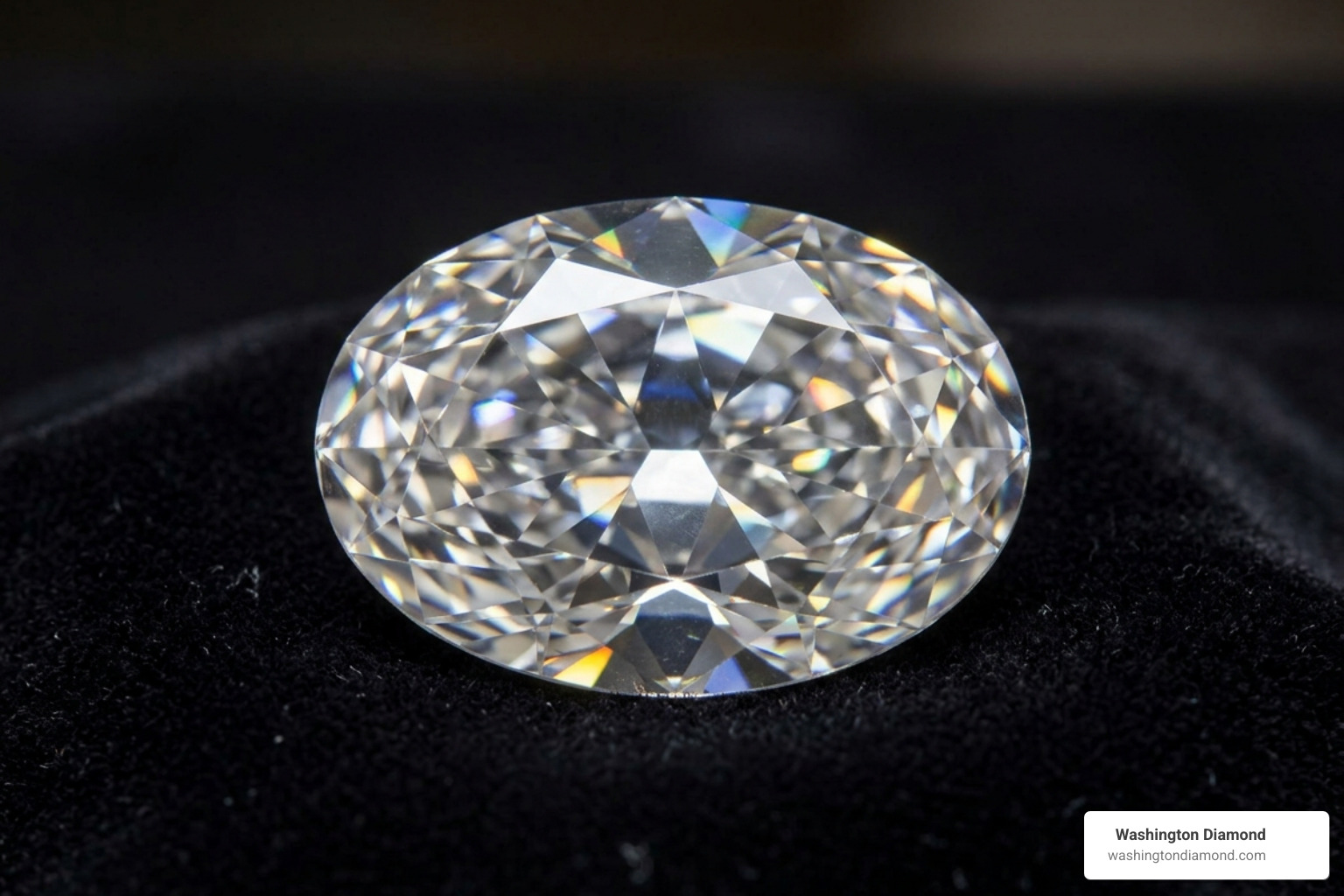
If you look closely at an Oval cut diamond, you might notice a dark shadow across the center that looks like—you guessed it—a bow tie. This is caused by light blockage. When you look at a diamond, your head and shoulders actually block some of the light from entering the stone, creating a shadow on the central facets.
Almost every oval diamond has a bow tie to some degree; it’s simply a part of the stone’s anatomy. However, a "good" bow tie is subtle and adds character and contrast. A "bad" bow tie is a heavy, black void that kills the diamond's sparkle. Minimizing this effect requires finding a stone with a balanced pavilion depth.
The Ideal Length-to-Width Ratio
The "personality" of an oval diamond is determined by its Length-to-Width (L/W) ratio. This is calculated by dividing the length by the width.
- 1.30 to 1.40: These stones are "chubbier" and more rounded. They offer a classic look that appeals to those who like the round aesthetic but want something slightly different.
- 1.40 to 1.50: This is the "Goldilocks" zone. It is the most popular range because it provides the perfect balance of elongation and elegance.
- 1.51 and above: These stones are very slender and elongated. They look striking but can be more prone to showing a prominent bow tie.
The ratio is a matter of personal taste. Whether you prefer a wide, full shape or a slim, dramatic one, we can help you source the perfect Loose Diamonds to match your vision.
Evaluating the 4Cs for Oval Diamonds
When buying an Oval cut diamond, you have to play the 4Cs (Cut, Color, Clarity, and Carat) a bit differently than you would with other shapes. For a comprehensive deep dive, check out our Oval Diamond Engagement Ring Ultimate Guide.
Cut is king. Even though there is no official GIA cut grade, the proportions determine the sparkle and the bow tie. Carat weight is also interesting here—because ovals look bigger than they are, you might find that a 1.8-carat oval gives you the visual "punch" of a 2-carat round for a fraction of the cost.
We also offer both natural and lab-grown oval diamonds. While they are chemically and physically identical, lab-grown options provide a path to a much larger stone for the same budget.
Best Color and Clarity Grades
Ovals are fantastic at hiding small imperfections (inclusions) because of their brilliant faceting. However, they tend to show color more than round diamonds, especially at the rounded tips.
- Color: We generally recommend the G or H range for the best balance of beauty and value. If you are setting the diamond in yellow or rose gold, you can even go down to an I or J and the stone will still look white against the warm metal.
- Clarity: VS2 or SI1 is usually the "sweet spot." Most inclusions in these grades are invisible to the naked eye (eye-clean). Unlike an Emerald Cut Diamond, which has long, open facets that act like windows, the "crushed ice" look of an oval's sparkle does a great job of masking tiny spots.
Popular Engagement Ring Settings for Oval Diamonds
The versatility of the Oval cut diamond is one of its greatest strengths. It looks at home in almost any setting style.
- Solitaire: A classic choice that lets the unique shape of the stone do the talking. We love using "eagle claw" prongs to give it a modern, edgy feel.
- Halo: Surrounding an oval with a border of smaller diamonds can make the center stone look even more massive. A "hidden halo" (where the diamonds sit just under the center stone) is a very popular modern twist.
- East-West: Instead of the traditional vertical "North-South" orientation, the diamond is set horizontally. This is a bold, fashion-forward choice that feels incredibly unique.
Whether you want something vintage-inspired or sleek and modern, our Custom Engagement Rings Ultimate Guide can help you start the design process. You can also brush up on the basics with our Engagement Ring Settings 101.
Enhancing Sparkle with Pavé and Side Stones
If you want maximum brilliance, consider a pavé setting. This involves lining the band with tiny diamonds, creating a "paved" look of pure light. You can explore the differences between standard and micro-pavé in our Pave Engagement Setting Complete Guide or see a specific example like the 3 Row Micro Pave Engagement Ring.
Another elegant option is the three-stone ring. Pairing an oval center stone with pear-shaped or cadillac-shaped side stones creates a beautiful, tapered look that flows gracefully around the finger. For more on these delicate settings, see our Micro Pave Setting overview.
Frequently Asked Questions about Oval Diamonds
Are oval diamonds more expensive than round diamonds?
Actually, no! As mentioned earlier, they are typically 20% to 25% less expensive. Because the shape of an oval is more similar to the natural shape of many rough diamond crystals, there is less wastage during the cutting process. You get more "diamond" for your dollar.
Do oval diamonds look bigger than other shapes?
Yes. Because they are elongated and have a larger "table" (the flat top part of the diamond), they spread their weight out. An oval diamond will almost always have larger millimeter measurements than a round or princess cut diamond of the same carat weight. It’s a similar trick used by the emerald cut, which you can read about in our Custom Emerald Cut Engagement Rings Guide.
Are oval diamonds durable for everyday wear?
Absolutely. One of the downsides of shapes like the marquise, pear, or princess cut is that they have sharp corners or points that can snag on clothing or chip if hit hard. The Oval cut diamond has entirely rounded edges, making it one of the most durable fancy shapes for people with active lifestyles.
Conclusion
Choosing an Oval cut diamond is a brilliant way to get a timeless, elegant look that stands out from the crowd while offering incredible value. Whether you’re looking for a natural stone with a rich history or a modern lab-grown diamond, the oval shape provides a flattering silhouette and a sparkle that is hard to beat.
At Washington Diamond, we believe that buying an engagement ring should be as memorable as the proposal itself. We invite you to our private, appointment-only studio in Northern Virginia, where you can view a curated selection of stones in a relaxed, no-pressure environment. We’ll help you navigate the nuances of ratios, bow ties, and settings to find the one that truly speaks to you.
Ready to see the brilliance for yourself? Find your perfect stone in our collection of loose diamonds or contact us today to schedule your private consultation.
Have a question about your jewelry?
We've been helping clients with diamonds, custom design, repairs, appraisals, and more since 1969. Book a private appointment at our Falls Church studio.
Book an AppointmentTrusted since 1969 · Falls Church, VA · 703-536-3600
From the blog
View all


