

Lab vs. Natural: How to Compare Engagement Rings Like a Pro
The Smartest Way to Start Your Engagement Ring Search

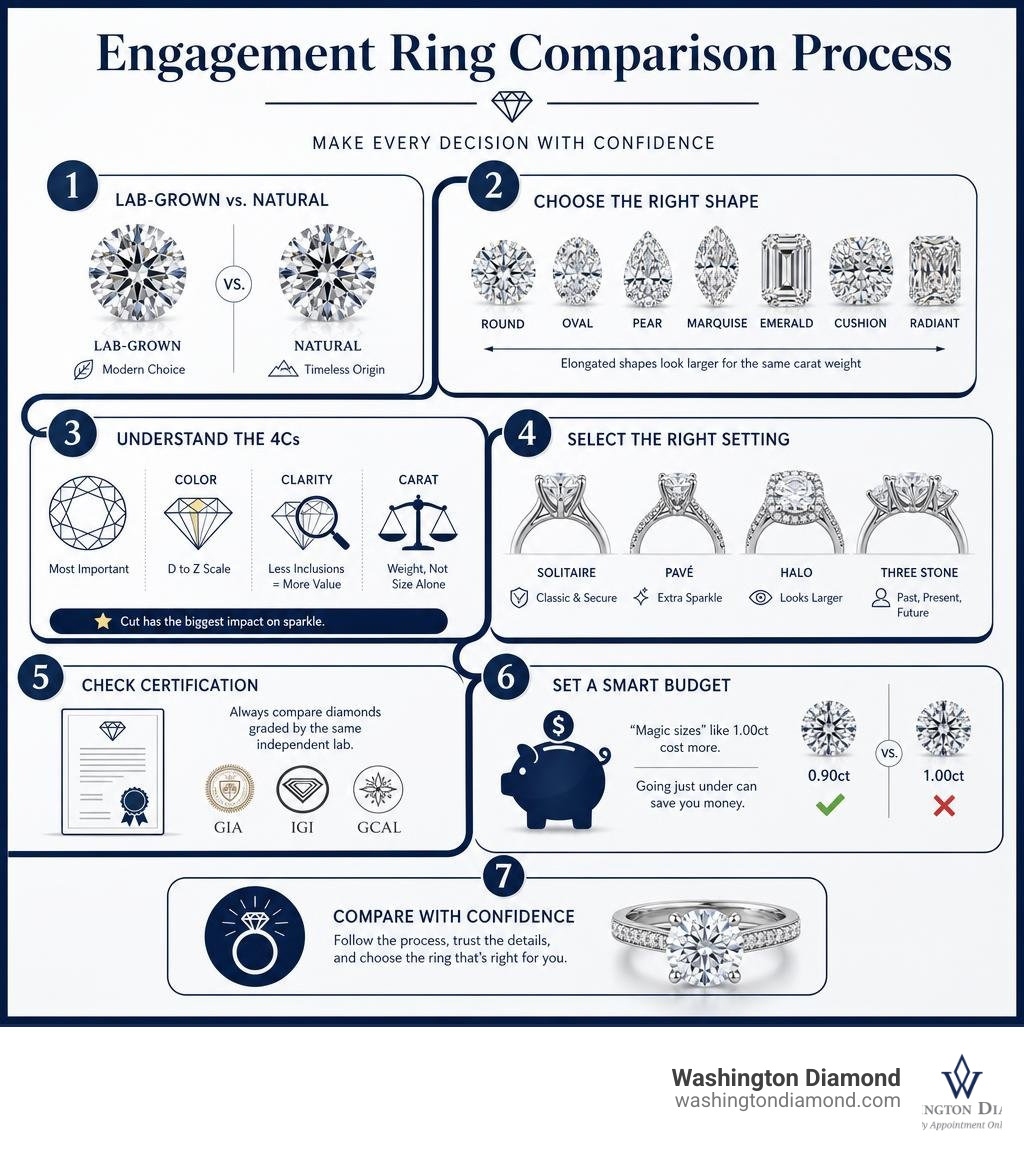
If you need engagement ring comparison help, here's a quick-start guide to the most important decisions:
| What to Compare | Why It Matters |
|---|---|
| Lab-grown vs. natural diamond | Price difference of 30–70%; same hardness and sparkle |
| Diamond shape | Elongated shapes (oval, pear, marquise) look larger for the same carat weight |
| Cut style | Brilliant cuts hide flaws and maximize sparkle; step cuts need higher clarity |
| The 4Cs | Cut matters most; prioritize it before color, clarity, or carat |
| Setting style | Affects security, daily comfort, and how big the stone looks |
| Certification | Only compare diamonds graded by the same lab (GIA, IGI, or GCAL) |
| Budget | "Magic sizes" like 1.00ct cost more — going just under saves money |
Choosing an engagement ring is one of the biggest jewelry decisions most people ever make. The average U.S. consumer spent over $6,000 on an engagement ring, yet many buyers walk into the process without a clear framework for comparing their options — and end up overwhelmed.
The good news? Comparing rings doesn't have to be confusing. Whether you're weighing lab-grown against natural diamonds, trying to figure out which shape flatters a hand, or sorting out what the 4Cs actually mean for your budget, there's a logical path through it all.
I'm Tom Daube, a GIA-certified diamond specialist and jewelry designer with decades of experience helping buyers navigate exactly this kind of engagement ring comparison help — consistently delivering diamonds at or below wholesale prices. In the sections below, I'll walk you through everything you need to compare rings with confidence.
Lab-Grown vs. Natural Diamonds: The Ultimate Comparison
When you begin your search, the very first fork in the road is often deciding between a lab-grown and a natural diamond. Let’s clear up the biggest misconception right away: lab-grown diamonds are real diamonds. They are not cubic zirconia or moissanite. Physically, chemically, and optically, they are identical to natural diamonds. Both rate a perfect 10 on the Mohs hardness scale.
To help you visualize the trade-offs, here is a side-by-side breakdown:
| Feature | Lab-Grown Diamonds | Natural Diamonds |
|---|---|---|
| Origin | Created in a laboratory using advanced technology (HPHT or CVD methods) | Formed deep within the Earth over billions of years under heat and pressure |
| Price (1.00ct) | Typically ranges from $2,800 to $4,200 (including setting) | Typically ranges from $6,500 to $9,000+ depending on quality |
| Visual Appearance | Identical sparkle, fire, and scintillation to natural diamonds | Identical sparkle, fire, and scintillation to lab-grown diamonds |
| Long-Term Value | Minimal resale value; prices continue to adjust as production scales | Holds value well over time due to natural rarity and finite supply |
| Best For | Maximizing size and quality on a budget; value-driven buyers | Buyers who value tradition, geological history, and long-term rarity |
Choosing between the two comes down to your personal values. If your partner dreams of a massive, flawless stone and you want to keep your budget comfortable, lab-grown diamonds offer incredible visual value. In fact, lab-grown diamonds can cost 30% to 70% less than mined diamonds of similar quality.
On the other hand, if the idea of a stone formed by nature billions of years ago is central to your love story, a natural diamond is the classic, time-tested choice. To explore how these differences impact your overall budget, check out our Engagement Ring Prices Guide 2026.
Understanding Diamond Certification and Grading Reports
When you are looking for engagement ring comparison help, the golden rule is this: only compare diamonds graded by the same laboratory.
Different gemological laboratories have different grading standards. The Gemological Institute of America (GIA) is the industry gold standard. Other highly respected labs include the International Gemological Institute (IGI) and the Gem Certification & Assurance Lab (GCAL). For additional consumer education, GIA offers a helpful overview of what is included in a diamond grading report and how diamond quality factors are evaluated.
A GIA report ensures that a diamond graded as an "F color, VS2 clarity" is exactly that. If you compare a GIA-graded diamond to one graded by a lesser-known lab with looser standards, you might think you are getting a deal on paper, but the actual stone may look yellow or heavily included in person.
To put grading standards in perspective, ultra-high-end luxury brands famously accept only a tiny fraction (sometimes less than 0.04%) of the world's gem-grade diamonds because their internal cut, color, and clarity standards are so strict. While you don't need to pay a massive luxury markup to get an extraordinary stone, you do need a reliable grading report to protect your investment.
"Magic Sizes" and Price-Per-Carat Math
In the diamond industry, prices do not increase linearly. Instead, they jump dramatically at "magic sizes" like 0.50ct, 0.75ct, 1.00ct, 1.50ct, and 2.00ct.
Because demand is incredibly high for a clean "one-carat" diamond, a 1.00ct stone will cost significantly more than a 0.90ct stone, even if they look virtually identical to the naked eye. By choosing a 0.92ct diamond instead of a 1.00ct diamond, you can save a significant amount of money without sacrificing visual presence.
Additionally, always look at the price-per-carat math. For example:
- A 1.43ct diamond priced at $4,500 averages out to $3,147 per carat.
- A 1.39ct diamond priced at $4,500 averages out to $3,237 per carat.
Calculating this allows you to see exactly where the value lies when comparing loose stones side-by-side.
How to Get Engagement Ring Comparison Help Online and In-Person
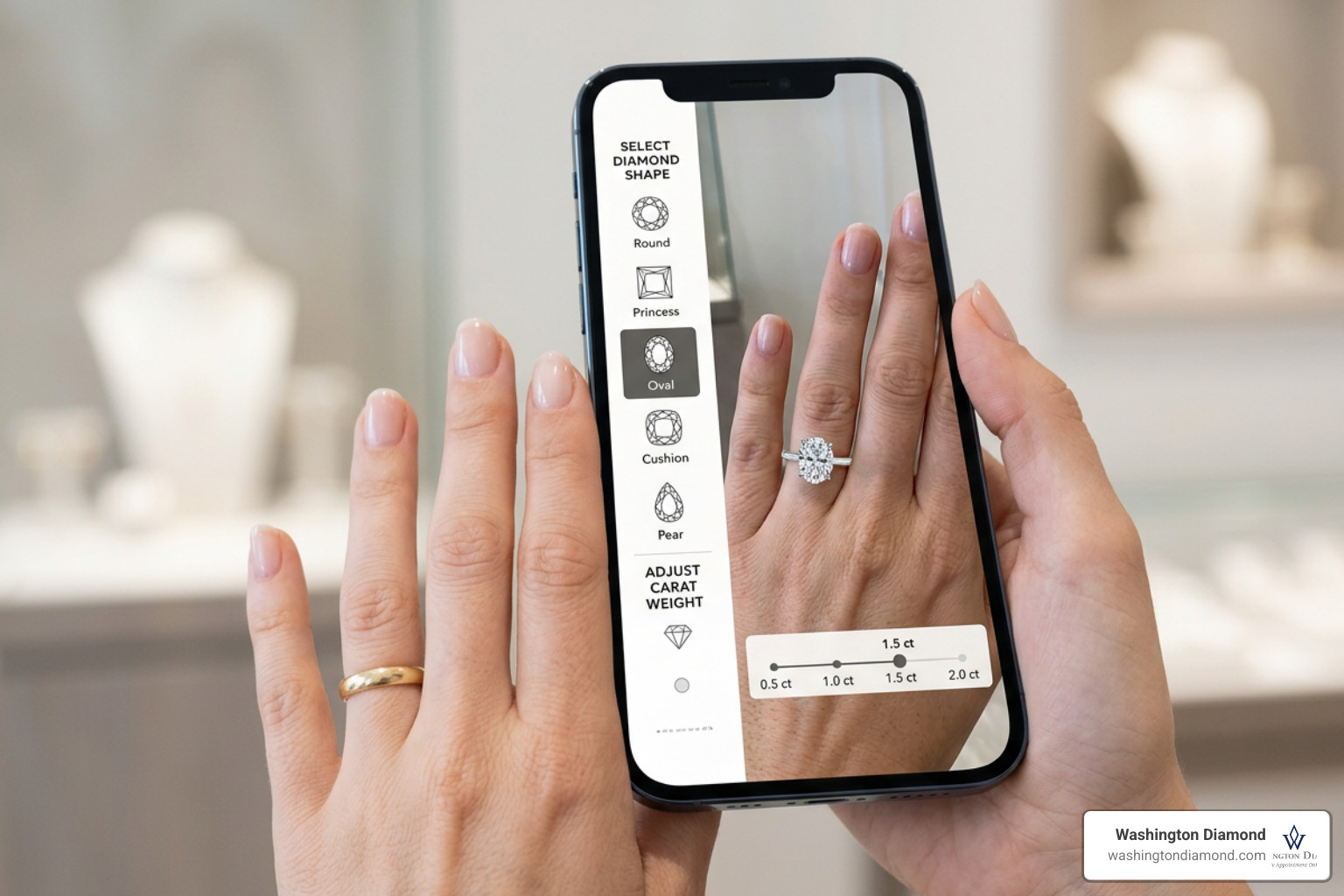
In today's market, you have more tools than ever to help you compare rings. The best approach is a combination of online visualization and personalized, in-person expertise.
When beginning your journey, taking an interactive style quiz can help narrow down your aesthetic. If you're wondering which style matches your partner's personality, try our quick guide: Which Engagement Ring Rocks Your World.
For buyers in Northern Virginia, finding the right jeweler can feel overwhelming with so many traditional retail showrooms and national chains available. However, we believe the best way to compare diamonds is in a relaxed, private setting. At Washington Diamond, we operate on an appointment-only basis in Northern Virginia, giving you our undivided attention without any high-pressure sales tactics.
Using Virtual Tools for Engagement Ring Comparison Help
Virtual ring viewers and AI-powered try-on tools are excellent for initial research. These tools use true-to-scale rendering to show how different diamond shapes and carat weights look on a model hand.
While virtual tools are incredibly accurate for comparing proportions—such as how a 1.50ct oval compares to a 2.00ct round—remember that they cannot simulate how a diamond reacts to different lighting conditions in the real world. A virtual tool is a great starting point, but seeing the fire and scintillation of a loose diamond in person is irreplaceable.
How Finger Size Influences Perceived Carat Weight
The average ring size for women in the United States is around 6 to 6.5. This is an important stat because finger size directly influences how large a diamond looks on the hand:
- Petite Hands (Sizes 4 to 5.5): A 0.80ct to 1.20ct stone will have a massive visual presence and look proportionally much larger.
- Average to Larger Hands (Sizes 7+): A 1.25ct or larger stone is typically preferred to achieve the same relative "finger coverage."
If your partner has very slender fingers, you don't need to buy a massive carat weight to get a show-stopping look!
Comparing Diamond Shapes and Cut Styles
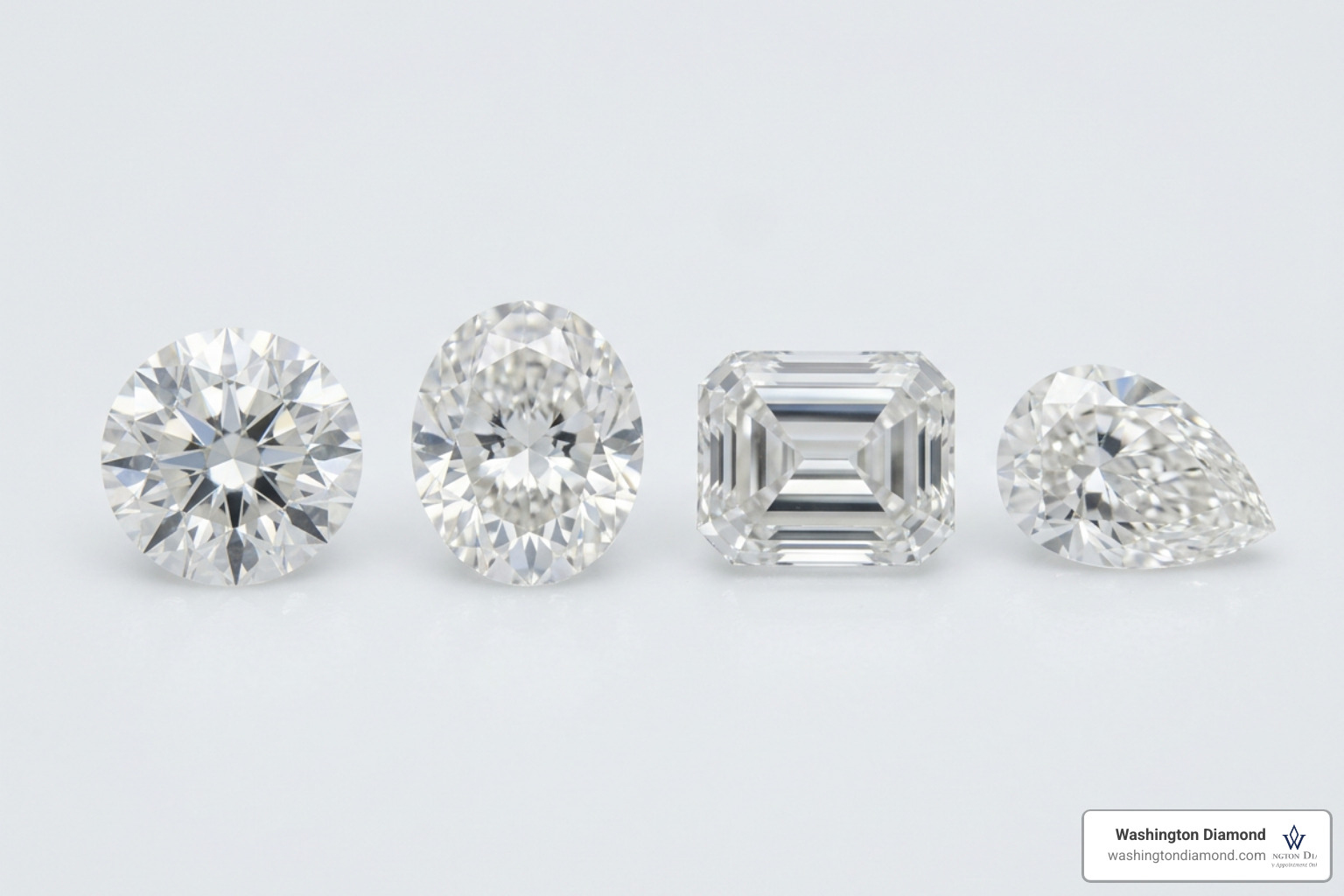
The silhouette of your diamond—its shape—is the most defining visual element of the ring. Beyond aesthetics, the shape also dictates how large the stone looks and how it handles light.
When evaluating shapes, pay close attention to the length-to-width (L/W) ratio and the millimeter (mm) dimensions. Carat is a measure of weight, not size. Two diamonds can both weigh 1.00ct, but if one is cut shallower, it will have a larger millimeter "spread" across the top, making it look bigger face-up.
Be aware of the "bowtie effect"—a dark shadow resembling a bowtie across the center of certain shapes (like ovals, pears, and marquise cuts). A skilled jeweler will help you select a stone where this effect is minimal. For a deep dive into one of today's most popular shapes, read our Oval Diamond Engagement Ring Ultimate Guide.
Elongated Shapes vs. Round Cuts
Round brilliant diamonds are the most popular shape for a reason—their 57 or 58 facets are engineered for unmatched sparkle. However, because they are symmetrical and carry a lot of their weight in their depth, they can look smaller face-up than elongated shapes of the same carat weight.
Elongated shapes—such as oval, pear, marquise, and emerald cuts—distribute their weight across a longer surface area. This creates an optical illusion that makes the stone look larger on the finger and visually elongates the wearer's hand.
Brilliant Cuts vs. Step Cuts
The way a diamond is faceted determines its "cut style." The two primary styles are brilliant cuts and step cuts:
- Brilliant Cuts (Round, Oval, Cushion, Radiant, Pear): These feature small, triangular facets designed to reflect maximum light. They produce intense sparkle, fire, and scintillation. Because of their busy facet patterns, brilliant cuts are excellent at hiding tiny natural inclusions and masking slight color tints.
- Step Cuts (Emerald, Asscher): These feature long, parallel facets that resemble steps. Instead of a fiery sparkle, they produce a clean, elegant "hall of mirrors" effect. Because the facets act like open windows, step cuts do not hide inclusions or color well. We recommend prioritizing a higher clarity grade (VS2 or higher) and a better color grade (G or higher) for step cuts. To learn more about designing a ring around this elegant style, explore our Custom Emerald Cut Engagement Rings Guide.
Prioritizing the 4Cs and Setting Styles Within Your Budget
When shopping for an engagement ring, the goal is to maximize visual impact without overstretching your budget. To do this, you must learn how to prioritize the 4Cs (Cut, Color, Clarity, and Carat) and pair your stone with the right setting. For expert savings strategies, read our guide on Affordable Bling Top Tips for Best Value Engagement Rings.
Balancing the 4Cs on a Budget
If you want the most beautiful diamond possible for your money, always prioritize Cut.
A diamond with perfect color and clarity will still look dull and lifeless if it is poorly cut. A well-cut diamond, however, will reflect light beautifully, masking a lower color grade (like H or I) or a lower clarity grade (like SI1).
Here is our recommended priority list for budget-conscious buyers:
- Cut: Excellent or Ideal (Never compromise here).
- Color: Near-Colorless (G to J). If you are setting the diamond in yellow gold or rose gold, you can easily drop to an I or J color because the warm metal will mask any slight yellow tint.
- Clarity: Eye-Clean (VS2 or SI1). There is no need to pay a premium for a VVS1 diamond if the inclusions in an SI1 diamond cannot be seen without a microscope.
- Carat: Buy just under the "magic sizes" (e.g., a 0.90ct instead of a 1.00ct).
How Setting Styles Affect Security and Wearability
Your setting style is not just about looks; it dictates how secure the stone is and how well the ring fits into your daily routine.
- Solitaire: Classic and timeless, but leaves the diamond's edges exposed.
- Halo: A ring of smaller diamonds surrounds the center stone. This can make a 0.90ct stone look like a 1.20ct stone, giving you great visual value.
- Bezel: A metal rim completely surrounds the edge of the stone. This is the most secure setting style—perfect for active lifestyles—and prevents snagging on clothing.
- Three-Stone: Represents the past, present, and future, offering a brilliant, wide span of sparkle across the finger.
If you choose a pointed shape like a pear, marquise, or princess cut, make sure your setting features protective V-prongs or claw prongs at the corners to prevent chipping. For a complete breakdown of your options, consult our Engagement Ring Settings 101 guide.
Ready-Made vs. Custom-Designed Engagement Rings
Should you buy a ring straight out of a display case, or design one from scratch?
Ready-made rings are convenient if you are on a tight timeline, but they offer limited design flexibility. Custom design, on the other hand, allows you to create a completely unique piece that perfectly fits your partner's style, lifestyle, and finger proportions.
At Washington Diamond, we specialize in a collaborative custom design process. Using advanced CAD modeling, we bring your vision to life in a digital 3D space, allowing you to tweak every detail—from the band width to the prong style—before we cast the ring in metal. This process is also ideal if you want to incorporate an heirloom family stone into a modern setting.
Choosing the Right Path for Your Ring
- Timeline: Ready-made rings can be sized and ready in a few days. A custom-designed ring typically takes 4 to 8 weeks from the initial consultation to the final polish.
- Personalization: Custom design lets you control every variable. You can design a band that perfectly accommodates a flush-fit wedding band or select the exact metal alloy that matches your partner's skin tone.
For a step-by-step look at how custom rings are built, read our Custom Design Engagement Ring Guide and explore our Custom Engagement Ring Band Guide.
Frequently Asked Questions
Where Can I Find Expert Engagement Ring Comparison Help?
The best place to get comparison help is from a certified gemologist in a private, low-pressure environment. While online tools are helpful for initial research, seeing diamonds in person under different lighting conditions with an expert by your side is the only way to buy with absolute confidence. To find the right partner for your journey, check out our Best Engagement Ring Stores Guide.
How Do I Protect and Care for My Engagement Ring?
To keep your ring sparkling like new, we recommend cleaning it regularly with warm water, mild dish soap, and a soft-bristled toothbrush. You should also bring your ring to a professional jeweler at least once a year for a prong check to ensure the stone is secure.
Finally, protect your investment with a dedicated jewelry insurance policy immediately after purchase. For detailed advice, see our Ultimate Engagement Ring Care Guide and Protect Your Precious The Ultimate Guide to Engagement Ring Insurance.
Which Diamond Shape Looks the Largest on the Finger?
Elongated shapes—specifically marquise, pear, and oval cuts—look the largest for their carat weight. Because more of their physical mass is distributed across the top of the stone (the "face-up" area) rather than in the depth of the stone, they offer a larger millimeter spread than round or princess cuts of the same weight.
Conclusion
At Washington Diamond, we believe that buying an engagement ring should be an exciting, memorable, and entirely stress-free experience. Our private, appointment-only studio in Northern Virginia is designed to give you the quiet space and expert guidance you need to make an informed, confident decision.
Whether you decide on a classic natural diamond or a stunning, value-driven lab-grown stone, we are here to help you craft a piece that tells your unique love story. Ready to start designing? Explore our Custom Engagement Rings Ultimate Guide and schedule your private consultation with us today.
Have a question about your jewelry?
We've been helping clients with diamonds, custom design, repairs, appraisals, and more since 1969. Book a private appointment at our Falls Church studio.
Book an AppointmentTrusted since 1969 · Falls Church, VA · 703-536-3600
From the blog
View all


