

Making Cents of Diamonds: A Guide to Tiny Sparklers and Carat Weights
What Is a 1 Cent Diamond Size? A Quick Answer Before We Dive In

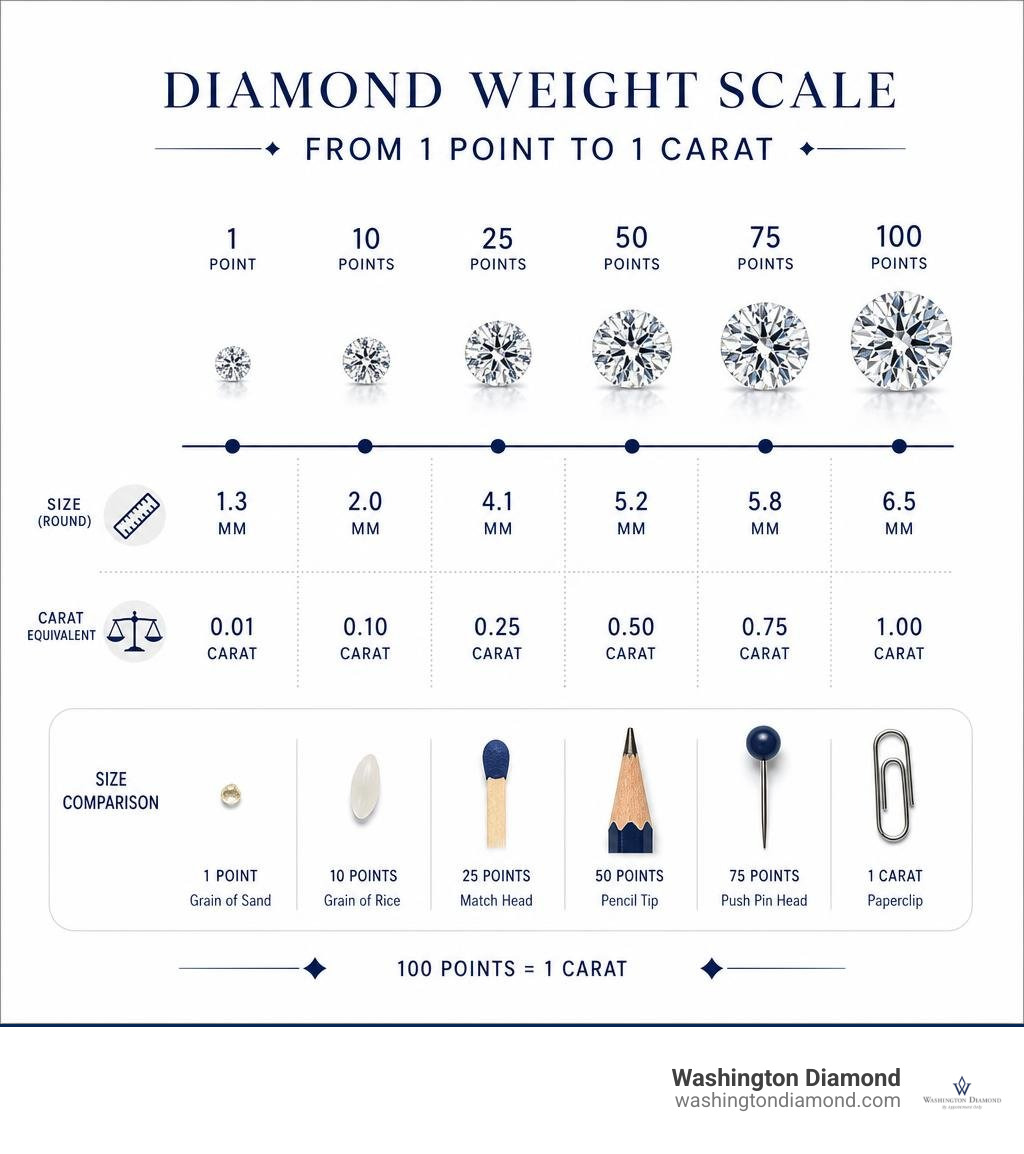
Understanding 1 cent diamond size starts with one simple fact: in diamond terminology, "1 cent" means 1 point, which equals 0.01 carats. Here's a quick breakdown:
| Term | Equivalent | Approx. Size (Round) |
|---|---|---|
| 1 cent (1 point) | 0.01 carats | ~1.3 mm diameter |
| 25 cents (25 points) | 0.25 carats | ~4.1 mm diameter |
| 100 cents (100 points) | 1.00 carat | ~6.5 mm diameter |
So a 1 cent diamond is tiny — about the size of a fine grain of sand. You'll find these micro diamonds used as accent stones in pavé, halo, and channel settings, where they add shimmer and sparkle without competing with a center stone.
A carat itself weighs exactly 0.2 grams — roughly the same as a single paperclip. That puts a 1 cent diamond at just 0.002 grams. Small, but far from insignificant when dozens of them line a ring together.
I'm Tom Daube, a GIA-certified diamond specialist with decades of experience helping buyers understand every detail of diamond weight and sizing — including the often-overlooked role of 1 cent diamond size accent stones in fine jewelry design. Let's walk through everything you need to know, from the tiniest accent diamonds all the way up to choosing the perfect carat weight for your special piece.
Simple guide to 1 cent diamond size:
Demystifying the 1 Cent Diamond Size: Points vs. Carats
When you step into our private, appointment-only design studio in Northern Virginia, one of the first things we discuss is how the industry talks about diamond weight. While the average consumer is highly familiar with the word "carat," jewelers frequently use terms like "points" or "cents" when dealing with smaller gems.
Historically, the term "cent" comes from the decimal division of a single carat. Just as one dollar is divided into 100 cents, one carat is divided into 100 points (or cents). Therefore, a 1 cent diamond size refers to a diamond that weighs exactly 0.01 carats.
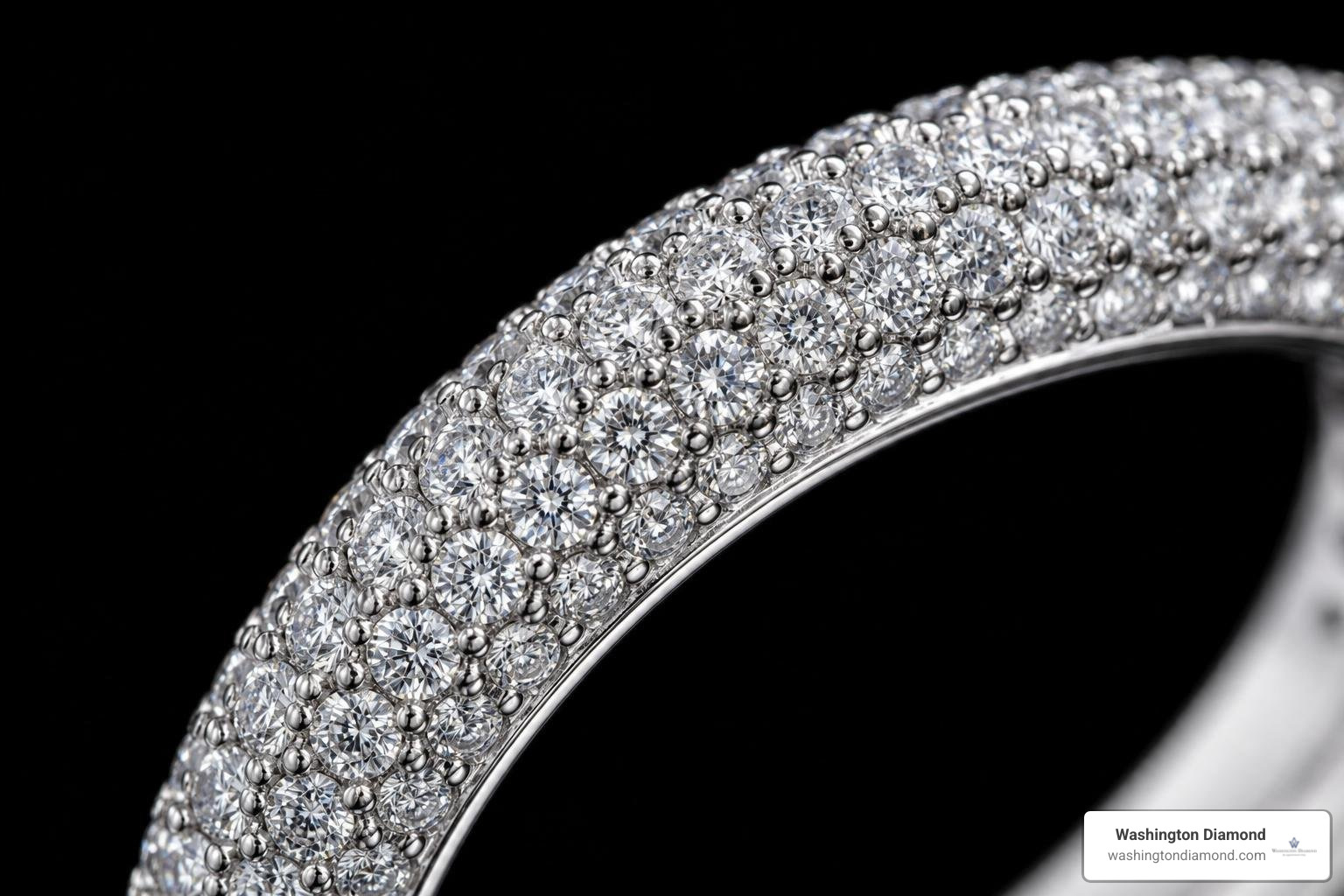
These tiny gems are collectively known in the trade as "melee" diamonds. Melee diamonds are small diamonds used to embellish jewelry pieces, typically weighing less than 0.20 carats (20 points). Despite their small individual size, they play a massive role in modern jewelry design, adding unmatched brilliance and texture to engagement rings, wedding bands, and custom pendants.
What is the Physical 1 Cent Diamond Size in Millimeters?
To truly visualize a 1 cent diamond size, we have to look past the weight and focus on the physical dimensions. A standard round brilliant cut diamond weighing 0.01 carats (1 point) has a physical diameter of approximately 1.3 millimeters.
To put that into perspective:
- A standard US dime is 1.35 mm thick. A 1 cent diamond is almost exactly as wide as a dime is thick.
- A standard wooden pencil lead is about 2.0 mm in diameter, making a 1 cent diamond significantly narrower than the tip of a pencil.
In terms of mass, because one carat equals exactly 0.2 grams (0.0071 ounces), a 1 cent diamond weighs a mere 0.002 grams. Because they are so incredibly light and small, cutting and sorting them requires specialized tools, steady hands, and immense expertise. At our Northern Virginia studio, we hand-select these tiny accents to ensure they match perfectly in cut, color, and clarity, creating a seamless river of light across your custom jewelry.
How 1 Cent Diamond Size Accents Compare to Larger Center Stones
While a single 1 cent diamond might not catch your eye from across the room, they possess an incredible collective power. In jewelry design, these tiny accents are used to create complex visual structures that enhance the size and drama of a larger center stone.
- Pavé Settings: In a pavé setting (derived from the French word for "paved"), dozens of 1 cent diamonds are set closely together with tiny metal beads. This creates a surface that literally looks paved with diamonds, offering a continuous field of sparkle.
- Halo Rings: Placing a border of 1 cent diamonds around a 1 carat center stone can make the center stone look up to 50% larger. The human eye struggles to distinguish where the center stone ends and the halo begins from a distance, creating a magnificent optical illusion.
- Visual Contrast: Using small accent diamonds on the band creates a striking contrast that draws the eye directly toward the center stone, making the primary diamond pop with dramatic intensity.
When evaluating a piece of jewelry with multiple small stones, you will often see the term "Total Weight" (TW) or "Total Carat Weight" (TCW). This represents the combined weight of all the diamonds in the piece. For example, a ring might feature a 1.00-carat center stone surrounded by fifty 1 cent diamond size accents, bringing the total weight of the ring to 1.50 carats TW.
The 1 Carat Benchmark: Dimensions, Shapes, and Finger Coverage
While understanding the microscopic world of the 1 cent diamond size is essential for appreciating fine jewelry craftsmanship, the 1 carat mark remains the ultimate milestone for center stones.
A standard 1 carat round brilliant diamond is cut to maximize light return, typically featuring 57 or 58 facets. When cut to ideal proportions, a 1 carat round diamond measures approximately 6.5 mm in diameter (typically ranging between 6.34 mm and 6.6 mm). It features a face-up area of approximately 33.18 mm² and a physical volume of 56.82 mm³.
However, physical dimensions vary wildly depending on the shape of the diamond. Below is a comprehensive table showing how a 1 carat diamond's dimensions, face-up area, and typical length-to-width ratios change across different popular cuts:
| Diamond Shape (1.00 Carat) | Typical Dimensions (mm) | Face-Up Area (mm²) | Typical Length-to-Width Ratio | Visual Size Impression |
|---|---|---|---|---|
| Round Brilliant | 6.5 x 6.5 x 3.92 | 33.18 | 1.00 | Standard / Balanced |
| Oval Cut | 7.7 x 5.7 x 3.5 | 34.49 | 1.30 – 1.40 | Looks Larger / Elongated |
| Marquise Cut | 10.0 x 5.0 x 3.0 | 39.27 | 2.00 | Looks Much Larger / Long |
| Pear Shape | 8.5 x 5.5 x 3.3 | 36.75 | 1.50 – 1.60 | Looks Larger / Elegant |
| Princess Cut | 5.5 x 5.5 x 3.85 | 30.25 | 1.00 | Looks Smaller / Compact |
| Emerald Cut | 7.0 x 5.0 x 3.2 | 35.00 | 1.40 | Looks Larger / Mirror-like |
Face-Up Size and Shape Comparisons
As the table demonstrates, carat weight is a measure of mass, not physical dimensions. A 1 carat princess cut diamond has a face-up area of 30.25 mm², which is nearly 9% smaller than a round brilliant. This is because a princess cut carries more of its weight in its deep, square corners and pavilion.
Conversely, elongated shapes like the oval, pear, and marquise cuts distribute their weight horizontally, giving them a much larger "spread" or face-up area. A 1 carat marquise cut, for example, measures a striking 10.0 mm in length. This elongated shape makes the stone appear significantly larger than a 1 carat round brilliant, despite weighing the exact same on the scale.
Visualizing a 1 Carat Diamond on a Finger
How do these measurements translate to real life? When worn on a hand, the visual impact of a diamond is heavily influenced by the wearer's finger size.
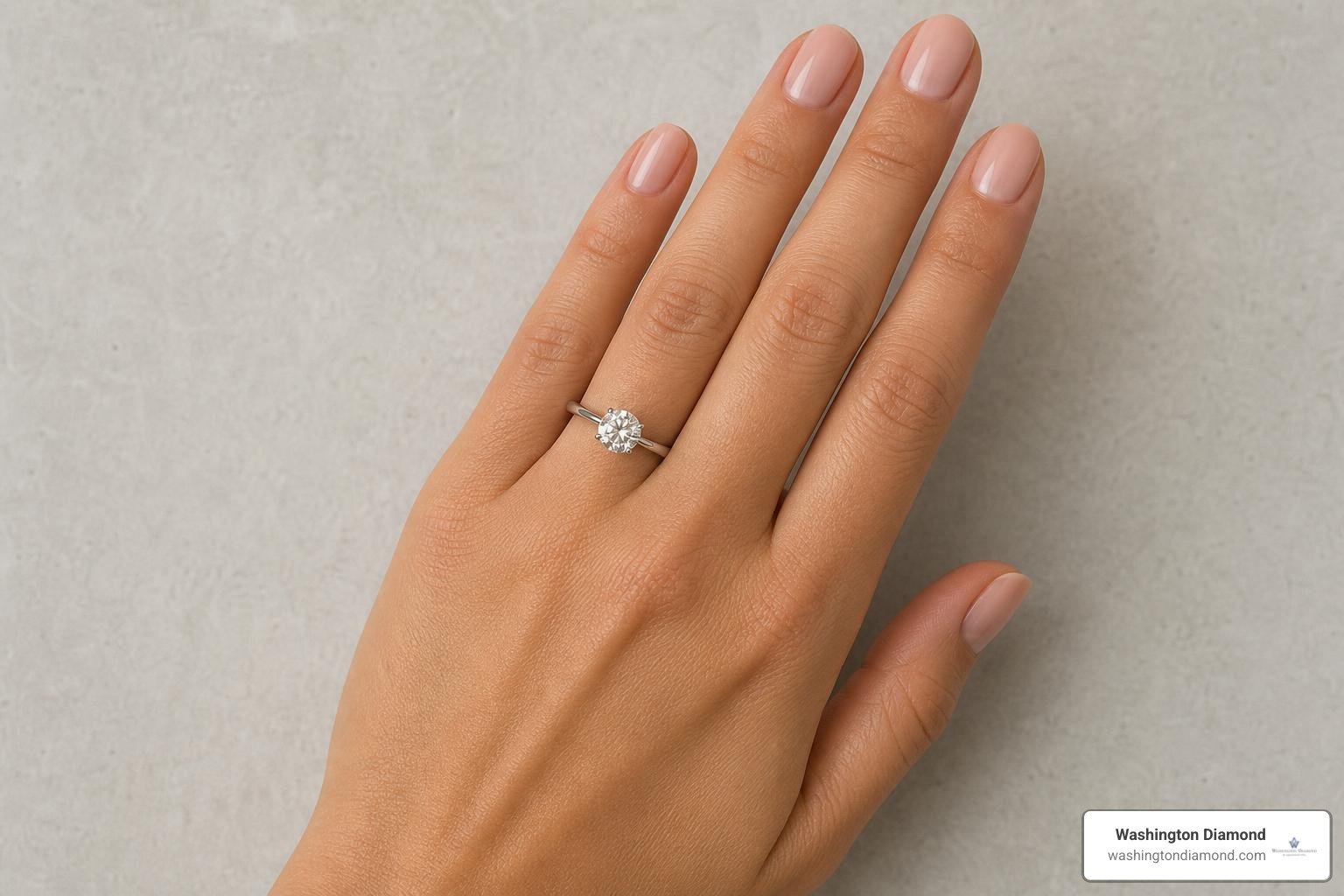
On an average-sized female finger (US size 6.5, which is roughly 16.9 mm wide):
- A 1 carat round brilliant diamond (measuring 6.5 mm in diameter) covers approximately 39% of the finger's width when viewed directly from the top.
- In terms of total surface area, a standard 1 carat round diamond covers roughly 7% of the visible finger width from side to side when accounting for the curvature of the finger.
Because a 1 carat diamond provides such a balanced, proportional look on the hand, it has remained the most popular center stone size for decades. It offers excellent finger coverage without overwhelming the hand or getting caught on everyday objects.
Gemstone Comparisons and Weight Estimation Formulas
One of the most fascinating aspects of gemology is that different gemstones have different densities, known scientifically as specific gravity. Because of this, two gemstones that weigh exactly 1.00 carat can look completely different in physical size.
Think of it like a pound of lead versus a pound of feathers. Because lead is dense, a pound of it fits in the palm of your hand. Feathers are far less dense, so a pound of them would fill a large pillow.
This concept is perfectly illustrated when comparing diamonds to other popular gemstones. For a deeper dive into this phenomenon, you can explore the Carat Size Reference: What Does 1 Carat Look Like Across Gemstones?.
Why Carat Weight Does Not Equal Visual Size Across Gemstones
To understand why a 1 carat ruby is physically smaller than a 1 carat diamond, we must look at their specific gravity (g/cm³):
- Emerald (Beryl): Specific Gravity of ~2.72 (Low density)
- Diamond: Specific Gravity of 3.52 (Moderate density)
- Ruby & Sapphire (Corundum): Specific Gravity of 4.00 (High density)
Because sapphire and ruby are highly dense, they pack more mass into a smaller volume. Consequently, a 1 carat sapphire will look physically smaller (measuring around 6.0 mm in a round cut) than a 1 carat diamond (6.5 mm).
On the other hand, emerald has a very low density. Because it is less dense, it requires a larger volume to reach the same weight. A 1 carat emerald will look significantly larger face-up than a 1 carat diamond, often measuring around 7.0 mm in diameter.
How to Estimate Carat Weight from Millimeter Measurements
If you have a loose gemstone or one set in a vintage piece, you can estimate its carat weight using physical measurements and a basic mathematical formula. To do this, you will need a digital caliper to measure the stone's length, width, and depth in millimeters.
The standard formula for estimating the weight of a round brilliant cut gemstone is:
$$\text{Estimated Carat Weight} = \text{Diameter}^2 \times \text{Depth} \times \text{Specific Gravity Correction Factor}$$
For a round diamond, the formula is simplified using a specific gravity correction factor of 0.0061:
$$\text{Weight (ct)} = \text{Diameter (mm)} \times \text{Diameter (mm)} \times \text{Depth (mm)} \times 0.0061$$
Here are the specific gravity correction factors for other common gemstone families:
- Diamond: 0.0061
- Corundum (Ruby/Sapphire): 0.0062
- Beryl (Emerald/Aquamarine): 0.0057
- Quartz (Amethyst/Citrine): 0.0060
Note: While these formulas are incredibly helpful for obtaining a close approximation, they should never replace an official appraisal from a certified gemological laboratory like the GIA.
Smart Buying Strategies: Maximizing Value and 'Buying Shy'
When shopping for a diamond, the price tag does not scale linearly. Because larger rough diamond crystals are exponentially rarer in nature, diamond prices jump dramatically at major weight milestones (such as 0.50 ct, 0.75 ct, and especially 1.00 ct).
This pricing structure opens up a brilliant opportunity for savvy buyers to save money without sacrificing visual impact.
The 'Buying Shy' Strategy Explained
"Buying shy" is an industry term for purchasing a diamond that weighs just under a major carat milestone—for example, selecting a 0.95-carat diamond instead of a 1.00-carat diamond.
Because a 0.95-carat diamond sits just below the coveted 1.00-carat threshold, it escapes the steep price premium associated with "full carat" stones. However, the physical difference in size is completely indistinguishable to the naked eye.
Let’s look at the math:
- A perfect 1.00-carat round diamond measures 6.50 mm in diameter.
- A well-cut 0.95-carat round diamond measures approximately 6.40 mm in diameter.
The difference of 0.10 millimeters is less than the width of a human hair. By "buying shy," you can easily save 15% to 25% on the cost of the diamond while walking away with a stone that looks identical on your partner's finger.
Recommended Cut, Color, and Clarity Grades
To get the absolute best value for your budget, we always recommend focusing your funds on the factor that has the greatest impact on a diamond's beauty: Cut. A diamond with an Excellent cut (GIA) or Ideal cut (AGS) will reflect almost all the light that enters it, making it look incredibly bright, fiery, and often larger than its actual carat weight.
Here is our signature "sweet spot" guide for maximizing your budget:
- Cut: Always choose an Excellent or Ideal cut. A poorly cut diamond will leak light out of the bottom, making it look dull, dark, and physically smaller than it is.
- Clarity: Look for an eye-clean SI1 or SI2 clarity grade. This means the diamond has tiny natural inclusions, but they are completely invisible to the naked eye. Paying a premium for a Flawless (FL) or Very Very Slightly Included (VVS1) diamond is unnecessary because they look identical to an eye-clean SI1 stone without magnification.
- Color: If you are setting your diamond in a platinum or white gold band, a J color diamond offers incredible value while still appearing bright white. If you prefer yellow gold or rose gold settings, you can comfortably drop to a K color diamond, as the warm metal of the ring will naturally mask any slight warm undertones in the stone.
Frequently Asked Questions about Diamond Sizes
Is a 1 carat lab-grown diamond the same size as a 1 carat natural diamond?
Yes, absolutely. Lab-grown diamonds are physically, chemically, and optically identical to natural diamonds mined from the earth. They share the exact same crystal structure and specific gravity (3.52). Because their density is identical, a 1 carat lab-grown round brilliant diamond will measure the exact same size as a 1 carat natural round brilliant diamond—approximately 6.5 mm in diameter.
How do you measure a diamond that is already set in a ring?
Measuring a set diamond is slightly more challenging because the metal of the prongs or bezel can block access to the stone's edges. To estimate its size:
- Use a digital caliper to measure the diameter at its widest point, taking care not to scratch the metal setting.
- Measure the depth from the top of the table to the bottom culet (if the setting allows access to the bottom of the stone).
- If the depth cannot be directly measured, jewelers estimate the depth by multiplying the diameter by a standard depth percentage (usually around 61% for well-cut round diamonds).
- Apply the standard diamond weight estimation formula to find the approximate carat weight.
What factors make a 1 carat diamond look larger or smaller than its actual weight?
Two primary cut proportions dictate how large a diamond looks:
- Depth Percentage: The depth percentage is calculated by dividing the physical depth of the diamond by its average diameter. The recommended range for an excellent round cut is 58% to 62.5% (with 60.3% being highly ideal). If a diamond is cut too deep (over 63%), a significant portion of its weight is hidden in the bottom of the stone where you cannot see it, making the face-up diameter look much smaller (e.g., a 1ct stone looking like a 0.90ct stone).
- Table Size: The table is the flat facet on the very top of the diamond. The recommended table percentage is 53% to 58%. A table that is too large can make a stone look flat and spread-out, while a table that is too small can make the stone look deep and compact.
Conclusion
Whether you are admiring the microscopic precision of a 1 cent diamond size accent stone or searching for the perfect 1.50-carat center stone, understanding the relationship between carat weight, physical dimensions, and cut quality is the key to making a brilliant purchase.
At Washington Diamond, we believe that choosing a diamond should be an intimate, celebratory, and highly personalized experience. We reject the high-pressure sales environments of traditional jewelry stores and the impersonal, blind purchasing of online retailers. Instead, we welcome you into our private, appointment-only studio in Northern Virginia, where you receive our undivided attention.
We will guide you through our curated selection of GIA-certified diamonds, showing you exactly how different cuts, colors, and accent stones interact under professional magnification and in natural light. Together, we will design a custom piece of jewelry that tells your unique story.
Ready to find your perfect sparkler? Schedule a private consultation with Washington Diamond today, and let us bring your dream design to life.
Have a question about your jewelry?
We've been helping clients with diamonds, custom design, repairs, appraisals, and more since 1969. Book a private appointment at our Falls Church studio.
Book an AppointmentTrusted since 1969 · Falls Church, VA · 703-536-3600
From the blog
View all


