

Size vs Sparkle: Choosing Your Ideal Oval Loose Diamond Carat
Why a 1 Carat Oval Loose Diamond Is One of the Smartest Diamond Choices in 2026

A 1 carat oval loose diamond gives you more visible surface area than almost any other shape at the same weight — and in 2026, it remains one of the most sought-after choices for engagement rings and fine jewelry.
Quick answer for buyers comparing oval diamond carat weights:
| What You Want | What to Look For |
|---|---|
| Best visual size | Oval beats round, princess, and cushion at 1 carat |
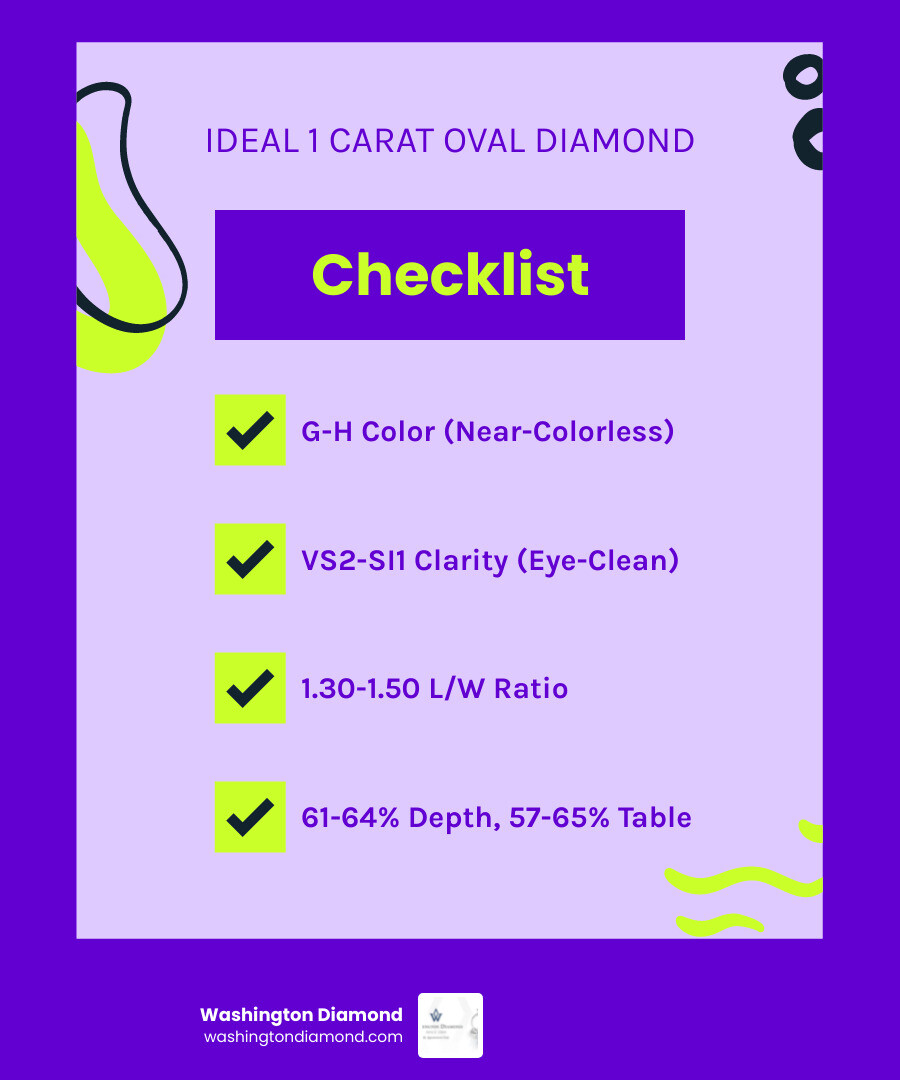
| Best sparkle | Very Good or Ideal cut, 61-64% depth, 57-65% table |
| Best color value | G or H color (near-colorless, no visible tint) |
| Best clarity value | VS2 or SI1 (clean to the naked eye) |
| Price range (natural) | ~$2,461 to $6,701 depending on grades |
| Price range (lab-grown) | From ~$364 for EF/VS step-cut |
| Ideal shape ratio | 1.30 to 1.50 length-to-width ratio |
| Certification | GIA or IGI recommended |
The oval shape does something no round diamond can: it elongates the finger and distributes carat weight across a larger face-up surface. That means your 1 carat oval will look noticeably bigger on the hand than a 1 carat round of the same quality. It also tends to cost less per carat than a round — making it an exceptional value.
But not all 1 carat oval diamonds are equal. Cut proportions, the presence of a "bow-tie" shadow, color grade, and certification all have a major impact on how your diamond actually looks and what it's worth.
This guide walks you through everything — from the 4Cs to proportions to natural vs. lab-grown pricing — so you can choose with confidence.
I'm Tom Daube, a GIA-certified diamond specialist with decades of experience helping clients find the right 1 carat oval loose diamond at prices typically below listed wholesale. As one of the top-rated jewelers in the country, I've guided countless buyers through exactly this decision — and I'm here to make it simple for you.
1 carat oval loose diamond word list:
Understanding the 4Cs for a 1 Carat Oval Loose Diamond
When we talk about a 1 carat oval loose diamond, we are balancing four distinct pillars of quality. While carat weight is the most discussed, it is actually the interaction of all four that determines if a diamond is a "stunner" or just a stone.
Carat Weight and Visual Size Carat is a measure of weight, not size. However, because of their elongated shape, oval diamonds have a larger "face-up" surface area than round diamonds. A standard 1.00-carat round diamond measures about 6.4mm in diameter. In contrast, a well-cut 1 carat oval loose diamond can measure approximately 7.7mm x 5.5mm. This makes the oval appear significantly larger to the eye, giving you more "bang for your buck."
Color Grades (The D-Z Scale) Diamond color is graded on a scale from D (colorless) to Z (noticeable light yellow or brown). For an oval diamond, we often recommend the "Near Colorless" range (G, H, or I). Because ovals are brilliant cuts, they are excellent at hiding color. An F-color diamond is icy white, but a G or H color diamond often looks identical to the naked eye once set in a ring, saving you thousands of dollars.
Clarity and Inclusions Clarity refers to the tiny "birthmarks" inside a diamond, known as inclusions. These are graded under 10x magnification. For a 1 carat oval loose diamond, the "sweet spot" for value is VS2 or SI1. At these grades, the inclusions are typically invisible to the naked eye (eye-clean). Since ovals have a complex facet pattern, they are quite forgiving and can hide small crystals or feathers better than step-cuts like the emerald cut.
To dive deeper into these nuances, check out our guide on Beyond The 4Cs How To Choose Your Perfect Certified Loose Diamond.
Maximizing Sparkle in a 1 Carat Oval Loose Diamond
Sparkle is the lifeblood of a diamond. It is composed of brilliance (white light reflection), fire (rainbow flashes), and scintillation (the play of light as the stone moves). In a 1 carat oval loose diamond, sparkle is entirely dependent on cut quality.
Unlike round diamonds, the GIA does not provide an official "Cut Grade" for oval diamonds. Instead, we evaluate "Polish" and "Symmetry." You should aim for "Excellent" or "Very Good" in both categories. A well-proportioned oval will exhibit a beautiful "crushed ice" look or distinct broad flashes, depending on the facet arrangement.
Some high-end oval diamonds even display "Hearts and Arrows" patterns when viewed through a special scope, indicating a level of precision that maximizes light return. If a diamond is cut too deep, the light leaks out the bottom, making the stone look dark. If it's too shallow, it loses its "fire." For more on selecting the right cut, see our Loose Diamonds Complete Guide.
Best Value Grades for a 1 Carat Oval Loose Diamond
Finding the "best value" means finding the point where quality and price intersect perfectly. Based on April 2026 market data, here is how the pricing breaks down for natural 1 carat oval loose diamond options:
- The Premium Choice (F-VS2, Ideal Cut): Priced around $4,460. This is for the buyer who wants high color and high clarity with no compromises.
- The Sweet Spot (G-VS2): Often priced between $3,500 and $4,100. This offers a perfectly white appearance and an eye-clean stone.
- The Value Leader (I-SI1, Very Good Cut): Available for approximately $2,461. This is the best way to get into a 1-carat natural stone on a budget while still maintaining a beautiful aesthetic.
When shopping, always look for GIA or IGI certification. These reports act as a "passport" for your diamond, verifying its DNA and ensuring you are paying a fair price. Understanding How To Calculate Diamond Price Per Carat can help you compare listings with transparency.
Proportions and the "Bow-Tie" Effect
One of the most critical aspects of choosing a 1 carat oval loose diamond is the length-to-width (L/W) ratio. This determines if the diamond looks short and chubby or long and slender.
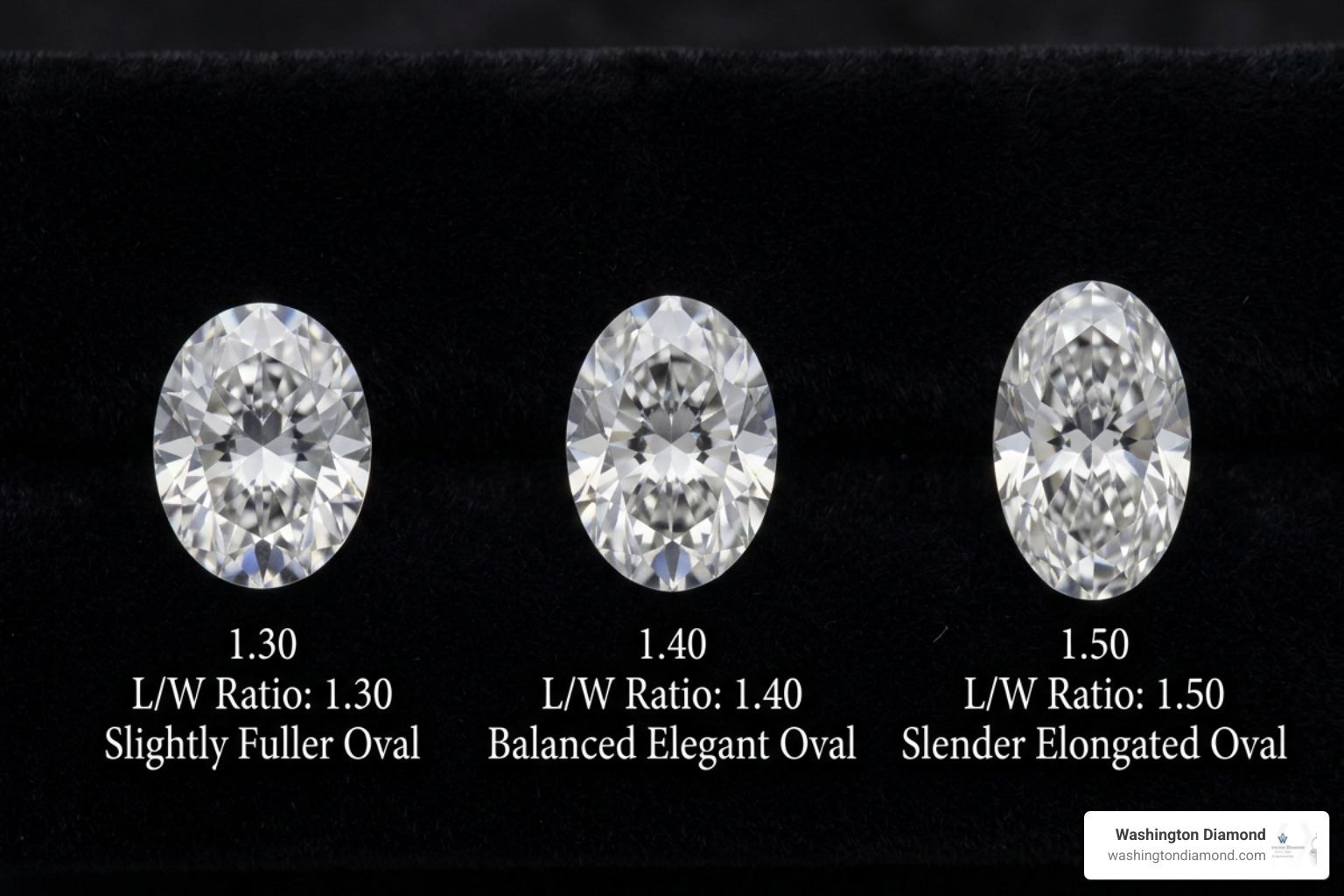
The Ideal Ratio
- 1.30 - 1.35: A classic, slightly fuller oval.
- 1.40 - 1.45: The "golden ratio" for ovals, providing a balanced, elegant elongation.
- 1.50+: A very slender, elongated look that significantly stretches the finger.
The Bow-Tie Shadow Almost all oval diamonds have a "bow-tie" — a dark area across the center of the stone that resembles a man's bow-tie. This is caused by light blockage from the viewer’s head. A faint bow-tie is normal and adds character, but a heavy, black bow-tie is a sign of poor cutting and should be avoided.
Technical Proportions Table
| Feature | Ideal Range | Why It Matters |
|---|---|---|
| Depth % | 61% - 64% | Controls how light reflects back to your eye |
| Table % | 57% - 65% | Affects the "window" through which you see the diamond's fire |
| Girdle | Thin to Thick | Protects the stone from chipping; avoid "Extremely Thin" |
| Culet | None / Pointed | Prevents a "hole" appearing in the center of the sparkle |
Natural vs. Lab-Grown: Pricing and Quality
In 2026, the choice between natural and lab-grown diamonds is largely a matter of personal philosophy and budget. Both are chemically, physically, and optically identical.
Natural Diamonds Natural diamonds are billions of years old, formed deep within the earth. They are rare, finite, and hold a traditional "heirloom" value. All our natural diamonds are ethically sourced through the Kimberley Process. A natural 1 carat oval loose diamond of high quality (G-VS2) will typically cost between $3,500 and $5,000.
Lab-Grown Diamonds Lab-grown diamonds are created using HPHT (High Pressure High Temperature) or CVD (Chemical Vapor Deposition) processes. They offer incredible value. For example, a 1.00-carat Step Cut Oval Lab Grown diamond (EF/VS quality) can be found for as low as $364. This allows buyers to significantly "size up" for the same budget.
Before you decide, it's helpful to Calculate The Value Of A Diamond Before You Buy Or Sell to understand long-term value retention. Whether you choose natural or lab, we can help you set it in one of our Washington Diamond - Custom Engagement Rings.
Technical Factors of a 1 Carat Oval Loose Diamond
Beyond the 4Cs, several "hidden" factors influence a diamond's performance:
- Polish and Symmetry: Excellent polish ensures the surface is smooth as glass. Excellent symmetry ensures the facets line up perfectly.
- Fluorescence: This is a diamond's reaction to UV light. "Faint" fluorescence is usually unnoticeable. "Medium" or "Strong" can sometimes make a diamond look slightly hazy in sunlight, but it can also make a lower-color diamond (like a J or K) look whiter.
- Brilliant Cut vs. Step Cut: Most ovals are "brilliant cut," meaning they have triangular and kite-shaped facets for maximum sparkle. However, "step-cut" ovals are gaining popularity for their modern, geometric look and "hall of mirrors" effect.
Understanding these details is key to knowing How To Calculate Price Of A Diamond accurately.
Comparing the Oval Shape to Other Diamond Cuts
How does the 1 carat oval loose diamond stack up against its cousins?
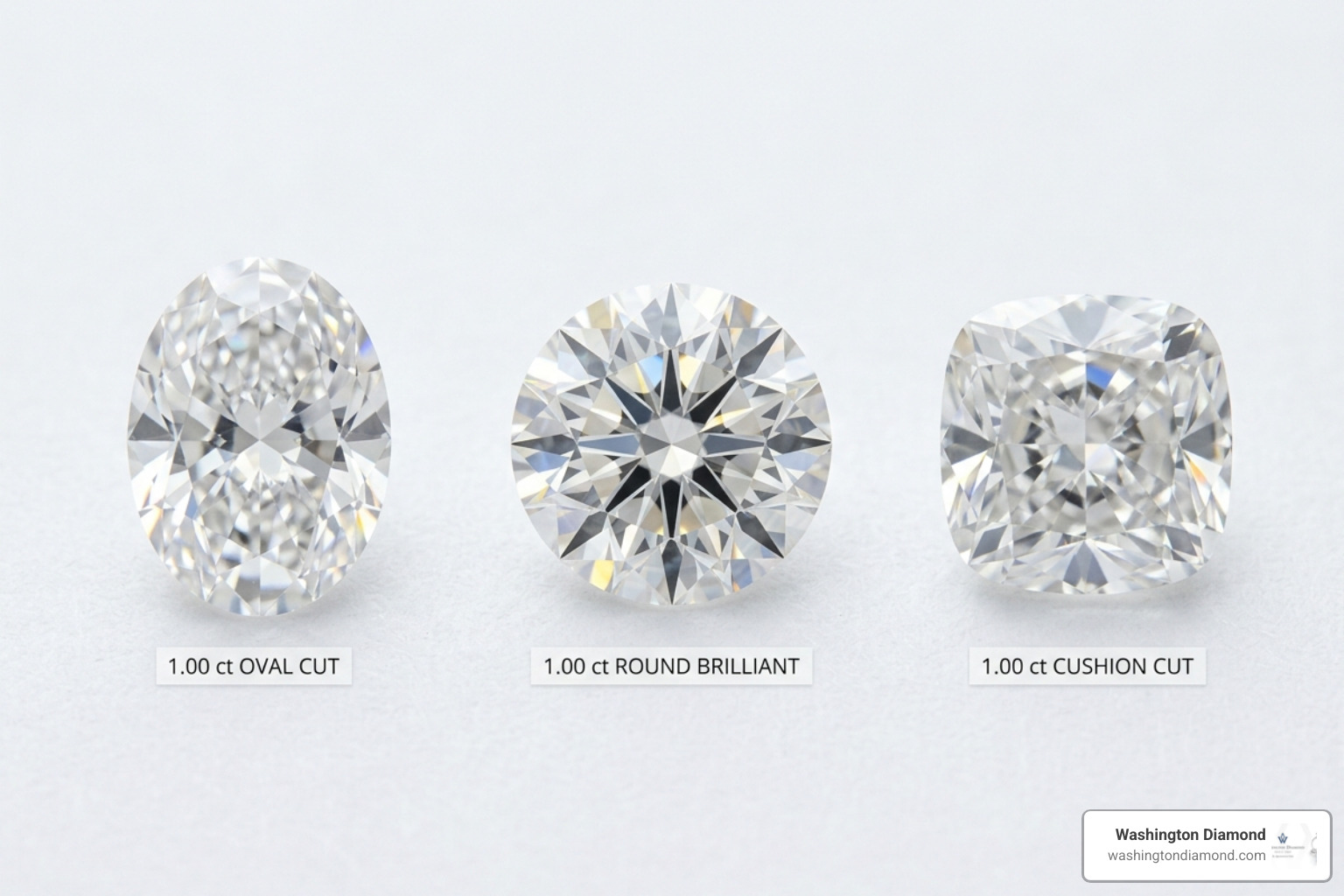
- Oval vs. Round: The oval has about 10% more surface area than a round diamond of the same weight. It offers a similar level of brilliance but with a unique, modern silhouette.
- Oval vs. Cushion: Cushion cuts are "deeper" stones, meaning more of their weight is hidden at the bottom. An oval will almost always look larger than a cushion of the same carat weight.
- Durability: Because ovals have soft, rounded edges, they are more durable than shapes with sharp corners (like princess or marquise). However, the slim ends are still somewhat vulnerable. We recommend protective settings like a six-prong or a halo to ensure long-term wear.
For more personality-based comparisons, visit The Perfect Diamond Shape For Every Personality or explore our Washington Diamond - Diamond Education portal.
Frequently Asked Questions about Oval Diamonds
Do oval diamonds look bigger than round diamonds?
Yes! Because of their elongated shape and the way they are cut, oval diamonds have a larger table (top surface) than round diamonds. A 1 carat oval loose diamond typically appears about 10-15% larger than a 1-carat round brilliant.
What is the best length-to-width ratio for an oval?
While 1.35 to 1.45 is considered the traditional "ideal," it really comes down to personal preference. If you have shorter fingers, a more elongated 1.50 ratio can help create a slimming effect. If you prefer a more classic look, stay closer to 1.30.
Are oval diamonds more expensive than other shapes?
Actually, they are usually 10% to 25% less expensive than round diamonds of the same quality. Round diamonds are the most expensive because they involve the most "rough" diamond waste during the cutting process. Ovals provide excellent value for money.
Conclusion
Choosing a 1 carat oval loose diamond is an exercise in balancing size, sparkle, and budget. Whether you are drawn to the timeless rarity of a natural stone or the incredible value of a lab-grown diamond, the oval shape remains a top-tier choice for its elegance and finger-slimming properties.
At Washington Diamond, we believe the process of buying a diamond should be as memorable as the occasion it celebrates. Our private, appointment-only studio in Northern Virginia offers you an undivided, personalized experience. We don't just show you diamonds; we educate you on how to spot the "best value" stones that don't always show up on a standard grading report.
From our lifetime upgrade programs to our rigorous authenticity verification, we are here to ensure your investment is protected. Ready to find your perfect stone? Explore our collection of Loose Diamonds or book your private consultation today.
Have a question about your jewelry?
We've been helping clients with diamonds, custom design, repairs, appraisals, and more since 1969. Book a private appointment at our Falls Church studio.
Book an AppointmentTrusted since 1969 · Falls Church, VA · 703-536-3600
From the blog
View all


