

The Ultimate Diamond Price Calculator: Get Instant Values for Your Gem
Why Diamond Prices Are So Hard to Figure Out (And How to Fix That)
How to calculate price of a diamond comes down to four core factors — cut, color, clarity, and carat weight — combined with a simple formula:
Total Price = Carat Weight × Price Per Carat
But your price per carat shifts based on quality grades. Here's a quick snapshot:
| Factor | What It Affects | Example Impact |
|---|---|---|
| Carat weight | Base price tier | 1.00ct costs ~20% more than 0.99ct |
| Cut grade | Brilliance and demand | Excellent cut commands top dollar |
| Color grade | Rarity (D = best) | D vs. H color = up to ~62% price difference |
| Clarity grade | Inclusions visible at 10x | VVS1 vs. VS2 can differ by ~30% |
| Shape | Market demand | Round brilliant commands highest prices |
| Certification | Trust and accuracy | GIA-certified stones trade at a premium |
So a well-cut 1-carat round brilliant diamond can range from around $2,000 to $14,000 — depending on where it lands across all these grades.
That range surprises most people. And it's exactly why so many buyers feel overwhelmed or worry they're overpaying.
Diamond pricing isn't random. It's a system — but it's not a simple one. Wholesale baselines, carat weight thresholds, fluorescence discounts, lab-grown alternatives — there are layers beneath the surface that most jewelers never explain clearly.
This guide breaks all of it down in plain language, so you can walk into any diamond purchase with confidence.
I'm Tom Daube, a GIA-certified diamond specialist with decades of experience helping buyers understand how to calculate price of a diamond — from wholesale benchmarks to real-world value. I've sorted and evaluated more diamonds than I can count, and I'm here to make sure you get the most for your money.
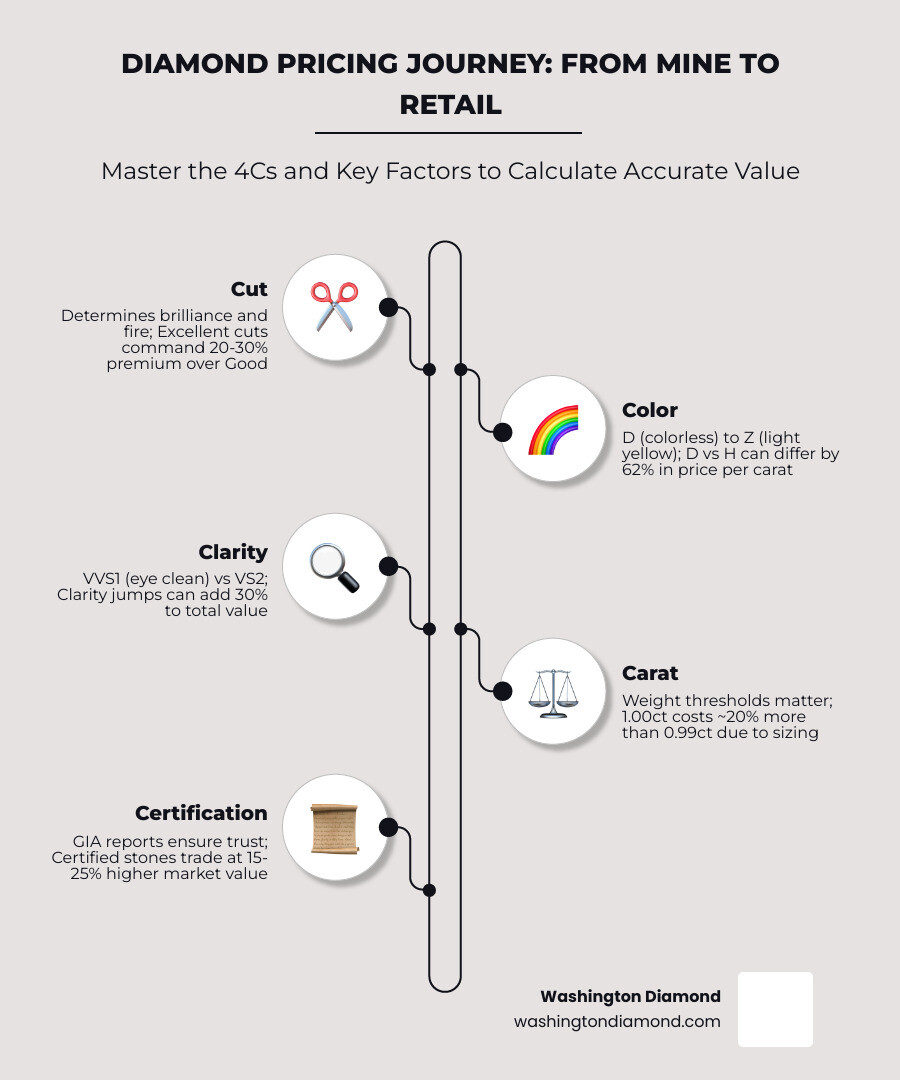
Simple guide to how to calculate price of a diamond:
Understanding the 4 Cs: The Foundation of Diamond Pricing
To master how to calculate price of a diamond, we must first look at the "Big Four." These are the global standards established by the Gemological Institute of America (GIA) to communicate diamond quality. Think of these as the ingredients in a recipe; change one, and the "flavor" (and price) of the diamond changes instantly.
- Cut: Often confused with shape, "cut" refers to how well a diamond's facets interact with light. A diamond with an "Excellent" cut grade will sparkle intensely, while a "Poor" cut will look dull.
- Color: Diamonds are graded on a scale from D (colorless) to Z (light yellow or brown). The closer to D, the rarer and more expensive the stone.
- Clarity: This measures the internal "inclusions" and external "blemishes." The scale ranges from Flawless (FL) to Included (I3).
- Carat Weight: This is the physical weight of the diamond. One carat equals 0.20 grams.
While these four are the stars of the show, a fifth "C" is arguably the most important: GIA certification. Without an independent grading report, the other four Cs are just the seller's opinion. At Washington Diamond, we always emphasize that a certified loose diamond is the only way to ensure you are getting exactly what you pay for.
How to calculate price of a diamond using the 4 Cs
When we look at a diamond, we aren't just looking at a rock; we are looking at rarity. The impact of the 4 Cs on price isn't equal across the board.
Cut quality actually has the biggest impact on a diamond's beauty and, consequently, its value. A diamond with perfect color but a poor cut will look "leaky" and dark, making it worth significantly less than a well-cut stone with slightly more color.
Rarity drives the price of color and clarity. For example, a 1-carat D-color Flawless diamond is exponentially rarer than an H-color VS2 diamond. While they might look similar to the naked eye, the D Flawless stone can cost over 60% more simply because there are so few of them in nature. Understanding how to calculate price of a diamond means recognizing that you are paying for a combination of visual beauty (cut) and geological rarity (color/clarity).
The Math Behind the Sparkle: How to Calculate Price of a Diamond Per Carat
The most important thing to understand about diamond math is that prices are quoted "per carat," but they don't stay the same as the diamond gets bigger. If a 1-carat diamond is $5,000, a 2-carat diamond of the same quality isn't $10,000—it might be $18,000 or more.
Why? Because larger diamonds are much harder to find in nature. This is called "exponential pricing."
| Weight | Quality Grade | Est. Price Per Carat | Total Price |
|---|---|---|---|
| 0.50 ct | G / VS2 | $3,200 | $1,600 |
| 1.00 ct | G / VS2 | $6,000 | $6,000 |
| 1.50 ct | G / VS2 | $8,500 | $12,750 |
| 2.00 ct | G / VS2 | $11,000 | $22,000 |
To use the price per carat formula, you simply take the price per carat listed on a wholesale chart and multiply it by the actual weight. For example, if a 1.20-carat diamond is priced at $5,000 per carat, the total is $6,000.
Why weight thresholds matter in your diamond price calculation
There is a psychological phenomenon in the diamond world called "under-sizes." Diamond prices jump significantly at "round" numbers like 0.50ct, 0.70ct, 0.90ct, and especially 1.00ct.
A 1.00-carat diamond can cost 10% to 20% more than a 0.99-carat diamond of the exact same quality. Why? Because people love the "status" of a full carat. Savvy buyers can save thousands by looking for a 0.90ct or 0.95ct stone. It will look virtually identical to a 1-carat stone but will fall into a lower price-per-carat category. This is one of the best secrets in how to calculate price of a diamond effectively.
Advanced Factors: Rapaport, Fluorescence, and Lab-Grown Trends
If you want to know how the pros do it, you have to know about the Rapaport Price List. Created in 1978, this is the "Blue Book" of the diamond industry. It provides a baseline wholesale price for diamonds based on their size, color, and clarity. Most diamonds in the retail market trade at a "discount to Rap"—meaning a jeweler might buy a stone at "20% back" (20% below the Rapaport price).
However, Rapaport doesn't tell the whole story. Other factors can swing the price:
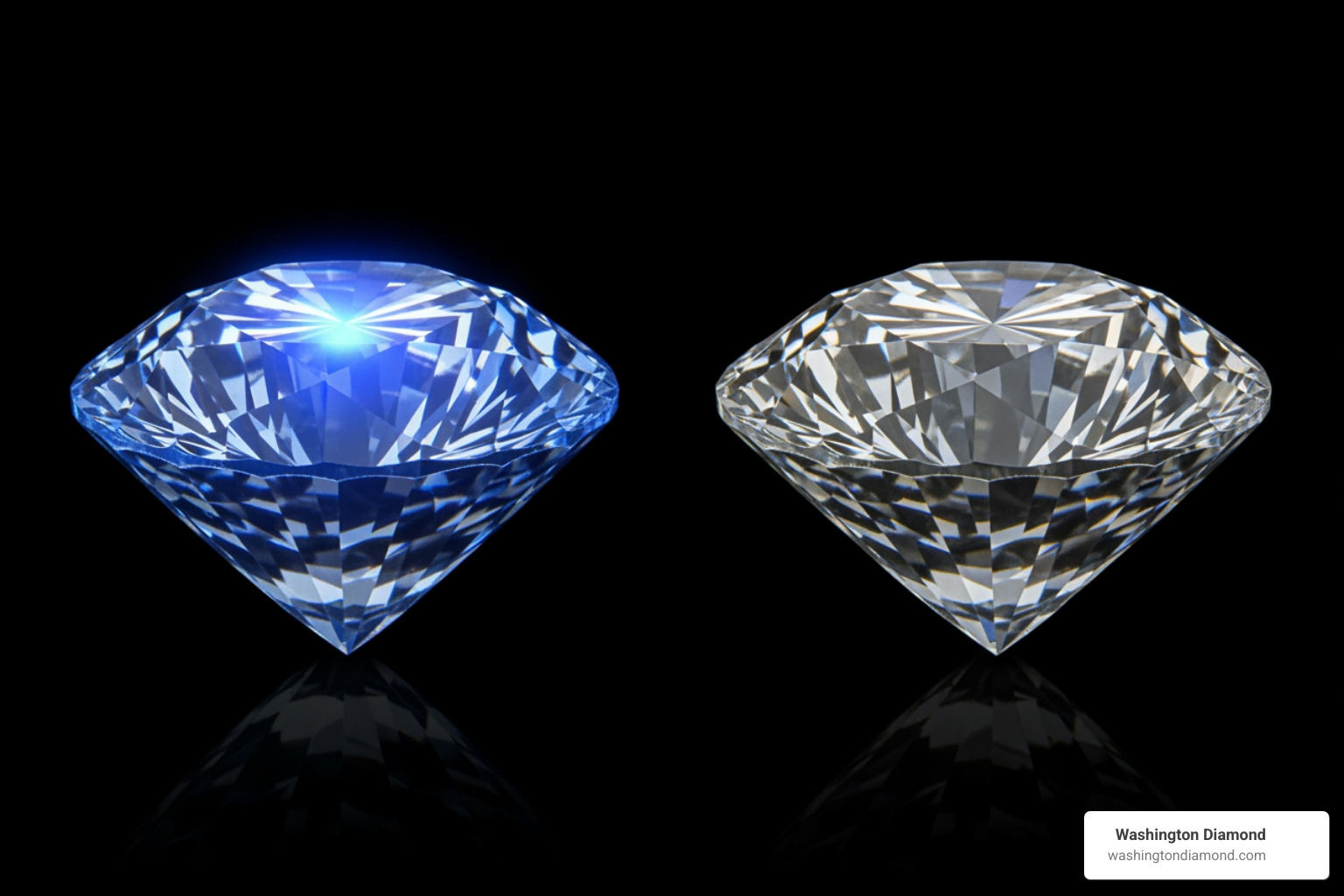
- Fluorescence: This is a diamond's tendency to emit a soft blue glow when exposed to UV light. In high-color diamonds (D-F), "Strong Blue" fluorescence can actually decrease the price by 15-25% because it can make the stone look oily or milky. In lower-color diamonds (J-M), it can actually increase value by making the stone look whiter!
- Lab-Grown Diamonds: These are chemically and physically identical to natural diamonds but are created in a lab. Today, lab-grown diamonds are priced 20% to 50% lower than natural ones. For many couples in Northern Virginia, this allows them to get a much larger stone for the same budget. You can see the difference in our guide to lab-grown pricing.
Using a professional tool to calculate price of a diamond
While manual calculations are great for understanding the logic, the market moves fast. Using a professional diamond value calculator is the best way to get real-time data. These tools aggregate thousands of listings to give you an average market price.
That "fancy shapes" (like Oval, Pear, or Princess) are typically 10-30% cheaper than Round Brilliant diamonds because they produce less waste when being cut from the rough stone. A round diamond requires cutting away more of the original crystal to achieve that perfect sparkle, which is why it commands a premium.
Retail vs. Resale: What is Your Diamond Really Worth?
One of the hardest truths in the jewelry world is the difference between retail price and resale value. When you buy a diamond at a retail store, you are paying for the diamond, the jeweler’s expertise, the store’s overhead, and a marketing markup.
As soon as you walk out the door, the diamond "depreciates," much like a new car. Unless you are buying a world-class, museum-quality fancy colored diamond (like a rare pink or blue), diamonds are generally not "investments" that appreciate in value. It's vital to calculate the value of a diamond with realistic expectations before you buy or sell.
Maximizing value in the secondary market
If you are looking to sell, you can typically expect to receive 20% to 50% of the original retail price. Why the gap? Because a jeweler can buy a brand-new diamond at wholesale prices anytime they want. To buy a "pre-owned" stone from a consumer, they need a significant incentive.
To get the most for your stone:
- Have a GIA report: This proves the quality without a doubt.
- Know the difference between an appraisal and market value: An appraisal is for insurance purposes and is often "inflated" to cover replacement costs. It is not what you can sell it for.
- Use online tools: You can calculate your ring's value online to get a ballpark figure before visiting a buyer in person.
Frequently Asked Questions about Diamond Valuation
Why is a 1-carat diamond so much more expensive than a 0.90-carat?
As mentioned, 1.00ct is a major "milestone." Cutters will often sacrifice the quality of the cut (making it too deep or too shallow) just to keep the weight at 1.00ct because they know they can charge a 20% premium for that number. A 0.90ct stone is often cut better and offers much better value.
Does fluorescence always decrease a diamond's value?
Not at all! In diamonds with a slight yellow tint (I, J, or K color), blue fluorescence can cancel out the yellow and make the diamond look more colorless. In these cases, it can actually be a "feature" rather than a "flaw."
How much of the retail price can I get back when selling?
Usually between 20% and 50%. The higher the quality and the more "standard" the stone (like a 1ct G/VS2 Round), the easier it is to sell and the higher the percentage you'll likely recover.
Conclusion
At Washington Diamond, we believe that how to calculate price of a diamond shouldn't be a mystery. Our private, appointment-only studio in Northern Virginia was designed specifically to move away from the high-pressure retail environment. We want to give you the undivided attention and expert data you need to make a smart choice.
Whether you are looking to buy the perfect engagement ring or simply want to calculate the value of a diamond before you buy or sell, our team is here to provide a personalized, transparent experience. Diamond pricing is a science, but finding the right diamond for your budget is an art. Let us help you master both.
Have a question about your jewelry?
We've been helping clients with diamonds, custom design, repairs, appraisals, and more since 1969. Book a private appointment at our Falls Church studio.
Book an AppointmentTrusted since 1969 · Falls Church, VA · 703-536-3600
From the blog
View all


