

Unlock the Sparkle: How to Figure Out Your Diamond's Worth
Why Understanding Diamond Pricing Matters for Your Perfect Purchase
How to calculate diamond price per carat is simpler than most people think, but it's often shrouded in mystery by the jewelry industry. Here's the quick answer:
Basic Formula:
- Find the total diamond price (what you'd pay for the entire stone)
- Divide by the carat weight (Total Price ÷ Carat Weight = Price Per Carat)
- Example: A $8,000 diamond weighing 2.0 carats = $4,000 per carat
What Determines That Price:
- Carat - Weight of the diamond (larger = exponentially more expensive)
- Cut - Quality of proportions and sparkle (biggest impact on beauty)
- Color - How colorless it is (D is best, increases with each grade)
- Clarity - Number of inclusions or flaws (fewer = higher price)
Take this scenario: You're comparing two diamonds online. One costs $10,300 for 2 carats. Another costs $16,350, also 2 carats. Same size, wildly different prices. Why?
The answer lies in understanding that price per carat is just the starting point. The real value comes from knowing how each quality factor—from cut grade to clarity to certification—affects that final number.
While most people focus on the total price tag, understanding the price per carat gives you the power to compare diamonds fairly and spot genuine value.
The diamond industry uses the "4Cs"—Carat, Cut, Color, and Clarity—as the universal language of quality. These aren't just marketing terms. They're the actual factors that determine what you'll pay, whether you're shopping at a local jeweler or browsing online.
In this guide, we'll break down how diamond pricing works, explain the calculations dealers use, and give you the knowledge to make a confident choice.
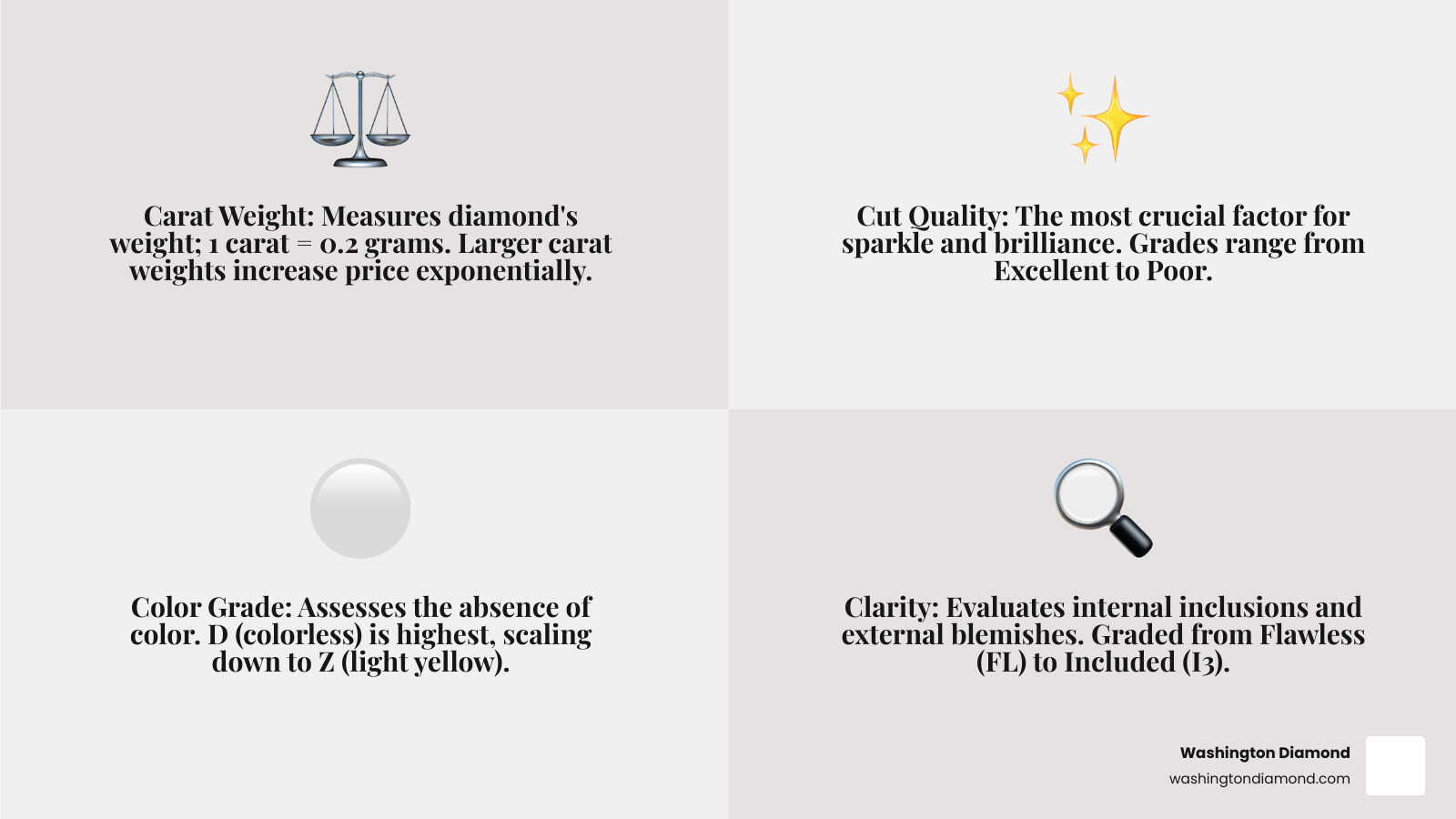
The Building Blocks of Diamond Value: Understanding the 4Cs
At Washington Diamond, we believe an informed buyer is a confident buyer. A diamond's price is primarily determined by the 4Cs: Carat, Cut, Color, and Clarity. Standardized by the Gemological Institute of America (GIA), these factors create a global language for evaluating diamonds. While other elements play a role, mastering the 4Cs is the first step. For more insights, see our guide on Beyond the 4Cs: How to Choose Your Perfect Certified Loose Diamond.
Carat Weight: More Than Just Size
When we talk about a diamond's "carat" weight, we're referring to its mass, not its physical size. One carat is precisely defined as 0.2 grams. While a heavier diamond generally appears larger, its exact dimensions can vary depending on its cut and shape. For instance, a 1-carat round brilliant diamond typically measures around 6.5 mm in diameter.
The relationship between carat weight and price is exponential, not linear. As a diamond's weight increases, its price per carat also increases. This is because larger diamonds are significantly rarer; finding one 2-carat diamond is much harder than finding two 1-carat diamonds of similar quality, driving up the price.
This leads to "price jumps" at "magic sizes" like the full and half-carat marks (0.50 ct, 1.00 ct, etc.). Due to high demand for these weights, a 1.00-carat diamond can cost up to 20% more than a 0.99-carat diamond of the same quality. Crossing that threshold places it in a higher pricing category, or grid, causing a significant jump in value.
For example, a 1-carat diamond might cost $5,000 per carat, while a similar 2-carat diamond could cost $10,000 per carat or more. This means the 2-carat stone's total price is more than double the 1-carat's. A 1-carat diamond can range from $1,300 to $16,500, while a 2-carat diamond can range from $6,500 to $55,000, showing how the per-carat price escalates.
For those considering larger diamonds, our guide on Decoding the Dollar: Your Guide to 2 Carat Diamond Pricing provides even more detailed insights.
Cut Quality: The Source of Sparkle
While carat weight gets attention, a diamond's cut quality is arguably the most important C, as it directly impacts beauty and brilliance. Cut refers to how well a diamond's facets interact with light. An expert cut maximizes sparkle, while a poor cut will appear dull and lifeless, regardless of color or clarity.
The GIA assesses cut quality in round brilliant diamonds based on proportions, symmetry, and polish, graded from Excellent to Poor. An Excellent cut reflects nearly all light, creating breathtaking sparkle. A Poor cut allows light to "leak" out, diminishing its brilliance.
We always advise prioritizing an excellent cut. It can make a diamond with a slightly lower color or clarity grade appear more vibrant and beautiful than a higher-grade diamond with an inferior cut. This is a fantastic way to find exceptional value, as investing in cut quality yields the greatest visual impact for your budget.
Color: The Absence of Hue
A diamond's color refers to its lack of color. The GIA color grading scale ranges from D (completely colorless) to Z (light yellow or brown). The less color a diamond has, the higher its grade and value. Colorless diamonds (D, E, F) are the rarest and command the highest prices.
However, the human eye often struggles to distinguish subtle color differences once a diamond is mounted. Near-colorless diamonds (G, H, I, J) offer excellent value, as they appear colorless to the naked eye, especially in white gold or platinum. For yellow or rose gold settings, even diamonds in the K-M range can appear beautifully white.
The impact of color on price can be significant. For example, the difference between a 1-carat G color and H color diamond can be as much as $1,000. While D color is technically the best, the premium for each step up is often better allocated to an exceptional cut.
For more detailed information on diamond color, we recommend reviewing this resource from GIA.
Clarity: A Diamond's Unique Fingerprint
Clarity refers to the absence of inclusions (internal) and blemishes (external). These natural "birthmarks" make each diamond unique. The GIA clarity scale ranges from Flawless (FL) to Included (I3), assessed under 10x magnification:
- FL (Flawless): No inclusions or blemishes visible under 10x magnification. Extremely rare.
- IF (Internally Flawless): No inclusions visible under 10x magnification. Very rare.
- VVS1 & VVS2 (Very, Very Slightly Included): Inclusions are extremely difficult to see under 10x magnification.
- VS1 & VS2 (Very Slightly Included): Inclusions are difficult to see under 10x magnification.
- SI1 & SI2 (Slightly Included): Inclusions are noticeable under 10x magnification but may be eye-clean (invisible to the naked eye).
- I1, I2, I3 (Included): Inclusions are obvious under 10x magnification and typically visible to the naked eye.
For most buyers, the sweet spot for value lies in the VS and SI grades. Many VS2 and SI1 diamonds are "eye-clean," offering a beautiful appearance without the price premium of FL or IF grades. This highlights the importance of visual inspection, as the quality within the SI1 grade can vary, affecting price.
How to Calculate Diamond Price Per Carat: The Core Formula
Now that we've covered the 4Cs, let's focus on how to calculate diamond price per carat. This metric is crucial for comparing diamonds of different sizes and qualities on an equal footing, revealing the underlying value beyond the total price.
The Basic Calculation: Price Per Carat vs. Total Price
The formula for calculating price per carat is straightforward:
Total Diamond Price ÷ Carat Weight = Price Per Carat
For example, if a diamond is priced at $8,000 and weighs 2.0 carats, its price per carat is $4,000. If another diamond of similar quality is 1.5 carats and costs $6,000, its price per carat is also $4,000. This simple calculation helps us standardize comparisons.
Real-world pricing is more nuanced. The industry often uses wholesale price lists, like the Rapaport Diamond Report, which provides baseline per-carat prices for specific color, clarity, and carat-weight categories. Retailers then apply discounts or premiums based on factors like cut quality, fluorescence, and market demand. Understanding how a final price is determined requires looking beyond the basic calculation.
Why the Price Per Carat Isn't Linear
As mentioned, the price per carat for diamonds is not linear. A 2-carat diamond costs significantly more than double a 1-carat diamond of the same quality because its price per carat is higher.
This non-linear pricing is primarily due to:
- Rarity Factor: As discussed, larger diamonds are exponentially rarer. This scarcity drives up their intrinsic value and, consequently, their price per carat.
- Weight Categories (Grids): The diamond industry categorizes diamonds into specific weight "grids" (e.g., 0.90-0.99 ct, 1.00-1.49 ct). Crossing into a higher weight category automatically increases the price per carat for every diamond within that category. This is why a 1.00-carat diamond has a much higher price per carat than a 0.99-carat diamond.
- Market Demand: There's a strong psychological demand for diamonds at "magic sizes" like 1.00, 1.50, and 2.00 carats. This demand further inflates the price per carat at these specific thresholds.
For example, a 1-carat diamond's price per carat might range from $2,000 to $14,000, while a 2-carat diamond's could range from $4,200 to $29,000. The per-carat values are significantly higher for the larger stone, demonstrating this fundamental aspect of diamond pricing.
How to estimate the price per carat for your diamond
Estimating the price per carat for your specific diamond requires research and careful comparison. Here's our approach:
- Use Online Calculators: Several reputable online tools, like the one in our guide The Diamond Value Calculator: Your Secret Weapon for Smart Buying, allow you to input a diamond's 4Cs and generate a price estimate. These tools use databases of current prices to provide a "fair price estimate" and a price range.
- Compare Similar Stones: The most effective way to gauge a diamond's price per carat is to compare it to other diamonds with identical or very similar characteristics. Look for diamonds with the same carat weight, cut, color, clarity, shape, and grading laboratory (e.g., GIA).
- Understand Price Ranges: Diamond prices are not fixed. A 1-carat diamond can range from $1,300 to $16,500, and a 2-carat diamond from $6,500 to $55,000. Your goal is to understand where your diamond sits within these ranges based on its specific quality. A diamond that seems significantly underpriced is often a red flag, while an overpriced one suggests you can find better value elsewhere.
By combining these methods, you can gain a realistic understanding of your diamond's price per carat and its overall market value.
Beyond the Basics: Other Factors Influencing Diamond Worth
While the 4Cs are the primary drivers of value, several other characteristics can influence a diamond's price per carat. These secondary factors can cumulatively affect a diamond's brilliance, desirability, and ultimately, its market worth. For a broader selection, explore our Loose Diamonds collection.
Diamond Shape
The shape of a diamond refers to its outline (e.g., round, princess, oval). While personal preference is key, the chosen shape significantly impacts the price per carat.
- Round Brilliant: The round brilliant is the most popular and, consequently, the most expensive shape per carat. This is due to its exceptional brilliance and high demand. It also involves more rough diamond waste during cutting.
- Fancy Shapes: All other shapes are "fancy shapes" (Princess, Oval, Cushion, etc.). Generally, fancy shapes offer more carat weight for your money. For example, a 1-carat princess or cushion cut can be significantly less expensive than a 1-carat round brilliant of similar quality. This is partly because cutting fancy shapes often results in less waste from the original rough diamond.
Choosing a fancy shape can be a smart way to maximize carat weight and unique aesthetics for your budget. Our guide on The Perfect Diamond Shape for Every Personality can help you explore your options.
Certification and Grading Labs
A comprehensive grading report from a reputable laboratory is your diamond's scientific fingerprint. Without one, you're relying solely on a seller's word—a risky proposition.
At Washington Diamond, we strongly recommend diamonds certified by the GIA (Gemological Institute of America). The GIA is the industry standard for its stringent, consistent, and unbiased grading. A GIA certificate provides peace of mind that the diamond's stated qualities are accurate.
Other labs like IGI and EGL exist, but their grading standards can be less consistent than GIA's. A diamond graded by another lab might receive a higher grade than it would from the GIA, creating a perceived "bargain" that is actually overpriced for its true quality. For this reason, GIA-certified diamonds command a premium, and we consider a GIA certificate essential for any diamond over $1,000. You can learn more about what a GIA report entails directly from the GIA.
Fluorescence, Polish, and Symmetry
These three factors can also influence a diamond's price and appearance:
- Fluorescence: This is a diamond's glow (usually blue) under UV light. Strong or very strong fluorescence can negatively impact the value of high-color diamonds (D-H grades), sometimes making them appear milky or hazy and devaluing them by 15-25%. In lower color grades (I-Z), fluorescence is less of an issue and can sometimes make a faint yellow tint appear whiter.
- Polish: This refers to the smoothness of the diamond's surface. An excellent polish ensures light can enter and exit cleanly, contributing to brilliance.
- Symmetry: This refers to the precise alignment of the diamond's facets. Excellent symmetry ensures light is reflected evenly, maximizing sparkle.
Both polish and symmetry are components of the overall cut grade. Diamonds with "Excellent" or "Very Good" ratings for polish and symmetry command higher prices than those with lower ratings.
Natural vs. Lab-Grown Diamonds
The rise of lab-grown diamonds is a significant development. They are chemically, physically, and optically identical to natural diamonds but are created in a laboratory. The biggest difference is their price per carat.
- Price Difference: Lab-grown diamonds are significantly cheaper than natural diamonds, often priced 20% to 50% lower or more. This is because they can be produced repeatedly and are less rare.
- Value Retention: This is where the two types diverge significantly. Natural diamonds, due to their rarity, typically retain significant value and have historically shown the capacity to appreciate. Lab-grown diamonds, on the other hand, hold little to no resale potential. As production becomes more efficient, their prices are expected to continue to decrease, making them an unlikely long-term investment.
For those prioritizing budget or a smaller environmental footprint, lab-grown diamonds are a compelling choice. However, for those concerned with long-term value and heirloom potential, natural diamonds remain the preferred option. Our guide on Lab-Grown Diamond Engagement Rings: Ethical Elegance for Your Big Day offers a deeper look into this market.
Frequently Asked Questions about Diamond Pricing
We often hear similar questions from our clients in Northern Virginia when they're trying to understand diamond pricing. Here are some of the most common ones we address:
Why do diamond prices jump so much at the 1-carat mark?
The significant price jump at the 1-carat mark (and other "magic sizes" like 0.50 ct) is due to psychological demand and the industry's pricing grids. Consumers strongly desire a "full carat," so diamonds at or above this threshold are placed in a higher price-per-carat category. A 0.99-carat diamond is in a lower pricing grid than a 1.00-carat stone, even if they look identical. Crossing that 1.00-carat mark can increase the total price by up to 20%, as the stone enters a new, more desirable weight category.
What's a good price for a 1-carat diamond?
A "good" price for a 1-carat diamond varies widely—from $1,300 to over $16,500—depending on its quality. For a great value (a beautiful, eye-clean, and brilliant 1-carat round diamond), a typical budget is the $4,500 - $6,000 range. This price point often allows for:
- Excellent Cut: Crucial for maximizing sparkle.
- G-J Color: Appears colorless to the naked eye, especially when set.
- VS2 or SI1 Clarity: Eye-clean, meaning inclusions are not visible without magnification.
By prioritizing an excellent cut, you can find fantastic value by compromising slightly on color (like an I or J) or clarity (a well-chosen, eye-clean SI1), as the final price depends on the unique combination of all factors.
Is cut really more important than color or clarity?
From our experience, and the consensus among many diamond experts, yes, the cut is often considered the most important of the 4Cs for maximizing a diamond's visual beauty and sparkle.
Here's why we believe this:
- Direct Impact on Brilliance: The cut directly dictates how a diamond interacts with light. An excellent cut will make any diamond, even one with slightly lower color or clarity grades, appear more brilliant, fiery, and lively. A poor cut, conversely, will make even a perfect D Flawless diamond look dull.
- Visible Difference: The difference between an excellent cut and a good or fair cut is often immediately apparent to the naked eye. The differences between adjacent color grades (e.g., G vs. H) or clarity grades (e.g., VS1 vs. VS2) are much harder to spot without magnification.
- Value Optimization: By prioritizing an excellent cut, you can often select a diamond with a slightly lower color (e.g., a G or H) or clarity (e.g., an eye-clean VS2 or SI1) that still looks stunningly brilliant, allowing you to allocate more of your budget to other factors.
While color and clarity certainly impact price, an exceptional cut is what truly brings a diamond to life.
Find Your Diamond's True Value
Understanding how to calculate diamond price per carat is a powerful tool. We've explored how the 4Cs, along with factors like shape and certification, contribute to a diamond's final price. We've also seen that price per carat isn't linear and that natural and lab-grown diamonds offer distinct value propositions.
At Washington Diamond, we believe that education empowers you to make the best decision. Our goal is not just to sell you a diamond, but to help you understand its true worth and find a piece that perfectly symbolizes your meaningful moments.
Navigating diamonds can feel complex, but you don't have to do it alone. We offer a private, appointment-only studio experience right here in Northern Virginia, ensuring you receive our undivided attention. We'll guide you through our curated selection, explain every detail, and help you find the perfect diamond that matches both your vision and your budget.
Ready to start on this exciting journey? Let us help you Calculate the Value of a Diamond Before You Buy or Sell and find the diamond that truly sparkles for you. We look forward to creating a memorable, personalized experience.
Have a question about your jewelry?
We've been helping clients with diamonds, custom design, repairs, appraisals, and more since 1969. Book a private appointment at our Falls Church studio.
Book an AppointmentTrusted since 1969 · Falls Church, VA · 703-536-3600
From the blog
View all


