

The Ultimate Guide to Compare Engagement Ring Styles
Compare Engagement Ring Styles With Your Real Life in Mind

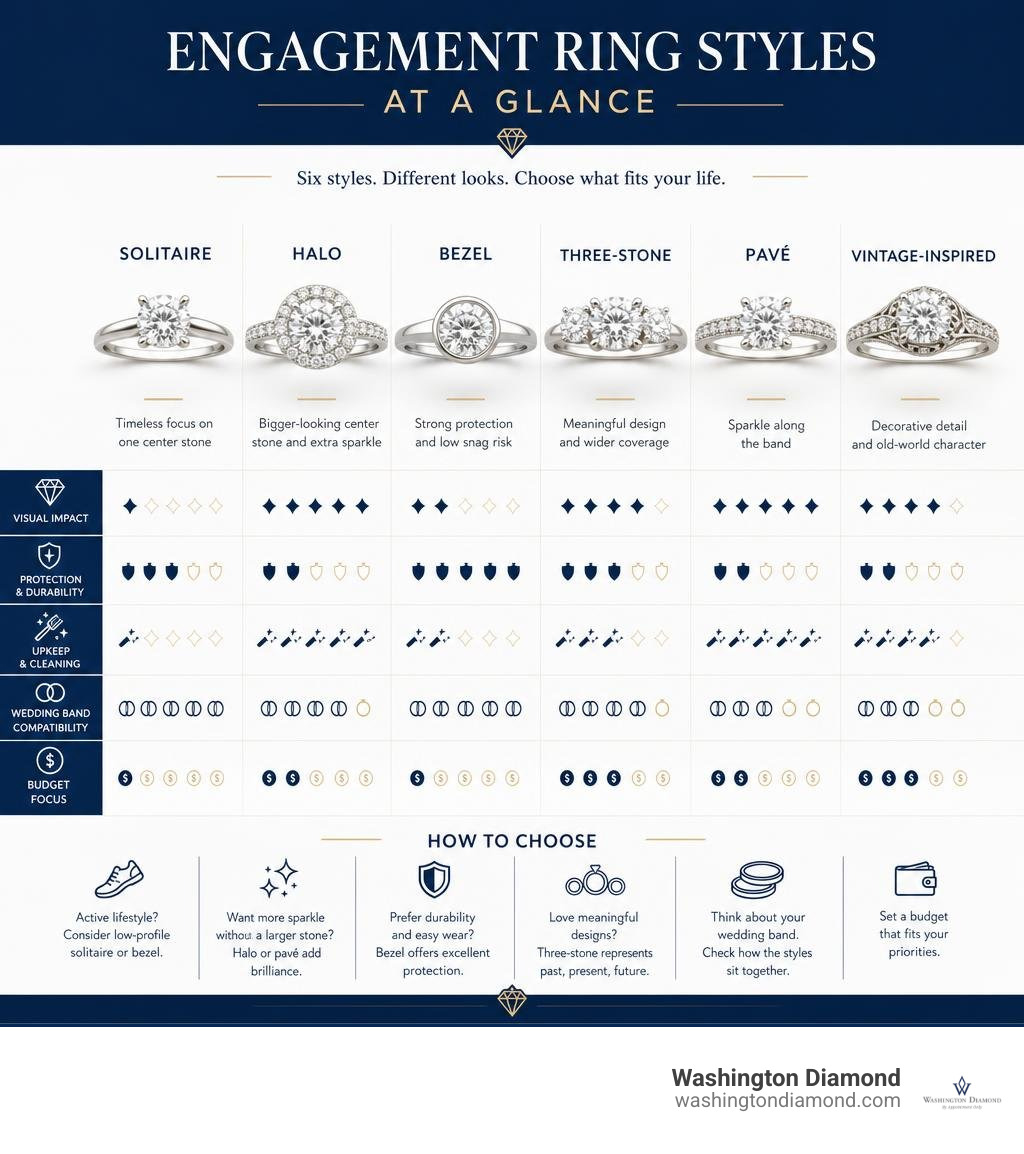
Engagement ring styles range from clean, classic solitaires to bright halos, protective bezels, symbolic three-stone designs, detailed pavé bands, and vintage-inspired settings. The right choice depends less on what looks best in a photo and more on the balance you want between visual size, sparkle, comfort, upkeep, budget, and wedding-band fit.
| Style | Best known for | Practical tradeoff |
|---|---|---|
| Solitaire | Timeless focus on one center stone | Usually simple to clean and pair |
| Halo | Bigger-looking center stone and extra sparkle | More small stones to inspect and clean |
| Bezel | Strong protection and low snag risk | Metal can cover more of the diamond edge |
| Three-stone | Meaningful design and wider finger coverage | Costs are shared across multiple stones |
| Pavé | Sparkle along the band | Needs regular checks for tiny accent stones |
| Vintage-inspired | Decorative detail and old-world character | Often has more texture and cleaning points |
A ring should work on your hand, in your routine, and beside the wedding band you hope to wear. A low-profile bezel or solitaire can suit active daily wear, while a halo or pavé design can create more visual presence without requiring a larger center diamond. Even a “simple” solitaire can look very different depending on its prongs, basket, band width, and side profile.
I’m Tom Daube, a jewelry designer with experience in GIA-certified diamonds, custom jewelry, diamond recutting, and classic designs; I help clients compare engagement ring styles with a clear view of beauty, value, and long-term wear. The sections ahead break down the choices so you can narrow your options with confidence.
Essential Framework to Compare Engagement Ring Styles
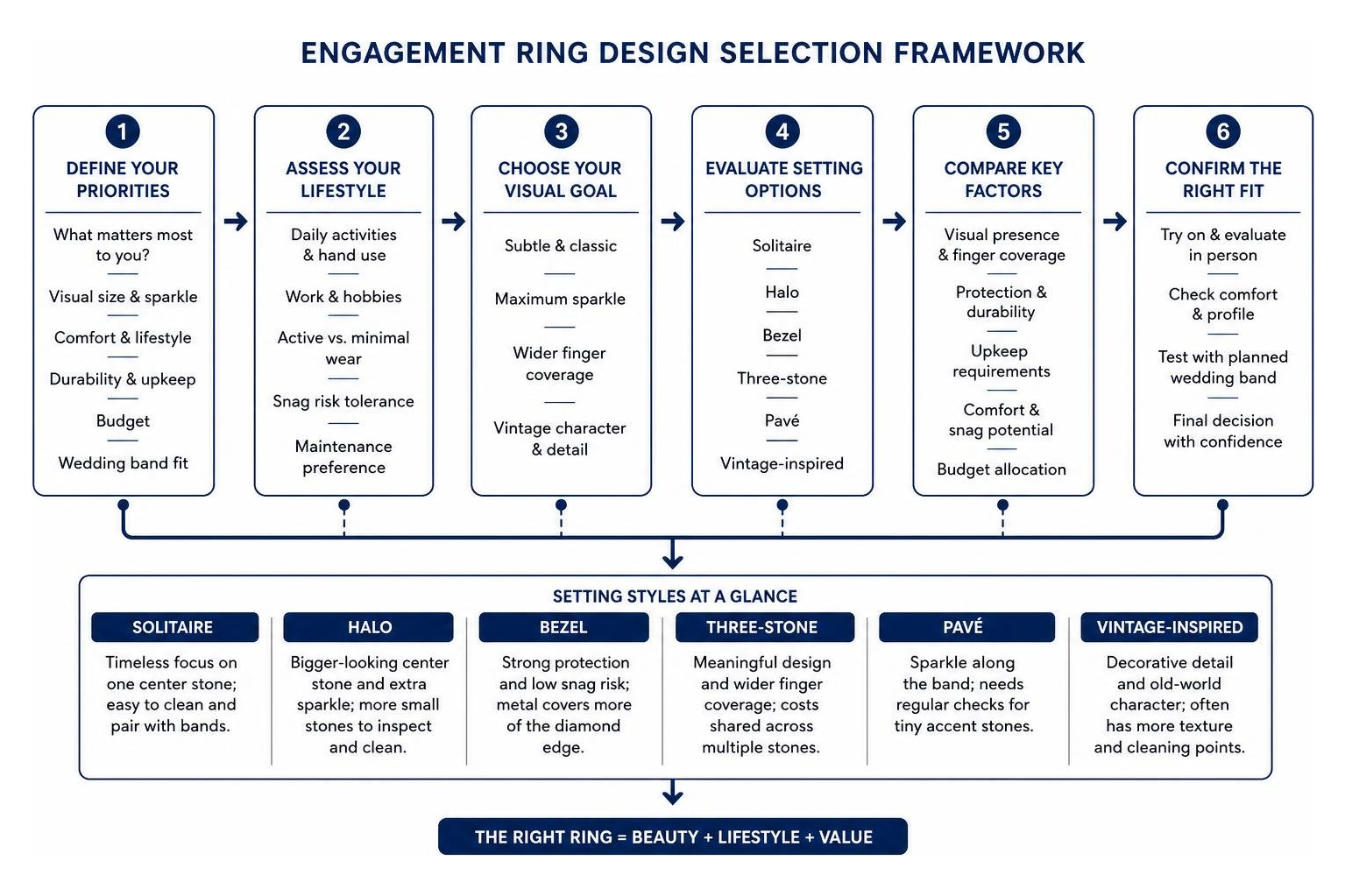
When we sit down with clients in our Northern Virginia showroom, we quickly learn that finding the ideal setting isn't just about pick-and-choose aesthetics. It’s about building a framework that matches how you live, what you value visually, and how you want to allocate your funds.
Choosing among engagement ring styles is a three-way negotiation between physical dimensions, visual impact, and setting complexity.
Visual Presence and Finger Coverage
Finger coverage refers to how much horizontal metal and gemstone spread spans across the width of your finger. A center stone does not act alone in establishing visual scale; the setting framework surrounding it plays a major structural and optical role.
For example, a 1.00-carat round brilliant diamond measures roughly 6.5mm across. Set as a simple solitaire on a thin 1.5mm band, the central stone stands out dramatically as a single focal point, but leaves substantial open space across the top of the finger. If that exact same 1.00-carat gem is set inside a halo ring, the outer boundary can expand to 8.5mm or 9.0mm, dramatically changing how large the stone appears from above.
Likewise, side-stone settings like a three-stone ring expand horizontal coverage across the finger without increasing the height or profile of the center stone. When you evaluate options, elongate shapes like ovals or emerald cuts naturally offer more finger coverage length-wise, while halos and multi-stone settings build lateral span. If you feel overwhelmed by optical dimensions, using a structured Engagement Ring Comparison Help guide helps contextualize how width, length, and depth work together.
Budget Balancing: Center Stone vs Setting Cost
In the United States, the average engagement ring purchase sits around $5,500. A critical choice every buyer faces is how to divide that total budget between the center diamond and the precious metal mounting.
- Solitaire Settings: Because a solitaire requires minimal accent gem setting labor, mounting costs often stay lower (typically $600 to $1,500 depending on metal choice and design complexity). This leaves up to 85% of your total budget dedicated solely to securing a higher carat weight, cut, or clarity for your primary diamond.
- Halo and Multi-Stone Settings: Elaborate settings with intricate diamond side stones or pavé work require meticulous hand-setting under microscope magnification. Settings can range from $1,500 to $3,500+, which redistributes funds away from the center gem size.
- Bezel Settings: While metal-heavy, bezels require precise craftsmanship to fit the diamond perimeter tightly without gaps, balancing mid-tier pricing with superior structural durability.
If maximizing center stone scale is your ultimate goal, exploring strategies in our Engagement Ring Prices Guide 2026 or applying Affordable Bling Top Tips for Best Value Engagement Rings can help you decide whether to put your hard-earned dollars into side-stone sparkle or maximum center stone size.
Detailed Breakdown of Popular Setting Styles
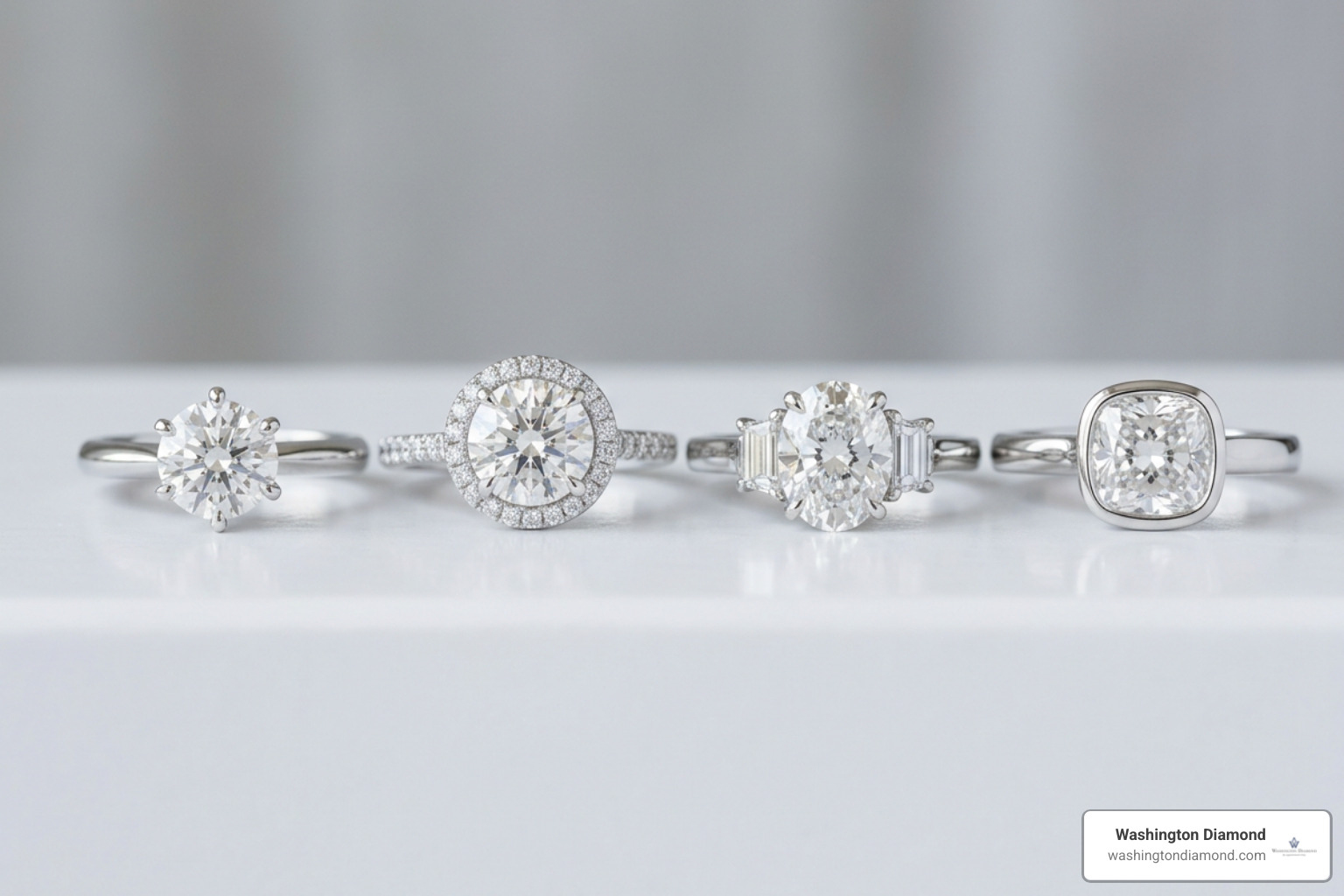
Every setting style has a distinct structural anatomy. Understanding these differences allows you to choose a setting that harmonizes with your personal taste and daily habits. For broader background, you can explore our comprehensive breakdown on Engagement Ring Settings 101 or review third-party resources like the Engagement Ring Styles Guide: Solitaire vs Halo.
Solitaire and Bezel Settings for Low Maintenance
Solitaire Settings The classic solitaire remains the king of modern engagement rings, accounting for approximately 25% of all engagement ring sales. Its defining characteristic is simplicity: a single diamond elevated on a sleek metal band, anchored by prongs (usually four or six).
- Pros: Timeless elegance, effortless light performance from all angles, easy to clean, maximum budget allocation toward the center diamond.
- Cons: Exposes the outer diamond edge (girdle) to direct impacts if set high; offers no accent gem sparkle.
If you lean toward pure minimalism, reviewing our guide on the classic Solitaire Diamond Ring will show you how subtle tweaks—like knife-edge bands or hidden gallery wires—add distinct style to minimalist designs.
Bezel Settings Preferred by 10% of engagement ring buyers, the bezel setting encases the diamond’s perimeter in a custom-fitted collar of gold or platinum. It can be a full bezel (completely surrounding the stone) or a partial/half bezel (leaving open sides for extra light entry).
- Pros: Ultimate edge protection, smooth zero-snag profile, ideal for active lifestyles, modern clean aesthetic.
- Cons: Completely covers outer edge facets, slightly reducing side-profile light entry; skilled labor required makes custom metal fitting essential.
Bezel mountings are seeing a major resurgence among modern buyers who crave effortless wear. You can see how this structural design operates in modern pairings by reading The Modern Twist A Look at Bezel and Oval Toi et Moi Rings.
Halo, Pavé, and Three-Stone Settings for Maximum Sparkle
Halo Settings Halo settings feature a border of small round accent diamonds surrounding the center stone. Over the past five years, halos have experienced a 20% growth in popularity, earning their spot as the second most requested style among couples.
- Pros: Extends visual diameter significantly (a 1.00-carat center stone can easily look like a 1.50-carat to 2.00-carat stone), adds immense top-down sparkle.
- Cons: Higher maintenance due to numerous micro-prongs; requires more detailed cleaning to keep skin oils out of the gallery behind the stones.
To unpack variations like seamless single halos, geometric vintage frames, or double halos, read our dedicated Halo Engagement Rings Guide 2026.
Pavé Settings Pavé (pronounced pah-vay, from the French word for paved) settings embed small accent diamonds along the surface of the ring band. Featured in roughly 18% of engagement rings, pavé uses miniature prongs or metal beads to secure a ribbon of light across your finger.
- Pros: Transforms a plain band into a gleaming light reflector; adds continuous luxury sparkle.
- Cons: Requires gentle handling; resizing can be complex if pavé extends fully around the ring (eternity style).
For a deeper look into micro-pavé, U-cut, and channel settings, check out our Pave Engagement Setting Complete Guide.
Three-Stone Settings Selected by about 15% of couples, the three-stone setting features a central diamond flanked by two supporting side gems. Traditionally, these three gems symbolize a couple’s past, present, and future.
- Pros: Rich symbolic meaning, excellent finger coverage, highly customizable balance (e.g., using side baguettes for an architectural feel or side rounds for soft brilliance).
- Cons: Spreads the budget across three distinct diamonds; higher side profiles can bump adjacent fingers if side stones are overly large.
Vintage-Inspired and Cathedral Details
Vintage-Inspired Settings With a 30% increase in search popularity over recent years, vintage-inspired settings draw design cues from historic design eras like Victorian romance, Art Deco geometry, and Edwardian filigree.
These mountings feature hand-engraved metalwork, milgrain detailing (tiny beaded edges), and intricate scrollwork. Unlike true antique rings that may suffer from worn metal legs, modern vintage-style rings combine antique aesthetics with modern structural strength. Explore historical nuances in our Vintage Engagement Rings Ultimate Guide.
Cathedral Settings and Hidden Details A cathedral setting features metal arches that extend upward from the shank to cradle the diamond basket.
- Structural Advantage: The elevated arches offer immense protection to the center stone stem and allow wedding bands to slide directly beneath the head.
- Hidden Details: Hidden halos (a small ring of diamonds tucked under the main setting head, visible only from the side view) and bridge pavé add subtle personal accents without altering the sleek top-down view.
To see how structural arches elevate low-set stones, check out our deep-dive on the Cathedral Engagement Setting.
Practical Considerations: Daily Wear and Band Pairing

A ring may look spectacular resting safely in a velvet box, but its true test comes during everyday life.
Matching Engagement Ring Styles to Daily Wear and Maintenance
Nearly 70% of engagement ring shoppers report that 'everyday wear practicality' is a leading deciding factor when picking a setting. When evaluating engagement ring styles, consider how your routine aligns with these structural demands:
- Active Lifestyles & Manual Work: Healthcare professionals, artists, fitness enthusiasts, and gardeners should prioritize low-profile, smooth settings. Raised cathedral solitaires with high prongs can easily snag on clothing or catch on gloves. Bezel settings or low-set bezel solitaire hybrids eliminate prong snags entirely.
- Maintenance Tolerances: Every prong on a ring is a moving mechanical part that wears down slightly over years of rubbing against denim, coats, and desks. A classic 4-prong solitaire requires inspecting just four points. A full halo with a pavé band may have upwards of 40 to 60 tiny prongs!
Keep your ring glowing bright by checking out our steps in the Engagement Ring Cleaning Guide and following long-term structural tips in the Ultimate Engagement Ring Care Guide.
Pairing Settings with Wedding Bands
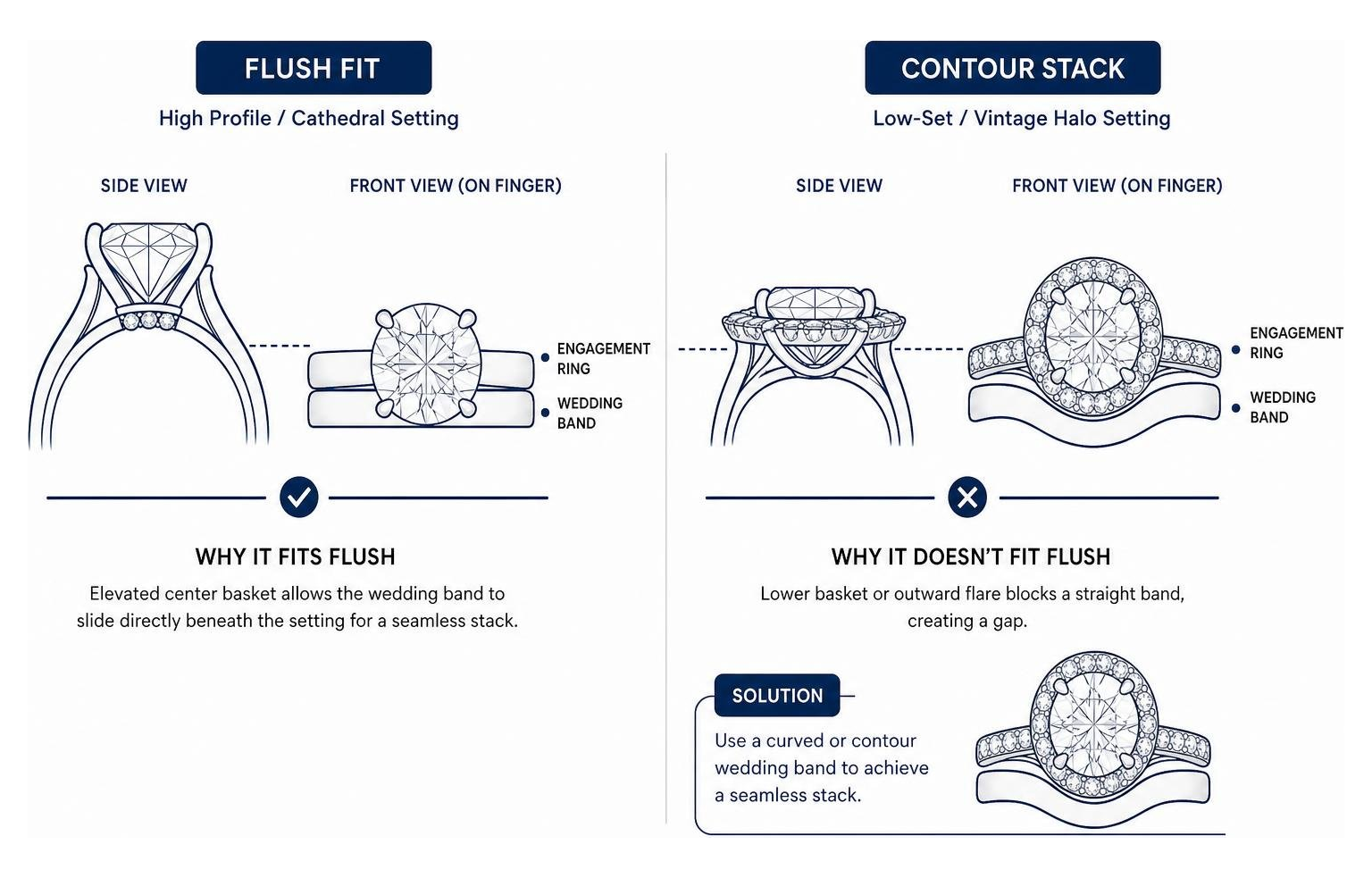
One of the most common oversights buyers make is selecting an engagement ring without considering how a wedding ring will sit beside it.
- Flush Fit (Standard High-Profile or Cathedral): If the center basket sits elevated on top of the band, a standard straight wedding band will slide flush against it without any gaps.
- Non-Flush Fit (Low-Set Basket or Vintage Halo): If the basket flares outward right at finger level, a straight wedding band will bump into the basket stem, leaving an open notch or gap between the two rings.
- Curved or Contour Bands: If you prefer a low-profile engagement ring basket but want seamless stack alignment, you may need a custom contoured or chevron wedding band that bends snugly around the central mounting.
Aesthetic Harmony: Metal Colors and Diamond Shapes
Choosing an engagement ring style requires uniting metal choice, center cut, and design details into a balanced ring design.
Timeless vs Trend-Aware Engagement Ring Styles
When selecting a ring, consider whether you prefer timeless design traditions or modern, trend-conscious details.
- Timeless Styles: Single-stone solitaires, classic round three-stone settings, and simple bezel mounts have maintained popularity for over a century. They resist changing fashion trends and easily pass down as family heirlooms.
- Trend-Aware Styles: Styles like Toi et Moi (two-stone rings featuring contrasting shapes like an oval and pear side-by-side) offer modern artistic flair. While striking and contemporary, trend-focused styles should be chosen out of genuine personal love rather than temporary social media hype. Explore this creative aesthetic in The Art of Two Unpacking Toi et Moi Ring Settings.
Metal Tones and Diamond Cuts
The precious metal color you pick sets the background frame for your diamond's natural color and optical shape:
- Yellow Gold: Adds warm vintage charm. Yellow gold flatters slightly lower diamond color grades (K-M) by harmonizing with warm undertones.
- White Gold & Platinum: Platinum and white gold create a bright, seamless backdrop that maximizes diamond whiteness. For details on metal alloys and maintenance, read our White Gold Engagement Rings Guide.
- Rose Gold: Offers a romantic, blush accent that makes pavé and vintage filligree designs pop with unique distinction.
Metal choice works hand-in-hand with center stone geometry. Soft, elongated stones like those featured in our Oval Cut Diamond Complete Guide pair beautifully with slim solitaire or delicate micro-halo bands to exaggerate length. Meanwhile, clean geometric cuts covered in our Emerald Cut Diamond Complete Guide demand precise, clean-lined settings—like step-cut side baguettes or tailored bezels—to match their crisp hall-of-mirrors effect.
Frequently Asked Questions
Which engagement ring style makes the center stone look largest?
The halo setting is unmatched when it comes to boosting perceived stone size. By surrounding the main diamond with a border of small accent diamonds, a halo optical trick tricks the eye into seeing one massive, continuous diamond footprint.
Similarly, choosing a thin, delicate pavé band (around 1.5mm to 1.8mm wide) creates contrast that makes the center stone look larger by comparison.
Which engagement ring style is best for an active lifestyle?
The bezel setting is the premier choice for people with active routines, medical professions, or hands-on hobbies. Because a solid wall of metal holds the diamond's girdle rather than exposed prongs, there are no structural points to catch on clothing or scratch surfaces.
If you prefer a classic prong look, opt for a low-profile cathedral solitaire where the center diamond sits low to the finger to minimize accidental bumps.
How do I balance my budget between the center diamond and setting style?
Start with your overall total budget (for example, the average national benchmark of $5,500). If your heart is set on a highly intricate halo or vintage cathedral setting (which may cost $2,000 to $3,000 for metal and hand-setting), adjust your expectations for center stone size accordingly.
Conversely, if you want a large 1.50-carat or 2.00-carat diamond, choose a clean, budget-friendly classic solitaire setting to put more money toward the diamond. You can also maximize your diamond sizing budget by exploring Lab Grown Diamond Engagement Rings Ethical Elegance for Your Big Day, which offer substantial savings over natural diamonds.
Conclusion
Finding the right ring setting comes down to evaluating how aesthetics, comfort, budget, and long-term care fit your daily routine.
As you finalize your search, try this easy decision process:
- Shortlist Three Styles: Pick one safe timeless choice (e.g., Solitaire), one high-presence sparkle choice (e.g., Halo or Pavé), and one functional practical choice (e.g., Bezel).
- Evaluate Your Routine: Be honest about your daily habits, hand usage, and willingness to perform regular prong inspections.
- Check the Side Profile: Never evaluate a ring from top-down photos alone—always examine setting height, basket clearance, and how flush your future wedding band will sit.
At Washington Diamond, our private, appointment-only studio in Northern Virginia gives you our undivided attention in a relaxed environment without retail sales pressure. We sit down with you to review certified loose diamonds side-by-side with precision-crafted settings, ensuring your final selection is engineered to last a lifetime.
Ready to take the next step? Explore our foundational overview on Engagement Ring Settings 101 or schedule a private consultation with our experts today.
Have a question about your jewelry?
We've been helping clients with diamonds, custom design, repairs, appraisals, and more since 1969. Book a private appointment at our Falls Church studio.
Book an AppointmentTrusted since 1969 · Falls Church, VA · 703-536-3600
From the blog
View all


