

Timeless Romance: A Meaning and Setting Guide to the 3 Diamond Past Present Future Ring
What a Three-Stone Ring Says About Your Story

A 3 diamond past present future ring uses one diamond for each chapter of a relationship: the memories you share, the commitment you make today, and the future you hope to build. Also called a trilogy ring, it gives a familiar three-stone design a personal meaning.
The diamonds can be equal in size or draw the eye toward a larger center stone. This guide will help you understand the symbolism and choose a design that feels like your story.
I'm Tom Daube. My experience with diamond selection, jewelry design, and diamond recutting helps me explain what to look for in a 3 diamond past present future ring.
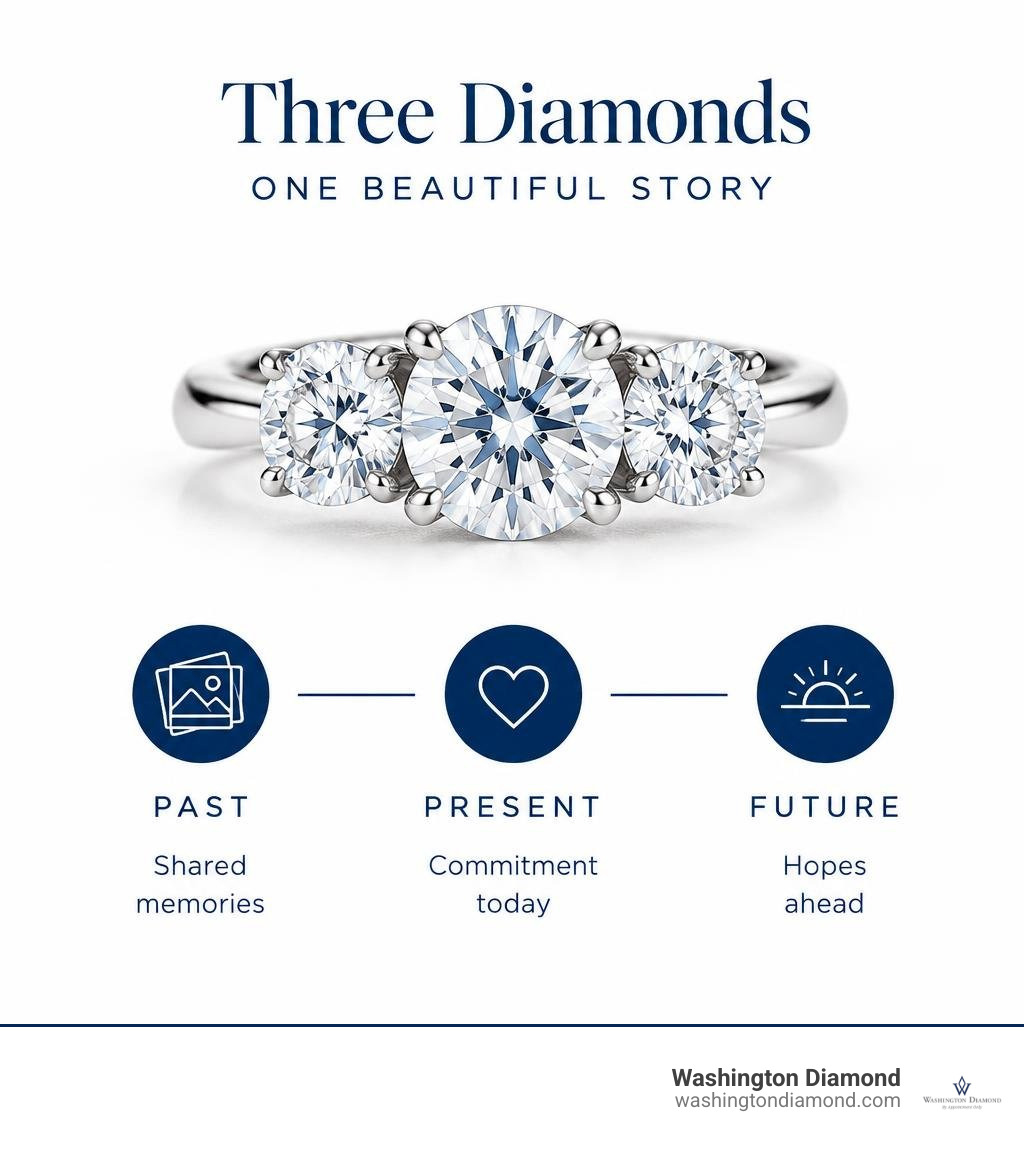
3 diamond past present future ring terms simplified:
The Symbolism and Evolution of Trilogy Rings

While the three-stone silhouette looks effortlessly modern on the hand, its storytelling power spans centuries of jewelry design. The concept of using multiple gems to tell a narrative gained popularity during the Georgian and Victorian eras, when jewelry often carried hidden messages, sentimental acrostics, and romantic symbolism. Over the decades, the design transitioned from ornate, antique heirlooms into sleek, balanced settings that celebrate an unbroken continuum of love.
The Core Trilogy Meaning
At its heart, the trilogy design serves as an enduring metaphor for a shared life journey.
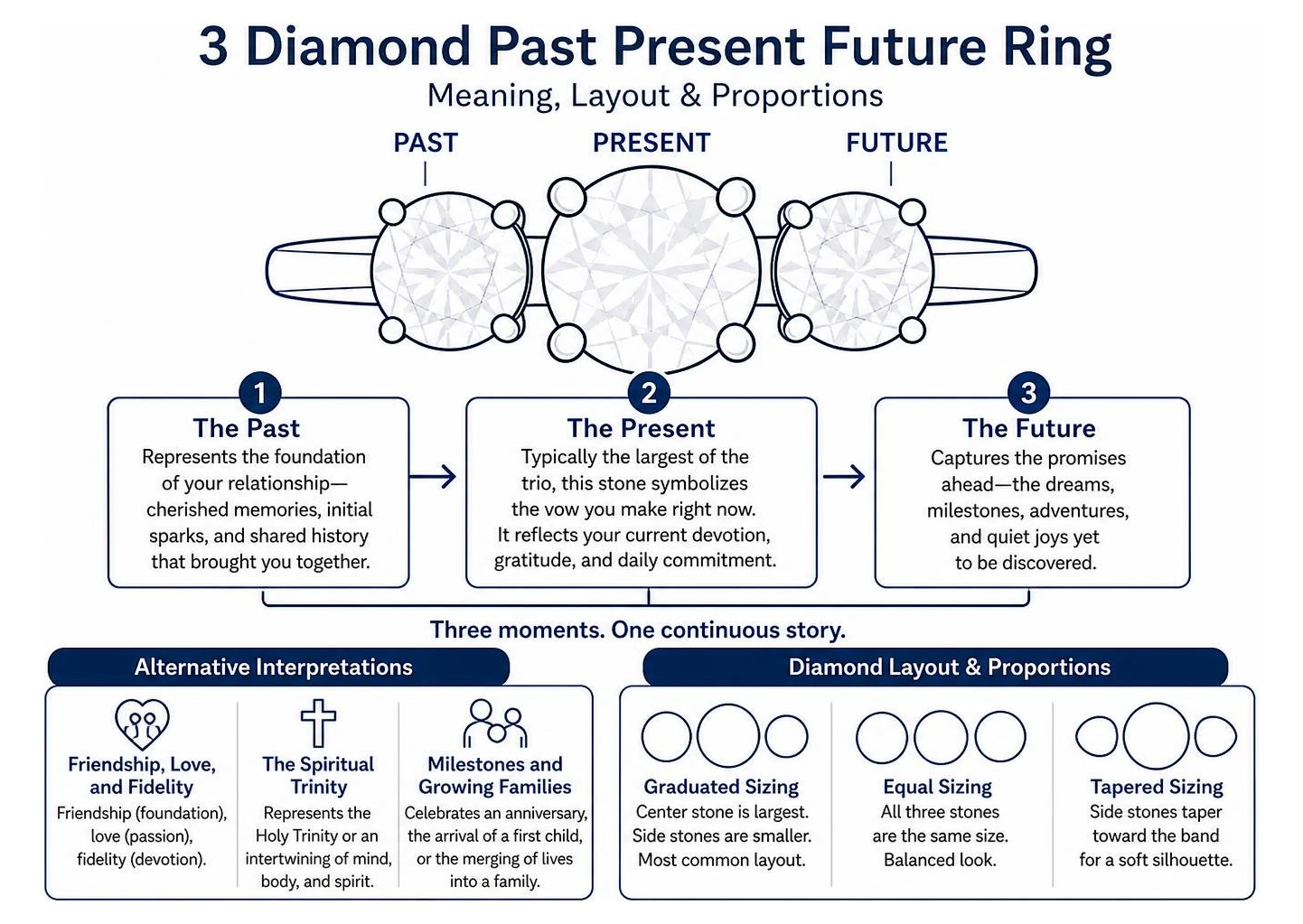
- The Past (Left Diamond): Represents the foundation of your relationship—the cherished memories, initial sparks, and shared history that brought the two of you together.
- The Present (Center Diamond): Typically the largest of the trio, this stone symbolizes the vow you make right now. It reflects your current devotion, gratitude, and daily commitment.
- The Future (Right Diamond): Captures the promises ahead—the dreams, milestones, adventures, and quiet joys yet to be discovered.
By binding these three moments into a single precious metal band, the ring turns an engagement into a continuous, unfolding story rather than a single isolated day.
Alternative Interpretations and Significance
While temporal romance is the most recognized meaning, the three stones carry a range of other heartfelt interpretations:
- Friendship, Love, and Fidelity: In classic Victorian romanticism, three gems often stood for friendship (the foundation), love (the passion), and fidelity (the devotion).
- The Spiritual Trinity: For many couples, the trio evokes spiritual harmony, representing the Holy Trinity or an intertwining of mind, body, and spirit.
- Milestones and Growing Families: Beyond an initial proposal, three stones are frequently gifted to celebrate a significant anniversary, the arrival of a first child, or the merging of lives into a family.
Many couples today explore vintage-inspired designs to blend this rich heritage with handcrafted filigree, milgrain borders, and antique-style diamond cuts.
How to Choose and Design a 3 Diamond Past Present Future Ring
Designing a trilogy ring is all about finding visual harmony. Unlike a single center stone setting where one diamond dictates the entire look, a three-stone ring requires precise alignment in scale, color, and silhouette.
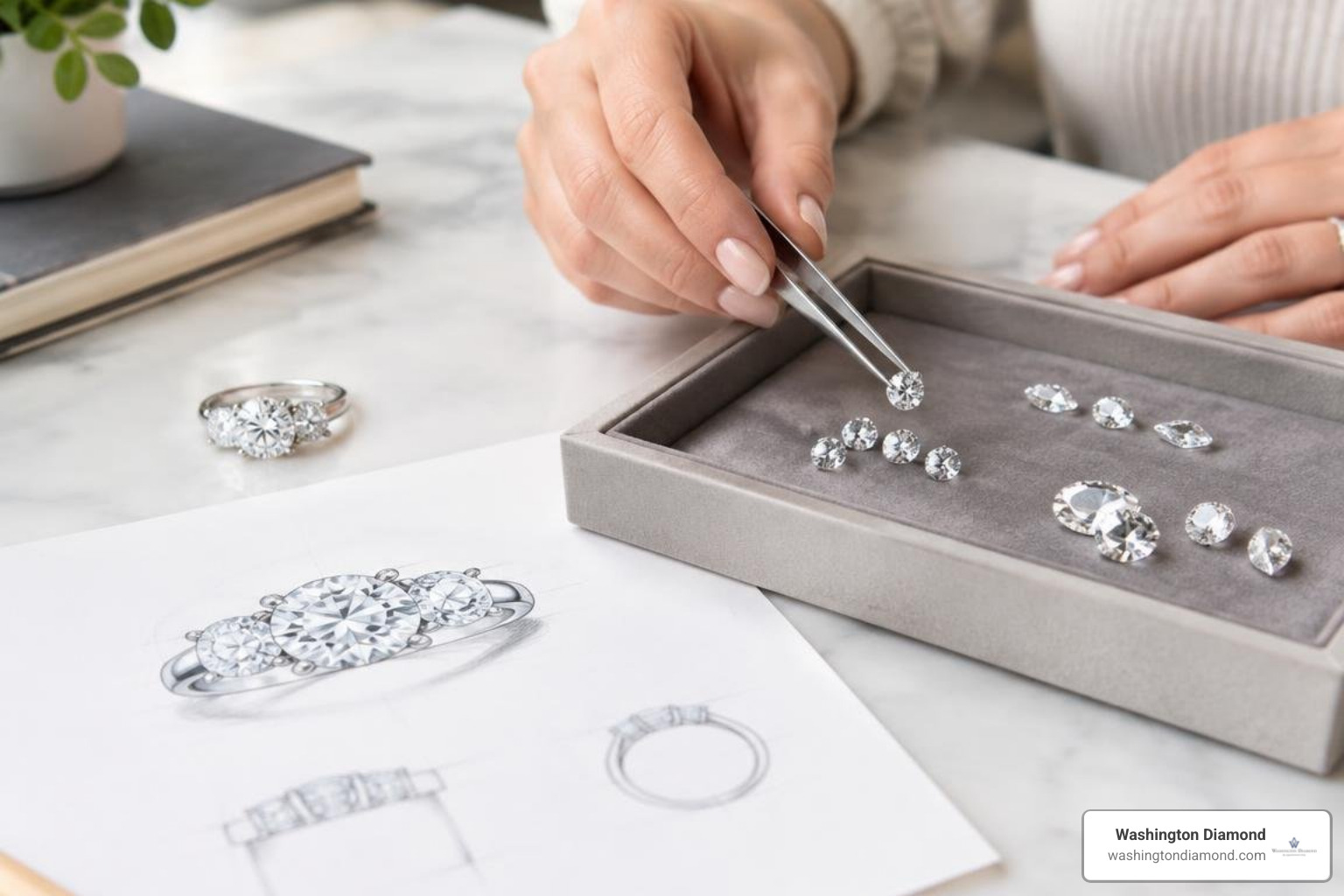
When commissioning a custom engagement ring, you get to tailor every angle to reflect your personal aesthetic. You can reference expert resources such as the Three Stone Engagement Ring Buying Guide | GIA 4Cs to understand the core metrics of diamond grading.
Diamond Shapes and Proportions for a 3 Diamond Past Present Future Ring
The balance between the center gem and its flanking partners defines the ring's overall personality. The most common arrangement is graduated sizing, where the center stone takes center stage while smaller side stones gently taper toward the band.
Popular Shape Combinations
- Round Brilliant Trio: The quintessential classic. Three round diamonds side by side create a seamless wall of light and maximum brilliance.
- Oval Center with Pear or Round Accents: An elongated oval center flanked by tapered pears creates a flattering, finger-slimming line.
- Emerald Cut Center with Trapezoids or Baguettes: A clean, architectural Art Deco look that highlights crisp step-cut facets.
- Cushion or Radiant with Trilliant (Triangular) Diamonds: A bold, geometric pairing with exceptional fire.
Matching Quality Across All Three Stones
Because the diamonds sit immediately adjacent to one another, color and clarity matching are essential. If you choose a near-colorless (G-H) center stone, your side stones should fall within the exact same color grade range. A stark contrast in hue (for example, pairing an F-color side stone with a J-color center) will make the warmer stone appear darker than it would in isolation.
Couples looking to maximize their budget while selecting pristine proportions can also consider custom lab-grown diamonds, which offer the identical chemical, optical, and physical properties of mined diamonds at accessible price points.
Classic and Modern Settings for a 3 Diamond Past Present Future Ring
The setting structure impacts both the ring's durability and its everyday wearability. Exploring engagement ring setting education can help you decide between several key designs:
- Prong Settings (4-Prong or 6-Prong): Traditional prongs allow maximum ambient light to enter the stones from every side, creating unmatched sparkle. Shared prongs reduce metal clutter between the diamonds.
- Bezel Settings: A smooth rim of precious metal encases each diamond. This modern, low-profile design is snag-free and ideal for active lifestyles.
- Basket and Trellis Settings: A trellis setting features elegantly interwoven prongs that cross beneath the stones, adding an artistic, romantic profile view.
- Metal Options: Platinum provides natural white luster and superior prong strength, while 18k and 14k yellow or white gold bring warmth and timeless elegance.
Comparing Three-Stone Rings to Other Engagement Ring Styles
Choosing the right engagement ring style comes down to balancing finger coverage, symbolism, maintenance, and budget.
| Ring Style | Visual Finger Coverage | Core Symbolism | Maintenance Level | Sparkle Profile |
|---|---|---|---|---|
| Three-Stone Ring | High (spreads horizontally across finger) | Past, Present, Future; Journey | Moderate (checking 3 stone settings) | Broad, cohesive wall of light |
| Solitaire | Focused / Minimal | Singularity, pure focus on one gem | Low (only 1 center setting) | Deep center brilliance |
| Halo Setting | Broad / High | Radiance, vintage glamour | Moderate to High (multiple micro-prongs) | Scintillating outer frame |
Three-Stone Rings vs. Solitaires
A classic solitaire diamond ring places all visual emphasis onto a single magnificent diamond. Solitaires offer an understated, minimalist elegance that never goes out of style. However, if you are looking for wide horizontal finger coverage without needing a massive single center stone, a three-stone setting delivers significantly more presence across the hand. Our solitaire engagement band guide explores the nuances of single-stone designs in depth.
Three-Stone Rings vs. Halo Settings
While halo engagement rings use a ring of micro-pave accent stones to artificially expand the visual diameter of a center gem, a three-stone design achieves high finger coverage using substantial, individual diamonds. Trilogy rings provide distinct geometric contrast and rich temporal storytelling that a standard halo design does not offer.
Practical Tips for Buying, Pairing, and Maintenance
When putting together your engagement ring suite, practical considerations ensure your piece remains comfortable and secure for decades. Reviewing custom design guidance will help you balance diamond quality, band thickness, and setting profiles.
Pairing with Wedding Bands
Because a three-stone ring features a wider basket underneath, standard straight wedding bands may not always sit completely flush against the engagement ring. To achieve a seamless look, consider:
- High-Set Baskets: Choosing a three-stone setting engineered with an elevated head allows a traditional straight band to slide directly underneath.
- Curved or Contoured Bands: A gently curving wedding band dips around the center setting, locking the two rings together without friction.
- Notched or Chevron Bands: Pointed bands add an architectural frame to the trilogy stones.
If you are beginning your search for wedding jewelry, exploring our guide to wedding ring selection or discovering bespoke options for wedding bands in McLean VA can help you find a complementary match.
Care and Long-Term Maintenance
Three-stone rings have more prongs and contact points than simpler solitaires, making routine care vital:
- Regular Prong Checks: Schedule a professional inspection with an experienced gemologist twice a year to ensure no prongs have loosened or caught on knit fabrics.
- At-Home Cleaning: Soak your ring in a small bowl of warm water with mild liquid dish soap for 15 minutes. Gently brush around the side stones with an extra-soft baby toothbrush, rinse thoroughly, and pat dry with a lint-free cloth.
- Safe Storage: When not wearing your ring, store it in a fabric-lined jewelry box or soft pouch so the diamonds do not scratch other pieces.
Frequently Asked Questions about Three-Stone Diamond Rings
Does the center diamond always have to be larger than the side stones?
Not at all. While graduated layouts—where the center diamond is noticeably larger—are the most popular choice to emphasize the "Present," rings with three equally sized diamonds create a stunning, symmetrical eternity look. Equal-stone trilogy rings offer a bold, ribbon-like band of sparkle across the finger.
Can I mix different diamond shapes in a three-stone setting?
Yes, mixing shapes is one of the most exciting aspects of designing a three-stone ring! Combining geometric step cuts with brilliant cuts (such as an emerald cut center paired with tapered baguette or trapezoid side stones) creates an elegant Art Deco contrast. Similarly, pairing an oval or cushion cut with pear side stones creates soft, romantic lines.
What is the ideal ratio for side diamonds in a trilogy ring?
Most classic graduated designs use side diamonds whose total carat weight equals roughly one-third to one-half the size of the center diamond. For example, a 1.50-carat center diamond is frequently paired with two 0.35- to 0.50-carat side stones (roughly 0.70 to 1.00 carat total weight in the side gems). This proportion flatters the center stone without letting the side stones disappear or overwhelm the setting.
Conclusion
A three-stone engagement ring is far more than a stunning arrangement of precious metals and gems—it is a wearable testament to where you have been, the love you share today, and the promises of your tomorrows. Whether you prefer antique-inspired filigree, sleek contemporary bezels, or dramatic mixed diamond cuts, this classic style offers timeless versatility.
At Washington Diamond, we believe choosing an engagement ring should be an intimate, celebratory experience. Our private, appointment-only studio in Northern Virginia provides you with undivided attention, expert diamond guidance, and a pressure-free environment to craft the piece of your dreams. We invite you to schedule a consultation with our team and explore the handcrafted collection of three-stone engagement rings to begin your next chapter.
Have a question about your jewelry?
We've been helping clients with diamonds, custom design, repairs, appraisals, and more since 1969. Book a private appointment at our Falls Church studio.
Book an AppointmentTrusted since 1969 · Falls Church, VA · 703-536-3600
From the blog
View all


