

The Alexandria Guide to Wedding Ring Selection
Why Wedding Ring Selection Deserves More Thought Than Most Couples Expect

Wedding ring selection is one of the most personal decisions you'll make for your wedding day — and one of the easiest to rush.
Here's a quick overview of what the process involves:
| Step | What to Consider |
|---|---|
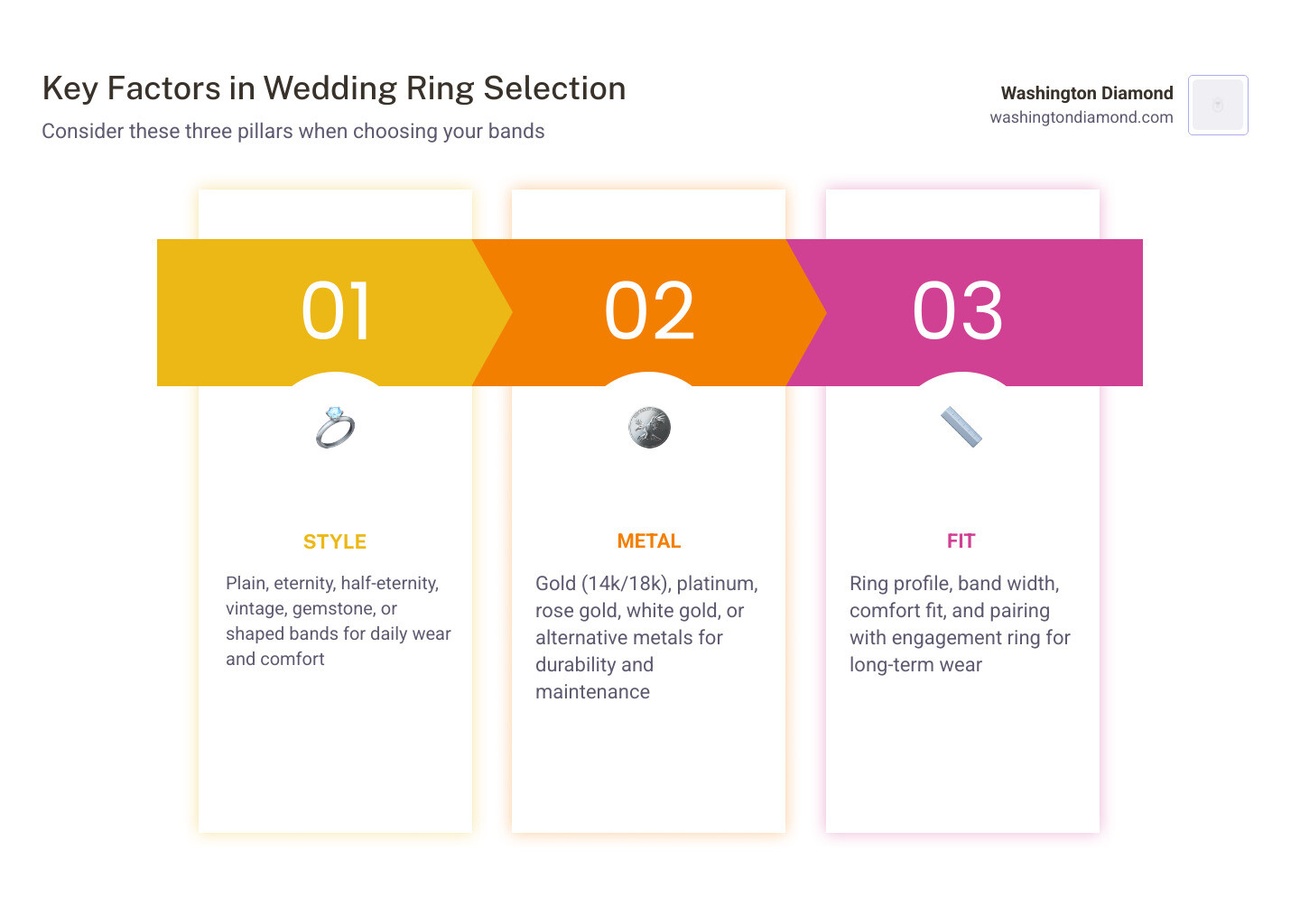
| Style | Plain, eternity, half-eternity, vintage, gemstone, or shaped |
| Metal | Gold (14k/18k), platinum, rose gold, white gold, or alternative metals |
| Fit | Ring profile, band width, comfort fit, and pairing with your engagement ring |
| Budget | Ranges from around $100 for simple bands to $3,000+ for diamond styles |
| Timeline | Start 3–4 months out; 6–8 months if you want a custom design |
| Personalization | Engravings, hidden stones, mixed metals, bespoke designs |
Unlike an engagement ring, your wedding band is on your finger every single day — through work, workouts, and everything in between. That changes what "the right ring" actually means.
Most couples enjoy their engagement bliss for a while before thinking about bands. That's completely normal. But when the time comes, there's a lot more to navigate than just picking a style you like online.
This guide walks you through every decision clearly — from understanding the difference between a wedding ring and a wedding band, to finding the perfect fit alongside your existing engagement ring.
I'm Tom Daube, a GIA-certified diamond specialist and jewelry designer with decades of experience helping couples navigate the wedding ring selection process with confidence and clarity. In the sections ahead, I'll share everything I've learned so you can make a choice you'll love for life.
Know your Wedding ring selection terms:
Wedding Ring Selection Basics: What You’re Choosing and Why
When we sit down with couples in our Northern Virginia studio, the first thing we often clarify is the "why" behind the ring. A wedding ring isn't just an accessory; it's an emblem of enduring commitment. Its circular shape—having no beginning and no end—represents a bond that is infinite.
While many traditions date back to ancient Egypt or the Roman concept of the vena amoris (the "vein of love" believed to run from the left fourth finger directly to the heart), modern wedding ring selection is much more about personal expression than strict adherence to ancient rules.
What is the difference between a wedding ring and a wedding band?
In the jewelry world, these terms are often used interchangeably, but there are subtle distinctions. Traditionally, a "wedding band" refers to a plain metal ring, often chosen for its understated elegance and durability. A "wedding ring," on the other hand, is a more inclusive term that often describes styles featuring diamonds or gemstones.
Whether you prefer a sleek, high-polished gold band or a shimmering eternity ring, both serve the same purpose: they are the physical manifestation of the vows you exchange during your ceremony.
Wedding ring vs. engagement ring: different roles, same story
The engagement ring is typically the "star of the show," presented during the proposal and usually featuring a prominent center stone. The average engagement diamond in the U.S. currently sits between 1.08 and 1.2 carats.
The wedding ring is the "partner" to that story. It is exchanged during the wedding ceremony and is often designed to sit flush against the engagement ring. While the engagement ring signifies the intention to marry, the wedding ring symbolizes the formal union.
Should couples choose matching, complementary, or non-matching rings?
One of the most common questions we hear is: "Do our rings have to match?" The short answer is: absolutely not.
- Matching Sets: Some couples love the symbolism of identical bands, representing their shared path.
- Complementary Styles: You might choose the same metal (like platinum) but different widths or finishes to honor individual tastes while maintaining a visual link.
- Non-Matching: It is perfectly acceptable for one partner to want a diamond-encrusted band while the other prefers a rugged, brushed-metal finish. Your rings should reflect your individual personalities.
Wedding Ring Selection Styles, Profiles, and Settings
The style you choose dictates the "vibe" of your wedding set. From the timeless simplicity of a plain band to the intricate details of a vintage-inspired design, your choice should balance aesthetics with your daily routine.
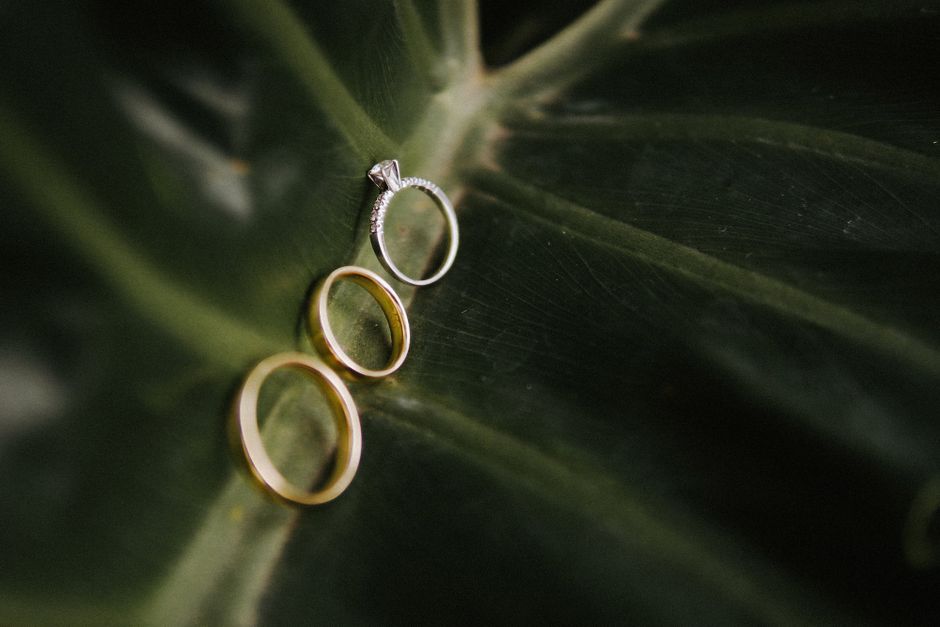
Most popular wedding ring styles in Wedding ring selection
- Plain Metal Bands: The classic choice. They are low-maintenance, easy to clean, and never go out of style.
- Eternity Bands: These feature diamonds or gemstones encircling the entire band. They offer maximum sparkle from every angle.
- Half-Eternity and 3/4 Eternity: These have stones across the top half or three-quarters of the band. They are often more comfortable than full eternity rings and—crucially—can be resized more easily.
- Pavé and Channel Sets: These styles secure small diamonds within the metal, providing a "paved" look of brilliance or a sleek, protected row of stones.
- Stackable and Shaped Bands: Designed to nestle against unique engagement ring shapes, these are becoming increasingly popular for a custom, curated look.
Ring profiles and shapes that affect comfort
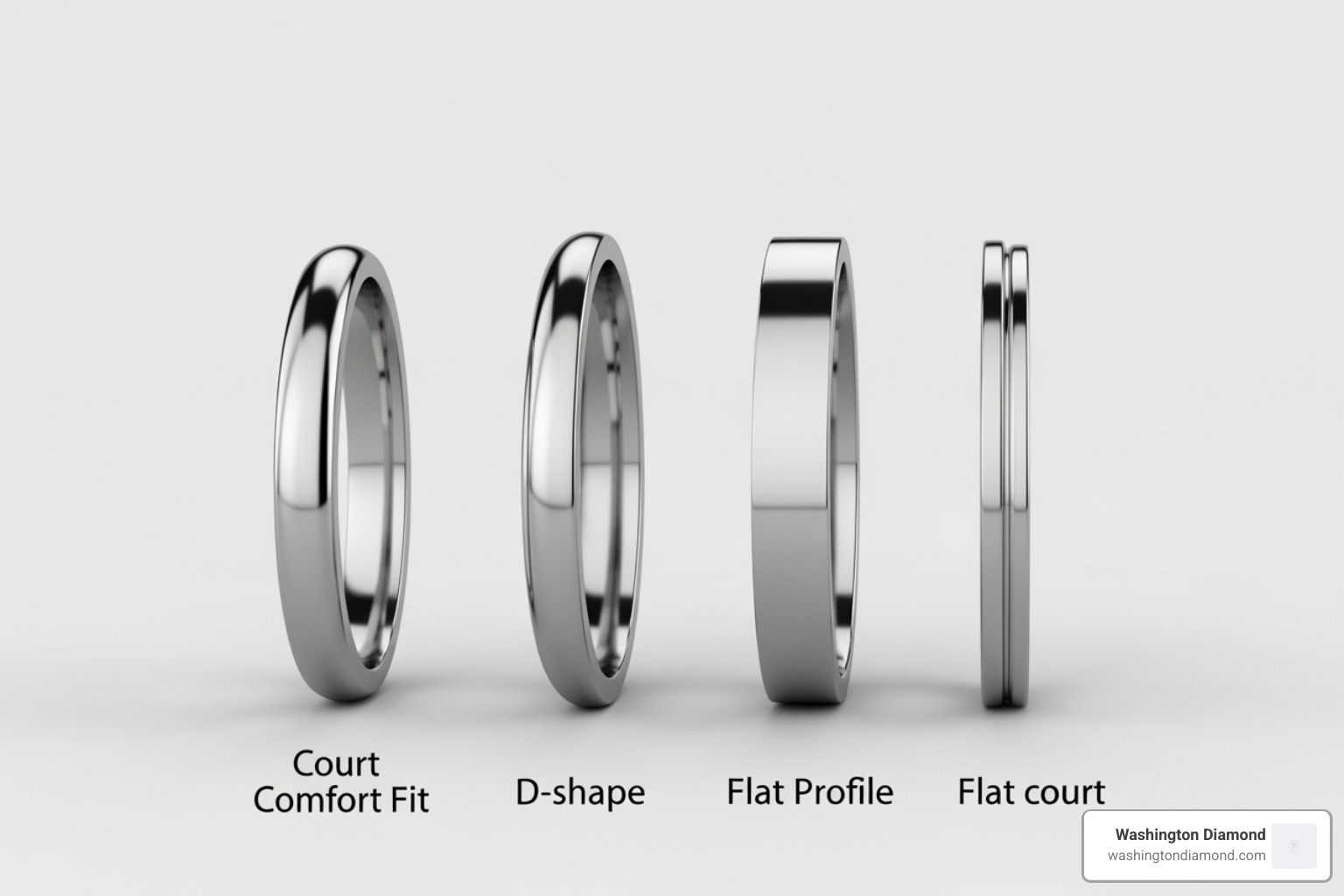
The "profile" refers to the cross-section shape of the ring. This is what you actually feel against your skin and adjacent fingers.
- Court (Comfort Fit): Rounded on both the inside and outside. This is widely considered the most comfortable for daily wear.
- D-Shape: Flat on the inside and rounded on the outside. It sits close to the finger but looks traditional.
- Flat: Flat on all sides for a modern, architectural look.
- Flat Court: Flat on the outside but rounded on the inside, offering a contemporary look with a comfort-fit feel.
Best stone settings for diamond or gemstone wedding rings
If you choose a ring with stones, the setting determines how secure those stones are.
- Channel Setting: Stones are set between two walls of metal. This is very secure and "glove-friendly" because there are no prongs to snag.
- Bezel Setting: Metal surrounds the perimeter of the stone. It’s the ultimate choice for an active lifestyle.
- Bar Setting: Metal bars hold stones in place on two sides, allowing more light to enter the diamonds.
- Prong/Scallop: Offers the most sparkle but requires more frequent checks to ensure prongs haven't loosened.
For a deeper dive into how stones stay put, check out our guide on Engagement Ring Settings 101.
How to Choose the Best Metal, Width, and Fit
The metal you choose affects the ring's color, weight, and how it ages over time. In May 2026, we are seeing a strong trend toward mixed metals, but the "Big Three" remain the most popular.
Which metals are best for wedding rings and how do they compare?
| Metal | Pros | Cons |
|---|---|---|
| Platinum | Naturally white, hypoallergenic, extremely durable. | Most expensive; develops a "patina" (soft matte finish) over time. |
| 14k/18k Yellow Gold | Classic, warm, easier to repair and resize. | Can scratch; 18k is softer than 14k. |
| White Gold | Modern, bright look; more affordable than platinum. | Requires rhodium replating every 1-2 years to maintain whiteness. |
| Rose Gold | Romantic, unique, complements most skin tones. | Contains copper (not hypoallergenic). |
For those leaning toward the classics, our Yellow Gold Wedding Bands editorial is a great resource. If you want the ultimate in durability, see our Custom Platinum Wedding Band Guide.
How lifestyle, comfort, and durability should guide your choice
We always ask our clients: "What do you do with your hands?"
- The Healthcare Professional: If you wear gloves all day, a flush, channel-set or plain band is best to avoid snagging.
- The Outdoor Enthusiast: If you’re hiking or climbing, platinum's durability or a bezel setting is your best friend.
- The Office Executive: You have more freedom for delicate pavé or high-profile settings.
Choosing the right width and fit for long-term comfort
Width is measured in millimeters (mm).
- Women's Bands: Typically range from 2mm to 4mm. A 2mm or 2.5mm band is the standard for a "dainty" look that doesn't overpower the engagement ring.
- Men's Bands: Usually range from 4mm to 8mm. A 6mm band is the "goldilocks" size for most men—not too thin, not too chunky.
Wider bands fit more snugly. If you choose a very wide band, you may need to go up a quarter-size for comfort.
Pairing Wedding Bands with an Engagement Ring
The goal of wedding ring selection for most women is to create a seamless "bridal set." You want the rings to look like they were made for each other—even if they weren't bought at the same time.
How to ensure your wedding band complements or fits with an existing engagement ring
To achieve a cohesive look, we recommend matching the metal type and the "height" of the bands. If your engagement ring has a high profile, a straight band can sit flush against it. If your engagement ring has a low-set stone that "pokes out" at the base, you will likely need a contoured or curved band.
For more on this, explore our Custom Engagement Ring Band Guide.
Wedding ring selection for solitaires, halos, and low-set engagement rings
- Solitaires: These are the most versatile. Almost any band—straight, diamond-set, or plain—will look great.
- Halos: Because the "head" of the ring is wider, you may need a curved band to avoid a large gap.
- Three-Stone Rings: These often pair beautifully with a slightly wider band to balance the visual weight of the three diamonds.
When custom wedding rings make the most sense
Sometimes, a "stock" ring just won't fit right. This is common with vintage heirlooms or very unique modern designs like a Toi et Moi setting.
Custom design allows us to "shadow" the exact curves of your engagement ring, ensuring a perfect fit. Learn more about creating Your Unique Love Story: Custom Wedding Rings in the Nation's Capital.
Budget, Timeline, and Personalization
Let's talk logistics. Wedding ring selection shouldn't be a source of stress, but it does require a bit of planning.
How much should couples budget for wedding rings?
On average, wedding rings cost anywhere from $100 to $3,000.
- Plain gold bands often start around $280–$500.
- Diamond wedding rings typically range from $800 to $3,000+, depending on the total carat weight and metal.
- Platinum will always command a premium over gold due to its density and purity.
When to start shopping and how long the process takes
We recommend starting your wedding ring selection journey 3 to 4 months before the big day.
- Standard Orders: Usually take 3–4 weeks for production.
- Custom Designs: Can take 6–8 weeks from initial sketch to final polish.
- Resizing: If you buy a "ready-to-wear" ring, allow 2 weeks for perfect sizing.
Personalization ideas that make wedding rings meaningful
A ring is a canvas for your story. Beyond the style of the metal, consider:
- Engraving: Your wedding date, each other's initials, or a short phrase like "Always" or "To the Moon." Check out our 130 Wedding Band Engraving Ideas for inspiration.
- Hidden Stones: Many couples add a small "secret" gemstone (like a birthstone) to the inside of the band.
- Finish: Choose between high-polish, brushed, matte, or hammered textures to make a standard band feel unique.
For more ideas, see Popular Engravings on Wedding Rings.
Frequently Asked Questions about Wedding ring selection
Is an eternity ring or half-eternity ring better for everyday wear?
Half-eternity rings are often more practical. They are more comfortable (since there are no stones rubbing against your other fingers) and, most importantly, they can be resized if your finger size changes over the years. Full eternity rings generally cannot be resized.
Can wedding rings be resized later?
Most plain bands and half-eternity rings can be resized easily. However, metals like tungsten and titanium cannot be resized at all. If you choose these, your measurement must be perfect from day one.
Do wedding rings need insurance and regular care?
Yes! While we think of wedding rings as "forever," the metal can wear down and stones can loosen. We recommend a professional "clean and check" every six months. As for protection, we highly recommend Protect Your Precious: The Ultimate Guide to Engagement Ring Insurance.
For at-home maintenance, follow our Ultimate Engagement Ring Care Guide to keep that sparkle alive.
Conclusion: Choosing Wedding Rings You’ll Love for Life
Wedding ring selection is about more than just picking a piece of jewelry; it’s about choosing the one object you will carry with you every day as a reminder of your partner.
At Washington Diamond, we believe this process should be as special as the ceremony itself. Our private, appointment-only studio in Northern Virginia is designed to give you the quiet, focused time you need to explore metals, try on profiles, and find the perfect match for your lifestyle.
Whether you are looking for a classic gold band, a shimmering Diamond Wedding Ring, or a bespoke creation that fits your engagement ring like a glove, we are here to guide you.
Ready to find your perfect pair? Learn more about our custom jewelry services and let's start your next chapter together.
Have a question about your jewelry?
We've been helping clients with diamonds, custom design, repairs, appraisals, and more since 1969. Book a private appointment at our Falls Church studio.
Book an AppointmentTrusted since 1969 · Falls Church, VA · 703-536-3600
From the blog
View all


