

Pure Gold Luxury: A Guide to 24 Carat Rings
Is a 24 Carat Ring Right for Everyday Wear?

A 24 carat ring is made from nearly pure gold, typically 99.9%. Its rich yellow color is striking, but pure gold is soft: the ring can scratch, dent, or change shape more easily than an 18k or 14k ring. It can be worn, but if you want a ring for daily use, a simple, sturdy band and a willingness to handle it with care matter more than purity alone.
I’m Tom Daube, a jewelry designer with experience creating fine custom pieces and helping people choose meaningful jewelry. I’ll help you decide whether a 24 carat ring suits how you plan to wear it.
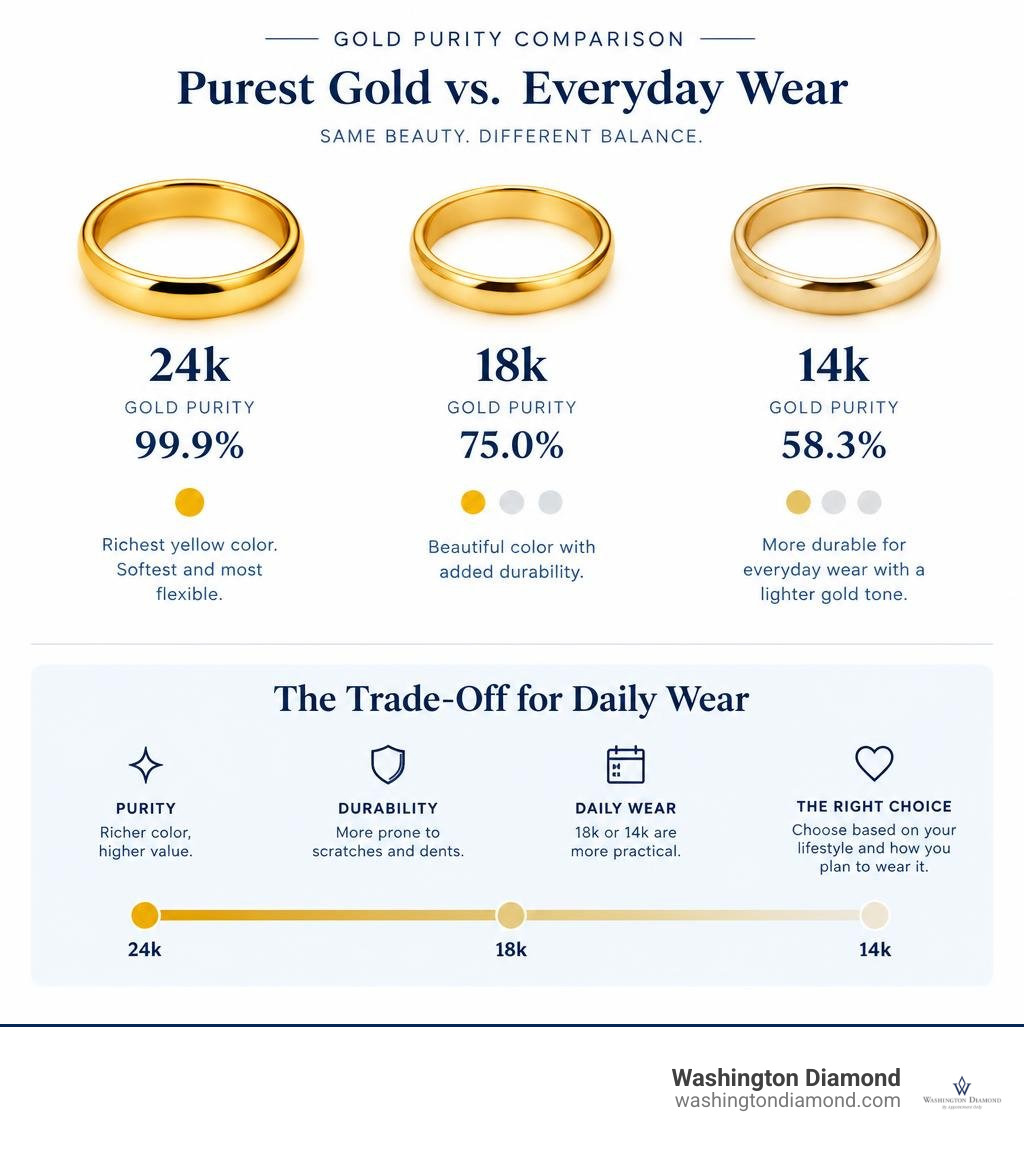
Easy 24 carat ring glossary:
What a 24 carat ring means: purity and composition
Karat, often written as “k” or “K,” describes the proportion of gold in an alloy. In jewelry, 24-karat gold is the highest common fineness and is typically marked 999, meaning it contains about 99.9% gold. The small remainder may consist of trace impurities or other permitted materials.
That high purity gives 24k gold its strong, warm yellow color. By comparison, lower-karat gold contains more alloy metals, such as copper, silver, zinc, or palladium. These additions can change the color and make the metal harder. For a clear overview of how gold purity is represented in jewelry, see gold purity guidance.
A hallmark or fineness stamp can indicate a ring’s gold content, but a stamp alone does not prove authenticity. We’ll cover verification later in the guide.
How 24-karat gold compares with 18k and 14k gold
The karat number describes gold content out of 24 parts. So 18k gold is 18 parts gold out of 24, or 75% gold. 14k is 14 parts gold out of 24, or about 58.3% gold. The remaining portions are alloy metals.
| Gold type | Gold content | Color | Relative hardness | Typical use |
|---|---|---|---|---|
| 24k | About 99.9% | Deep, rich yellow | Softest | Simple bands and jewelry chosen for purity or tradition |
| 18k | 75% | Yellow, white, or rose, depending on alloy | Harder than 24k; varies by alloy | Fine jewelry, including rings with gemstones |
| 14k | About 58.3% | Yellow, white, or rose, depending on alloy | Generally harder than 18k and 24k | Rings intended for frequent wear |
Color and hardness depend on the specific alloy, so two rings of the same karat can look and perform somewhat differently. A diamond’s “carat,” by contrast, measures its weight, not the purity of the gold holding it.
Is a 24 carat ring durable enough for daily wear?
Pure gold is malleable, which means it can bend or change shape under pressure instead of breaking. That quality is useful when shaping the metal, but it makes a 24k ring more vulnerable to everyday knocks. Repeated contact with hard surfaces can leave scratches and dents, and a thin band may gradually become misshapen.
Gold hardness is measured using tests such as the Vickers hardness test. Approximate figures sometimes cited are 25 to 30 HV for 24k gold and 60 to 90 HV for some 18k alloys. These are not universal ratings: results vary with alloy, manufacturing, and test conditions. The important practical point is that pure gold is generally much softer than common lower-karat ring alloys. Read about the Vickers hardness test.
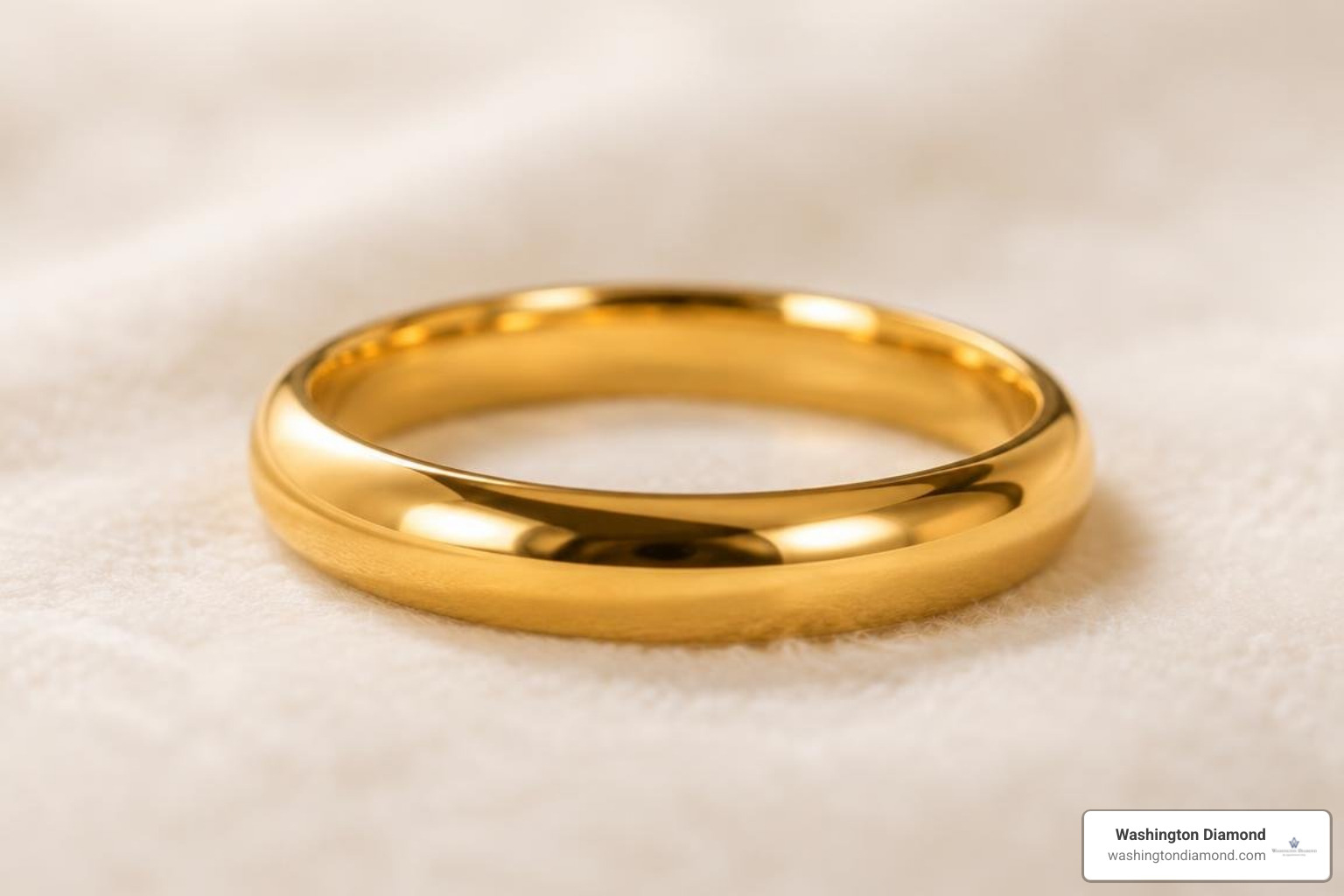
A sturdy, low-profile band is less exposed to snags than a tall, elaborate design. Still, “durable enough” depends on your routine. A ring worn occasionally or removed for hands-on work may stay in good condition for years. A ring worn around the clock, including during exercise, housework, or manual work, is more likely to show wear and need reshaping or repair.
Advantages and disadvantages of a 24 carat ring
Advantages
- Exceptional purity: The ring is almost entirely gold, with very little alloy metal.
- Distinctive color: Its rich yellow tone is more intense than that of many lower-karat alloys.
- Meaning and tradition: Some buyers value the symbolism of choosing the highest common gold purity.
- Gold-content value: Its material value is closely tied to its gold weight and the market price of gold.
Disadvantages
- Softness: Scratches, dents, and distortion are more likely than with harder alloys.
- More attentive care: You may need to remove it for activities that could cause impact or abrasion.
- Fewer setting options: Delicate prongs and tall stone settings are poor matches for a soft metal.
- Price: At the same weight, a 24k ring contains more gold than an 18k or 14k ring and can cost more. Craftsmanship and design also affect the final price.
Best styles and settings to reduce damage
Choose a design that protects the gold and avoids delicate parts that can bend. A simple band is often the most practical choice. A thicker band may resist distortion better than a very thin one, though the ring can still dent.
Rounded edges and a low-profile shape reduce the chance of catching the ring on clothing or objects. If the design includes a gemstone, a low setting helps keep it less exposed. A bezel, which surrounds the stone with a rim of metal, or a flush setting, where the stone sits close to the surface, can offer more protection than raised prongs.
Avoid tall settings, fine prongs, and raised decorative details if you expect to wear the ring frequently. Any setting in soft gold needs careful design and regular inspection. If the ring is an important daily symbol, consider how you’ll wear it as well as how it looks in a display case.
24 carat ring prices, resale value, and cultural significance

There is no single standard price for a 24k ring. Its cost depends on the gold market price, the ring’s weight, workmanship, design, gemstones, and the retailer’s costs. As a result, a small plain band may cost hundreds of dollars, while a heavier or more elaborate piece can cost substantially more. Current gold prices change, so a quote can vary over time.
At the same weight and with similar labor, 24k usually costs more than an 18k or 14k ring because it contains more gold. However, a heavier 14k ring can cost more than a very lightweight 24k ring. Price comparisons are most useful when you compare rings of similar weight and design.
Gold jewelry also carries cultural meaning. In some families and traditions, high-purity gold is chosen for weddings, festivals, or gifts marking important milestones. For people in Northern Virginia whose family traditions include gold jewelry, a 24k ring may express continuity, celebration, or a preference for high-purity gold. The significance varies by person and family; no single style or custom represents everyone.
What affects the price of a 24-karat ring?
| Cost factor | 24k ring | 18k ring | 14k ring |
|---|---|---|---|
| Gold content | Highest; usually the greatest gold value at equal weight | 75% gold | About 58.3% gold |
| Gold weight | More weight generally means more gold cost | More weight generally means more gold cost | More weight generally means more gold cost |
| Craftsmanship | Intricate work can raise the price | Intricate work can raise the price | Intricate work can raise the price |
| Gemstones and design | Adds cost, but some settings may be less suitable for soft gold | Can accommodate a wider range of settings | Can accommodate a wider range of settings |
| Market and retailer costs | Vary by gold prices and seller | Vary by gold prices and seller | Vary by gold prices and seller |
Ask for the ring’s weight, stated fineness, and a clear breakdown of the price. If a ring has a gemstone, ask how much of the price reflects the stone and how much reflects the gold and workmanship. A certificate or receipt can help document what you bought.
Is a 24 carat ring a good investment?
A 24k ring has substantial gold content, but jewelry is not the same as buying gold at its market price. The retail price includes labor, design, and other costs that may not be recovered if you sell the ring. A buyer may also deduct refining, testing, or resale costs, and gemstones or distinctive workmanship may not add as much resale value as they added to the original price.
The ring’s gold value can rise or fall with the market. Taxes, resale fees, and the condition of the piece may affect what you receive. If investment is your main goal, compare the ring’s purchase price with the value of its gold content and understand the likely resale terms before buying. If you love the design and meaning, treat potential resale value as one factor rather than a guarantee of profit.
How to care for and authenticate a 24 carat ring
Because pure gold is soft, good care is mostly about preventing avoidable wear. Remove the ring before lifting heavy objects, exercising, gardening, cleaning, or doing work that could expose it to impact or abrasive surfaces. Take it off before swimming or using cleaning products, too. Chemicals may affect finishes or materials elsewhere in the ring, and a ring can be lost while you’re busy doing something else.
Have a jeweler inspect the band and any setting periodically, especially if you wear it often. A professional can check for distortion, looseness, and damage before a small issue becomes a bigger repair.
How to clean and store a 24-karat ring
For routine cleaning, use lukewarm water with a small amount of mild soap. Gently wipe the ring with a soft cloth or use a very soft brush, then rinse it carefully and dry it completely with a clean, lint-free cloth. Avoid scrubbing hard; pure gold can scratch.
Store the ring separately in a soft pouch or a lined compartment so it does not rub against harder jewelry. Keep it away from abrasive products and household chemicals. Avoid ultrasonic cleaners unless a qualified jeweler has confirmed that they are safe for every part of your ring. The metal may not be the only concern: gemstones, settings, and previous repairs can affect whether a cleaning method is appropriate.
How to verify a ring’s authenticity
Start with the seller’s description and documentation. A receipt should state the ring’s fineness, and any certificate or assay report should clearly identify what was tested. Look for a purity mark such as 999, but stamps can be copied or applied inaccurately. A hallmark is useful evidence, not a substitute for testing.
If you are uncertain, ask a qualified jewelry professional or independent testing service to assess the ring. X-ray fluorescence (XRF) testing can measure the metal’s composition without cutting the ring, although results can be affected by plating or surface layers. Acid testing is another method, but it can damage the item and may not reveal the full composition of a plated piece. Don’t try it at home.
Be cautious of a piece advertised as solid 24k gold if the price seems unusually low or the seller cannot provide clear documentation. Gold-plated jewelry has a surface layer of gold over another material; it is not the same as a ring made throughout from 24k gold. Precious-metal marking guidance from the Federal Trade Commission also distinguishes gold content from claims such as plated or filled, so check that the description matches the actual construction.
Frequently Asked Questions about 24 Carat Rings
Can you wear a 24 carat ring every day?
Yes, but daily wear increases the chance of scratches, dents, and changes in shape. A sturdy, simple band and careful habits can help. Remove it for exercise, heavy work, and activities where it may be knocked or scraped. If you want a ring you rarely need to take off, a harder gold alloy may be a more practical fit.
Is a 24 carat ring too soft to be practical?
Not necessarily. It can be practical if you value purity and rich yellow color, choose a protective design, and accept that the ring will need more care than a harder alloy. Softness is a trade-off, not an automatic reason to rule it out. Your routine and preferred style matter.
Does a 24 carat ring hold its resale value?
It retains value based partly on its gold content, but resale offers may be lower than the original retail price. Workmanship, retail costs, market changes, taxes, and resale deductions all matter. A ring’s value to its owner can also include sentimental meaning that a gold buyer cannot measure.
Conclusion
A 24k ring offers exceptional purity and a deep yellow color, but it is softer and more vulnerable to wear than 18k or 14k gold. A low-profile, substantial band can help reduce damage, while careful use and gentle cleaning help preserve its appearance. Whether it suits you depends on the balance you want between purity, durability, and everyday convenience.
We offer a private, appointment-only studio experience in Northern Virginia, where we can give you undivided attention as you consider jewelry for life’s meaningful moments. For personalized jewelry guidance, we invite you to connect with us and discuss what matters most in your choice.
Have a question about your jewelry?
We've been helping clients with diamonds, custom design, repairs, appraisals, and more since 1969. Book a private appointment at our Falls Church studio.
Book an AppointmentTrusted since 1969 · Falls Church, VA · 703-536-3600
From the blog
View all


