

Carat Weight Demystified: What is the Average Engagement Ring Carat?
The Average Engagement Ring Carat: The Short Answer

In the United States, the average engagement ring carat is about 1 carat, with many center diamonds falling between 1.0 and 1.2 carats. The most commonly purchased range is roughly 0.9 to 1.5 carats.
That average changes by region. Engagement-ring center stones average about 0.6 carats in the UK, approximately 0.5 carats across Europe, and often 0.30 to 0.70 carats in Asian markets. Still, carat is only a weight measurement - not a direct measure of how large a diamond looks on the hand.
A well-cut 1-carat round diamond is about 6.5 mm wide, but an oval, pear, or marquise of the same weight can look larger because it covers more of the finger. Your ring size, diamond shape, cut quality, setting, budget, and daily routine all matter more than chasing a single "right" number.
I am Tom Daube, a jewelry designer and diamond specialist with extensive experience evaluating well-proportioned GIA-certified diamonds, custom jewelry, and trade-up options. In this guide, I will help you put the average engagement ring carat into context so you can choose a diamond that looks exceptional and feels right for your life.
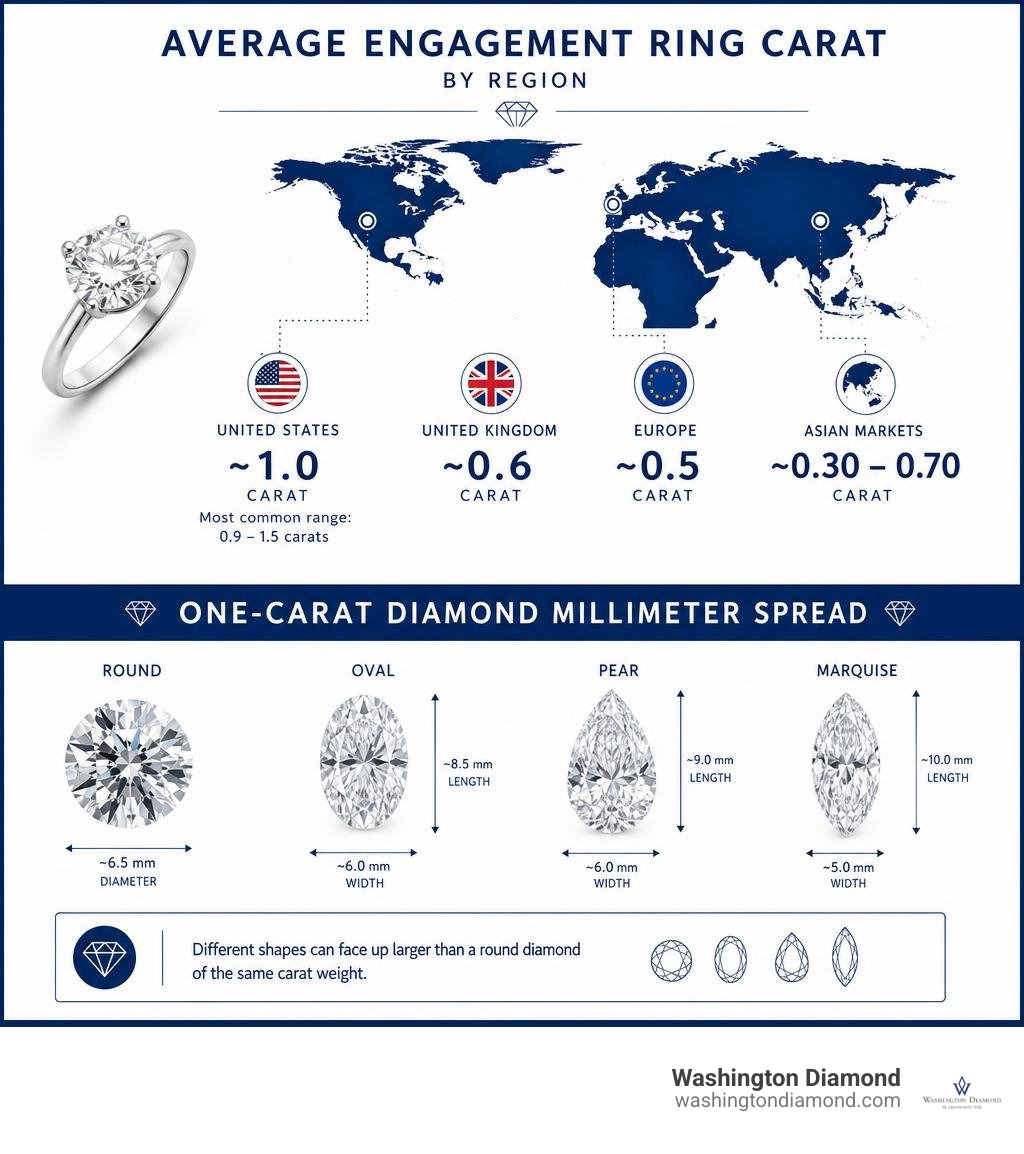
Average engagement ring carat word guide:
Understanding the Average Engagement Ring Carat Across the Globe
When you begin looking at fine jewelry, it is natural to wonder where your preferences fit within broader market benchmarks. We frequently see clients surprised by how dramatically diamond preferences shift depending on geography, culture, and regional lifestyles.
According to global retail data detailed in Average Engagement Ring Size: U.S. & Global Carat Trends, what is considered a standard center stone in North America is often viewed as quite grand in other parts of the world. The table below illustrates how center stone benchmarks translate across key global regions alongside standard round millimeter dimensions:
| Region | Typical Carat Range | Standard Round Diameter (mm) | Cultural Focus |
|---|---|---|---|
| United States | 1.00 – 1.20 ct | ~6.5 mm | Balance of size and finger presence |
| United Kingdom | 0.60 – 0.80 ct | ~5.4 – 5.9 mm | Understated elegance and vintage styling |
| Continental Europe | 0.50 – 0.60 ct | ~5.1 – 5.4 mm | Compact settings and high metalwork detail |
| East Asia | 0.30 – 0.70 ct | ~4.3 – 5.7 mm | Exceptional color and clarity grades |
Average Engagement Ring Carat by Country and Region
The United States leads the international market in average center stone weight. Domestically, the standard center stone sits comfortably between 1.0 and 1.2 carats. Many couples opt for stones in the 0.90 to 1.50 carat window, balancing noticeable finger presence with daily wearability.
Across the Atlantic, European sensibilities lean toward more modest, delicate proportions. In the United Kingdom, the typical engagement ring features a center stone of roughly 0.60 carats, while continental Europe hovers around 0.50 carats. In these markets, consumers often prioritize intricate band detailing, low-profile settings, or antique cuts over sheer stone size.
In Asian markets, particularly in Japan, South Korea, and China, the average center diamond generally ranges between 0.30 and 0.70 carats. Shoppers in these regions often focus heavily on purity, prioritizing top-tier color grades (D–F) and clarity ratings (VVS or Flawless) rather than purchasing larger carat weights with minor inclusions. Understanding this international context highlights that our baseline for average diamond size is shaped heavily by regional fashion.
Demographic and Age Factors Influencing Diamond Choices
Beyond geography, a buyer's life stage plays a significant role in diamond selection. Younger couples in their early twenties to early thirties typically choose diamonds between 1.0 and 2.0 carats. At this stage, couples are often balancing early career budgets, first home purchases, and wedding expenses.
Conversely, older clients or couples purchasing for milestone anniversaries often select significantly larger stones, frequently exceeding 2.5 to 3.0 carats. With established savings and career advancement, purchasing power naturally increases.
The widespread availability of lab-grown diamonds has also shifted demographic patterns. Couples looking to maximize dimensions can now achieve larger carat profiles at accessible prices, while buyers selecting natural diamonds continue to invest in long-term rarity. Both paths allow you to tailor your selection to your personal comfort level without feeling bound by outdated rules regarding the average cost for engagement ring investments.
Carat Weight vs. Visual Size: Why Spread Matters

One of the most critical concepts we share in our private studio is that carat is a unit of mass, not physical dimensions. One metric carat equals exactly 200 milligrams (0.2 grams). Because carat measures weight rather than surface area, two diamonds with the exact same carat weight can look remarkably different in size when viewed from above.
The visual spread of a diamond depends heavily on its cut proportions and depth percentage:
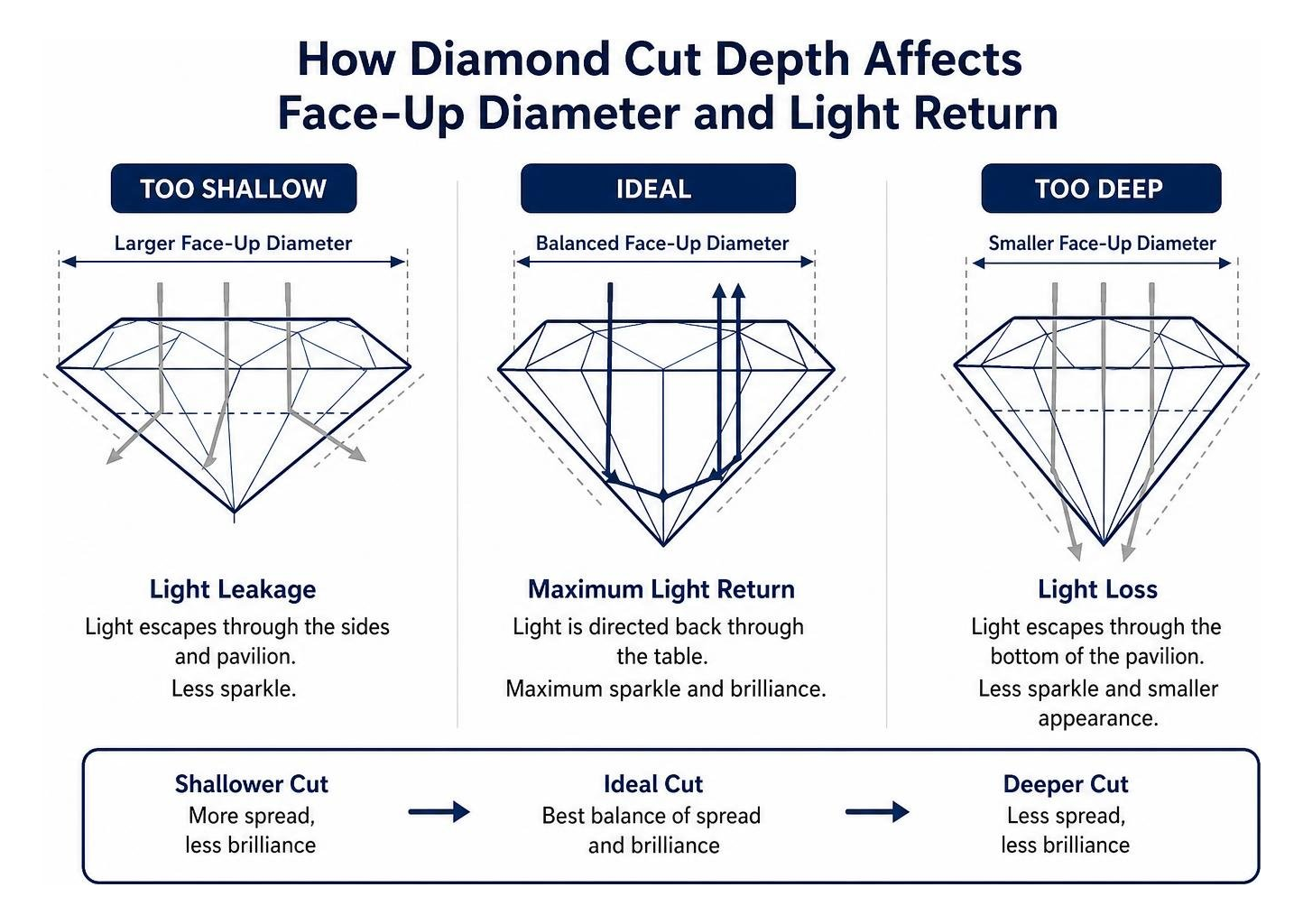
If a diamond is cut too deep, significant weight is hidden in the pavilion (the bottom half of the stone). This hidden mass does not contribute to the face-up spread and actually harms the diamond's ability to refract light back to your eye, resulting in a duller, smaller-looking stone. Conversely, a masterfully proportioned cut directs weight to the upper crown and table while maintaining ideal light return, creating maximum sparkle and visual spread.
Shapes That Maximize Finger Coverage
Diamond shape dictates how carat weight is distributed across the stone's surface. Elongated shapes distribute their weight across a greater surface length, making them appear noticeably larger than compact shapes of identical carat weight.
- Oval Cuts: With their elongated silhouette and brilliant faceting pattern, oval diamonds offer a generous face-up surface area that appears roughly 10% larger than a round diamond of equal weight.
- Marquise Shape: Featuring pointed ends and an extended body, the marquise cut boasts the largest surface area per carat of any traditional diamond cut, creating striking finger coverage.
- Pear Cut: Combining the softness of a round cut with the point of a marquise, pear-shaped diamonds draw the eye along the finger, delivering substantial visual scale.
- Emerald Cut: While step-cut diamonds sparkle with flashes rather than brilliant fire, their open, rectangular tables create an expansive, architectural presence on the hand.
In contrast, shapes like cushion cuts, princess cuts, and Asscher cuts carry more of their mass deep within the stone's belly. While they offer distinct charm and vintage appeal, they present a slightly smaller millimeter spread per carat than their elongated counterparts.
The Impact of Finger Size and Proportions
A diamond does not exist in isolation; it sits against the backdrop of your finger. Optical perception means that finger size dramatically alters how large a center stone appears.
Consider a classic 1.0-carat round diamond measuring approximately 6.5 mm:
- On a petite size 4 finger, that 6.5 mm stone covers roughly 45% of the finger's width, creating a bold, dominant appearance.
- On a size 8 finger, the exact same diamond covers closer to 35% of the width, presenting a more subtle, delicate look.
When selecting a ring design, as outlined in our solitaire engagement ring ultimate guide, matching the proportions of the band width and stone shape to your hand structure creates a harmonious, visually balanced piece.
Diamond Size Categories: From Petite to Statement Stones
To help navigate the marketplace, jewelers often categorize diamond carat sizes into distinct visual tiers:
- Petite (Under 0.75 Carats): Dainty and understated. These stones are ideal for minimalist solitaires, delicate vintage bands, or active wearers who prefer low-profile jewelry.
- Classic Average (0.90 to 1.25 Carats): The sweet spot for American engagement rings. This tier offers timeless proportions, substantial sparkle, and versatile styling options.
- Noticeably Large (1.50 to 2.00 Carats): Eye-catching and prominent. Stones in this range provide generous finger coverage and stand out across any room.
- Statement Piece (3.00+ Carats): High-impact luxury. These diamonds offer undeniable presence and serve as true focal points.
What Is Considered a Big Diamond Today?
In today's retail market, consumers generally consider any diamond of 3.0 carats or larger to be a "big" diamond.
Social media feeds often amplify multi-carat rings worn by celebrities, which can skew our perception of what everyday rings look like. In reality, stepping into a 2-carat stone already places a ring well above national averages. For a deeper breakdown of millimeter measurements and hand coverage in this category, our 2 carat diamond size guide provides detailed visual comparisons.
It is also worth noting a psychological phenomenon we often discuss with clients: diamonds mentally "shrink" over time. When you first put on an engagement ring, it may feel massive on your hand. Within a few months of daily wear, your eye adapts to the scale, and the stone simply feels natural.
The Most Popular Diamond Shapes and Sizes in 2026
The classic round brilliant remains the most popular diamond shape due to its unmatched light performance and 58 precisely angled facets. However, oval diamonds continue to hold strong market share among couples seeking elongated lines and maximized finger coverage.
Recent industry reviews, including bridal trend analysis from What Is the Average Carat Size for a Diamond Engagement Ring?, highlight a growing appreciation for emerald, radiant, and pear cuts. For a comprehensive look at current silhouette and mounting trends, explore our engagement ring styles guide 2026.
How to Choose the Ideal Carat Size for Your Lifestyle and Budget

Selecting an engagement ring should be an exciting experience rather than a mathematical compromise. Finding the right balance involves looking at your daily routine, design preferences, and financial comfort.
Finding the Ideal Average Engagement Ring Carat for Your Daily Life
A ring should complement your day-to-day life effortlessly. If you work in healthcare, fitness, culinary arts, or any field requiring frequent glove use or hands-on activity, practical design choices matter:
- Setting Height: High-prong settings showcase large stones dramatically, but they catch more easily on fabrics and equipment. A lower-profile cathedral or bezel setting provides excellent protection for daily wear.
- Prong Security: Larger stones require sturdy prongs. Platinum or 14k gold prongs offer durable grip, especially for shapes with delicate tips like marquise or pear cuts.
- Comfort: If you prefer an active lifestyle, choosing a well-proportioned 1.0 to 1.5-carat stone in a secure mount often provides the ideal blend of sparkle and practicality.
Creative Ways to Enhance or Upgrade Diamond Presence Later
Your engagement ring design is not set in stone forever. There are several ways to expand visual presence over time:
- Layering with Stacking Bands: Adding diamond-accented wedding bands, contoured chevron bands, or eternity rings creates extensive finger coverage without modifying your center stone.
- Adding Side Stones or a Halo: Resetting your center diamond into a three-stone mounting or surrounding it with a delicate pavé halo adds significant overall width.
- Milestone Anniversary Upgrades: Many couples begin with a classic diamond and choose to trade up or reset their center stone to celebrate a 5th, 10th, or 20th anniversary.
Frequently Asked Questions About Diamond Carat Sizes
What is the most commonly purchased diamond carat size?
The most frequently purchased diamond carat range in the United States is between 0.90 and 1.50 carats, with 1.00 to 1.20 carats serving as the median center stone weight.
Does a higher carat weight always look bigger on the finger?
Not necessarily. A diamond cut with excessive depth hides weight beneath the setting, resulting in a smaller face-up diameter and diminished brilliance. A well-proportioned diamond of slightly lower carat weight often appears larger and brighter than a poorly cut heavier stone.
How can you maximize carat size without exceeding your budget?
To maximize size while maintaining budget comfort:
- Select elongated shapes (oval, pear, marquise, or emerald) which offer greater surface spread.
- Choose "under-size" carat weights (such as 0.90 ct or 1.90 ct) just below traditional round-number price jumps.
- Prioritize Cut grade above all else, while selecting eye-clean SI1 clarity and near-colorless (G–H) grades that look pristine to the naked eye.
Conclusion
While market data shows that the typical center stone in the U.S. rests right around one carat, the ideal ring is never defined by statistics. The right diamond is the one that brings you joy, complements your hand, fits seamlessly into your daily life, and respects your financial comfort.
At Washington Diamond, we believe choosing an engagement ring should be a relaxed, pressure-free journey. In our private, appointment-only studio in Northern Virginia, we provide our undivided attention to help you examine diamonds side by side in natural light, demystify proportions, and find the perfect piece for your story. When you are ready to begin, we invite you to explore custom engagement rings with our team.
Have a question about your jewelry?
We've been helping clients with diamonds, custom design, repairs, appraisals, and more since 1969. Book a private appointment at our Falls Church studio.
Book an AppointmentTrusted since 1969 · Falls Church, VA · 703-536-3600
From the blog
View all


