

Average Diamond Sizes and Why You Might Want to Go Bigger
What Is the Average Diamond Size for an Engagement Ring?

The average diamond size for a U.S. engagement ring is about 1.7 carats overall, while the average center stone is 1.8 carats, based on 2024 survey data. That figure has risen from 1.6 and 1.7 carats, respectively, in 2023, largely because lab-grown diamonds make larger stones more reachable for many buyers.
| Diamond category | Typical average carat weight |
|---|---|
| U.S. engagement ring, total diamond weight | 1.7 carats |
| U.S. engagement ring, center stone | 1.8 carats |
| Lab-grown engagement-ring center stone | 2.0 carats |
| Natural diamond engagement-ring center stone | 1.6 carats |
| Diamond sold across all jewelry types | 0.7 carats |
Still, averages are only a starting point. A diamond's carat weight measures weight, not how large it looks from the top. Shape, cut proportions, and ring design can make two diamonds of the same weight look very different on the hand.
I am Tom Daube, a GIA-trained diamond professional, jewelry designer, and diamond recutting specialist who helps clients compare average diamond size with the real-world proportions and visual impact that matter. Before deciding whether to go bigger, it helps to understand what the numbers actually mean.
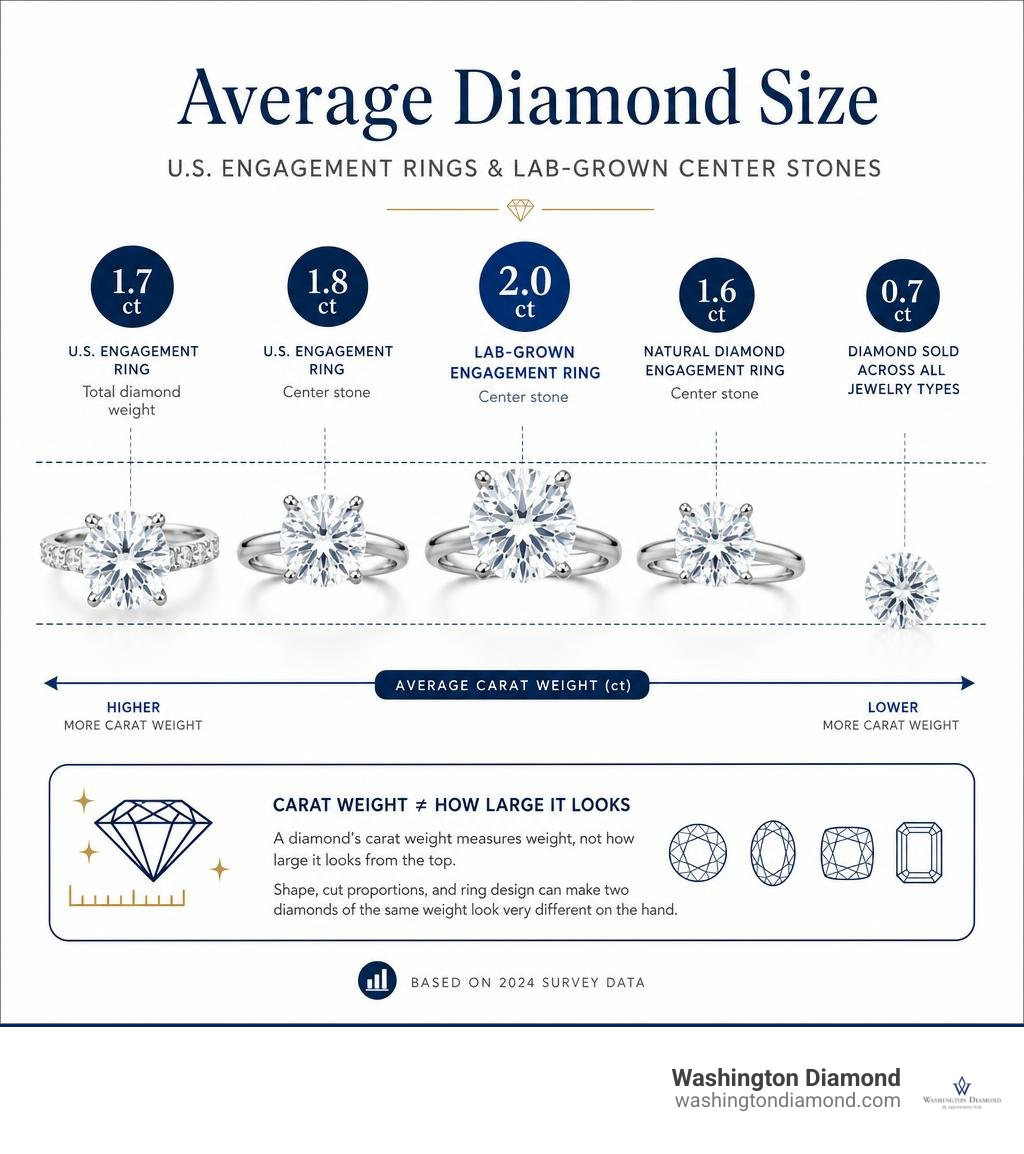
Quick look at average diamond size:
Understanding the National Average Diamond Size Trends

When we look at broader engagement ring trends, national numbers paint a fascinating picture of how preferences have evolved over time. Across the United States, the typical engagement ring features a total weight around 1.7 carats, with center stones alone averaging 1.8 carats. However, this metric changes depending on what type of diamond is selected and where the buyer lives.
For natural mined diamonds, the average center stone has held remarkably steady at 1.6 carats for several consecutive years. In contrast, lab-grown center stones average an impressive 2.0 carats. Today, about 33% of engagement rings purchased feature a center stone over 2 carats, and lab-grown options have expanded to capture over half of the engagement ring market share.
To explore more broad industry metrics, view Diamond Statistics 2026. If you are interested in standard round cut dimensions, check out our 1 Carat Round Diamond Complete Guide.
Average Diamond Size Across Major US Cities and Global Regions
Geographic factors heavily influence expectations around average diamond size. In major U.S. metropolitan areas—including suburban hubs like Northern Virginia—buyers frequently seek center stones between 1.5 and 2.5 carats. In contrast, smaller U.S. towns often average between 0.5 and 0.7 carats.
Looking internationally reveals even greater contrasts:
- Europe: Understated elegance dominates. Average diamond sizes range from 0.5 to 0.8 carats, with the UK averaging around 0.6 carats.
- Asia: High clarity and exceptional color take priority over raw mass. Averages range from 0.5 to 0.7 carats, with Japan prioritizing delicate craftsmanship at around 0.3 carats.
For more regional breakdowns, see What is the Average Diamond Size for an Engagement Ring?.
Mined vs Lab-Grown Diamonds: The New Shift in Average Diamond Size
The shift toward lab-grown diamonds is the primary engine behind rising national averages. Lab-created gems possess identical chemical, physical, and optical characteristics to earth-mined diamonds, yet cost significantly less per carat.
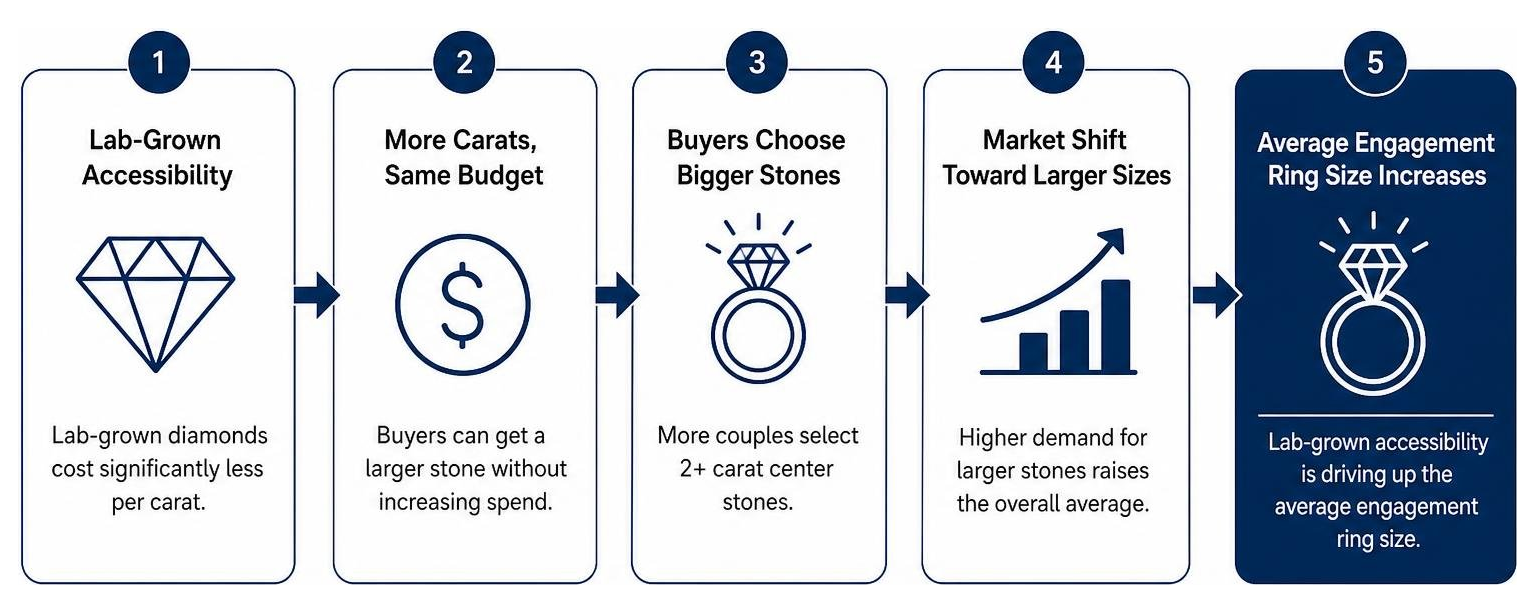
Because a couple can secure a 2-carat lab-grown stone for a fraction of the cost of a similar natural diamond, many buyers choose to scale up their center stone without increasing their total spend. To compare current pricing dynamics, read our breakdown on 3 Carat Lab Grown Diamond Price.
Carat Weight vs. Face-Up Visual Size
One of the most frequent misconceptions we address in our studio is the belief that carat weight dictates physical dimensions. Carat measures weight (1 carat = 0.2 grams), not surface footprint. A deep stone hides weight in its belly, whereas an elongated shape spreads weight across its top plane.
| Diamond Shape | Ideal 1.00 ct Surface Footprint | Visual Size Impression | Relative Face-Up Surface Area Rank |
|---|---|---|---|
| Marquise | ~10.0 x 5.0 mm | Largest visual impact | 1 (Largest) |
| Trillion | ~6.5 x 6.5 mm | Very bold geometry | 2 |
| Pear | ~8.5 x 5.5 mm | Substantially elongated | 3 |
| Oval | ~7.7 x 5.7 mm | Exceptionally spacious | 4 |
| Round Brilliant | ~6.5 x 6.5 mm | Standard baseline | 5 |
| Princess | ~5.5 x 5.5 mm | Compact footprint | 8 |
| Asscher | ~5.5 x 5.5 mm | Smallest relative top view | 11 (Smallest) |
In real-world inventory, cutters frequently preserve weight to cross "magic weight thresholds" (like 1.00 ct or 2.00 ct) where pricing jumps exponentially. For instance, data from hundreds of thousands of loose stones shows thousands of 1.01 ct diamonds available, but hardly any at 0.99 ct. To review an extensive technical study on shape surface area, read the Carat Weight vs. Face-Up Size Analysis.
How Diamond Cut and Proportions Alter Real Dimensions
A stone's cut grade fundamentally governs its visual presence. An Excellent or Ideal cut reflects light precisely out of the top table, making the gem appear up to 10% larger. Conversely, a diamond cut too deep masks carat weight beneath the girdle plane, leaving a dull, smaller face-up footprint.
Key proportion parameters include:
- Table Percentage: The flat top facet area relative to total width.
- Pavilion Depth: The lower pavilion angle; if too steep, light leaks out the sides.
- Girdle Thickness: A heavy girdle adds invisible weight without improving top surface area.
To learn more about selecting properly proportioned stones, browse our Loose Diamonds Complete Guide.
Fancy Diamond Shapes That Face Up Larger
Fancy elongated shapes offer clever optical advantages. Oval, marquise, and pear cuts distribute diamond mass horizontally and vertically across the finger, appearing up to 15% larger than a round diamond of equal carat weight.
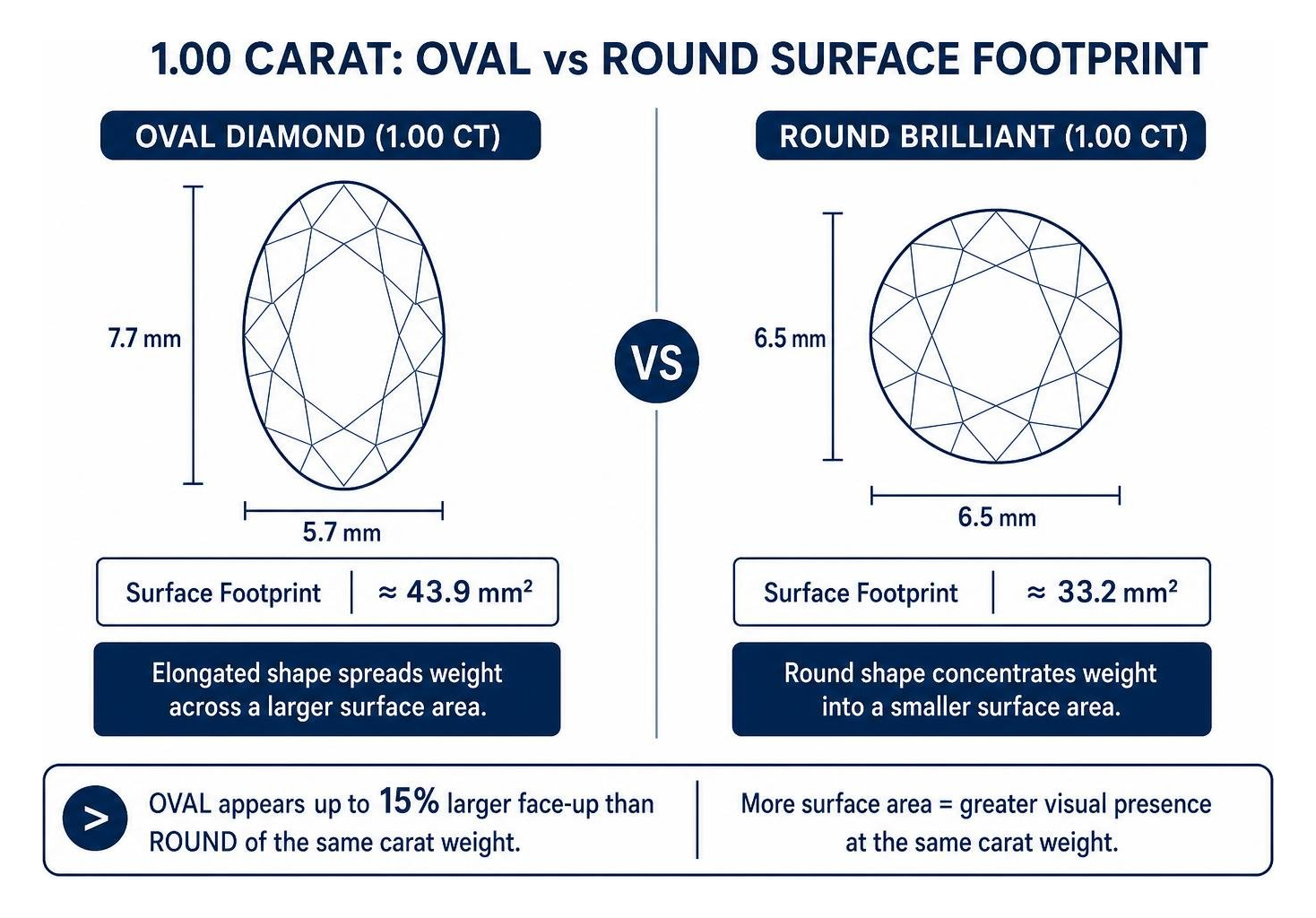
An oval diamond, for instance, draws the eye along its length, creating an elongating effect on the hand while covering more surface area. Explore full dimensions in our 1 Carat Oval Diamond Guide 2026.
Strategic Ways to Maximize Visual Size Without Overspending
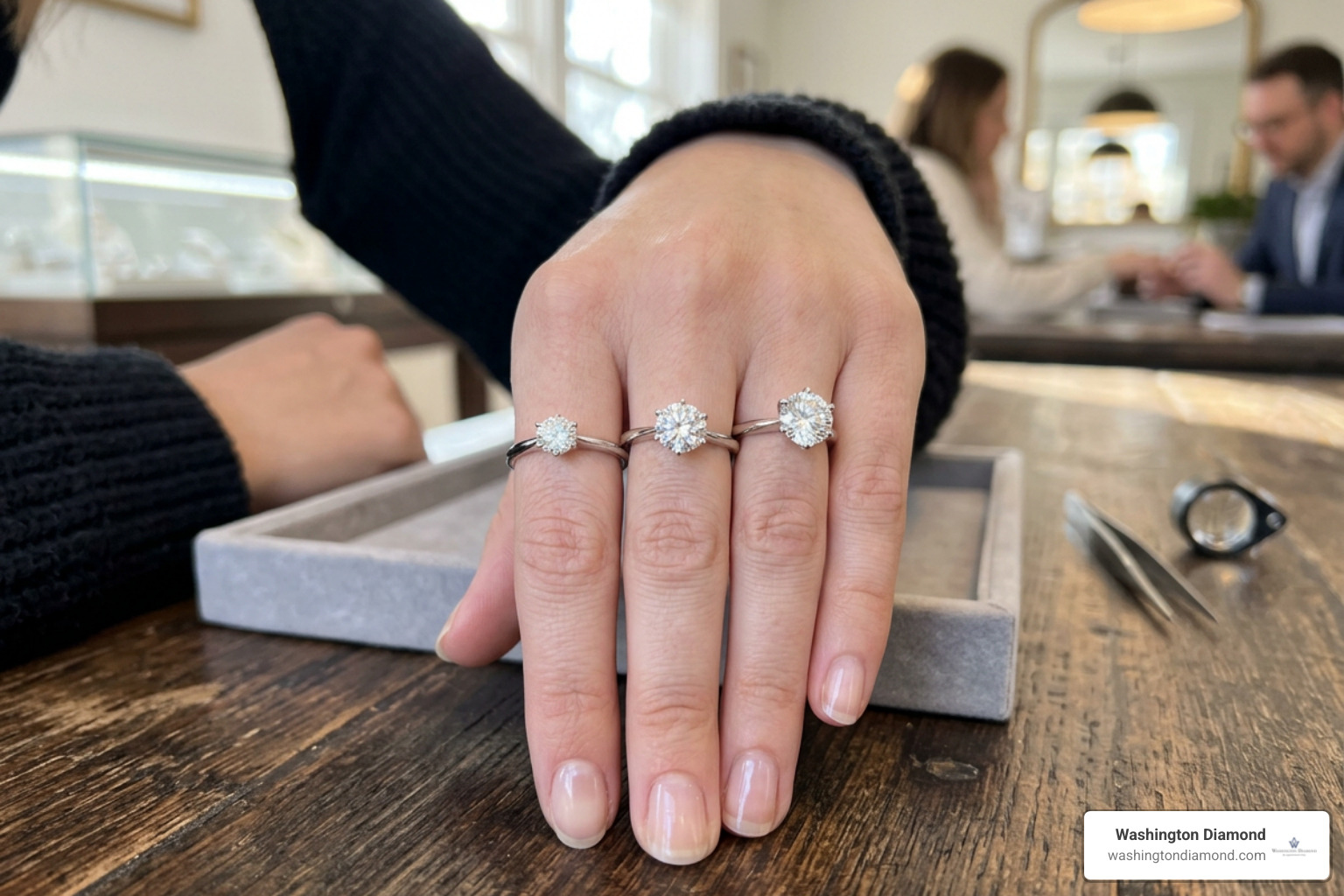
You do not need to double your budget to achieve a striking, high-impact aesthetic. By pairing smart setting design with strategic diamond selection, you can magnify the perceived size of your center gem.
- Halo Settings: A frame of delicate pavé accent stones around the center stone can increase visual presence by 10% to 30%.
- Cathedral Mountings: Arching bands elevate the center stone high above the finger plane, drawing light beneath and amplifying visibility.
- Slender Bands: Selecting a delicate 1.5mm to 1.8mm band creates a slim contrast that makes the center stone look noticeably prominent.
For setting inspiration, see our guide on the 1 Carat Cathedral Setting Guide.
Optimizing the 4Cs to Upgrade Your Carat Weight
To allocate maximum funds toward carat size without sacrificing beauty, apply strategic trade-offs across the 4Cs:
- Clarity: Skip internal perfection. A VS2 or eye-clean SI1 grade looks completely clear to the naked eye while unlocking substantial budget savings.
- Color: Near-colorless grades (G through I) present a crisp white visual face when set in white gold or platinum, saving up to 25% over colorless D-F stones.
- Cut: Never compromise on cut quality. Superior brilliance creates high contrast and sparkle, making the diamond look visibly expansive.
Review our tutorial on How to Calculate Diamond Price Per Carat to optimize your budget.
Choosing Lab-Grown Diamonds to Reach 2 Carats and Beyond
For clients seeking a 2.0-carat or larger footprint within a fixed budget, lab-grown diamonds offer an enticing avenue. Because lab-grown pricing scales comfortably without extreme per-carat price jumps, buyers can select top-tier cut, color, and clarity parameters alongside a substantial center stone.
To evaluate larger carats, consult our comprehensive 2 Carat Diamond Size Guide.
Key Factors When Choosing to Purchase Beyond National Carat Norms
While standard averages provide a helpful benchmark, personal lifestyle, hand structure, and style choices should always guide your decision. A 2.5-carat ring might feel magnificent for evening wear, but an active daily routine could call for low-profile mountings or protective bezel settings.
Consider how these aspects align with your expectations:
- Finger Size: A 1.0-carat stone offers substantial coverage on a size 4 finger, whereas a size 8 finger may accommodate a 1.8-carat stone with a similar visual balance.
- Proportion Preference: Matching the shape to your hand shape ensures a harmonious look. Read The Perfect Diamond Shape for Every Personality.
- Value Retention: Only 9% of natural diamonds mined are 1 carat or larger, contributing to 65% of total sales by value. Review comprehensive industry statistics at 100+ Diamond Statistics | Verified 2026 Data.
Frequently Asked Questions About Diamond Sizes
What is the average diamond size for an engagement ring in the US?
The overall average diamond size in the U.S. is approximately 1.7 carats total weight, with center stones averaging 1.8 carats. For natural earth-mined diamonds, the center stone average sits around 1.6 carats, while lab-grown center stones average 2.0 carats.
Does a higher carat weight always mean a visibly larger diamond?
No. Carat is a measure of weight, not physical size. Proportions matter immensely: shallow or elongated cuts (such as ovals and marquises) face up larger than deep cuts (such as cushions or princess cuts) of identical carat weight.
How much can lab-grown options increase my target diamond size?
Lab-grown diamonds typically offer savings that allow buyers to purchase center stones 30% to 50% larger than natural counterparts within the exact same spending threshold.
Conclusion
Finding the perfect ring isn't about matching a national benchmark—it's about finding the precise balance of proportions, setting architecture, and personal style that brings you delight every single day.
At Washington Diamond, we welcome you to our private, appointment-only studio in Northern Virginia. We provide undivided personal attention, guided expert comparisons, and an unhurried atmosphere so you can explore natural and lab-grown options at your own pace.
Ready to see how different carat sizes and cut shapes look on your hand? Schedule a Private Appointment with our expert team today.
Have a question about your jewelry?
We've been helping clients with diamonds, custom design, repairs, appraisals, and more since 1969. Book a private appointment at our Falls Church studio.
Book an AppointmentTrusted since 1969 · Falls Church, VA · 703-536-3600
From the blog
View all


