

Step-by-Step Guide to Choosing a Diamond Ring
What to Know Before Buying a Diamond Ring

Choosing a diamond ring is one of the most meaningful purchases you'll ever make. Whether it's for an engagement, anniversary, or personal milestone, the right ring should reflect both your taste and your values.
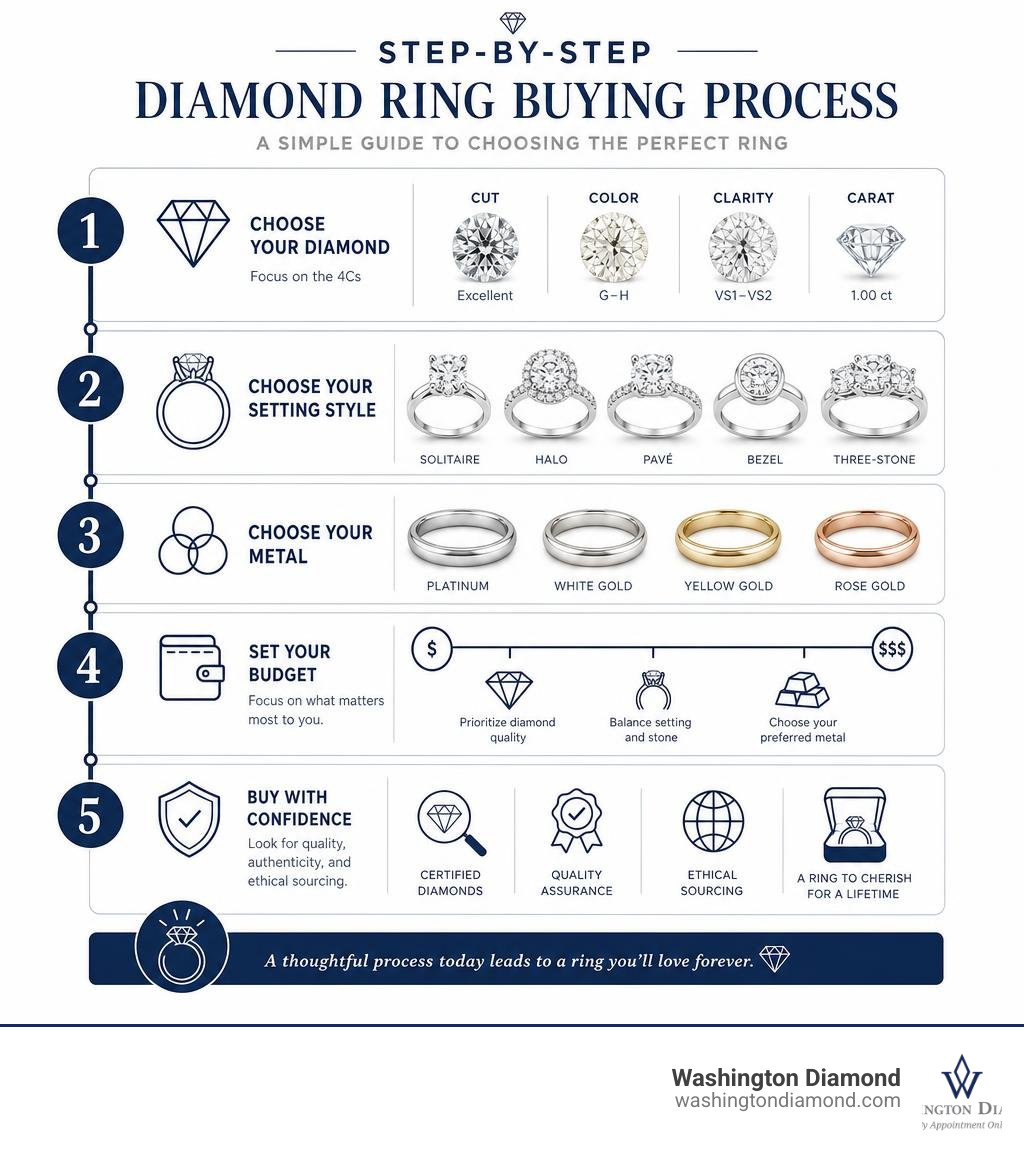
Here's a quick overview of the key decisions involved:
| Decision | What to Consider |
|---|---|
| Diamond type | Natural, lab-grown, or alternative gemstone |
| The 4Cs | Cut, color, clarity, and carat weight |
| Setting style | Solitaire, halo, pave, bezel, three-stone |
| Metal type | Platinum, white gold, yellow gold, or rose gold |
| Budget | Average 1-carat natural diamond ring runs $5,000-$6,500 at major U.S. retailers |
| Ethical sourcing | Conflict-free and traceable diamond origins |
The global diamond jewelry market was valued at around $79.4 billion in 2023, and it's growing fast. Lab-grown diamonds are gaining serious ground, now making up roughly 10% of the market and growing at over 15% per year. Meanwhile, styles are shifting too, with elongated shapes like oval and emerald cuts trending strongly in 2026.
For a trusted overview of diamond quality factors, the Gemological Institute of America explains how the 4Cs are used to evaluate diamonds.
There's a lot to navigate. But the right guidance makes it simple.
I'm Tom Daube, a jewelry designer and diamond specialist with top 1% recognition in the industry, and I've spent my career helping people find clearly better diamond rings - almost always priced under listed wholesale. In this guide, I'll walk you through every step so you can shop with total confidence.
Understanding the 4Cs of a Diamond Ring
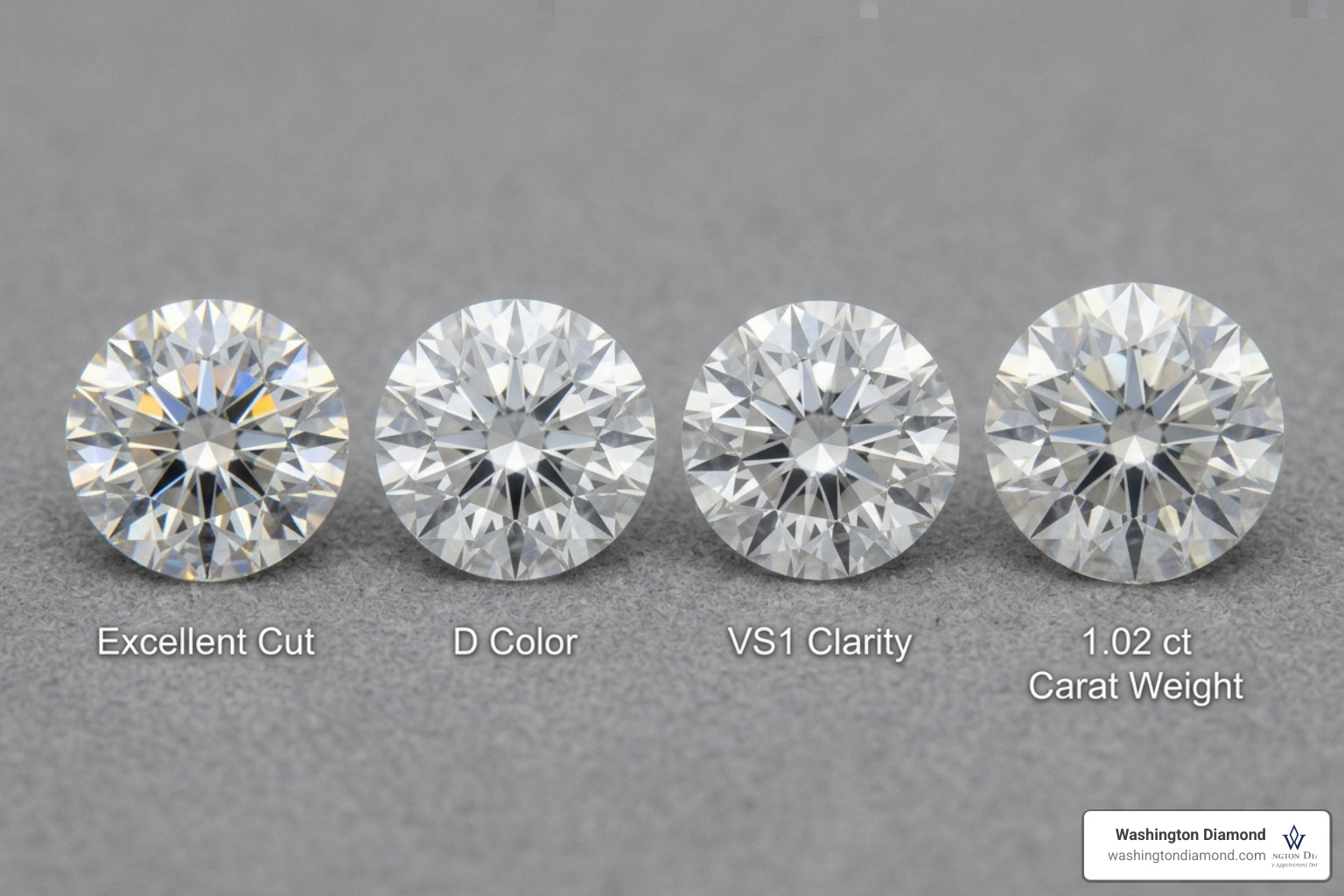
When you begin searching for a diamond ring, the "4Cs"—Cut, Carat Weight, Clarity, and Color—serve as your universal roadmap. Established by the Gemological Institute of America (GIA), this grading system determines both the beauty and the market value of every diamond on Earth.
Understanding how these four elements interact allows you to balance your budget while maximizing the visual impact of your ring.
| Diamond Shape | Cut Type | Light Performance | Best Suited For |
|---|---|---|---|
| Round Brilliant | Brilliant | Maximum sparkle and fire | Classic, timeless solitaire designs |
| Oval | Brilliant | High brilliance, elongates the finger | Modern, elegant, and flattering styles |
| Emerald Cut | Step Cut | Sleek, hall-of-mirrors effect | Vintage, art-deco, and sophisticated looks |
| Princess | Brilliant | Sharp, modern square sparkle | Contemporary, clean-lined settings |
| Cushion | Modified Brilliant | Soft, romantic vintage glow | Halo settings and romantic designs |
Selecting the Perfect Diamond Ring Cut
Of all the 4Cs, the cut has the most dramatic impact on how a diamond looks. Many people confuse "cut" with "shape" (such as round, pear, or oval), but cut actually refers to how well a diamond's facets interact with light.
A masterfully fashioned brilliant cut diamond acts like a highly tuned system of mirrors. Light enters through the top (the table), bounces off the internal walls (the pavilion), and reflects back out through the top to your eye in a display of blinding sparkle.
If a diamond is cut too shallow or too deep, the light leaks out of the sides or the bottom, leaving the stone looking dull, dark, and lifeless—no matter how large or pure it is.
When shopping for fancy shapes (any shape other than round, such as marquise, pear, or emerald cuts), light performance behaves differently. Step cuts, like the emerald cut, prioritize long, clean lines and structural clarity over pure sparkle.
We always advise our clients to prioritize cut quality above all else. A slightly smaller, exceptionally cut diamond will always look more radiant and eye-catching than a larger diamond with a mediocre cut.
Evaluating Carat, Clarity, and Color
Once you have selected your preferred cut and shape, it is time to balance the remaining three Cs:
- Carat Weight: This measures the diamond's physical weight, not its visual size. One carat equals 200 milligrams. Because large diamonds are rare in nature, prices jump exponentially at whole-carat marks (such as 1.00 ct, 1.50 ct, or 2.00 ct). To get the best value, we often recommend buying "under the mark"—for example, a 0.90-carat diamond will look virtually identical to a 1.00-carat diamond but can save you a significant amount of money.
- Clarity: This measures the purity of the diamond. Natural diamonds are formed deep within the earth under immense heat and pressure, which leaves tiny internal marks called "inclusions" and surface blemishes called "blemishes." The clarity scale ranges from Flawless (FL) to Included (I3). You do not need to pay a premium for a Flawless diamond; choosing an "eye-clean" diamond in the VS1, VS2, or even SI1 ranges means the inclusions are invisible to the naked eye, saving you thousands of dollars.
- Color: This scale measures the absence of color in a white diamond, starting at D (completely colorless) and running down to Z (light yellow or brown). Unless you are setting your diamond in platinum or white gold, you do not need a D, E, or F color grade. If you choose a yellow gold or rose gold band, the warm metal will reflect through the stone, meaning a G, H, or even I color diamond will look perfectly white and save you a substantial portion of your budget.
No matter which combination you choose, always ensure your stone comes with an independent, third-party grading report, preferably from the GIA. This certification is your blueprint, proving that the diamond you are buying matches the quality you are paying for.
Choosing the Right Metal, Setting, and Care
The centerpiece diamond may be the star of the show, but the metal band and setting style act as the director. Together, they secure the stone, protect it from daily wear, and define the overall aesthetic of your diamond ring.

Popular Settings for Your Diamond Ring
The setting refers to how the diamond is secured to the metal band. Each style offers a different balance of security, light exposure, and personality:
- The Solitaire Setting: The ultimate classic. It features a single diamond held aloft by subtle metal prongs (usually four or six). This style allows the maximum amount of light to enter the diamond from all angles, creating unmatched brilliance.
- The Halo Setting: A central diamond is encircled by a border of smaller accent diamonds. This not only adds immense sparkle but also tricks the eye into believing the center diamond is significantly larger than its actual carat weight.
- The Pavé Band: The band of the ring is paved with tiny, hand-set diamonds held in place by microscopic beads. This creates a continuous line of light along the finger.
- The Bezel Setting: A modern and highly secure choice where a thin metal rim completely surrounds the edge of the diamond. This protects the stone's fragile edges from chipping and is perfect for active lifestyles.
- The Three-Stone Design: Also known as the "trilogy" setting, this style features a center stone flanked by two side stones, traditionally symbolizing a couple's past, present, and future.
Matching Metals and Caring for Your Ring
Selecting the right metal is a balance of style, skin tone, and durability.
- Platinum: The most secure and durable precious metal. It is naturally hypoallergenic and has a cool, white sheen that never fades. Over time, it develops a soft, satin finish known as a patina, which many find highly desirable.
- White Gold: Offers a similar cool aesthetic to platinum but is lighter and more affordable. It is alloyed with white metals and plated with rhodium to give it a mirror-like finish, which will require replating every few years.
- Yellow Gold: A classic, warm choice that has seen a massive resurgence in popularity. It naturally complements diamonds with warmer color grades (G through J).
- Rose Gold: Created by alloying gold with copper, rose gold offers a romantic, vintage-inspired pink hue that looks stunning on all skin tones.
To keep your diamond ring looking as brilliant as the day you first put it on, regular maintenance is essential. Diamonds are natural grease magnets; lotions, soaps, and skin oils quickly build up on the underside of the stone, blocking light and dulling its sparkle.
To clean your ring at home, soak it in warm water mixed with a few drops of mild dish soap for 20 to 30 minutes. Gently brush the stone and setting with a brand-new, soft-bristled toothbrush, rinse thoroughly under warm running water (make sure the drain is plugged!), and dry with a lint-free cloth.
For safety and longevity, we recommend having your ring professionally inspected and deep-cleaned at least once or twice a year to ensure the metal prongs remain tight and the stones are secure.
Natural vs. Lab-Grown Diamonds and Alternative Gemstones
One of the most important decisions modern buyers face is choosing between a natural diamond, a lab-grown diamond, or an alternative gemstone.
Natural diamonds are geological miracles, forged over billions of years deep within the Earth's mantle under extreme heat and pressure. They carry an inherent rarity, prestige, and long-term value retention that makes them highly sought-after heirlooms.
Lab-grown diamonds, on the other hand, are grown in highly controlled laboratory environments that replicate the natural conditions of the Earth. Using either High Pressure High Temperature (HPHT) or Chemical Vapor Deposition (CVD) technology, scientists can grow a diamond crystal from a carbon seed.
It is crucial to understand that lab-grown diamonds are chemically, physically, and optically identical to natural diamonds. They are not fakes; they are real diamonds with the exact same hardness (10 on the Mohs scale) and refractive index.
Because the supply chain is shorter and they can be produced on demand, lab-grown diamonds offer incredible value, often costing 60% to 80% less than natural diamonds of the same quality. This allows buyers to significantly increase their carat size while staying within their budget.
For those looking beyond diamonds, alternative gemstones offer a vibrant splash of personality:
- Moissanite: A gemstone originally discovered in a meteor crater. It has a higher refractive index than diamonds, meaning it actually sparkles more than a diamond, throwing off fiery, rainbow-colored flashes of light at a fraction of the cost.
- Sapphires: Known for their deep, velvety blues (though they actually come in almost every color of the rainbow), sapphires are incredibly durable (9 on the Mohs scale) and make for stunning, timeless engagement rings.
When making your choice, ethical sourcing should also play a role. Today's buyers want to know where their gemstones come from.
At Washington Diamond, we believe in complete transparency, ensuring every natural stone we source is conflict-free and ethically mined, while also offering premium lab-grown options for those seeking a modern, sustainable choice.
Frequently Asked Questions about Diamond Rings
Buying a fine piece of jewelry comes with plenty of questions. Here are some of the most common concerns we hear from clients in our Northern Virginia studio.
What is the average price of a 1-carat diamond ring?
The price of a 1-carat diamond ring varies dramatically depending on whether the stone is natural or lab-grown, as well as its cut, color, and clarity.
On average, a 1-carat round brilliant natural diamond engagement ring at major U.S. retailers ranges from $5,000 to $6,500. However, if you choose a lab-grown diamond, you can find stunning, high-quality 1-carat options starting for significantly less, often between $1,500 and $2,500 depending on the complexity of the metal setting.
How do I find the correct ring size secretly?
Sizing a ring in secret is an art form. Here are a few clever ways to do it without raising suspicion:
- Borrow an existing ring: Sneak a ring they regularly wear on their ring finger out of their jewelry box. Trace the inside of the ring on a piece of paper, or press it gently into a bar of soap to create an impression.
- The string or paper method: If they are a heavy sleeper, you can carefully wrap a piece of thread around their ring finger while they sleep, marking the point where the ends meet.
- Enlist a friend: Have a close friend or family member casually bring up jewelry or take them "fun shopping" to try on rings.
If all else fails, buy a slightly larger size. It is much easier for a jeweler to resize a ring smaller than it is to stretch it larger.
Are lab-grown diamonds real diamonds?
Yes, absolutely. Lab-grown diamonds are real diamonds. They are not cubic zirconia or synthetic stimulants.
They possess the exact same chemical composition (pure carbon), physical properties, and optical characteristics as natural diamonds. The only difference is that they were grown in a laboratory over several weeks rather than in the earth over billions of years. Even professional gemologists cannot tell them apart without specialized laboratory equipment.
Conclusion
Finding the perfect diamond ring doesn't have to be an overwhelming or stressful experience. By understanding the 4Cs, selecting a setting that matches your lifestyle, and deciding between natural and lab-grown stones, you can make an informed purchase that will be cherished for generations.
At Washington Diamond, we offer a highly personalized, appointment-only private studio experience in Northern Virginia. We believe that choosing a piece of jewelry for life's most meaningful moments deserves undivided attention, expert guidance, and a relaxed, pressure-free environment.
Ready to begin your journey? Schedule a private consultation with Washington Diamond today, and let us help you bring your dream ring to life.
Have a question about your jewelry?
We've been helping clients with diamonds, custom design, repairs, appraisals, and more since 1969. Book a private appointment at our Falls Church studio.
Book an AppointmentTrusted since 1969 · Falls Church, VA · 703-536-3600
From the blog
View all


