

Put a Ring on It: The Real Average Cost for Engagement Ring
Average Cost for Engagement Ring in 2026: The National Benchmarks
Navigating the landscape of ring pricing can feel overwhelming, but looking at current market data provides a helpful starting point. In 2026, the national average spend sits at $6,200, representing a continued upward climb reflecting a +17.7% increase in jewelry prices over the last five years (2022–2026). However, because high-end luxury purchases mathematically pull the arithmetic average upward, looking at the median spend of $3,000–$4,000 gives us a clearer picture of what the typical American couple actually spends.
In fact, about 33% of couples purchase rings for under $3,000, while roughly 70% keep their total expenditure between $2,000 and $8,000. For an in-depth look at historical data, check out the How Much Does Engagement Ring Cost? (2026 Guide) | CostWhale source or read our comprehensive engagement ring prices guide 2026.
| Diamond & Ring Category | National Average | Typical Budget Range | Median Spend |
|---|---|---|---|
| Mined Natural Diamond Ring | $5,500 – $6,200 | $4,000 – $10,000 | $3,500 – $4,500 |
| Lab-Grown Diamond Ring | $3,800 | $1,800 – $5,200 | $2,500 – $3,500 |
| Moissanite / Alternative Gemstone | $1,200 | $500 – $2,000 | $800 – $1,500 |
How Carat Size Influences the Average Cost for Engagement Ring
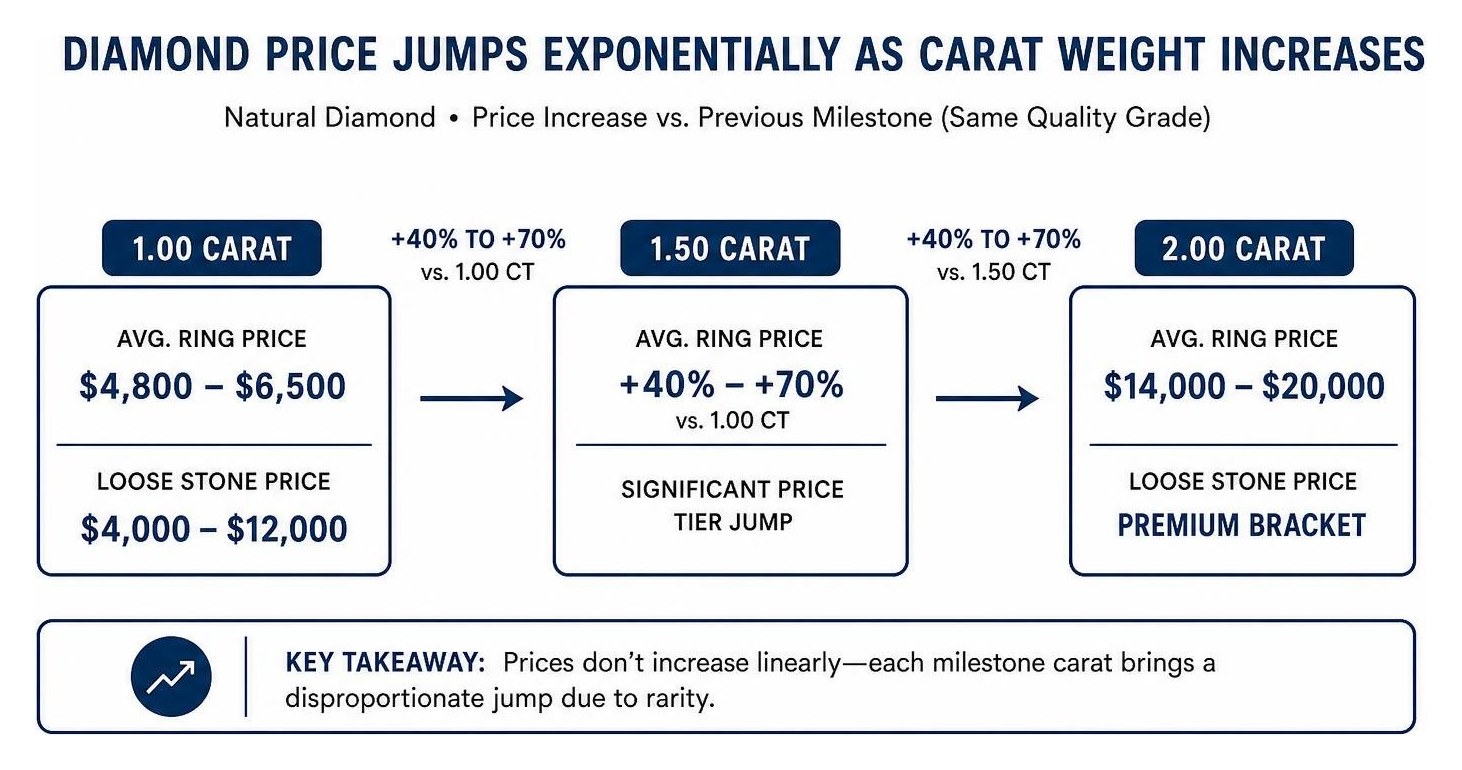
The center stone typically accounts for 75% to 90% of a ring's total price. Carat weight is by far the biggest pricing driver, but diamond pricing isn't linear—it's exponential. As diamonds grow larger, natural gem-quality rough becomes exponentially rarer in nature, causing prices per carat to jump steeply at whole milestone numbers (like 1.00, 1.50, and 2.00 carats).
- 1 Carat Benchmark: A 1.0 carat natural diamond ring generally ranges from $4,800 to $6,500 (with loose stone prices ranging from $4,000 to $12,000 depending on color and clarity). Conversely, a 1.0 carat lab-grown diamond ring averages $1,800 to $2,500. Learn more in our 1 carat oval diamond price guide.
- 1.5 Carat Benchmark: Moving to a 1.50 carat natural diamond introduces a significant price tier jump, often adding 40% to 70% in cost over a 1.0 carat stone of equal grade.
- 2 Carat Benchmark: A 2.0 carat natural diamond ring reaches a premium bracket of $14,000 to $20,000, whereas a lab-grown alternative ranges from $5,200 to $7,500. Explore the complete breakdown in our guide on decoding the dollar your guide to 2 carat diamond pricing.
State-by-State Engagement Ring Spending Variations
Where you live heavily dictates regional purchasing habits. High local costs of living, regional disposable income rates, and local cultural norms shape proposal budgets across the country. According to nationwide spatial data from Engagement Ring Cost by State 2026, state averages vary dramatically.
Washington leads the nation with an average ring cost of $10,109, followed closely by California at $9,482 and Illinois at $9,197. On the lower end of the spectrum, South Dakota averages $3,005. Here in our local Mid-Atlantic region, spending sits noticeably above national benchmarks. For instance, couples in Virginia spend an average of $7,934, reflecting the strong economic dynamics and personal income levels of Northern Virginia.
Natural vs. Lab-Grown Diamonds: Comparing Total Ring Costs
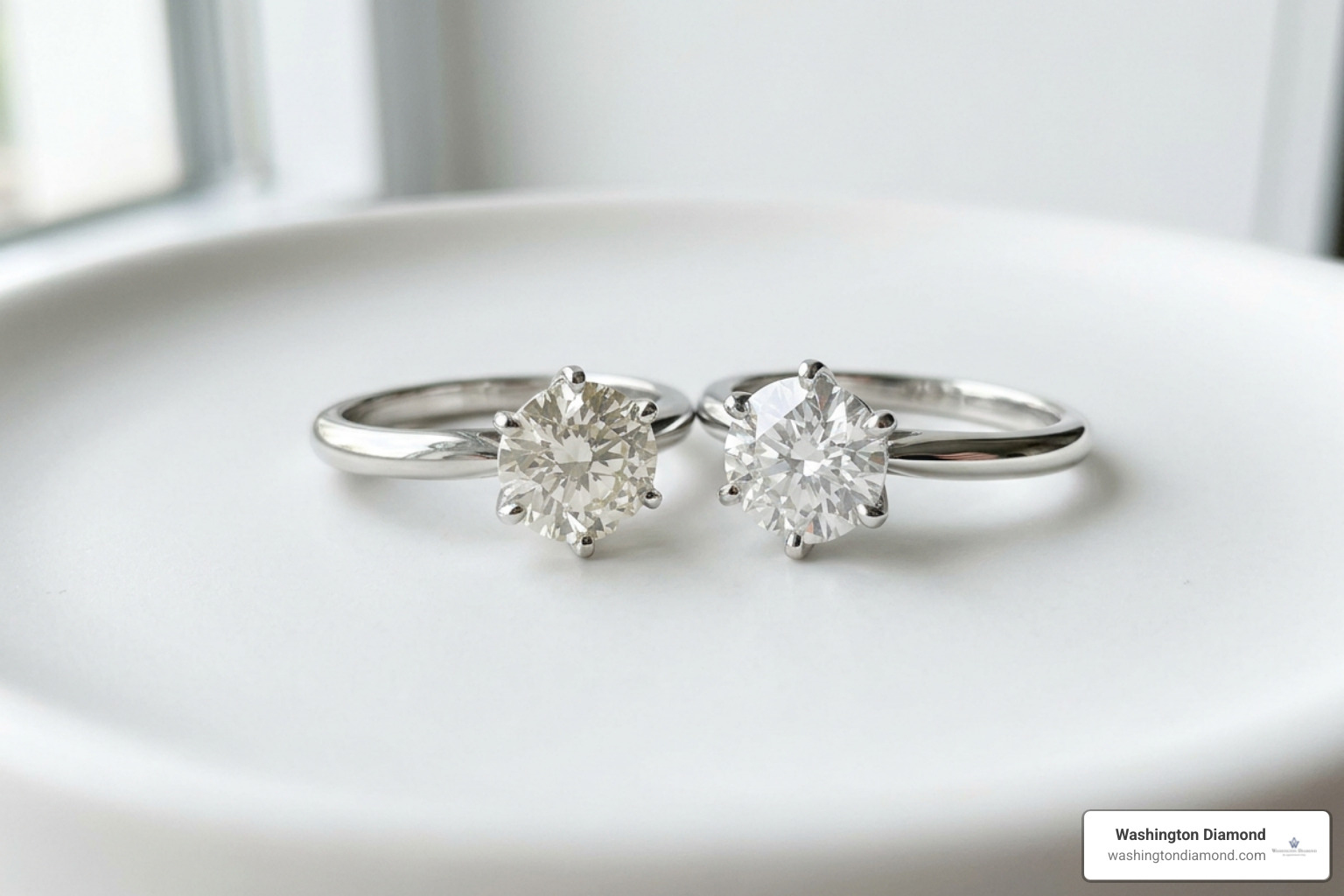
One of the most impactful choices you will make when balancing your average cost for engagement ring budget is selecting between a natural mined diamond and a lab-grown diamond.
Chemically, physically, and optically, lab-grown diamonds are identical to natural mined diamonds. They are graded on the exact same 4C scale by independent gemological laboratories like IGI and GIA. However, lab-grown diamonds cost 70% to 80% less than natural diamonds.
- Price Advantage: An average lab-grown engagement ring costs roughly $3,800, allowing buyers to secure a larger stone or a more intricate custom setting without stretching their finances. For example, a 2.0 carat lab-grown diamond ring costs between $5,200 and $7,500, whereas an equivalent natural diamond ring costs $14,000 to $20,000. Read more about these shifts in our guide on the average cost of a 2 carat lab grown diamond and check out our affordable lab grown diamonds complete guide.
- Resale Value Trade-Off: While lab-grown diamonds maximize up-front purchasing power, natural diamonds retain a higher proportion of long-term intrinsic value (traditionally retaining 30–50% of resale value compared to 10–20% for lab-grown).
- Moissanite Alternatives: For those seeking even greater savings, moissanite offers a brilliant, ultra-durable diamond alternative. A 1.0 carat equivalent moissanite stone typically costs just $300 to $600.
How the 4Cs Impact the Average Cost for Engagement Ring
Every diamond's price is evaluated using four core characteristics: Cut, Color, Clarity, and Carat weight. Understanding how these factors interlock helps you avoid paying for features you cannot see with the naked eye.
- Cut (Never Compromise): Cut quality dictates how light moves through the diamond, producing its sparkle and brilliance. A poorly cut diamond looks dull regardless of how pure its color or clarity is. Always prioritize an Excellent or Ideal cut grade.
- Color (The G-H Sweet Spot): Diamond color is graded from D (colorless) to Z (noticeable yellow tint). While D–F color grades command steep price premiums, G and H grade diamonds appear visually white to the naked eye when set in gold or platinum, saving you 20% to 30%.
- Clarity (Aim for Eye-Clean): Clarity measures microscopic internal inclusions. While Flawless (FL) and Very Very Slightly Included (VVS) grades cost top dollar, a VS2 or SI1 diamond offers an "eye-clean" appearance—meaning no flaws are visible without magnification—at a fraction of the cost.
- Carat Weight (Buy Fractionally Below): To save significantly, select diamonds just below major benchmark numbers (such as buying a 0.90 to 0.95 carat stone instead of a full 1.00 carat). These fractional carats offer substantial cost savings while appearing identical in size when set.
To master how these parameters interact, view our expert guides on how to calculate price of a diamond and our gia certified diamonds price guide.
Debunking the Three Months' Salary Rule & Setting Your Income Budget

If you've heard that you ought to spend two to three months of your gross salary on an engagement ring, you can safely set that idea aside. This rule was not an ancient custom; it was an ad campaign created by De Beers diamond marketers during the Great Depression. Initially suggesting one month's salary, the campaign expanded over time to push two and eventually three months' income.
Today's smart buyers focus on what they can afford without taking on high-interest debt. According to financial insights in How Much Should You Spend on an Engagement Ring? (2026), a modern and responsible target is 1 to 2 months of net disposable income (take-home pay after fixed expenses and savings).
Here are general engagement ring budget benchmarks based on household income:
- $30,000 – $50,000 Annual Net Income: Recommended budget of $1,000 – $2,500. Focus on high-quality 14k gold solitaire settings paired with lab-grown diamonds or moissanite.
- $50,000 – $75,000 Annual Net Income: Recommended budget of $2,500 – $4,500. Allows for a 1.0 to 1.5 carat lab-grown diamond ring or a classic 0.70 to 0.90 carat natural diamond solitaire.
- $75,000 – $100,000 Annual Net Income: Recommended budget of $4,500 – $7,000. Easily covers the national average, securing a premium 1.0 carat natural diamond ring or a top-tier lab-grown diamond with custom halo detailing.
- $100,000 – $150,000 Annual Net Income: Recommended budget of $7,000 – $12,000. Fits larger natural center stones (1.25 to 1.75 carats) mounted in platinum or custom multi-stone settings.
- $150,000+ Annual Net Income: Recommended budget of $12,000+. Opens up 2.0+ carat natural diamonds and custom designer pieces.
Hidden Costs and Smart Ways to Save Money

When establishing your engagement ring budget, the total out-the-door price includes more than just the loose center stone. Be sure to account for these additional components:
- The Setting & Metal Choice: The setting holds your center stone and typically represents 10% to 25% of the total ring cost. A simple 14k gold solitaire setting runs $300 to $700, while intricate halo, pavé, or vintage settings range from $800 to $3,000. Upgrading metal from 14k gold to 18k gold adds $200–$500, while choosing dense platinum adds $400–$800. Read more about metal choices in our 14 karat gold diamond ring price guide.
- Local Sales Tax: Sales tax can add a noticeable amount to a major purchase. On a $6,000 purchase in Northern Virginia, state and local sales taxes add several hundred dollars to the final cost.
- Ring Insurance: Expect to pay approximately 1% to 2% of the ring's appraised value annually for insurance against theft, loss, or damage ($60 to $120 per year for a $6,000 ring).
- Appraisals & Sizing: Always ensure your jeweler provides a formal appraisal for insurance purposes. Minor ring resizings or future cleanings should ideally be backed by your jeweler's ongoing service commitments.
For more value-maximizing strategies, explore our guide on affordable bling top tips for best value engagement rings.
Frequently Asked Questions About Engagement Ring Costs
What is the best engagement ring configuration for a $2,000 budget?
A $2,000 budget can create a beautiful, lasting ring. The best approach is pairing a classic 14k yellow or white gold solitaire setting ($400–$600) with a 1.0 carat lab-grown diamond of G–H color and VS2 clarity ($1,400–$1,600). Alternatively, you can select a 1.5 carat moissanite center stone in a classic diamond halo setting.
What is the average cost of a 1 carat, 1.5 carat, and 2 carat ring?
- 1.0 Carat: $4,800 to $6,500 for a natural diamond ring; $1,800 to $2,500 for a lab-grown diamond ring.
- 1.5 Carat: $8,500 to $13,000 for a natural diamond ring; $3,200 to $4,500 for a lab-grown diamond ring.
- 2.0 Carat: $14,000 to $20,000 for a natural diamond ring; $5,200 to $7,500 for a lab-grown diamond ring.
Are there hidden fees when purchasing an engagement ring?
Yes, potential unexpected costs include loose stone mounting fees, state sales tax, ring sizing adjustments, official appraisal reports, and annual ring insurance premiums. Always ask your jeweler for a complete, out-the-door quote to ensure there are no surprises.
Conclusion
Understanding the national average cost for engagement ring purchases gives you helpful context, but your budget should ultimately reflect your personal financial comfort and your partner's style. Whether you choose a classic natural diamond solitaire or a custom lab-grown creation, focusing on cut quality, eye-clean clarity, and smart setting choices guarantees a lifetime of sparkle.
At Washington Diamond, we believe choosing an engagement ring should be an enjoyable, pressure-free experience. In our private, appointment-only studio in Northern Virginia, we offer undivided attention, expert design advice, and transparent pricing tailored to your goals. Book a Private Ring Consultation with Washington Diamond today, and let us help you craft the perfect ring for your proposal.
Have a question about your jewelry?
We've been helping clients with diamonds, custom design, repairs, appraisals, and more since 1969. Book a private appointment at our Falls Church studio.
Book an AppointmentTrusted since 1969 · Falls Church, VA · 703-536-3600
From the blog
View all


