

Unearthing Value: How to Score Affordable Lab Grown Diamonds
The Brilliance of Lab-Grown Diamonds
Affordable lab grown diamonds offer the same beauty and durability as mined diamonds at up to 50% less cost. Here's what makes them an excellent value:
- Real Diamonds: Chemically, physically, and optically identical to mined diamonds
- Significant Savings: Priced 40-50% less than equivalent mined diamonds
- Higher Quality Options: Stretch your budget for larger carat sizes or better clarity grades
- Ethical Choice: Conflict-free and environmentally sustainable
- Same 4 Cs: Graded using identical standards (carat, cut, color, clarity)
Lab-grown diamonds aren't diamond alternatives like cubic zirconia or moissanite. They're 100% real diamonds, made of pure crystallized carbon. The only difference? They're created in controlled laboratory environments instead of deep in the earth.
Think of it like making ice in your freezer versus getting it from a glacier. Both are frozen H2O, regardless of origin.
The price difference comes down to simple economics. Lab-grown diamonds skip the costly mining operations, long supply chains, and middlemen. Instead of traveling to five countries and touching 20 hands before reaching you, lab-grown diamonds go directly from lab to jeweler to your finger.
This shorter path means better value for you. The money you save can go toward a larger stone, a higher quality grade, or a more elaborate setting for that special engagement ring or anniversary piece.
Whether you're planning a proposal or celebrating a milestone, lab-grown diamonds let you prioritize what matters most: the moment, the meaning, and the person you're sharing it with.
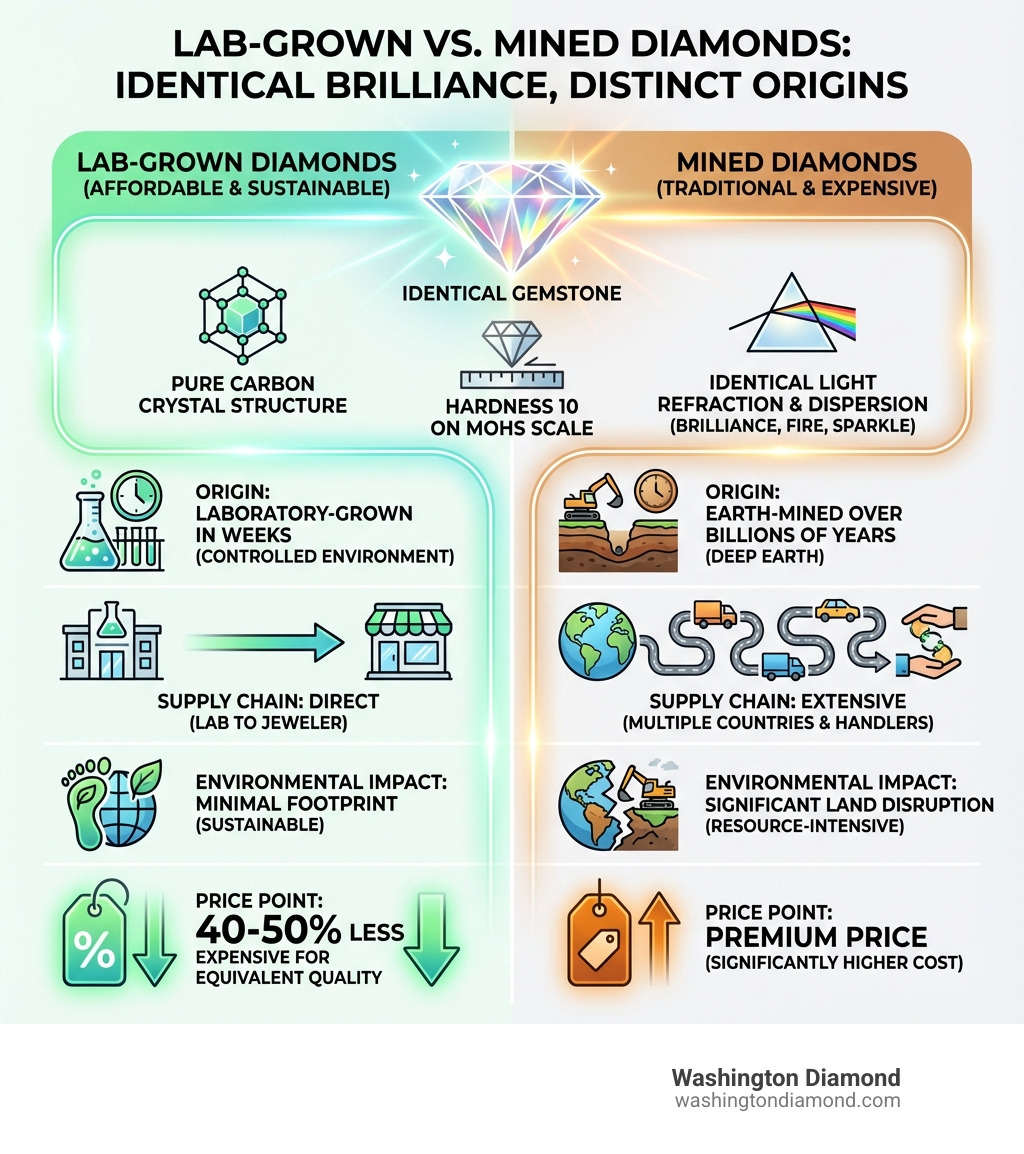
Easy affordable lab grown diamonds glossary:
Why Lab-Grown Diamonds Are the Smart Choice for Affordable Luxury
When we talk about affordable lab grown diamonds, we're embracing a smarter, more accessible way to acquire the world's most desired gemstone. Their affordability stems from an efficient creation process, a streamlined supply chain, and technological advancements.
Unlike mined diamonds, which require costly and extensive operations, lab-grown diamonds are cultivated in a controlled environment. This eliminates massive excavation efforts, heavy machinery, and the associated labor and environmental costs. This difference in origin is the primary driver of their accessible price.
The supply chain for lab-grown diamonds is also significantly shorter. A mined diamond can travel through numerous hands and countries, with each step adding to the cost. In contrast, lab-grown diamonds typically move directly from the lab to a cutting facility, and then to us, your jeweler. This direct path translates into savings for you. As we like to say at Washington Diamond, there are No Supply Chain Worries at Washington Diamond when securing your perfect stone.
The evolution of diamond-growing technology has also made these gems more affordable. Over the past two decades, scientists have refined the processes, making them more efficient and capable of producing larger, higher-quality diamonds. This progress, coupled with a competitive market, ensures you can find truly affordable lab grown diamonds without compromising on quality, allowing you to choose a larger or higher-quality stone for your budget.
The Science of Sparkle: How They Are Made
The creation of lab-grown diamonds is a marvel of modern science, replicating the conditions that form natural diamonds. The process begins with a tiny "diamond seed," a slice of a pre-existing diamond. This seed is placed in a carbon-rich environment where it crystallizes and grows, layer by layer.
There are two primary methods: High-Pressure High-Temperature (HPHT) and Chemical Vapor Deposition (CVD).
High-Pressure High-Temperature (HPHT) This method mimics the Earth's natural process. A diamond seed and pure carbon are placed in a chamber and subjected to immense pressure (around 5.5 GPa) and high temperatures (1,300-1,600°C). The carbon melts and crystallizes around the seed, a process that can take just days.
Chemical Vapor Deposition (CVD) The CVD method places a diamond seed in a vacuum chamber filled with carbon-rich gases (like methane). The chamber is heated (700-1,200°C), and microwaves break down the gas molecules. Carbon atoms then deposit onto the seed, growing the diamond atom by atom. This process is often favored for larger, high-quality colorless diamonds and can take six to twelve weeks.
Both methods produce diamonds that are chemically, physically, and optically identical to natural diamonds, with meticulous quality control ensuring consistency.
Here's a quick comparison of the two methods:
| Feature | High-Pressure High-Temperature (HPHT) | Chemical Vapor Deposition (CVD) |
|---|---|---|
| Mimics | Earth's deep mantle conditions | Atmospheric conditions where carbon gases react |
| Pressure | Very high (approx. 5.5 GPa) | Low (vacuum chamber) |
| Temperature | Very high (1,300-1,600°C) | High (700-1,200°C) |
| Carbon Source | Graphite | Carbon-rich gases (e.g., methane) |
| Growth Time | Days (for rough) | Weeks (6-12 weeks for sizable rough) |
| Typical Output | Historically smaller, some color variations; can be post-treated | Often higher quality, larger colorless diamonds; less need for treatment |
What Factors Influence the Price of Affordable Lab Grown Diamonds?
Just like their earth-mined counterparts, the price of affordable lab grown diamonds is primarily determined by the "4 Cs": Carat weight, Cut, Color, and Clarity. Understanding these factors helps you maximize your budget.
- Carat Weight: This refers to the diamond's weight. Larger diamonds are rarer and more expensive. With lab-grown diamonds, your budget can stretch further, potentially allowing you to choose a larger stone than a mined diamond of equivalent quality.
- Cut Quality: Often considered the most crucial "C," the cut determines how well a diamond's facets interact with light to create sparkle. An excellent cut maximizes brilliance. The affordability of lab-grown diamonds means you can often invest in a better cut without breaking the bank.
- Color Grades: Diamonds are graded from D (colorless) to Z (light yellow/brown). Colorless diamonds (D-F) are the rarest and most expensive. Near-colorless diamonds (G-J) offer excellent value, as any tint is often imperceptible to the naked eye.
- Clarity Characteristics: Clarity refers to the absence of internal flaws (inclusions) and external blemishes. The scale ranges from Flawless (FL) to Included (I). Most consumers opt for "eye-clean" diamonds (VS1-SI2), where inclusions aren't visible without magnification, offering beauty at an accessible price.
Beyond the 4 Cs, certification (GIA, IGI, GCAL) and production efficiencies can also influence price. However, the core principle remains: the affordability of lab-grown diamonds opens up a world of possibilities, allowing you to choose a larger or higher quality stone. For further guidance, you might find our insights on Top Picks: Where to Find the Best Price Lab-Grown Diamonds Online helpful.
A Buyer's Guide to High-Quality, Affordable Lab Grown Diamonds
Navigating diamonds can feel like a quest, but with affordable lab grown diamonds, it becomes a rewarding one, allowing you to secure an exceptional stone without compromise. At Washington Diamond, we empower our clients with the knowledge to make the best choice.
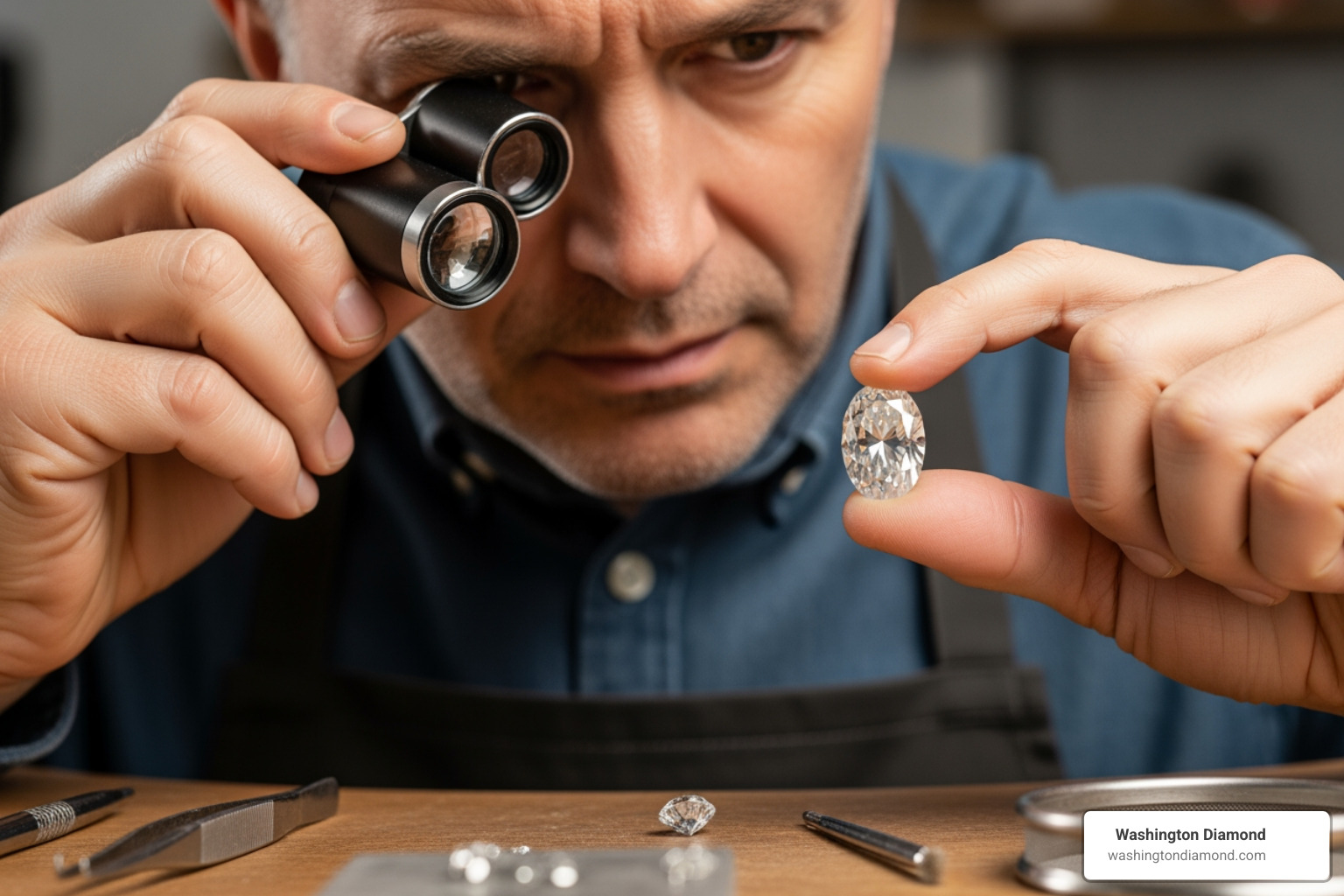
Understanding grading reports, choosing the right shape, and considering setting styles are crucial steps. Our personalized approach ensures you receive undivided attention to maximize your budget and find a diamond that reflects your desires.
For an additional neutral overview of how lab-grown diamonds compare to mined diamonds, you can also review the lab-grown diamond entry on Wikipedia alongside our expert guidance.
Decoding the 4 Cs for Lab-Grown Diamonds
The 4 Cs apply just as rigorously to lab-grown diamonds as they do to natural ones.
- Cut's Impact on Sparkle: We often tell clients that cut is king. It's the only "C" influenced by human hands and determines how brilliantly a diamond sparkles. An excellent cut ensures a dazzling display of light. Prioritizing cut quality is key to maximizing the visual impact of your affordable lab grown diamonds.
- Colorless vs. Near-Colorless: The color scale ranges from D (colorless) to Z (light yellow). For most fine jewelry, we recommend the D-J range. D-F diamonds are colorless, while G-J diamonds are "near-colorless," with any tint being undetectable to the naked eye once set. Choosing a G or H color offers significant savings without sacrificing visual appeal.
- Eye-Clean Clarity: An "eye-clean" diamond is the sweet spot for value, meaning any inclusions are not visible to the naked eye. Diamonds in the VS1, VS2, and SI1 grades are often eye-clean, offering a beautiful appearance at an accessible price. We can help you identify eye-clean diamonds to ensure you get maximum beauty for your investment.
- Carat Size vs. Budget: The beauty of affordable lab grown diamonds is their flexibility. If a larger diamond is a priority, you can often get a significant increase in carat weight for the same budget compared to a natural diamond. Alternatively, you can maintain your desired carat weight while upgrading the cut or color. To dive deeper, the Gemological Institute of America (GIA) offers extensive information on lab-grown diamonds.
Certifications and Quality: What to Look For
A reputable grading report is paramount. This independent assessment provides an unbiased evaluation of a diamond's 4 Cs and confirms its origin. For lab-grown diamonds, look for reports from respected labs like:
- GIA (Gemological Institute of America): A leading authority in gemology.
- IGI (International Gemological Institute): Widely recognized for grading lab-grown diamonds.
- GCAL (Gem Certification & Appraisal Lab): Offers detailed reports, often including light performance metrics.
These labs provide peace of mind. Be wary of companies that grade their own diamonds, as this presents a conflict of interest. Always opt for a diamond with a third-party grading report. Many lab-grown diamonds also feature a microscopic laser inscription on their girdle that corresponds to their grading report for extra verification.
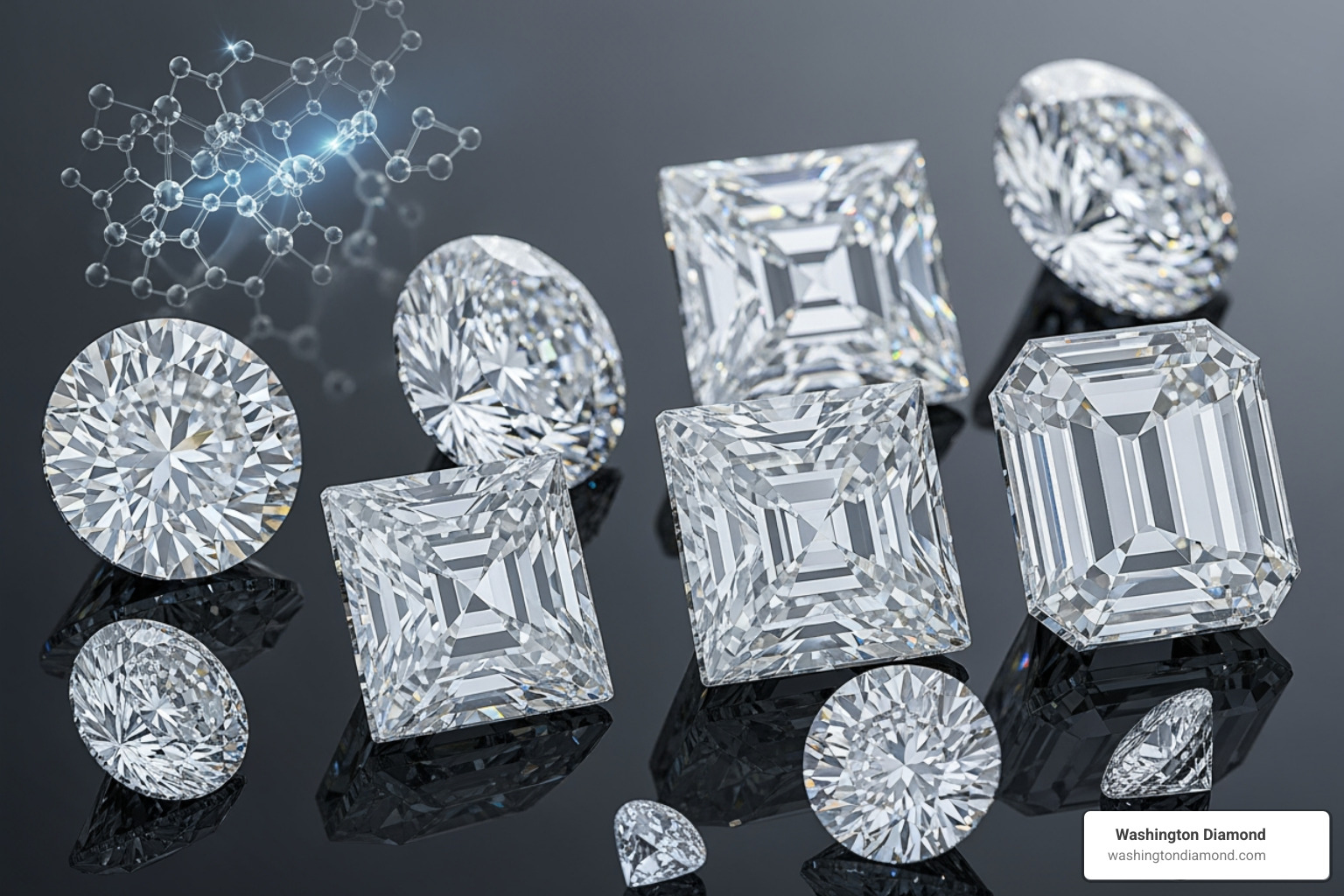
You might also encounter "Type IIa diamonds." This refers to a rare, chemically pure category of diamonds with exceptional transparency and brilliance. While only 1-2% of mined diamonds are Type IIa, advancements in technology mean we can consistently produce these incredibly pure and brilliant stones. When you choose a lab-grown Type IIa diamond, you're selecting a gem renowned for its purity and brilliance.
Loose Diamonds vs. Pre-Set: Finding the Best Value
For the best value and personalization with affordable lab grown diamonds, we highly recommend selecting a Loose Diamond and then choosing a setting.
Buying a loose diamond first offers unparalleled customization. You can hand-pick the exact stone that meets your quality preferences and budget. Once you've found your perfect diamond, you can explore our extensive collection of settings to create a piece that perfectly matches your style. This provides budget flexibility, letting you allocate funds where they matter most—be it carat weight, color, or setting design.
At Washington Diamond, we love helping clients create bespoke pieces. The possibilities for shapes and styles are endless. Popular shapes we offer include:
- Round
- Cushion
- Oval
- Emerald
- Princess
- Pear
- Radiant
- Marquise
- Asscher
- Heart
We also offer unique cuts for distinctive jewelry. For something truly out of the ordinary, you might explore options like Salt & Pepper Lab Diamonds: Your Guide to Their Unique Charm and Creation. Choosing a loose diamond ensures your final piece is as unique as your story.
The Ethical and Environmental Edge of Lab-Grown Diamonds
A compelling reason many clients choose affordable lab grown diamonds is their ethical and environmental advantages. In a world conscious of its impact, lab-grown diamonds offer a guilt-free sparkle that aligns with modern values.
The journey of a lab-grown diamond is transparent and responsible. Unlike mined diamonds with sometimes uncertain origins, lab-grown diamonds are guaranteed conflict-free. This means they are not associated with funding conflicts or human rights abuses, a guarantee that is paramount to us at Washington Diamond.
The environmental footprint of lab-grown diamonds is also significantly smaller. Diamond mining can involve extensive land disruption, habitat destruction, and high water and energy use. In contrast, lab-grown diamonds are produced in controlled environments that minimize these impacts. Many labs use renewable energy, further reducing their carbon footprint and making them an excellent choice for the environmentally conscious consumer.
What "Ethically Sourced" Really Means
For lab-grown diamonds, "ethically sourced" means a clear, traceable origin adhering to high social and environmental standards.
- Traceability: The origin of a lab-grown diamond is always known. We can trace your diamond to the specific lab where it was grown, providing complete transparency that is often challenging with mined diamonds.
- Environmental Impact: Ethical sourcing means a commitment to minimizing ecological harm. This includes reducing land disturbance, conserving water, and striving for sustainable production by recycling resources and reducing waste.
- Labor Practices: Ethical production means fair labor practices and safe working conditions in advanced facilities, a contrast to historical issues in traditional diamond mining.
- Supporting Communities: While not directly supporting mining communities, many companies in the lab-grown sector engage in philanthropy, donating to humanitarian causes or initiatives that empower communities affected by the mining industry. We encourage you to learn more in our article, What Does Ethically Sourced Actually Mean?. Additionally, B-Corp certification signifies a company's commitment to high standards of social and environmental performance, accountability, and transparency.
Frequently Asked Questions about Lab-Grown Diamonds
We understand you might have questions about affordable lab grown diamonds, a newer yet equally legitimate option in the diamond market. Here are answers to common inquiries.
Are lab-grown diamonds less durable or sparkly than natural diamonds?
Absolutely not. This is a common misconception. Lab-grown diamonds are real diamonds, possessing the exact same chemical composition, crystal structure, and physical properties as natural diamonds.
- Identical Hardness: Both register a perfect 10 on the Mohs scale of hardness, making them exceptionally durable and ideal for everyday wear.
- Same Physical Properties: There is no difference in their inherent strength or resistance to scratching.
- Light Performance and Sparkle: A diamond's sparkle is determined by its cut quality, not its origin. A well-cut lab-grown diamond will exhibit the same dazzling light performance as a well-cut natural diamond.
There is no discernible difference in durability or sparkle between a high-quality lab-grown diamond and a high-quality natural diamond. They are physically, chemically, and optically the same.
Do affordable lab grown diamonds have any drawbacks?
The most discussed "drawback" is resale value. The reality is that the resale market for any diamond, natural or lab-grown, is complex and typically yields less than the original purchase price. Because lab-grown diamonds are significantly more affordable upfront (up to 50% less), the financial impact of resale is less significant.
The market for lab-grown diamonds is evolving, and perceptions are changing rapidly as more consumers accept their benefits. For most, the primary advantage is acquiring a stunning, real diamond at an accessible price. The "drawback" becomes less relevant when you consider the joy of owning a beautiful, ethical diamond that fits your budget.
Can people tell the difference between a lab-grown and a mined diamond?
No, not with the naked eye. This is a resounding no.
- Visually Identical: To the unaided eye, lab-grown diamonds are indistinguishable from natural diamonds. Even experienced jewelers cannot tell the difference without specialized equipment.
- Requires Specialized Equipment: Only advanced gemological testing can differentiate them by detecting microscopic differences in growth patterns that have no impact on the diamond's beauty or durability.
- FTC Ruling: The U.S. Federal Trade Commission (FTC) ruled in 2018 that a "diamond is a diamond" regardless of its origin, as long as it has the same properties. This underscores that lab-grown diamonds are real diamonds.
Rest assured, your affordable lab grown diamonds will impress and delight, and no one can tell its origin just by looking at it.
Conclusion: Find Your Perfect Diamond Without Compromise
Choosing a diamond is a momentous decision, often marking a significant milestone or a profound expression of love. With affordable lab grown diamonds, you no longer have to compromise between your desires and your budget. We've explored how these magnificent gems offer exceptional value, quality, and ethical peace of mind, making them a truly smart choice for today's discerning consumer.
From their identical chemical and physical properties to their stunning brilliance and ethical origins, lab-grown diamonds stand as a testament to innovation and responsible luxury. They empower you to select a larger carat, a higher clarity, or a more brilliant cut, all while staying within your financial comfort zone. The streamlined production and shorter supply chain mean more savings for you, changing what might have been a dream into a tangible reality.
At Washington Diamond, we are dedicated to making your diamond selection process as memorable and personal as the moments you celebrate. Our private, appointment-only studio in Northern Virginia ensures you receive our undivided attention and expert guidance. We take pride in offering a curated collection of high-quality lab-grown diamonds, helping you find a gem that not only sparkles beautifully but also aligns with your values.
We invite you to experience the Washington Diamond difference. Let us help you find your perfect diamond without compromise. Explore our curated collection of Loose Diamonds and begin your journey to finding a truly exceptional piece of jewelry that will be cherished for a lifetime.
Have a question about your jewelry?
We've been helping clients with diamonds, custom design, repairs, appraisals, and more since 1969. Book a private appointment at our Falls Church studio.
Book an AppointmentTrusted since 1969 · Falls Church, VA · 703-536-3600
From the blog
View all


