

Top Picks: Where to Find the Best Price Lab Grown Diamonds Online
Why Lab-Grown Diamonds Are Revolutionizing the Market
Best price lab grown diamonds are changing how people buy fine jewelry. These are real diamonds—with the same physical, chemical, and optical properties as mined diamonds—created in advanced laboratories instead of being extracted from the earth. Modern consumers now choose them for their exceptional value, ethical sourcing, and environmental benefits.
Quick Answer: Where to Find the Best Prices on Lab-Grown Diamonds
- Buy loose diamonds instead of pre-set jewelry for 20-30% savings
- Compare certified stones from multiple online retailers 3| Look for IGI or GIA certification to ensure quality
- Shop during sales at reputable online jewelers
- Consider wholesale sources that offer transparent pricing
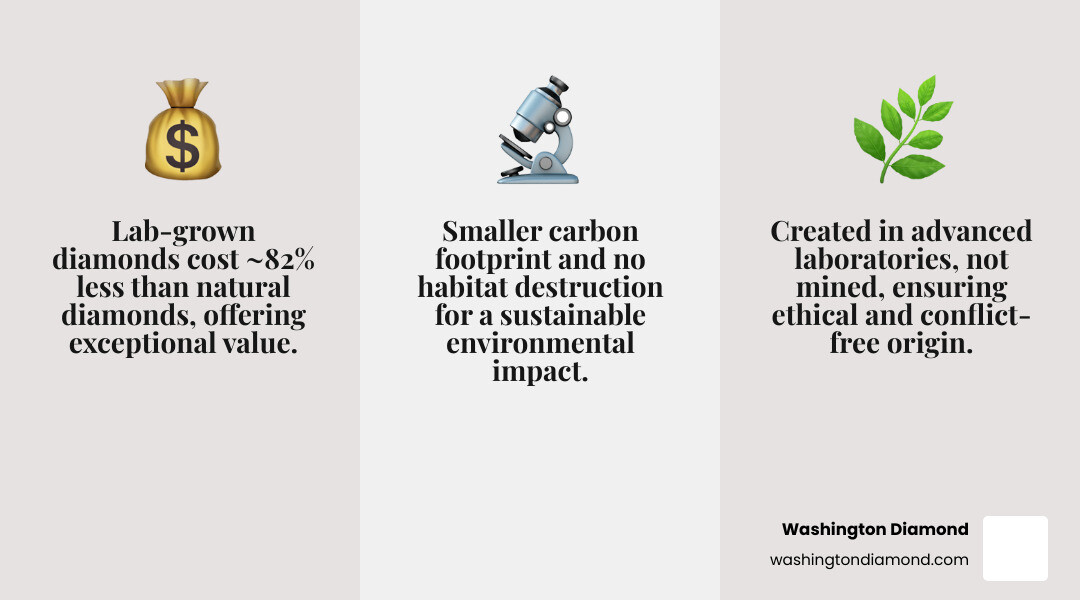
Lab-grown diamonds currently cost about 82% less than natural diamonds. This means you can get a stunning 2-carat diamond for the price you might expect to pay for a much smaller mined stone.
However, prices aren't static. Over the past year, lab-grown diamond prices have risen 18.77% due to increased demand. While manufacturing costs decline, competition among suppliers and retailers is creating interesting market dynamics.
This guide will show you where to find the best prices, what factors affect cost, and how to assess quality to get a diamond that's perfect for your special occasion.
What Determines the Price of a Lab-Grown Diamond?
When shopping for the best price lab grown diamonds, understanding what drives the cost is key. Lab-grown diamonds follow the same pricing principles as natural diamonds, based on specific, measurable characteristics.
The 4Cs: Cut, Color, Clarity, Carat
These four factors are the universal language of diamond quality for both lab-grown and mined diamonds.
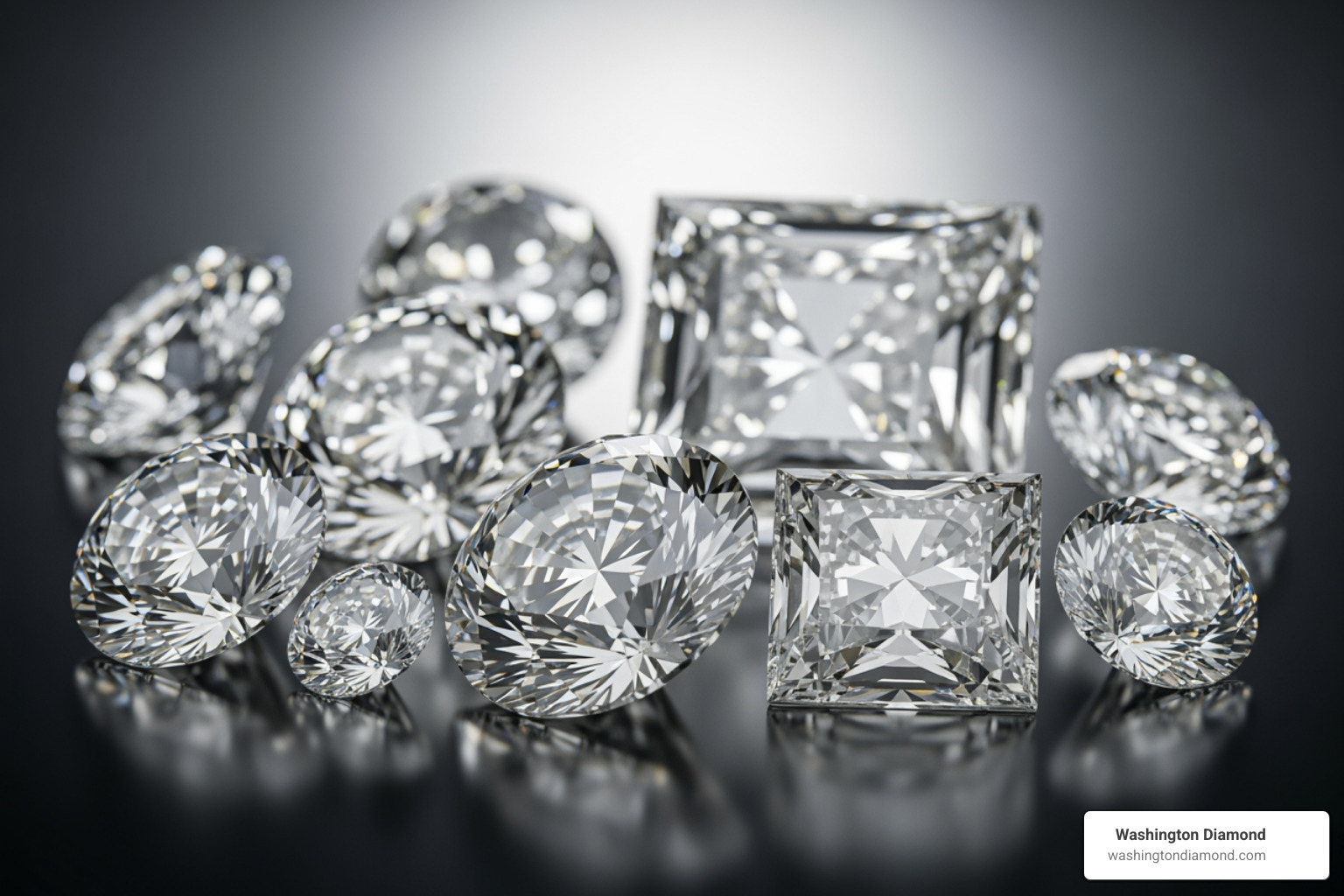
Cut is about how precisely a diamond's facets are angled and polished to create sparkle. An excellent cut can make a diamond with lower color or clarity grades look stunning. We always recommend prioritizing cut quality, as it has the biggest impact on a diamond's beauty. If you're curious about how different shapes reflect personality and style, check out our guide on The Perfect Diamond Shape for Every Personality.
Color is graded from D (colorless) to Z (light yellow/brown). The less color, the higher the grade and price. Lab-grown technology allows for consistent color and the creation of fancy colored diamonds (pink, blue, yellow) at accessible prices.
Clarity measures tiny imperfections called inclusions (internal) and blemishes (external). Even lab-grown diamonds can have inclusions. For the best price lab grown diamonds, look for "eye-clean" grades like VS1, VS2, or SI1. You won't see flaws without magnification and will save significantly compared to flawless grades.
Carat is a measure of weight (one carat = 200 milligrams). Larger diamonds are more expensive, but the lower cost of lab-grown diamonds means you can afford a much larger stone for your budget, making a 2-carat diamond an achievable dream.
Creation Method: Overview of How Lab-Grown Diamonds Are Made
Lab-grown diamonds are real diamonds, created using technology that replicates the Earth's natural process. Both main methods produce diamonds that are physically, chemically, and optically identical to natural ones.
High-Pressure/High-Temperature (HPHT) mimics nature by subjecting a diamond seed to extreme pressure and heat, causing carbon to crystallize and grow a larger diamond.
Chemical Vapor Deposition (CVD) places a diamond seed in a chamber with carbon-rich gases. When heated, carbon atoms deposit on the seed, building the diamond layer by layer.
Both methods create genuine diamonds, and the end result is a beautiful, authentic stone.
Certification: IGI and GIA Importance
When hunting for the best price lab grown diamonds, certification is your safety net. Independent labs grade diamonds objectively, giving you a detailed report on the 4Cs.
For lab-grown diamonds, the most trusted names are the International Gemological Institute (IGI) and the Gemological Institute of America (GIA). IGI is a pioneer in grading lab-grown diamonds, while GIA now provides comprehensive reports as well.
A certified diamond gives you confidence and transparency, making it easier to compare prices. Never buy a lab-grown diamond without a reputable certification—it's the only way to verify quality and ensure fair value.
Comparing Lab-Grown vs. Natural Diamonds
| Feature | Lab-Grown Diamonds | Natural Diamonds |
|---|---|---|
| Price | Approximately 82% less than natural diamonds (as of current data) | Significantly higher due to rarity and mining costs |
| Origin | Created in advanced laboratories (HPHT or CVD) | Mined from the Earth, formed over billions of years |
| Composition | Identical physical, chemical, and optical properties (real diamonds) | Identical physical, chemical, and optical properties (real diamonds) |
| Ethics | Guaranteed conflict-free, ethical sourcing | Can be conflict-free if certified, but historical concerns exist |
| Environment | Lower carbon footprint, minimal environmental disruption | Significant environmental impact from mining |
| Resale Value | Currently, not much of a resale market; value retention is not strong | More robust resale market, generally better value retention over time |
| Accessibility | More accessible, allowing for larger stones or higher quality within budget | Less accessible for comparable size/quality due often to budget constraints |
The bottom line is that lab-grown diamonds give you more diamond for your money. They are identical to natural diamonds in beauty and durability, with the main trade-off being resale value. If you're buying a diamond to wear and cherish, lab-grown offers incredible value.
Decoding the Market: How to Get the Best Price Lab Grown Diamonds
The lab-grown diamond market moves fast, and knowing what to look for can help you find incredible value. Here's how prices work and what strategies will help you land the best price lab grown diamonds.
Price Trends: Historical Decline and Recent Fluctuations
For years, lab-grown diamond prices dropped steadily due to improving technology and increased competition. However, surging demand recently caused prices to climb 18.77% in the past year. This signals a maturing market that recognizes the value of lab-grown diamonds.
What does this mean for you? The days of waiting for prices to drop indefinitely are likely over. While there's a floor to production costs, the good news is that lab-grown diamonds still cost about 82% less than their natural counterparts. If you're ready to buy, now is a great time. You can track market trends at resources like StoneAlgo.
Market Factors: Manufacturing Costs, Supplier Competition, Retailer Margins
Three factors set diamond prices: Manufacturing costs (the base price), supplier competition (which prevents inflation), and retailer margins (what you ultimately pay). Intense competition often leads to tighter margins and better prices for consumers. This is where shopping with a jeweler who has access to wholesale networks pays off. At Washington Diamond, we source from a vast inventory, allowing us to find the best price lab grown diamonds that match your specifications.
Key Strategies for Finding the Best Price Lab Grown Diamonds
Here are the strategies that make the biggest difference in finding the best value.
Loose vs. Set Jewelry
To save 20-30%, buy your diamond loose and choose a setting separately. Pre-set jewelry includes bundled markups on the diamond, setting, and labor, making it less economical. Buying a loose diamond gives you complete control and transparency. You can inspect the stone thoroughly and ensure the 4Cs meet your standards before it's set. With a loose diamond, what you see is exactly what you get. Our guide on Loose Diamonds explores this approach in more detail.
Another advantage is customization. Starting with a loose diamond means you aren't limited to in-stock settings. You can design a piece that's uniquely yours.
Customization Benefits
Our private studio in Northern Virginia specializes in this custom approach. We give you our undivided attention to select your perfect diamond and collaborate on a unique setting. Whether you want to incorporate a family detail or a specific metal combination, we have the expertise to make your vision a reality. The result is jewelry that's not just beautiful—it's deeply personal and often a better value.
Shopping Tips
- Compare certified stones from the same lab (IGI or GIA) for an apples-to-apples comparison.
- Shop during sales events like Black Friday or Memorial Day, but ensure the deal is genuine by checking the certification.
- Consider wholesale sources. At Washington Diamond, we can search our network of tens of thousands of diamonds to find options at wholesale prices that match your criteria.
- Use advanced filters online to narrow your search by shape, price, carat, and the other 4Cs.
Importance of Transparency
A confident jeweler will show you everything: grading reports, high-resolution images, and clear pricing. We believe in educating you so you can make a decision that feels right. If a jeweler is evasive about certification or pressures you, walk away. The best price lab grown diamonds are only a good deal if you know exactly what you're getting.
A Smart Buyer's Guide to Quality and Value
When searching for the best price lab grown diamonds, the goal is to find genuine value, not just the lowest price. This means understanding what makes them special and how to evaluate quality with confidence.
Ethical & Environmental Benefits
For many clients, choosing a lab-grown diamond is about more than budget; it's about peace of mind. Lab-grown diamonds are guaranteed conflict-free. Because they're created in controlled environments, there's no risk of supporting unethical labor practices.
The environmental advantages are just as compelling. Lab-grown diamonds avoid the environmental damage of mining, such as habitat destruction and pollution. They have a significantly lower carbon footprint, making them a truly sustainable choice. You're choosing a real diamond that aligns with your values. Learn more about what this means in our guide: What Does Ethically Sourced Actually Mean?.
Finding Reputable Sellers
Your choice of jeweler is as important as your choice of diamond. A trustworthy seller will be your guide.
Online shopping offers a vast selection and competitive pricing, ideal for research. The downside is you can't see the diamond in person. Shopping in person offers a personalized, hands-on experience. At Washington Diamond, our private, appointment-only studio is designed for this. We provide undivided attention, showing you diamonds up close and explaining the subtle differences.
Look for jewelers who are experts in lab-grown diamonds and can explain the 4Cs in plain language. Customer reviews on independent platforms offer insight into a jeweler's quality, service, and pricing.
How to Assess Quality to Ensure the Best Price
Getting the best price lab grown diamonds means knowing how to spot quality.
Reading a Certificate
Every reputable lab-grown diamond comes with a grading report from IGI or GIA. This report is the diamond's biography, detailing the 4Cs with precision. It also includes the diamond's dimensions, symmetry, polish, and a microscopic laser inscription on the girdle that matches the report number, confirming its identity.
Understanding this report empowers you to compare diamonds accurately. Ask your jeweler to walk you through the certificate; we love doing this because it helps you understand a diamond's value.
Key Markers to Check
- Prioritize cut grade above all else. An excellent or ideal cut maximizes a diamond's brilliance and can make it appear larger.
- For clarity, check if the diamond is "eye-clean." A VS2 or SI1 grade often appears flawless to the naked eye and costs much less than higher grades.
- For color, G or H diamonds appear beautifully white in most settings and offer substantial savings over D-grade stones.
- If possible, compare several diamonds side-by-side to train your eye and confirm your choice. For a deeper dive, see our guide: Calculate the Value of a Diamond Before You Buy or Sell.
Avoiding Common Pitfalls
- Never purchase an uncertified lab-grown diamond. Without a report, you have no objective proof of quality.
- Be wary of deals that seem too good to be true. An unusually low price might indicate a poor cut, undisclosed treatments, or an unreputable seller.
- Don't fixate only on carat weight. A smaller diamond with excellent grades will be more beautiful than a larger one with a mediocre cut or noticeable flaws.
Frequently Asked Questions about Lab-Grown Diamond Prices
We often hear similar questions from our clients about lab-grown diamonds, especially concerning their value and authenticity. Here are some of the most common ones.
Are lab-grown diamonds a good value for money?
Absolutely. The price-to-size ratio is remarkable. Costing about 82% less than natural diamonds, you can get a much larger stone for your budget—for example, a 2-carat lab-grown diamond for the price of a 1-carat natural one.
You sacrifice nothing for this lower price. Lab-grown diamonds have the exact same physical, chemical, and optical properties as natural diamonds. They are just as brilliant, fiery, and durable, rating a 10 on the Mohs scale of hardness. Only their origin story is different.
Will lab-grown diamonds lose their value?
It's important to approach this question with the right perspective. The resale market for lab-grown diamonds is not as strong as for natural diamonds, so they don't retain value in the same way. They should not be purchased as a financial investment.
Instead, focus on their personal and aesthetic value. Their true worth lies in their beauty, ethical sourcing, and the joy they bring, not their potential resale price. While prices have fluctuated, experts suggest they will likely stabilize as production costs reach a minimum. For our clients, the emotional and aesthetic value is what truly matters.
How can I be sure a lab-grown diamond is real?
Lab-grown diamonds are 100% real diamonds, not simulants like cubic zirconia or moissanite. They are made of pure carbon atoms in the same crystal structure as natural diamonds, making them physically and optically identical.
They are visually indistinguishable from natural diamonds, even with a jeweler's loupe. Only specialized lab equipment can tell them apart, which is why certification is crucial. Most certified lab-grown diamonds have a microscopic laser inscription on the diamond's girdle that includes the report number and often the words "LAB GROWN."
The most reliable way to be sure of a diamond's authenticity is to insist on a grading report from a reputable lab like IGI or GIA. This certificate is your guarantee of quality and authenticity. At Washington Diamond, we only work with certified diamonds and will gladly walk you through the report.
Conclusion: Finding Your Perfect Diamond at the Right Price
Finding the best price lab grown diamonds should be a rewarding experience. This guide has covered the essentials: the 4Cs, the importance of IGI and GIA certification, and current market trends, empowering you to make a smart choice.
Lab-grown diamonds are a smart choice that honors both your budget and your values. You get a larger, higher-quality diamond that is also conflict-free and has a smaller environmental footprint—a choice that feels as good as it looks.
Buying loose diamonds often provides the best savings and customization possibilities. By selecting your diamond first, you control what matters most, whether it's size, cut quality, or a balance of all 4Cs, before designing a unique setting.
At Washington Diamond, we make this experience personal and meaningful. Our private, appointment-only studio in Northern Virginia offers undivided attention and expert guidance custom to your vision. We have access to tens of thousands of lab-grown diamonds and will search until we find the one that makes your heart skip a beat, at a price that makes perfect sense.
This isn't just about finding a diamond. It's about finding your diamond—one that tells your story and celebrates your love. We'd be honored to help you find it.
For a curated selection and one-on-one guidance that you won't find anywhere else, explore our collection of loose diamonds. Let's create something beautiful together.
Have a question about your jewelry?
We've been helping clients with diamonds, custom design, repairs, appraisals, and more since 1969. Book a private appointment at our Falls Church studio.
Book an AppointmentTrusted since 1969 · Falls Church, VA · 703-536-3600
From the blog
View all


