

Navigating the 2 Carat Diamond Price Range for Smart Ring Shoppers
Understanding the 2 Carat Diamond Price Range in 2026
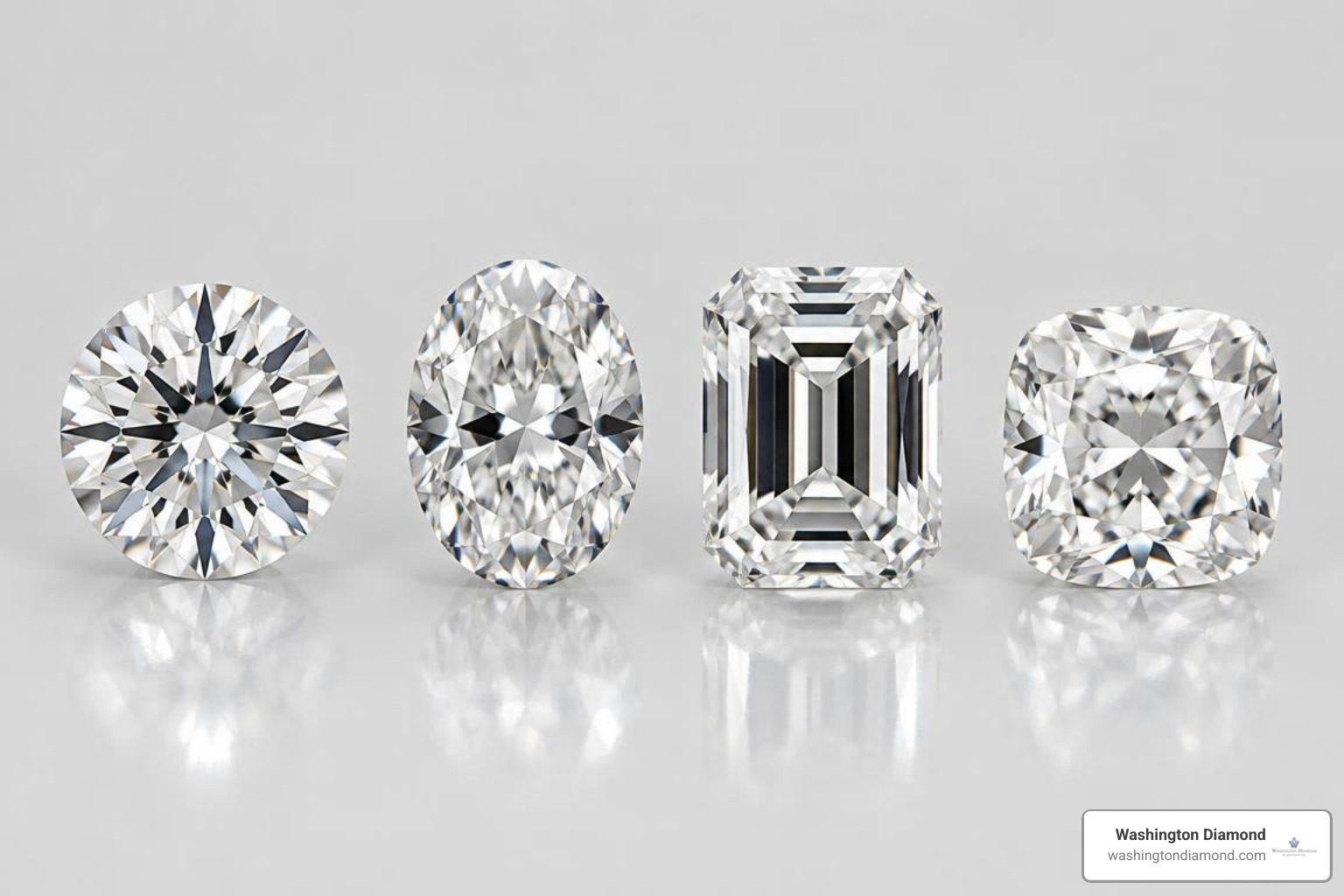
In September 2026, a natural 2-carat diamond typically costs between $9,694 and $19,926, while a lab-grown 2-carat diamond ranges from $648 to $1,614. The typical overall price is $14,671 for natural stones and $987 for lab-created stones, with natural diamonds trading at roughly 14.9 times the price of lab-grown alternatives.
When planning an engagement ring or celebrating a milestone anniversary, the two-carat mark stands out as one of the most coveted diamond sizes. It delivers undeniable presence on the finger, striking a balance between bold elegance and everyday wearability. Yet, understanding the actual market figures behind these gems can often feel overwhelming.
In September 2026, the diamond market features millions of active stones across global exchanges. With over 3 million active listings currently tracked in market inventories, pricing is determined by precise metrics rather than guesswork.
To help you navigate current benchmarks, examine how pricing breaks down across natural and lab-created stones in the current marketplace:
| Metric | Natural 2-Carat Diamond | Lab-Grown 2-Carat Diamond |
|---|---|---|
| Typical Overall Price | $14,671 | $987 |
| Typical Price Per Carat | $7,070 / ct | $476 / ct |
| Common Price-Per-Carat Range | $4,847 – $9,963 / ct | $324 – $807 / ct |
| Total Stone Price Range | $9,694 – $19,926 | $648 – $1,614 |
| Price Ratio (Natural vs. Lab) | 14.9x | 1.0x (Baseline) |
Natural stones reflect rarity, deep geological history, and long-term asset value, while lab-grown alternatives provide access to substantial carat weights at an accessible initial entry point. For up-to-the-minute market movements, smart buyers often consult live resources like 2 Carat Diamond Price, Live USD Data | Carat Hunter to monitor index shifts across major retail networks.
Natural vs. Lab-Grown 2 Carat Diamond Price Range Comparison
The difference in cost between natural and lab-grown stones is the single largest price driver in today's market. A typical natural 2-carat diamond trades at roughly 14.9 times the price of its lab-created counterpart. This creates an approximate 93% price savings when choosing a lab-grown diamond of identical cut, shape, color, and clarity.
At our private studio in Northern Virginia, we believe that informed clients make the best decisions for their personal stories. Whether you prioritize the billions of years of history found in ethically sourced diamonds or prefer the modern affordability of lab-created gems, the visual sparkle of an expertly cut diamond remains stunning in either medium.
Milestone Threshold Pricing and Carat Weight Premiums
Diamonds are priced in steps rather than along a continuous, linear scale. The diamond industry relies on "magic weights"—psychological milestones like 1.00 ct, 1.50 ct, 2.00 ct, and 3.00 ct. Crossing one of these numerical boundaries causes the price per carat to jump steeply.
For instance, a 0.95-carat natural diamond and a 1.00-carat natural diamond of identical cut, color, and clarity can differ in cost by 15% to 25%, despite being virtually indistinguishable once set. The exact same dynamic occurs at the 2.00-carat line.
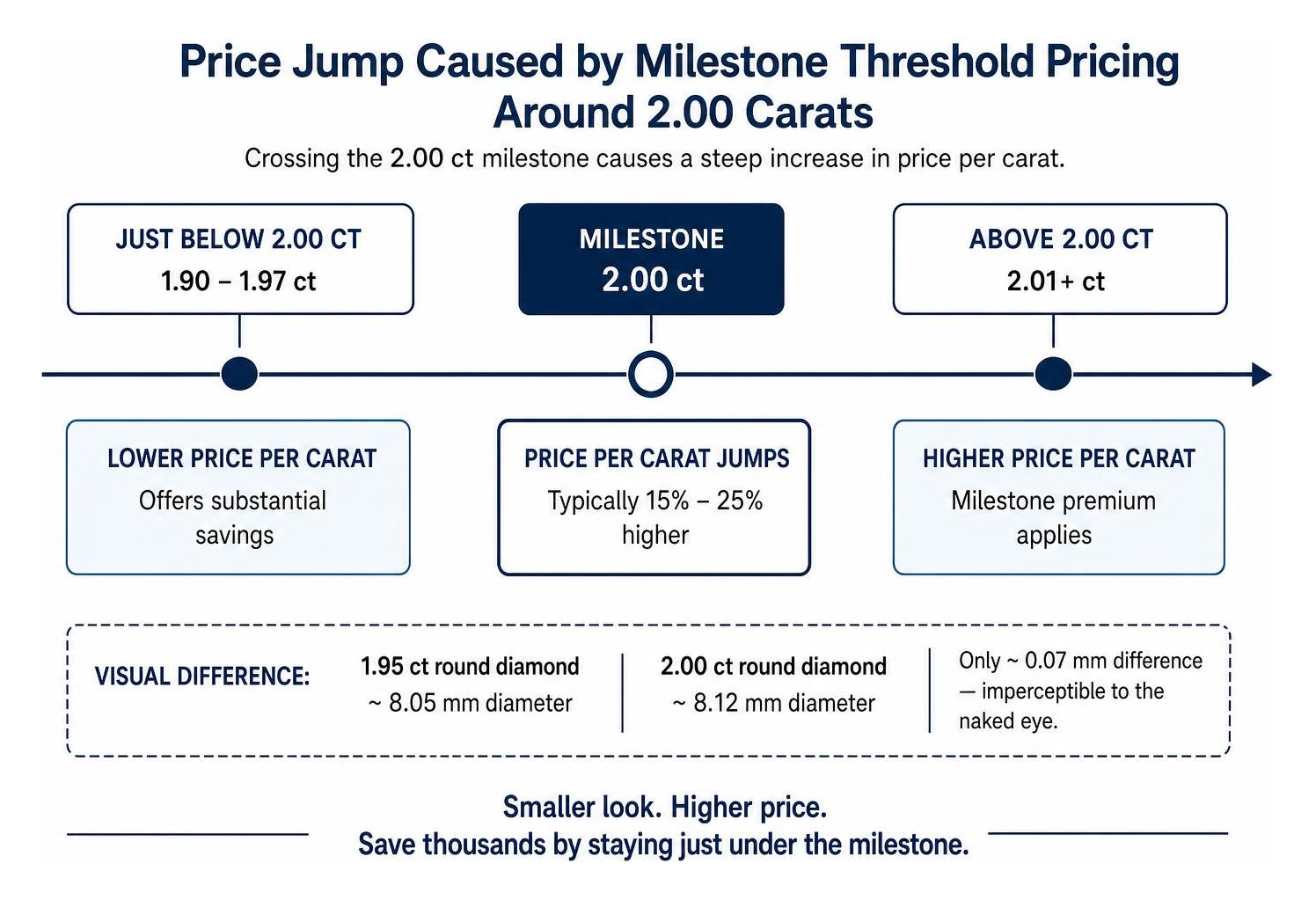
A stone weighing 1.90 to 1.97 carats typically offers substantial savings compared to an exact 2.00-carat gem. Because diamond diameter expands proportionally to the cube root of its weight, a well-cut 1.95-carat round diamond measures roughly 8.05 mm across, while a 2.00-carat round stone measures about 8.12 mm. To the naked human eye, a difference of 0.07 millimeters is imperceptible, but the price difference can save you thousands of dollars.
To see how these weight boundaries influence costs across every tier, explore our comprehensive diamond carat chart with price benchmarks before finalizing your design criteria.
How Diamond Shape Influences 2-Carat Pricing
Carat weight tells you only how heavy a gem is, not what shape it takes. The shape you choose alters not just the aesthetic profile of your ring, but also the total price per carat.
Why does shape impact diamond pricing so dramatically? The answer lies in the geometry of rough diamond crystals. When diamond cutters shape a rough octahedral crystal into a round brilliant diamond, they often discard 50% to 60% of the original rough stone to achieve ideal optical proportions. By contrast, fancy shapes—such as ovals, cushions, emeralds, and radiants—better conform to the natural outlines of rough diamonds, preserving a much higher percentage of the yield.
Higher manufacturing yield translates directly into lower per-carat pricing for you.
Round Brilliant vs. Fancy Shapes Breakdown
Round brilliant diamonds represent the single most popular cut, making up approximately 37% of all active 2-carat diamond inventory. Because of their unmatched light performance and higher cutting waste, round natural diamonds command a consistent market premium.
The table below illustrates the median price-per-carat figures across popular diamond shapes for 2-carat diamonds:
| Diamond Shape | Natural Median Price/ct | Lab-Grown Median Price/ct | Typical 2ct Natural Total |
|---|---|---|---|
| Marquise | $9,897 | $470 | $19,794 |
| Pear | $7,452 | $506 | $14,904 |
| Oval | $7,420 | $554 | $14,840 |
| Radiant | $7,347 | $518 | $14,694 |
| Round Brilliant | $7,180 | $435 | $14,360 |
| Emerald Cut | $7,168 | $444 | $14,336 |
| Cushion | $6,620 | $485 | $13,240 |
| Asscher | $6,161 | $531 | $12,322 |
| Heart | $5,901 | $393 | $11,802 |
| Princess | $5,380 | $509 | $10,760 |
Elongated shapes like ovals, pears, and marquise cuts offer an additional optical advantage: their extended surface area often makes them appear visually larger than a round diamond of the exact same carat weight. If you are captivated by an elongated silhouette, review our 1 carat oval diamond price guide to understand how proportions affect both value and beauty across different carat categories.
Color and Clarity Impact on 2 Carat Stones
Evaluating a 2-carat stone requires a closer look at color and clarity than smaller diamonds demand. Larger diamond facets act like miniature windows into the crystal structure; an inclusion or slight body color that hides effortlessly in a 0.75-carat diamond may become noticeable in a 2.00-carat center stone.
Mastering how clarity and color grades interact ensures you invest your budget where it actually enhances visual beauty. Building a foundation through essential diamond education will help you confidently identify high-performing diamonds without overpaying for unseen laboratory ratings.
Color Grade Variations and Per-Carat Costs
The GIA color grading scale ranks white diamonds from D (completely colorless) down to Z (light tint). In 2-carat natural diamonds, moving up just one color tier creates notable pricing jumps.
| Color Grade | Natural Median Price/ct | Lab-Grown Median Price/ct |
|---|---|---|
| D (Colorless) | $11,303 | $539 |
| E (Colorless) | $10,121 | $436 |
| F (Colorless) | $9,680 | $429 |
| G (Near Colorless) | $8,762 | $418 |
| H (Near Colorless) | $7,370 | $435 |
| I (Near Colorless) | $6,132 | $1,352 |
| J (Faint Color) | $4,986 | $1,441 |
Natural D-color stones trade at over $11,300 per carat because genuine colorless rough is geologically rare. However, near-colorless diamonds in the G to H range face up brilliantly white to the untrained eye, especially when set in platinum or white gold. If you plan to set your center stone in yellow gold or rose gold, you can comfortably select an H or I color stone, as the warm metal setting naturally complements slight body warmth while saving you thousands of dollars.
Clarity Grade Variations and Per-Carat Costs
Clarity measures the presence of microscopic internal characteristics (inclusions) and surface blemishes. At 2 carats, clarity grades show significant pricing variations:
| Clarity Grade | Natural Median Price/ct | Lab-Grown Median Price/ct |
|---|---|---|
| FL (Flawless) | $17,656 | $1,335 |
| IF (Internally Flawless) | $10,272 | $885 |
| VVS1 (Very, Very Slightly Included 1) | $9,048 | $526 |
| VVS2 (Very, Very Slightly Included 2) | $8,482 | $440 |
| VS1 (Very Slightly Included 1) | $8,317 | $436 |
| VS2 (Very Slightly Included 2) | $8,167 | $459 |
| SI1 (Slightly Included 1) | $7,093 | $794 |
| SI2 (Slightly Included 2) | $5,247 | $1,660 |
| I1 (Included 1) | $4,710 | $2,633 |
Flawless natural diamonds command astronomical premiums ($17,656/ct) purely due to collector rarity. Yet, an expertly vetted VS2 or high-grade SI1 diamond is almost always 100% "eye-clean"—meaning inclusions cannot be seen without a 10x jeweler's loupe.

Finding the Value Sweet Spot Within the 2 Carat Diamond Price Range
For the vast majority of ring buyers, the absolute value "sweet spot" for a 2-carat stone is E or F color paired with VS2 clarity.
Why is this combination ideal?
- Flawless Visual Appeal: An E/VS2 stone faces up clean, bright, and colorless to anyone admiring your ring in daily life.
- 40% to 60% Budget Savings: Choosing an E/VS2 stone instead of a D/FL (Flawless) or D/IF (Internally Flawless) stone saves between 40% and 60% on your total diamond cost.
- Optimal Budget Allocation: The money saved by avoiding microscopic perfection can be directed toward what truly matters: an Ideal or Excellent Cut Grade.
Cut quality controls light return, fire, and scintillation. A poorly cut D-Flawless diamond will look dull, glassy, and small, whereas an Ideal-cut G-VS2 diamond will sparkle across a crowded room.
Maximizing Value and Choosing the Perfect Setting
Finding an extraordinary 2-carat diamond is only half the journey; setting the stone securely in a custom mount brings the entire vision together. A well-designed ring setting accentuates the diamond’s silhouette, balances its finger coverage, and protects its delicate girdle edges.
When selecting handcrafted engagement ring settings, consider how design features influence your center stone's appearance:
- Prong Styles: A classic four-prong setting maximizes light entry and accentuates square or rectangular stones, while a six-prong setting provides extra protection for active lifestyles.
- Hidden Halos & Pavé Bands: Adding delicate diamond pavé along the band or a hidden halo beneath the center head adds subtle sparkle without distracting from the main 2-carat gem.
- Metal Color Selection: Platinum and 18k white gold accentuate the icy crispness of D–F color diamonds, whereas 18k yellow or rose gold provides warmth and contrast.
Every ring design should reflect the individual wearing it, balancing structural integrity with timeless beauty.
Frequently Asked Questions About 2 Carat Diamonds
What is the typical price difference between natural and lab-grown 2 carat diamonds?
A typical natural 2-carat diamond costs approximately $14,671 USD ($7,070 per carat), whereas an equivalent lab-grown diamond costs about $987 USD ($476 per carat). Natural diamonds trade at roughly 14.9 times the price of lab-grown alternatives, yielding an approximate 93% cost savings for buyers selecting lab-grown stones.
What is the recommended color and clarity sweet spot for a 2 carat diamond?
The premier value sweet spot for a 2-carat diamond is E or F color with VS2 clarity. This combination ensures the stone appears completely white and eye-clean under standard viewing conditions, while costing 40% to 60% less than top-tier D Flawless diamonds.
How much can you save by buying just under the 2.00 carat milestone?
Opting for a diamond weighing between 1.90 and 1.97 carats can save you 15% to 25% compared to an exact 2.00-carat stone of matching quality. Because their millimeter dimensions differ by less than a tenth of a millimeter, they look identical once set in a ring.
Conclusion
Choosing a 2-carat diamond is an exciting, memorable milestone. By understanding how carat thresholds, shapes, cut quality, and grading grades influence pricing, you can make an informed choice that balances beauty, quality, and budget.
At Washington Diamond, we believe buying fine jewelry should be personal, unhurried, and transparent. In our private, appointment-only studio in Northern Virginia, we provide dedicated, one-on-one guidance so you can examine diamonds side by side in a comfortable, pressure-free environment.
To explore stone options and design possibilities tailored to your vision, read our in-depth guide to 2 carat diamond pricing or schedule a private consultation with our design team today.
Have a question about your jewelry?
We've been helping clients with diamonds, custom design, repairs, appraisals, and more since 1969. Book a private appointment at our Falls Church studio.
Book an AppointmentTrusted since 1969 · Falls Church, VA · 703-536-3600
From the blog
View all


