

The Square Emerald Cut Diamond: A Vintage Twist on a Classic Shape
What Is a Square Emerald Cut Diamond?

A square emerald cut diamond has the straight, stepped facets and cropped corners of an emerald cut, but its length and width are nearly equal. Instead of the rapid sparkle of a round or princess cut, it shows broad flashes of light and a clear view into the stone. That gives it a calm, geometric look that suits both vintage-inspired and modern jewelry.
The open facets also make color, inclusions, and cut details easier to notice. When comparing stones, look beyond carat weight: check the face-up shape, color and clarity grades, polish, symmetry, and how the diamond looks in person or on video.
I'm Tom Daube, and my work with GIA-graded diamonds, custom jewelry, and diamond recutting informs this guide to choosing a square emerald cut diamond. For a broader historical perspective on this step-cut family, the emerald cut entry on Wikipedia offers useful background.
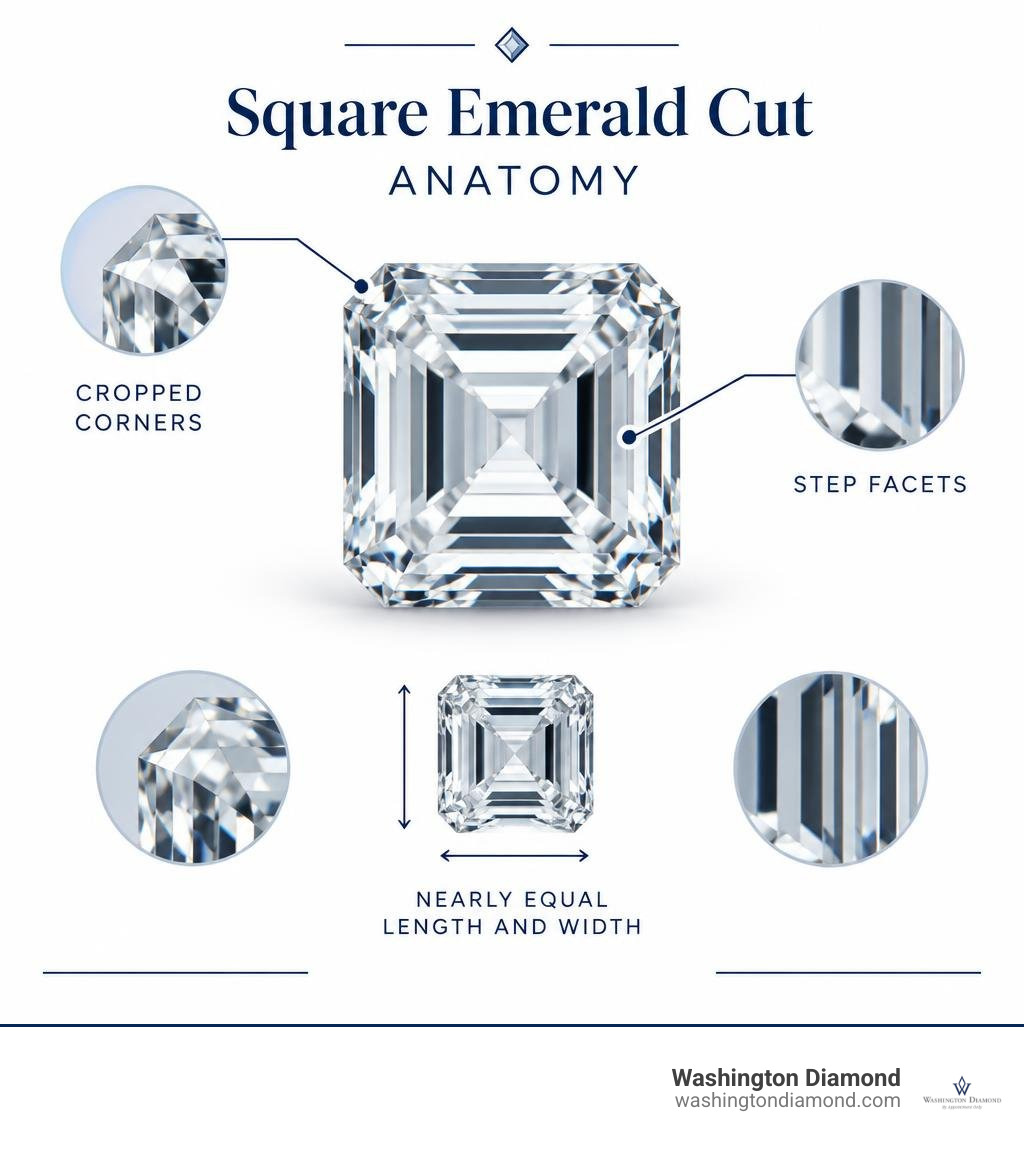
Square emerald cut diamond basics:
Anatomy and Proportions of a Square Emerald Cut Diamond
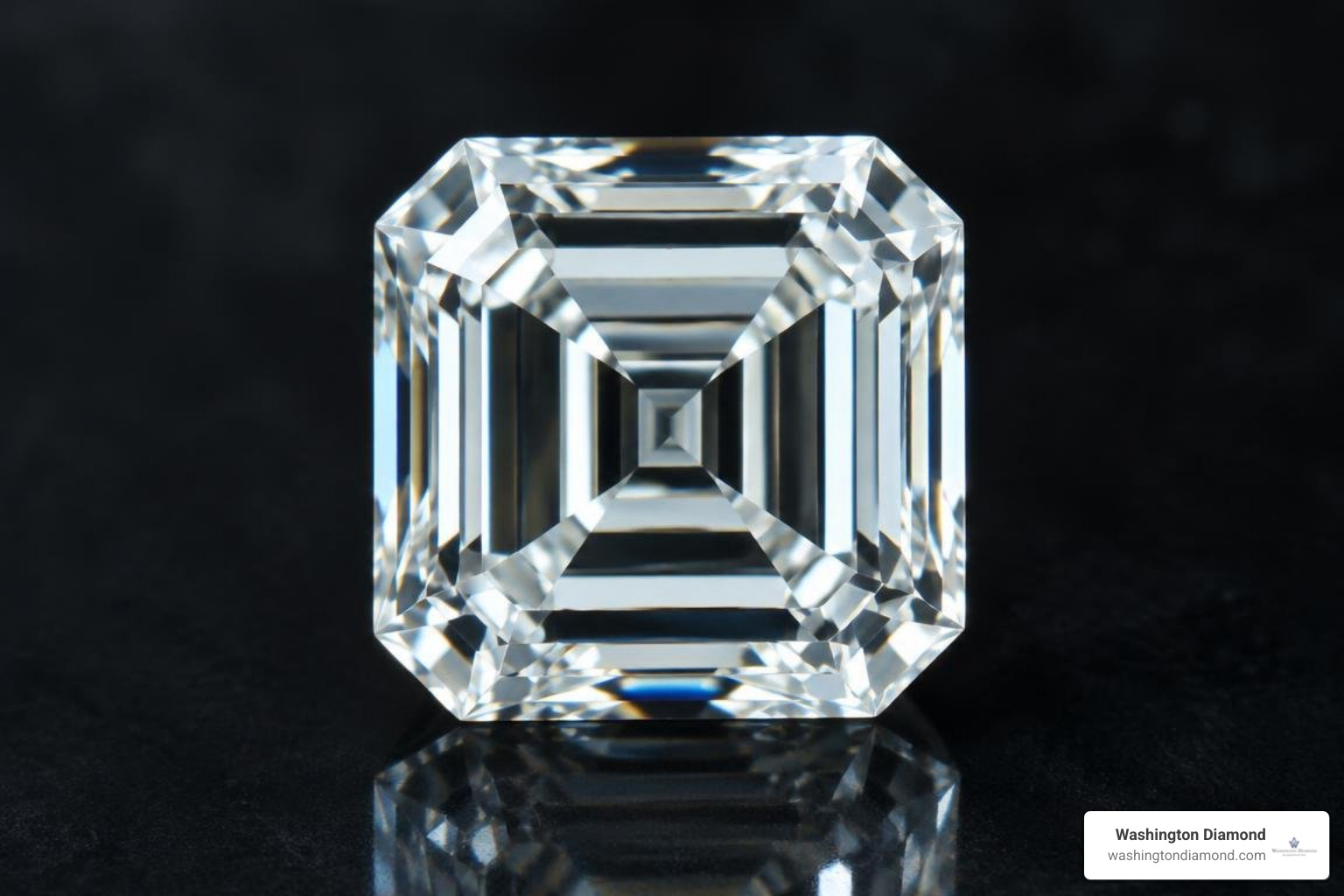
The architectural beauty of a square step cut comes from its strict geometric layout. Unlike brilliant cuts (such as round or cushion shapes) that utilize triangular and kite-shaped facets to scatter light in countless directions, step cuts use parallel, rectilinear facets that run along the length and width of the stone.
When you peer into a square emerald cut, you experience what gemologists call the "hall-of-mirrors" effect. Light enters the flat table facet and reflects off concentric step facets beneath, bouncing back in broad, rhythmic flashes of white and colored light.
To achieve a balanced look, buyers should carefully evaluate several geometric criteria:
- Length-to-Width (L/W) Ratio: For a stone to read as a true square to the naked eye, look for a ratio between 1.00 and 1.05. For example, a loose stone measuring 5.06 mm in length and 5.01 mm in width yields an L/W ratio of 1.01—offering a balanced, symmetrical footprint.
- Cropped Corners: The beveled, octagonal corners are functional as well as aesthetic. They protect the gemstone from chipping during setting and everyday wear while softening the transition between perpendicular edges.
- Table Percentage: The table (the large, flat facet on top) should ideally range between 60% and 69%. A table that is too large reduces the stone's ability to display dynamic crown facets.
- Depth Percentage: A well-proportioned depth usually sits between 64% and 72%. If a stone is cut too shallow, light leaks through the bottom; cut too deep, and unnecessary carat weight hides in the pavilion without contributing to face-up surface area.
Understanding these structural proportions is crucial when exploring diamond anatomy and cut fundamentals to ensure your selected gem maximizes light performance.
Square Emerald Cut vs. Traditional Emerald and Asscher Cuts
While square emerald cuts, traditional emerald cuts, and Asscher cuts all belong to the step-cut family, their internal patterning and external silhouettes create noticeably distinct visual personalities.
| Feature | Square Emerald Cut | Traditional Emerald Cut | Asscher Cut (Royal/Standard) |
|---|---|---|---|
| Primary Silhouette | Square (1.00 – 1.05 ratio) | Rectangular (1.30 – 1.60 ratio) | Square (1.00 – 1.03 ratio) |
| Facet Style | Parallel, rectilinear steps | Elongated parallel steps | Concentric steps with prominent windmills |
| Corner Size | Subtle to moderate bevels | Moderate bevels | Large, deep diagonal corners |
| Crown & Table | Moderate crown, wider flat table | Flat table, low crown | Higher crown, smaller top table |
| Optical Effect | Broad, calm planar flashes | Long geometric mirror reflections | Centered dynamic optical pattern |
A traditional emerald cut stretches into an elongated rectangle, drawing the eye vertically along the finger. In contrast, standard Asscher cuts feature much larger corner bevels—often creating an almost octagonal perimeter—paired with a high crown, smaller table, and a steep pavilion that forms a recognizable "windmill" pattern meeting at a single central point.
The square emerald cut balances both worlds: it retains the expansive, open table of an emerald cut while adopting the compact, balanced footprint of a square. If you are comparing silhouettes, reviewing custom emerald cut engagement ring designs or discovering the perfect diamond shape for your style can help determine which geometry complements your hand best.
Evaluating Quality and the 4Cs in Step Cuts
Because step cuts lack the multi-directional sparkle that masks natural flaws in brilliant cuts, choosing the right combination of color, clarity, polish, and symmetry is critical.

Clarity and Color: Why VVS2 and G Color Excel in a Square Emerald Cut Diamond
Step-cut diamonds behave like crystal-clear windows. Without a mosaic of brilliant facets to disguise internal characteristics, any dark carbon spot, feather, or cloud under the center table is immediately visible.
For this reason, clarity is paramount:
- VVS2 Clarity: A Very Very Slightly Included 2 (VVS2) grade ensures that inclusions are minute and extremely difficult even for trained gemologists to locate under 10x magnification. In a square emerald cut, a VVS2 rating guarantees an eye-clean appearance, allowing the stone's natural transparency and step architecture to shine unimpeded.
- G Color Grade: Because step cuts have large, flat planes, they can reveal subtle body warmth more readily than round brilliants. A 'G' color grade sits in the near-colorless bracket, presenting as an icy, pure white diamond when viewed face-up in white gold or platinum, without the steep price premium of D-F colorless grades.
Whether you are looking at our natural loose diamond selection or considering modern lab-grown diamond alternatives, pairing a G color with a VVS2 clarity grade hits the sweet spot between absolute visual purity and sensible value.
Polish, Symmetry, and GIA Certification Standards
When reviewing a Gemological Institute of America (GIA) grading report for a fancy shape step cut, you will notice that the GIA does not assign an overall "Cut Grade" as it does for standard round brilliants. The cut field will often appear as a simple dash (-).
Instead, light performance is evaluated through two key metrics:
- Polish (EX - Excellent): Indicates the smoothness of the diamond's outer surface. High-grade polish ensures crisp facet junctions and minimizes light drag, allowing maximum illumination to bounce across each step.
- Symmetry (VG - Very Good to EX - Excellent): Symmetry measures how precisely opposing facets match in size, shape, and angle. A diamond with Very Good symmetry ensures that the concentric steps align neatly, preserving uniform light return and preventing awkward dark zones.
Independent laboratory documentation from an authority like the GIA is your guarantee of a diamond's authenticity, millimeter dimensions, and precise 4C attributes.
Setting Styles and Design Ideas for Fine Jewelry
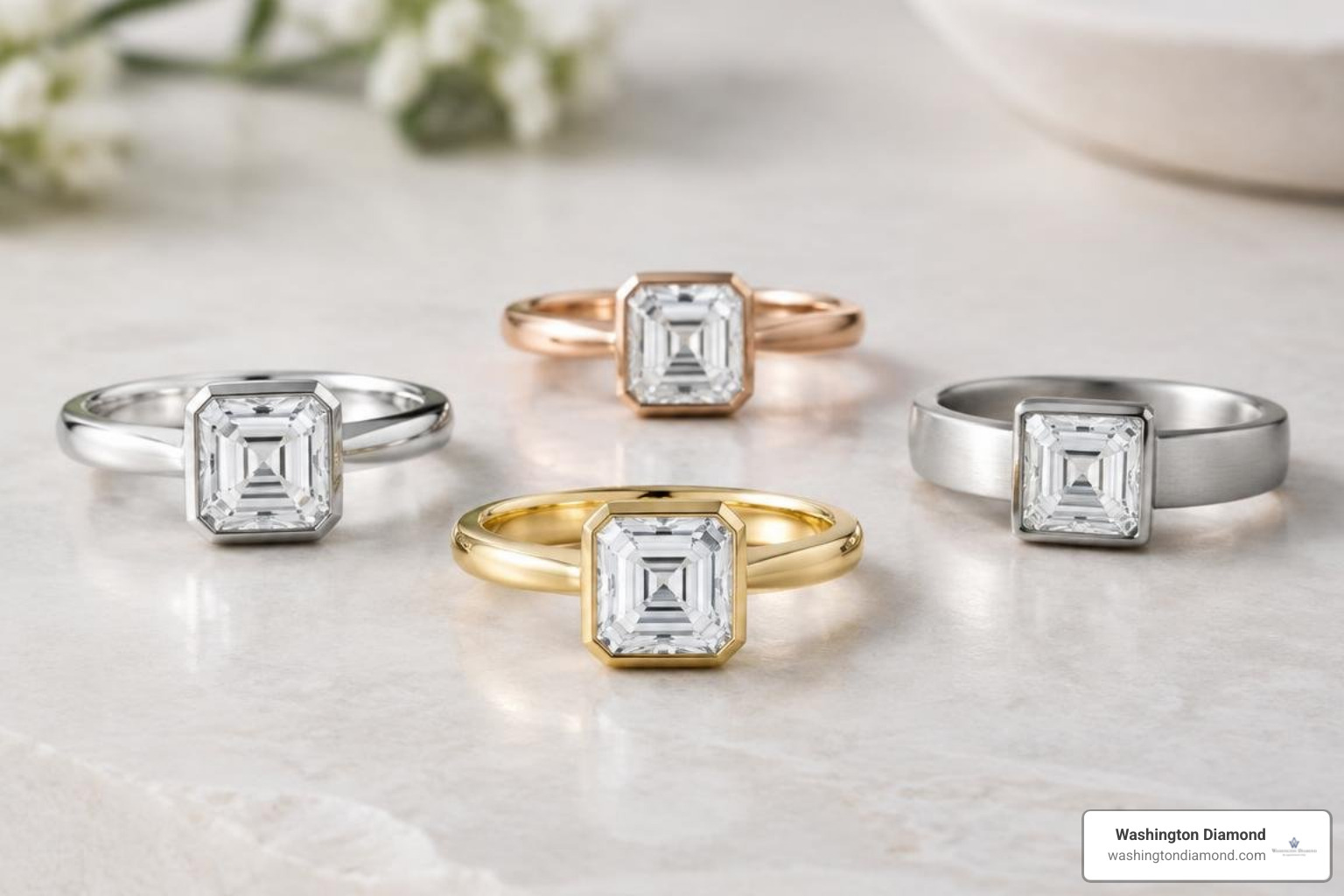
Setting a square step cut requires thoughtful craftsmanship that highlights its clean lines while safeguarding its corners.
- Solitaire with Chevron Prongs: Clean four-prong settings with V-shaped or chevron prongs cap the beveled corners securely, highlighting the stone's geometric silhouette.
- Modern Bezel Mountings: A full or semi-bezel wraps the diamond in a sleek ribbon of precious metal, accentuating Art Deco symmetry while offering maximum durability for active lifestyles.
- Three-Stone Arrangements: Flanking a square center stone with tapered baguettes, clean trapezoids, or trillion-cut side stones creates a smooth, tapering silhouette along the finger.
- Vintage Halos: Encasing a square emerald cut in a subtle micro-pavé or milgrain border provides an antique touch reminiscent of the 1920s.
Before choosing your mounting, browse our essential engagement ring settings guide or explore bespoke custom engagement rings online to design a setting tailored to your personal aesthetic.
Pricing Dynamics and Smart Buying Considerations
The pricing of a square emerald cut diamond is shaped by the interplay of carat weight, clarity purity, color grade, and structural balance.
For example, a high-quality natural loose diamond measuring approximately 5.06 mm x 5.01 mm x 3.4 mm at 0.78 carats with G color, VVS2 clarity, Excellent polish, and Very Good symmetry typically commands an estimated retail value in the range of $8,400 to $12,600.
When acquiring fine diamonds—whether sourcing through private jewelers or evaluating rare stones on secondary markets—it is important to keep practical factors in mind:
- Depth and Spread: Always compare millimeter dimensions, not just carat weight. A stone with balanced depth will display a wider face-up footprint per carat than one with excess pavilion weight.
- Transparent Provenance & Secure Shipping: Ensure high-value gemstones are accompanied by an original grading report, verified against laser inscriptions, and shipped via fully insured, secure courier services requiring signature confirmation.
- Buyer's Premiums: When acquiring stones through auction environments, factor in additional expenses—such as a 20% buyer's premium or certification validation fees—into your total investment budget.
For a deeper look into selecting the best stone for your budget, reference our expert engagement ring buying guide.
Frequently Asked Questions About Square Emerald Cut Diamonds
Is a square emerald cut diamond the same as an Asscher cut diamond?
Not quite. While both are square step cuts with beveled corners, an Asscher cut features larger corner facets, a smaller table, a higher crown, and a distinctive centralized optical pattern. A square emerald cut maintains a broader, more open table facet and a classic linear step-cut appearance.
Why is there no cut grade on a GIA report for a square emerald cut?
The GIA only issues formal cut grades (such as Excellent, Very Good, Good) for standard round brilliant diamonds. For fancy shapes like square emerald cuts, cut quality is assessed by reviewing individual proportions (table percentage, depth percentage, length-to-width ratio) alongside the explicit Polish and Symmetry ratings.
What are the ideal proportions for a 1.00 ratio square step cut?
For optimal visual balance and brilliance in a 1.00 to 1.05 ratio square step cut, aim for a depth percentage between 64% and 72%, a table percentage between 60% and 69%, a very thin to slightly thick girdle, and no culet (or a pointed culet).
Conclusion
The square emerald cut diamond offers a refined balance of vintage Art Deco heritage and sleek modern geometry. With its calm, architectural flashes of light and pure step-cut facets, it makes a distinctive centerpiece for custom fine jewelry.
At Washington Diamond, we believe choosing an exceptional gemstone should be as memorable as the occasion it celebrates. In our private, appointment-only studio in Northern Virginia, we provide undivided, one-on-one attention to help you explore, compare, and select loose diamonds in a relaxed environment.
Explore handcrafted engagement rings or schedule your private studio consultation with our team today to bring your custom design to life.
Have a question about your jewelry?
We've been helping clients with diamonds, custom design, repairs, appraisals, and more since 1969. Book a private appointment at our Falls Church studio.
Book an AppointmentTrusted since 1969 · Falls Church, VA · 703-536-3600
From the blog
View all


