

A Complete Guide to Princess Cut Rings for Your Crowning Moment
The Ring That Rules Them All: Your Guide to Princess Cut Rings
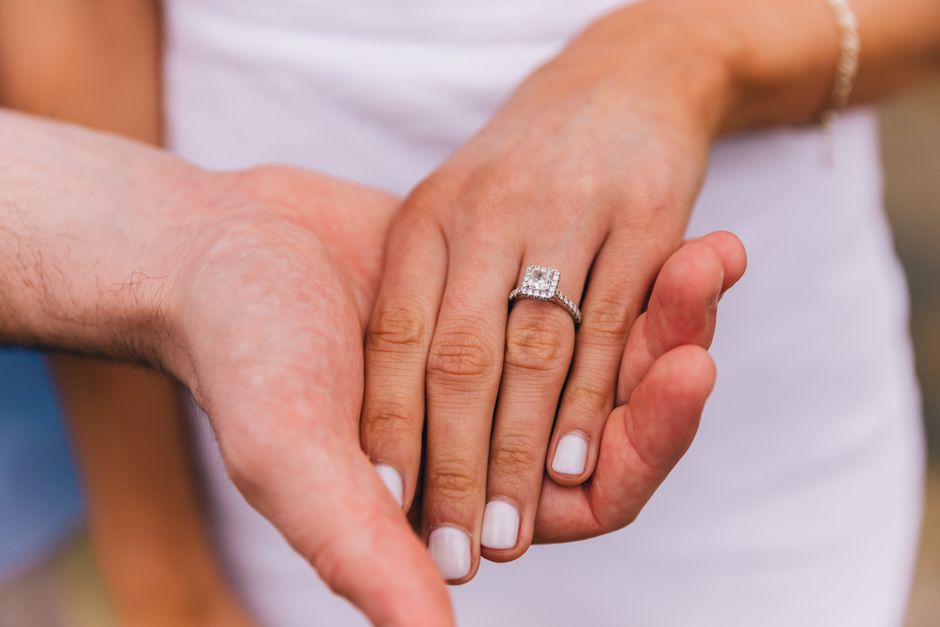
Princess cut rings are the second most popular choice for engagement rings worldwide — and it's easy to see why.
Here's a quick overview of what makes them special:
| Feature | Princess Cut Rings |
|---|---|
| Shape | Square with pointed corners |
| Cut style | Brilliant (like round diamonds) |
| Sparkle | Exceptional — rivaling round brilliant cuts |
| Price vs. round | Typically 10–25% less per carat |
| Popularity | Top 3 most requested engagement ring shapes |
| Stone options | Natural diamonds, lab-grown diamonds, moissanite |
| Best settings | Solitaire, halo, pave, three-stone |
| Metal options | Platinum, white gold, yellow gold, rose gold |
The princess cut blends geometric precision with brilliant sparkle — giving you a ring that feels both modern and timeless. Whether you're shopping for an engagement ring, an anniversary gift, or simply a meaningful piece of jewelry, this guide covers everything you need to make a confident, informed choice.
I'm Tom Daube, a top-1% jeweler with decades of experience helping clients find the perfect princess cut rings and other fine diamond jewelry, including GIA-certified diamonds with ideal proportions at highly competitive prices. Let's walk through everything you need to know — from cut anatomy to care tips — so your decision feels effortlessly clear.
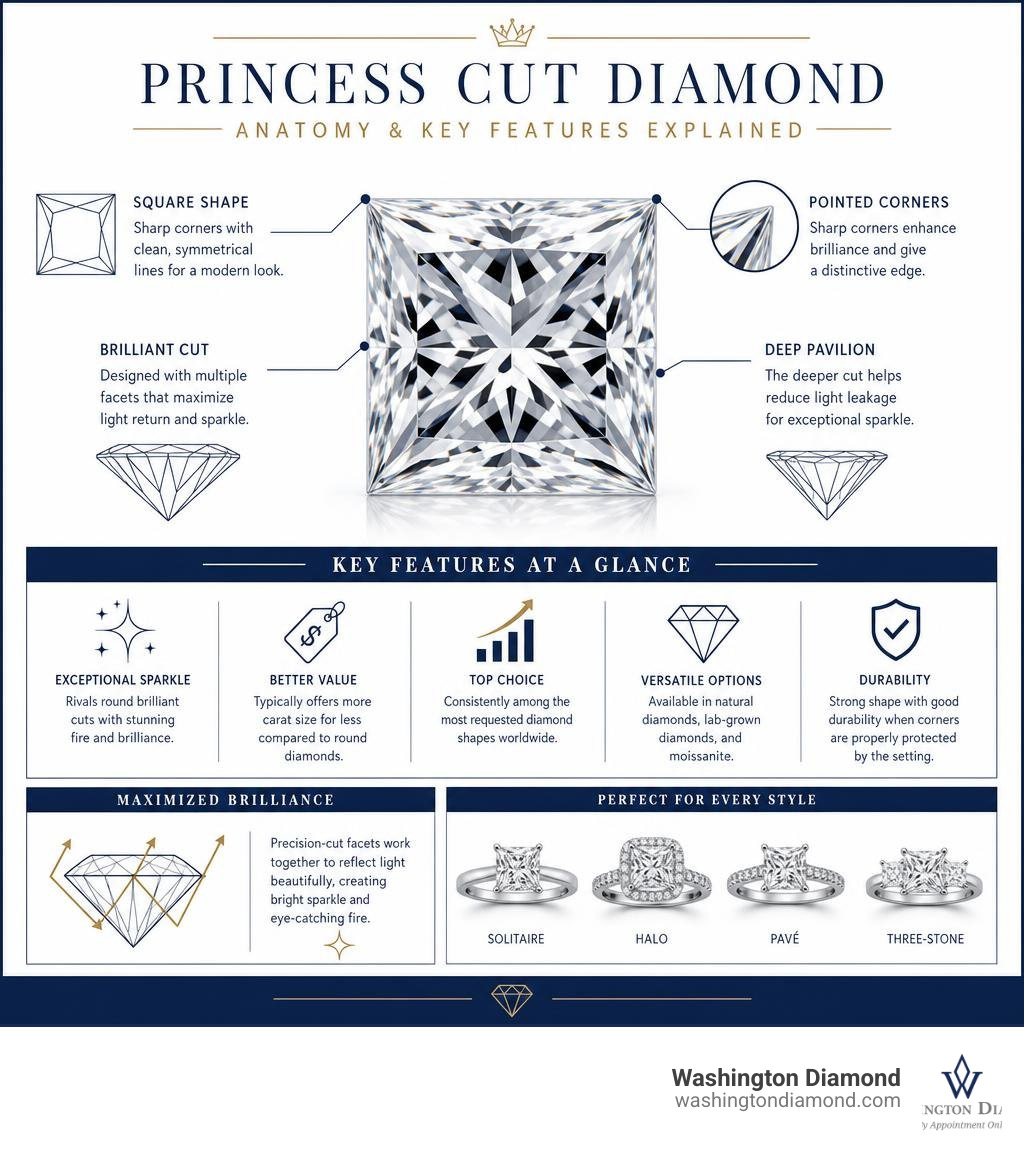
Princess cut rings vocabulary:
What is a Princess Cut Diamond?
To understand the magic of princess cut rings, we have to look at the anatomy of the stone itself. Created in the late 1970s by master diamond cutters, the princess cut was designed to answer a common dilemma: how do you get the unmatched, fiery sparkle of a round brilliant diamond while keeping the clean, modern look of a square shape?
Technically known as a square modified brilliant, the princess cut features a square face-up profile, four sharp, pointed corners, and a bevelled, pyramidal pavilion underneath. Unlike step-cut square diamonds (like the emerald or Asscher cuts, which feature long, parallel facets resembling a hall of mirrors), the princess cut is engineered with vertical, triangular facets. This brilliant-style faceting pattern bounces light in every direction, producing an incredibly high level of fire and scintillation.
When light enters a princess cut diamond, it reflects off these specialized facets and returns to your eye as an explosive display of sparkle. This makes it an ideal choice for anyone who loves high-contrast, geometric lines but refuses to compromise on that classic diamond "wow" factor. If you are curious about how this shape matches your personal style, check out our guide on The Perfect Diamond Shape for Every Personality.
Comparing Princess Cut Rings to Round Brilliant Diamonds
When choosing between these two giants of the bridal world, it helps to look at the numbers and the physics. While the round brilliant diamond is the undisputed champion of light return, princess cut rings are a very close second.
One of the most surprising benefits of the princess cut is its visual presence. Because of its square shape and long diagonal measurements, a princess cut diamond can actually appear up to 10% larger than a round diamond of the identical carat weight. When you look at a square stone, your eye naturally measures from corner to corner, which maximizes the perceived size of the diamond on your hand.
Another major difference lies in how these diamonds are cut from the rough crystal. Cutting a round diamond is a highly wasteful process; diamond cutters must shave away up to 55% to 60% of the original rough stone to achieve those perfect circular proportions. A princess cut, on the other hand, utilizes up to 80% to 90% of the natural octahedral rough crystal. Because there is so little waste, the cost savings are passed directly to you.
Here is a quick look at how they stack up side-by-side:
| Feature | Round Brilliant Diamond | Princess Cut Diamond |
|---|---|---|
| Faceting Style | Round Brilliant (58 facets) | Square Modified Brilliant (50 to 76 facets) |
| Light Performance | Maximum possible brilliance and fire | High brilliance with unique, geometric scintillation |
| Visual Size | Appears true to its carat weight | Can appear up to 10% larger due to diagonal length |
| Rough Material Yield | Low yield (40% to 45% of rough saved) | High yield (80% to 90% of rough saved) |
| Price Point | Premium pricing due to high material waste | Highly cost-effective (typically 10% to 25% lower cost) |
| Corner Vulnerability | No corners to protect | Four sharp corners requiring protective prongs |
If you are still torn between these two stunning options, our Engagement Ring Comparison Help tool can help you weigh the visual and financial pros and cons.
Why Choose Princess Cut Rings? Advantages and Popularity
There is a reason princess cut rings have remained firmly in the top three most requested styles year after year. First and foremost, they offer a striking modern aesthetic. The clean, geometric lines of a square diamond look incredibly crisp and sophisticated, making a bold statement that feels both contemporary and architectural.
Furthermore, princess cut diamonds are exceptionally versatile. They look equally breathtaking in a minimalist solitaire setting as they do surrounded by a glittering halo of smaller stones. Because they are highly efficient to cut, they offer a fantastic way to maximize your budget. You can easily purchase a larger, higher-quality princess cut diamond for the same price as a smaller round diamond. If you are planning your budget for an upcoming proposal, take a look at our Engagement Ring Prices Guide 2026 to see how different shapes fit your financial goals.
Natural vs. Lab-Grown Princess Cut Rings
As you shop for princess cut rings, you will quickly find that you have two excellent paths to choose from: natural, earth-mined diamonds and lab-grown diamonds.
Lab-grown princess cut diamonds are created using advanced technological processes like Chemical Vapor Deposition (CVD). These stones are chemically, physically, and optically identical to natural diamonds. They feature the exact same hardness (10 on the Mohs scale), the same refractive index, and the same spellbinding sparkle. Today, lab-grown princess cut diamonds are highly popular, representing a growing portion of the market for couples seeking sustainable and budget-friendly alternatives.
When evaluating these stones, certification is key. For natural diamonds, a GIA (Gemological Institute of America) grading report is the industry gold standard. For lab-grown diamonds, look for an IGI (International Gemological Institute) certificate, which provides a comprehensive, highly respected analysis of the stone's quality. Choosing lab-grown options allows you to prioritize larger carat weights or higher clarity grades without stretching your budget. To see how these stunning square cuts look in other jewelry styles, browse our collection of 1 Carat Princess Cut Diamond Earrings.
Selecting the Perfect Setting and Metal
The setting you choose for a princess cut diamond is not just about looks — it is also about safety. Because the princess cut has four sharp, pointed corners, those areas are highly vulnerable to chipping if they accidentally strike a hard surface.
To keep your diamond safe, we always recommend a setting that features protective prongs. The most popular choice is the V-shape prong, which wraps securely around each corner, shielding the delicate points from everyday wear. Alternatively, you can opt for compass prongs (where the prongs are positioned at the North, South, East, and West points of the stone), which turns the square diamond into a striking, kite-set orientation.
When it comes to metals, the choice is entirely yours:
- Platinum: The ultimate in durability. Its naturally white hue never fades, and its strength ensures your protective prongs remain rock-solid for decades.
- White Gold: A classic, sleek option that perfectly complements the cool, icy sparkle of a high-grade diamond.
- Yellow Gold: Provides a gorgeous, warm contrast. The rich golden tones create a beautiful frame around the sharp, modern edges of the square stone.
- Rose Gold: Adds a soft, romantic, vintage-inspired flair to an otherwise highly modern shape.
To learn more about how different metals and prong styles affect the security and look of your ring, explore our Engagement Ring Settings 101 guide.
Popular Styles: Solitaire, Halo, and Pave
Because of its clean lines, the princess cut adapts beautifully to a wide variety of design styles. Here are the most popular ways to showcase this magnificent shape:
- The Classic Solitaire: For the purist, a simple solitaire setting allows the geometric beauty of the princess cut to take center stage. Pair it with a thin, polished band to make the center stone appear even larger.
- The Hidden Halo: A modern favorite. This style features a delicate collar of tiny diamonds wrapped around the base of the center stone's prongs. It is a subtle, secret sparkle that you can only see from the side profile.
- French Cut Pave: If you love maximum brilliance, pairing a princess cut center stone with a pave band creates an uninterrupted line of light across your finger.
For a deeper dive into band options, check out our Pave Engagement Setting Complete Guide. If you have a highly specific vision in mind, you can also design a completely bespoke ring from scratch with our Custom Design Engagement Ring Guide.
How to Evaluate Quality: Carat, Color, and Clarity
When buying a princess cut diamond, the classic "4 Cs" still apply, but there are a few unique rules you should follow to get the best value:
1. Color: Look for Corner Warmth
Unlike round diamonds, which are excellent at masking color, princess cut diamonds tend to retain slightly more body color, particularly in their thick corners. If you are choosing a white metal like platinum or white gold, we recommend staying within the G to I color range to ensure the stone looks bright and colorless. If you prefer yellow gold, you can safely drop to a J or K color, as the warm metal will naturally mask any slight yellow tint in the diamond.
2. Clarity: Avoid Corner Inclusions
This is the most important rule for princess cut diamonds. When looking at a grading report, ensure there are no major inclusions (like feathers or dark crystals) located near the four sharp corners of the stone. Because these corners are already under structural stress from the prongs, an inclusion in these areas drastically increases the risk of the diamond cracking or chipping during the setting process or if it takes a hard hit during daily wear. Aim for an SI1 or VS2 clarity grade for the best balance of visual purity and budget.
3. Cut: Focus on Proportions
While the GIA does not issue an official "Cut Grade" for fancy shapes like the princess cut, you can look at the proportions on the grading report to ensure excellent light return. Look for a Total Depth of 65% to 75% and a Table Percentage of 60% to 75%. This ensures the stone is not cut too shallow (which causes light to leak out the bottom) or too deep (which hides carat weight in the bottom of the stone where you can't see it).
Pairing with Wedding Bands and Maintenance
Because of their square shape and straight edges, pairing princess cut rings with a wedding band requires a little bit of planning.
If you select a traditional straight wedding band, you may find that the corners of the princess cut prevent the band from sitting completely flush against the engagement ring, creating a small gap. Many couples love this look, but if you prefer a seamless, gap-free fit, you have a few fantastic options:
- Contoured (Curved) Bands: These bands are custom-curved to trace the exact outline of your engagement ring's setting, allowing them to nestle together perfectly.
- Chevron (Wishbone) Bands: A V-shaped band that dips gracefully around the square corner of the diamond, creating a highly stylish, modern pairing.
- High-Set Solitaires: Opting for a cathedral-style setting lifts the center diamond high enough off your finger that a standard, straight wedding band can slide right underneath it.
For a comprehensive look at how to design the perfect matching set, read our Custom Engagement Ring Band Guide.
Keeping Your Ring Sparkling
To maintain that breathtaking, crown-worthy sparkle, we recommend a simple weekly cleaning routine. Soak your ring in a bowl of warm water mixed with a few drops of mild dish soap for 10 to 15 minutes. Gently brush away dirt and oils using a soft-bristled baby toothbrush, paying special attention to the underside of the setting where lotion and dust tend to gather. Rinse thoroughly with clean water and pat dry with a lint-free microfiber cloth.
Frequently Asked Questions
Are princess cut diamonds more affordable than round diamonds?
Yes! Princess cut diamonds are significantly more affordable than round diamonds of the exact same carat weight, color, and clarity. Because diamond cutters can retain up to 90% of the rough octahedral crystal when cutting a princess shape (compared to only 40% to 50% for a round brilliant), there is very little material waste. This high yield makes them incredibly cost-effective, allowing you to get a larger, more brilliant stone for your budget.
Do princess cut diamonds chip easily?
The flat surfaces of a princess cut diamond are incredibly durable, but the four sharp, pointed corners are naturally vulnerable to impact. If a corner is left exposed and accidentally strikes a hard surface like a granite countertop or a metal doorframe, it can chip. However, this is easily prevented by choosing a secure setting with V-shape prongs or a protective bezel that completely covers and shields the corners.
What wedding band style looks best with a princess cut?
A chevron (wishbone) band or a custom-contoured band looks spectacular because they wrap seamlessly around the square edges of the ring. If your engagement ring has a high cathedral setting, a classic straight diamond-set band will also sit beautifully flush. To explore which style matches your personal aesthetic, take a look at our guide: Which Engagement Ring Rocks Your World.
Conclusion
With their striking geometric symmetry and exceptional, fiery sparkle, princess cut rings offer an elegant statement of style that is both modern and deeply timeless. Choosing the perfect ring is a highly personal journey, and having the right guidance makes all the difference.
At Washington Diamond, we believe that finding your dream ring should be as memorable as the proposal itself. Located in Northern Virginia, we operate a private, appointment-only studio where you receive our undivided attention, expert guidance, and a completely personalized, pressure-free experience. Whether you want to customize a classic style or create a completely bespoke design, we are here to bring your vision to life.
Ready to find your perfect match? Explore our Custom Engagement Rings Ultimate Guide to see how we craft heirloom-quality jewelry, and when you are ready, Schedule a private consultation with our diamond experts at our Northern Virginia studio. We look forward to helping you design your crowning moment!
Have a question about your jewelry?
We've been helping clients with diamonds, custom design, repairs, appraisals, and more since 1969. Book a private appointment at our Falls Church studio.
Book an AppointmentTrusted since 1969 · Falls Church, VA · 703-536-3600
From the blog
View all


