

How Much is a Two Carat Diamond? A Visual Guide to Carat Costs
What a Diamond Carat Chart with Price Actually Tells You

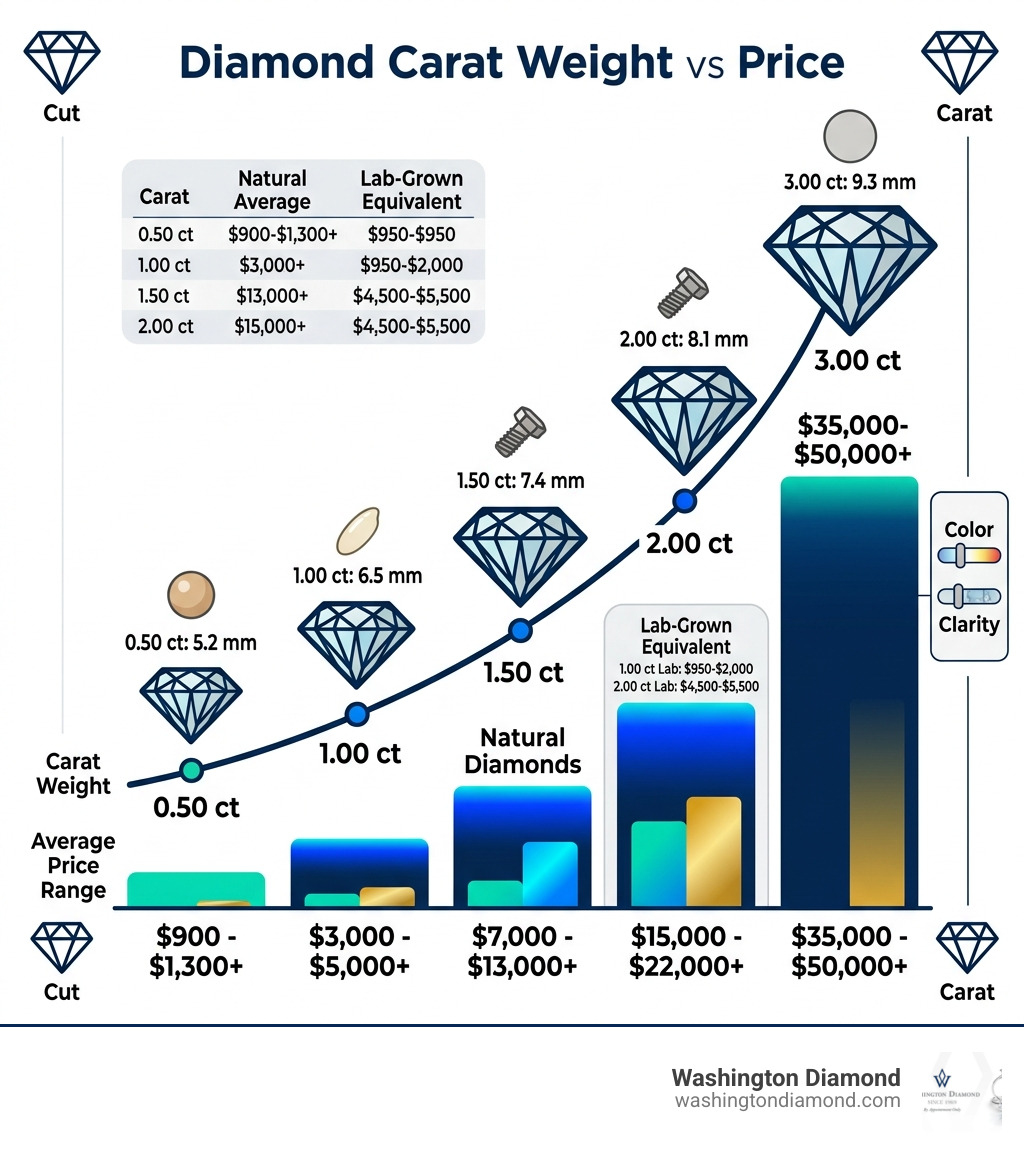
A diamond carat chart with price is the fastest way to understand what a diamond should cost before you ever walk into a store. Here's a snapshot of average natural diamond prices by carat weight as of April 2026:
| Carat Weight | Average Price (Natural) | Lab-Grown Equivalent |
|---|---|---|
| 0.50 ct | ~$1,062 | ~$300-$500 |
| 1.00 ct | ~$3,708 | ~$950-$2,000 |
| 1.50 ct | ~$8,000-$12,000 | ~$2,500-$3,500 |
| 2.00 ct | ~$17,464 | ~$4,500-$5,500 |
| 3.00 ct | ~$41,814 | ~$8,500-$11,500 |
Important: These are averages. The actual price of any diamond depends heavily on its cut, color, clarity, and certification. A 1-carat diamond can range from $2,500 to over $20,000 depending on those factors.
Prices are currently trending downward — overall diamond prices dropped about 5.44% in the past month, partly driven by growing lab-grown supply and shifting market demand.
Shopping for a two-carat diamond can feel overwhelming when you're staring at price tags that swing wildly for stones that look almost identical. Understanding why those numbers differ — and how to read a carat chart correctly — can save you thousands and help you find the right diamond with confidence.
I'm Tom Daube, a GIA-certified diamond expert and jeweler who has helped hundreds of clients navigate diamond pricing and find exceptional stones — often at or below wholesale. Using a diamond carat chart with price is one of the first tools I put in every buyer's hands. Let me walk you through exactly how to use one.
Diamond carat chart with price vocab explained:
Understanding the Diamond Carat Chart with Price
When we look at a diamond carat chart with price, we aren't just looking at a menu. We are looking at a complex matrix of rarity and market demand. In the diamond world, "carat" refers to the weight of the diamond, not its physical dimensions. One carat is exactly 0.2 grams—roughly the weight of a single paperclip.
However, because larger diamonds are significantly rarer in nature than smaller ones, the price doesn't just double when the weight doubles. It explodes. This is why a 2-carat diamond can cost three to four times as much as a 1-carat diamond of the same quality.
Deciphering "Price Per Carat"
To use these charts effectively, you must understand the industry standard: Price Per Carat (PPC). Jewelers don't usually say "this stone is $10,000." Instead, they might say "this stone is $5,000 per carat." If the diamond weighs 2 carats, your total is $10,000.
You can learn more about this math in our guide on how to calculate diamond price per carat. Understanding this allows you to compare diamonds of slightly different weights (like a 1.01ct vs. a 1.05ct) on an even playing field.
Market Inventory and Certification
The prices you see on a diamond carat chart with price are influenced by current market inventory. For instance, in April 2026, we are seeing a high inventory of 2-carat stones (over 41,000 currently available in major databases), which has contributed to a 5.37% price drop in that specific category over the last month.
When consulting a chart, always ensure the data refers to GIA-certified diamonds. The GIA (Gemological Institute of America) is the gold standard for grading. A "1-carat VS2" diamond graded by a lesser lab might actually be an SI1 in reality, making the "cheap" price on the chart a misleading bargain. For a deeper dive into these market movements, the Diamond Price Chart & Market Trends | Pricescope is an excellent resource for tracking live fluctuations.
How to Use a Diamond Carat Chart with Price to Save Money
One of the best ways we help our clients in Northern Virginia save money is by teaching them how to "buy shy." If you look at a diamond carat chart with price, you’ll notice that prices per carat take a massive leap at the 1.00-carat mark.
By choosing a diamond that weighs 0.90ct to 0.95ct, you can save up to 20-30% compared to a 1.00ct stone. Visually, the difference in size is virtually impossible to see with the naked eye, but your bank account will certainly feel it. We see similar opportunities across various sizes; for example, you can see how this works with smaller stones in our breakdown of how much for a 75 carat loose diamond your ultimate pricing breakdown.
The "Value" Sweet Spot: G-H Color and VS2 Clarity
If you want the most "bang for your buck," we typically recommend focusing on G or H color grades and VS2 clarity.
- Color: G and H diamonds appear white to the untrained eye when set in a ring. Moving up to D or E (colorless) can add thousands to the price without a significant visual payoff.
- Clarity: VS2 (Very Slightly Included) diamonds are almost always "eye-clean," meaning you can't see the inclusions without a magnifying loupe. Paying for VVS1 or Flawless is often paying for a "paper grade" that you can't actually see.
Analyzing the Diamond Carat Chart with Price for Different Shapes
The shape of your diamond significantly impacts where it falls on the price chart. The Round Brilliant cut is the most expensive shape—period.
Why? Two reasons:
- Rough Waste: When cutting a round diamond, jewelers lose about 60% of the original rough stone. Fancy shapes like Ovals, Pears, and Princess cuts use the rough material more efficiently.
- Demand: Round diamonds are the most popular, and the market reflects that.
Fancy Shape Savings
If you choose an Oval, Princess, or Emerald cut, you can often save 10% to 25% compared to a round diamond of the same carat weight.
- Princess Cuts: These are highly efficient to cut, often resulting in lower prices per carat. You can check out more on specific weight pricing like the 1 4 cttw diamond price to see how these totals add up.
- Oval and Pear Shapes: These "elongated" shapes often have a larger "face-up" area, meaning a 1.5-carat oval might look as large as a 2-carat round, despite costing much less.
- Emerald Cuts: These require higher clarity because their "hall of mirrors" facets don't hide inclusions as well as brilliant cuts do.
Why Diamond Prices Jump at "Magic Numbers"
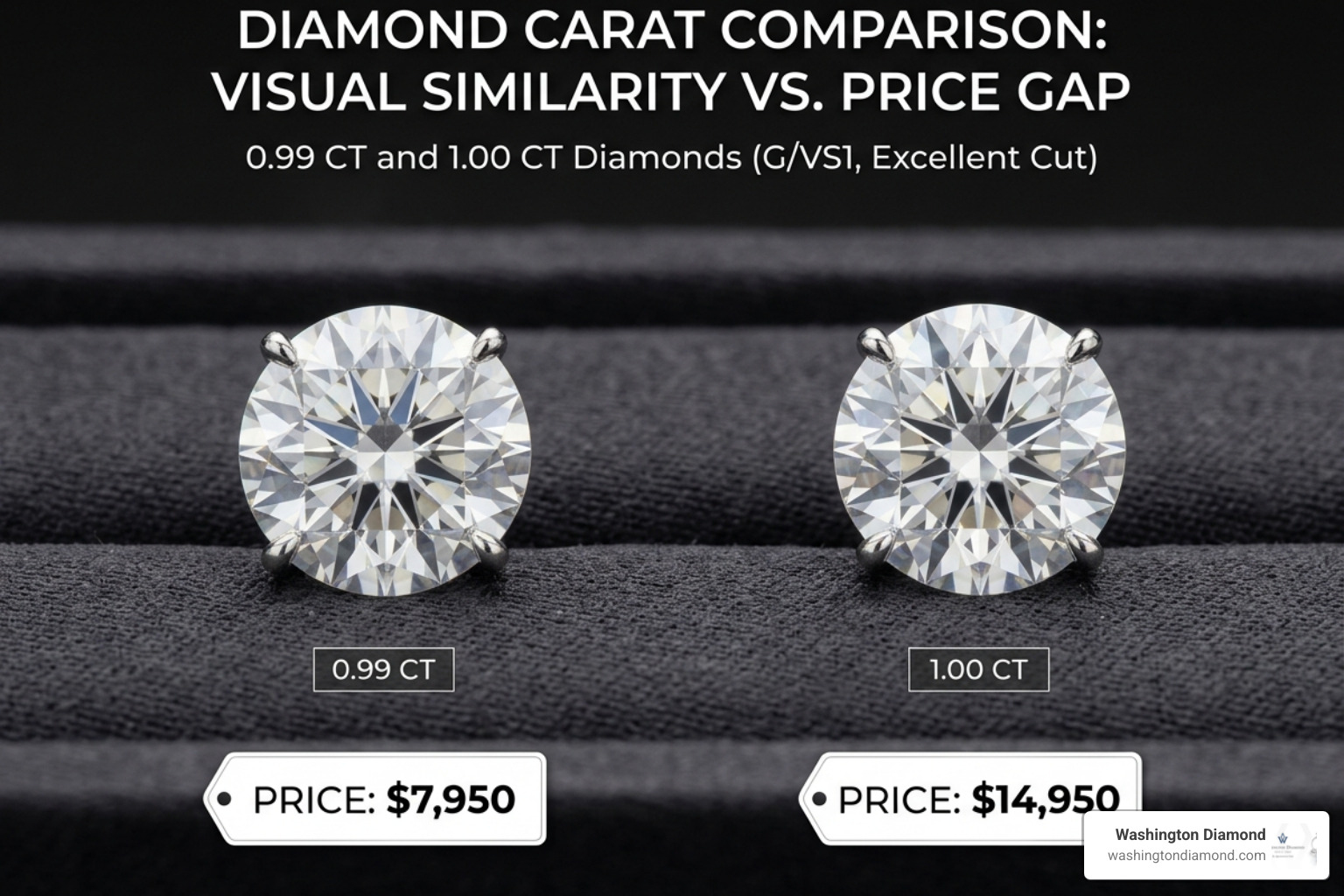
In the diamond industry, we have what we call "Magic Numbers." These are weights like 0.50ct, 0.75ct, 1.00ct, 1.50ct, and 2.00ct. When a diamond hits one of these marks, the price doesn't just go up—it teleports.
This is driven by consumer psychology. Everyone wants to say they have a "one-carat" or "two-carat" diamond. Because of this high demand, wholesalers and retailers price these stones at a premium. A 1.99-carat diamond is considered a "distressed" stone by some wholesalers because it failed to hit the 2.00-carat mark, even though it looks identical to a 2.00-carat stone.
For a detailed look at how this impacts the 2-carat market specifically, see our guide on decoding the dollar your guide to 2 carat diamond pricing.
Rarity and Supply Scarcity
As you move up the diamond carat chart with price, the supply drops. Finding a high-quality 3-carat rough stone is exponentially harder than finding a 1-carat stone. This scarcity, combined with the "magic number" demand, creates the non-linear price curve that often surprises first-time buyers.
Natural vs. Lab-Grown: A 2026 Price Comparison
As of April 2026, the gap between natural and lab-grown diamonds has never been wider. Lab-grown diamonds are chemically, physically, and optically identical to natural diamonds, but they are created in a factory rather than mined from the earth.
The Price Gap
Currently, lab-grown diamonds cost about 67% to 80% less than natural diamonds.
- A 1-carat natural diamond might cost you $3,700.
- A 1-carat lab-grown diamond of the same quality might cost you $1,000.
You can view a full comparison in our lab diamonds price chart.
The Resale Reality
While lab-grown diamonds offer incredible "visual size" for the money, it is important to understand the investment side. Natural diamonds are a finite resource and have historically retained a portion of their value. Lab-grown diamonds, because they can be manufactured in unlimited quantities, have seen their prices drop consistently.
We often tell our clients: if you want the biggest, sparkliest stone for your budget and don't care about resale value, lab-grown is a great choice. If you view your diamond as a family heirloom that should hold intrinsic value, natural is the way to go. For more specifics on the 2-carat lab market, check the average cost of a 2 carat lab grown diamond.
Beyond the Carat: Factors That Shift the Price Chart
A diamond carat chart with price is a great starting point, but it's not the whole story. Several "hidden" factors can cause a diamond to be priced 20% higher or lower than the chart suggests.
1. Cut Quality (The Most Important C)
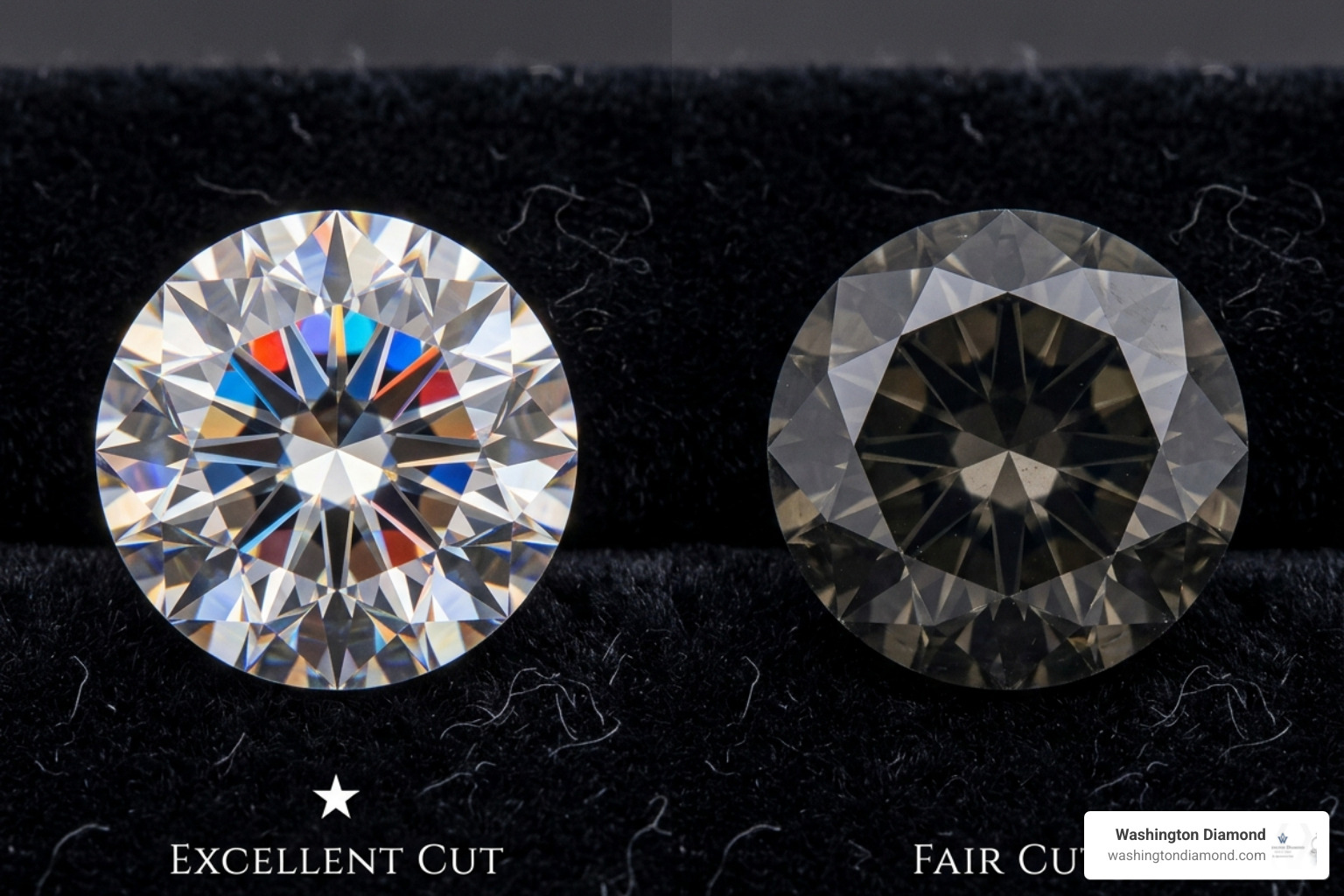
Cut is the only one of the 4Cs that is determined by human hands, and it is the most important. A poorly cut 2-carat diamond will look dull, dark, and potentially even smaller than a well-cut 1.5-carat diamond.
- Excellent/Ideal Cut: Commands a 10-15% premium but is worth every penny for the sparkle.
- Poor/Fair Cut: Often sold at a deep discount because the diamond won't "fire" properly.
2. Fluorescence
Fluorescence is the glow a diamond emits under UV light.
- In high color grades (D-F), strong fluorescence can make a stone look "milky" or "oily," leading to a 15-25% discount.
- In lower color grades (I-K), a little blue fluorescence can actually make the diamond look whiter, which is a rare "win-win" for buyers.
3. Symmetry and Polish
These "minor" grades on a GIA report can impact the price by 5-10%. We always look for "Triple Excellent" stones (Excellent Cut, Excellent Symmetry, Excellent Polish) to ensure the diamond performs at its peak. You can find more details on what to look for in our GIA certified diamonds price guide.
4. Market Indexes (Rapaport and IDEX)
Professionals use the Guide to the Price Lists (the Rapaport List) as a benchmark. This list is updated frequently and sets the "high cash asking price" for diamonds. Most retail and wholesale transactions happen at a discount to this list, depending on the quality of the specific stone.
Frequently Asked Questions about Diamond Pricing
Should I prioritize carat weight over cut quality?
In our professional opinion: Never. A large diamond with a poor cut is just a large, dull rock. A slightly smaller diamond with an "Excellent" cut will reflect more light, look more brilliant, and often appear larger because the light is reaching the very edges of the stone. Always buy the best cut your budget allows, even if it means dropping down 0.20 carats in weight.
How have diamond prices trended in early 2026?
The market in early 2026 has been favorable for buyers. We've seen a steady decline in prices (about 5.44% overall recently) due to a combination of increased lab-grown competition and a stabilization of the global supply chain. For a deeper look into the "why" behind these numbers, check out beyond the bling what a diamond price chart really tells you.
What is the difference between wholesale and retail diamond prices?
Retail prices include the jeweler's overhead (rent, staff, marketing) and a profit margin. Wholesale prices are what jewelers pay each other. At Washington Diamond, our appointment-only model in Northern Virginia allows us to keep overhead low, often bringing our prices much closer to wholesale than a traditional mall jeweler could manage. You can learn the specifics of these calculations in our guide on how to calculate price of a diamond.
Conclusion
Navigating a diamond carat chart with price is the first step toward becoming an educated buyer. By understanding that carat is weight, recognizing the "magic numbers," and prioritizing cut quality over raw size, you can find a diamond that looks spectacular without overpaying.
At Washington Diamond, we believe the process of buying a diamond should be as special as the moment it represents. Our private, appointment-only studio in Northern Virginia is designed to give you our undivided attention. We don't just show you charts; we show you the actual diamonds, explaining the nuances that the reports don't always capture.
Before you make your final decision, we encourage you to use the diamond value calculator your secret weapon for smart buying or read our full guide on how to calculate the value of a diamond before you buy or sell.
When you're ready for a personalized experience that goes beyond the numbers, we're here to help you find the perfect stone.
Have a question about your jewelry?
We've been helping clients with diamonds, custom design, repairs, appraisals, and more since 1969. Book a private appointment at our Falls Church studio.
Book an AppointmentTrusted since 1969 · Falls Church, VA · 703-536-3600
From the blog
View all


