

Sparkle Smart and Buy the Perfect 1 Carat Diamond Earrings
What to Know Before You Buy 1 Carat Diamond Earrings

If you're ready to buy 1 carat diamond earrings, here's a quick summary of what matters most:
| Factor | What to Know |
|---|---|
| Price range | Lab-grown: ~$500–$1,500 / Natural: ~$2,000–$5,000+ per pair |
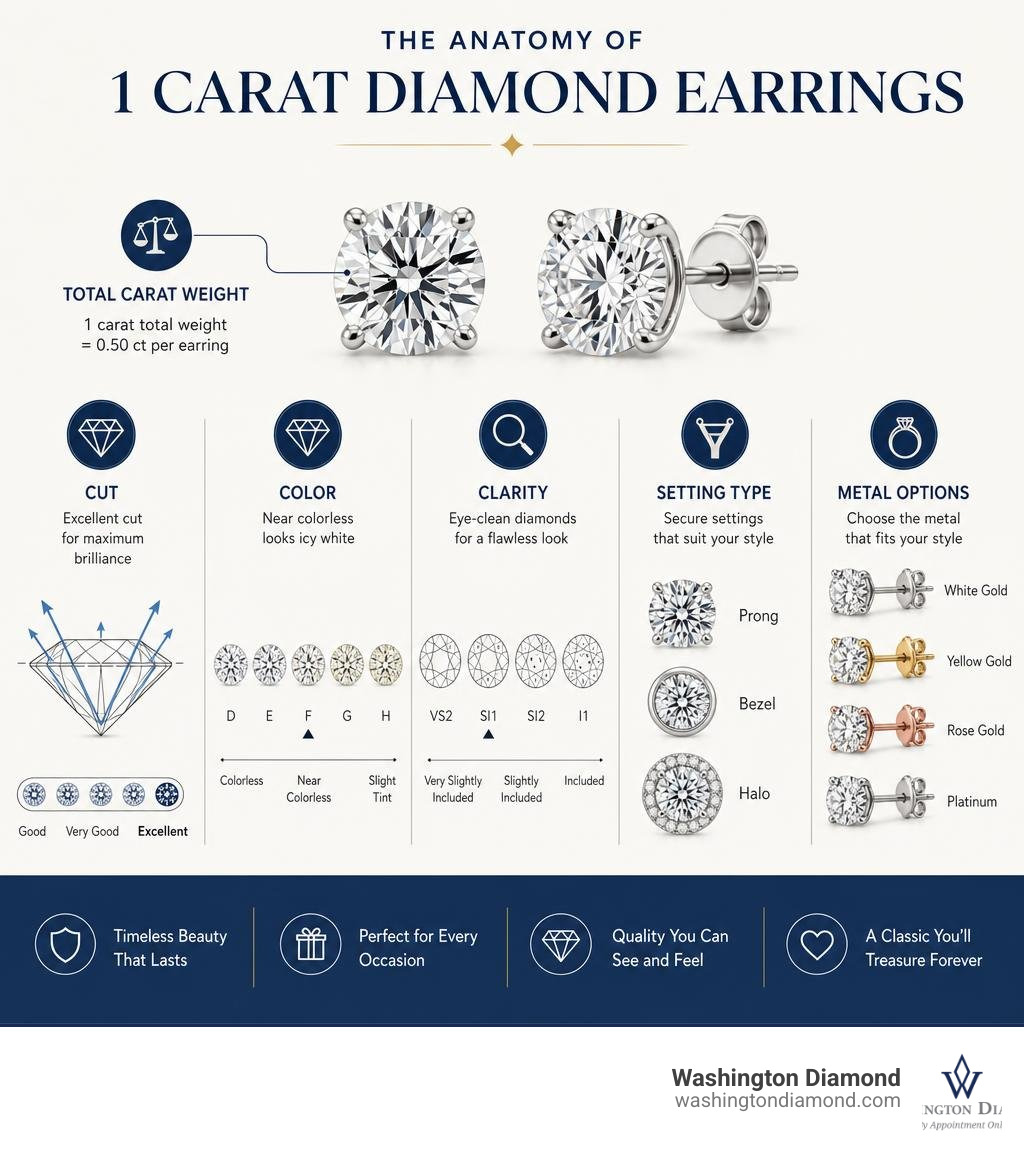
| Stone weight | "1 carat total weight" means 0.50 ct per earring, not 1 ct each |
| Best certification | Look for GIA or IGI certified diamonds |
| Popular settings | Prong, bezel, and halo are the most common |
| Metal options | 14K/18K white gold, yellow gold, rose gold, or platinum |
| Backing types | Screw backs offer more security than push backs |
| Natural vs. lab-grown | Same visual quality, lab-grown costs significantly less |
Whether you're shopping for a milestone anniversary, a meaningful gift, or simply treating yourself, 1 carat diamond studs are one of the most versatile and enduring pieces in any jewelry collection. But with prices ranging from a few hundred to several thousand dollars — and dozens of quality variables that affect what you actually see on your ear — it pays to understand what you're buying before you spend a cent.
I'm Tom Daube, a GIA-certified diamond specialist with decades of experience helping people buy 1 carat diamond earrings they'll treasure for life, consistently sourcing diamonds at prices well below standard wholesale. In this guide, I'll walk you through everything you need to make a confident, well-informed choice.
Explore more about buy 1 carat diamond earrings:
- 1 carat emerald cut earrings
- 1 ctw princess cut diamond earrings (Note: Adjusted internally for matching)
- black diamond bezel earrings (Note: Adjusted internally for matching)
Natural vs. Lab-Grown: Which 1 Carat Diamond Earrings Are Right for You?
When you set out to buy 1 carat diamond earrings in June 2026, the very first decision you will face is whether to choose natural diamonds or lab-grown diamonds. Both options are physically, chemically, and optically identical, but they carry vastly different price tags, value propositions, and origin stories.
Natural Diamonds: Timeless Value and Rarity
Natural diamonds were forged deep within the Earth's mantle billions of years ago under intense heat and pressure. For many buyers, the appeal of a natural diamond lies in its incredible rarity and the romance of owning a genuine piece of Earth's history.
From a financial perspective, natural diamonds retain a portion of their resale value over time, making them a traditional choice for heirlooms. However, that rarity comes with a premium. A pair of natural 1 carat round stud earrings in 14K yellow gold with GIA certification typically retails for around $2,600, while premium Canadian certified natural diamond solitaire stud earrings can easily cost up to $3,999.20.
Lab-Grown Diamonds: Modern Innovation and Value
If you want the absolute most sparkle for your budget, lab-grown diamonds are an incredibly compelling choice. Created in controlled laboratory environments that mimic the natural forces of the Earth, these stones are indistinguishable from natural diamonds—even to trained gemologists using standard magnification.
Because the supply chain is shorter and highly efficient, lab-grown options are exceptionally affordable. For example, a 1.00 TCW pair of lab-grown diamond earrings can be found for as low as $508. This allows you to redirect your budget toward higher-quality metal settings, larger carat weights, or flawless cut grades.
To explore this modern choice further, check out our comprehensive guide on the 1 Carat Man Made Diamond or read through our Certified Lab Diamonds Complete Guide to understand how these stones are graded.
Ethical Sourcing and Sustainability
Ethical considerations play a major role for many modern buyers. Lab-grown diamonds bypass the environmental impact of traditional open-pit mining, making them a popular choice for eco-conscious shoppers.
On the other hand, the natural diamond industry has made massive strides in transparency. Many buyers specifically seek out Canadian certified diamonds, which are mined in accordance with strict environmental laws and coordinate directly with local Indigenous communities to ensure fair wages and community development. Whichever path you choose, verifying the origin of your diamonds ensures your purchase aligns with your personal values.
Understanding the 4Cs When You Buy 1 Carat Diamond Earrings
The 4Cs—Cut, Color, Clarity, and Carat Weight—are the universal standards used to grade diamond quality. However, when you are shopping for earrings, the way you prioritize these factors should be slightly different than when you are buying an engagement ring. After all, earrings are viewed from a distance and are constantly in motion, meaning some imperfections are completely invisible to the naked eye.

Cut Quality: The Engine of Sparkle
If you remember only one rule from this guide, let it be this: never compromise on the cut. The cut grade determines how effectively a diamond reflects light. A poorly cut diamond will look dull, glassy, and lifeless, regardless of how white or clean it is. For maximum brilliance, always select an "Excellent" or "Ideal" cut grade. A well-cut diamond will hide minor color tinting and small clarity inclusions simply by throwing off an immense amount of fire and sparkle.
Color Grades: Finding the "Eye-Clean" Sweet Spot
Diamonds are graded on a scale from D (completely colorless) to Z (noticeable light yellow or brown tint).
- D-F (Colorless): Beautiful, but carries a heavy price premium.
- G-H (Near Colorless): The sweet spot for diamond studs. When set in white gold or platinum, these diamonds look completely white to anyone admiring them on your ears.
- I-J (Near Colorless): If you are setting your diamonds in yellow gold or rose gold, you can safely drop to an I or J color grade. The warm metal will naturally mask the slight warmth in the diamonds, saving you hundreds of dollars.
Clarity Levels: Don't Pay for What You Can't See
Clarity measures the internal flaws (inclusions) and surface blemishes (blemishes) within a diamond. Because earrings aren't scrutinized under a jeweler's loupe by passersby, you do not need a flawless (FL) or Very Very Slightly Included (VVS) diamond.
Opting for Slightly Included (SI1 or SI2) or Very Slightly Included (VS1 or VS2) diamonds is the smartest way to save money. An SI1 clarity grade is typically 100% "eye-clean," meaning the inclusions are invisible to the naked eye. Be cautious with Included (I1 or I2) grades; while they are highly affordable, some inclusions can block light and reduce the overall brilliance of the stone.
Carat Weight vs. Total Carat Weight (TCW)
It is vital to understand that diamond earrings are almost always sold by Total Carat Weight (TCW). This means a pair of "1 carat diamond earrings" actually features two 0.50-carat diamonds—one for each ear. If you want each individual earring to measure a full 1.00 carat, you must search for "2.00 TCW" earrings.
To help you visualize how these choices impact your budget, review the comparison table below:
| Diamond Quality Combination | Visual Impact | Price Tier | Best Metal Match |
|---|---|---|---|
| Excellent Cut, G-H Color, VS2 Clarity | Outstanding sparkle, completely white and eye-clean | Premium / Mid-High | Platinum or White Gold |
| Very Good Cut, I-J Color, SI1 Clarity | Great everyday shine, warm tone hidden by metal | Budget-Friendly / Value | Yellow Gold or Rose Gold |
| Ideal Cut, D-F Color, VVS2 Clarity | Collector's quality, ultra-bright and flawless | Luxury / High | Platinum |
For a deeper dive into choosing individual stones, read our guide on Beyond the 4Cs: How to Choose Your Perfect Certified Loose Diamond and reference our Diamond Carat Chart with Price to see how prices scale with carat weight. If you're curious about how these prices are determined behind the scenes, our article on How to Calculate Diamond Price per Carat breaks down the math simply.
Popular Styles, Settings, and Metals for 1 Carat Studs
Once you have selected your diamonds, the next step is choosing the perfect frame. The setting not only holds your precious stones securely but also plays a massive role in the overall aesthetic and perceived size of your earrings.

Choosing the Right Setting to Buy 1 Carat Diamond Earrings
There are three main setting styles that dominate the market for 1 carat diamond studs:
-
Prong Settings: This is the most classic and popular option. Prongs act like small metal claws that grasp the diamond, leaving the sides open to let in maximum light.
- Four-Prong Settings: Create a slightly squared-off look, offering a clean and modern silhouette.
- Six-Prong Settings: Secure the diamond beautifully and emphasize its roundness, making the stone look circular and full.
- Bezel Settings: In a bezel setting, a continuous band of metal wraps entirely around the edge of the diamond. This offers the ultimate protection against chips or loss and creates a sleek, contemporary, and low-profile look. It also makes the diamond's footprint look slightly larger on the ear.
- Halo Settings: If you want your 1 carat earrings to look like 2 carat earrings, the halo setting is your best friend. A central 0.35-carat diamond is surrounded by a ring of tiny micro-pavé diamonds, creating a sparkling constellation effect that dramatically enhances the visual size and brilliance of the earrings.
To find a style that matches your unique aesthetic, explore The Perfect Diamond Shape for Every Personality. If you prefer a vintage or highly structured look, you might also enjoy reading about 1 Carat Emerald Cut Earrings.
Metal Selection and Backing Types for Security
The metal you choose affects both the style and the durability of your earrings:
- White Gold (14K or 18K): A highly popular choice that offers a bright, reflective look. Some premium white gold alloys utilize palladium instead of nickel to reduce allergy risks and maintain their bright white color longer without frequent replating.
- Yellow Gold (14K or 18K): A classic, warm choice that looks exceptionally rich and pairs beautifully with diamonds that have a slightly warmer color grade (such as I or J).
- Rose Gold (14K): Offers a romantic, vintage, and feminine blush-pink tone that is highly unique.
- Platinum: The most durable and hypoallergenic metal available. Platinum is naturally white, will never change color, and holds diamonds incredibly securely due to its density.
When it comes to keeping your investment safe on your ears, the backing type is just as important as the metal. Push backs (butterfly backs) are highly convenient for daily wear but can loosen over time. For active individuals or those who plan to wear their studs continuously, screw backs provide threaded posts that prevent the backing from sliding off, offering unparalleled security.
How to Verify Quality and Authenticity Before Purchasing
With significant money on the line, you must verify that the diamonds you are buying are exactly what the retailer claims them to be. Never buy diamond earrings based on verbal promises alone.
Why Certification Matters When You Buy 1 Carat Diamond Earrings
An independent gemological certificate is your only guarantee of a diamond's true quality. The two most trusted grading laboratories in the world are:
- GIA (Gemological Institute of America): The gold standard of diamond grading, known for the strictest grading practices in the industry. You can learn more about their grading standards on the official GIA website.
- IGI (International Gemological Institute): A highly respected laboratory that has become the industry leader in grading lab-grown diamonds.
A proper certificate will outline the exact measurements, carat weight, cut, color, and clarity of each stone. Additionally, premium diamonds feature a micro-laser inscription on the girdle (the outer edge of the stone) that matches the certificate number, allowing you to easily verify its authenticity online.
For an in-depth look at how certification impacts cost, reference our GIA Certified Diamonds Price Guide to help guide your purchasing decision.
Smart Shopping: Online vs. In-Store and Care Tips
Where you choose to buy 1 carat diamond earrings will heavily influence your overall experience, the price you pay, and the level of service you receive.
Online vs. In-Store: Weighing the Options
Buying diamonds online offers undeniable convenience and often lower prices due to reduced retail overhead. However, buying online also means you cannot see how the diamonds interact with light in person, nor can you feel the weight and quality of the setting before purchasing.
Visiting an in-person jeweler allows you to compare different color and clarity grades side-by-side under proper lighting. At Washington Diamond, we bridge the gap between these two worlds. Operating as a private, appointment-only studio in Northern Virginia, we offer our clients undivided attention and a highly personalized experience. Because we don't maintain a costly retail storefront, we are consistently able to source loose diamonds and custom jewelry at prices well below standard wholesale—giving you the cost benefits of an online retailer alongside the security and luxury of a private consultation.
Keeping Your Earrings Sparkling
Once you own your beautiful new studs, proper care is essential to maintain their fire. Lotion, hairspray, and daily sweat can quickly form a film over the diamonds, blocking light and making them look dull.
We recommend cleaning your earrings once a week using a soft-bristled toothbrush, warm water, and mild dish soap. For comprehensive step-by-step instructions on keeping your jewelry looking brand new, refer to our Diamond Cleaning Care Guide.
Frequently Asked Questions About 1 Carat Diamond Earrings
How much do 1 carat diamond earrings typically cost?
The price of 1 carat diamond earrings varies widely depending on whether the stones are natural or lab-grown, as well as their 4Cs grades. Lab-grown 1 carat pairs typically range from $500 to $1,500. Natural 1 carat diamond studs generally start around $2,000 for basic commercial grades and can easily climb to $5,000 or more for top-tier GIA-certified stones.
What is the difference between 1 carat total weight (CTW) and 1 carat per earring?
"1 Carat Total Weight" (often written as 1.00 CT. T.W. or TCW) means the combined weight of both earrings is 1 carat, meaning each individual ear wears a 0.50-carat stone. If you want each earring to feature a 1.00-carat diamond, you must look for a pair labeled as 2.00 CTW.
Which backing type is the most secure for diamond studs?
Screw backs are widely considered the most secure backing type for diamond studs because the backing must be physically spun down the threaded post, making it highly unlikely to slip off accidentally. Heavy-duty locking clutches (like La Pousette backs) also offer excellent security and comfort.
Conclusion
When you decide to buy 1 carat diamond earrings, you are investing in a timeless piece of jewelry that will never go out of style. By understanding how to balance the 4Cs, deciding between natural and lab-grown options, and choosing a secure and beautiful setting, you can maximize your budget and walk away with a pair of earrings that sparkles brilliantly for decades to come.
If you are located in Northern Virginia or the surrounding Washington D.C. metro area, we invite you to book a private, personalized consultation at our Washington Diamond studio. We will guide you through our extensive selection of certified stones and help you design the perfect custom earrings in a relaxed, pressure-free environment.
Ready to start your diamond journey? Explore our Loose Diamonds Complete Guide or contact us today to schedule your private appointment.
Have a question about your jewelry?
We've been helping clients with diamonds, custom design, repairs, appraisals, and more since 1969. Book a private appointment at our Falls Church studio.
Book an AppointmentTrusted since 1969 · Falls Church, VA · 703-536-3600
From the blog
View all


