

How to Determine Accurate Ring Size in 3 Easy-to-Follow Steps
How to Find a Ring Size That Fits
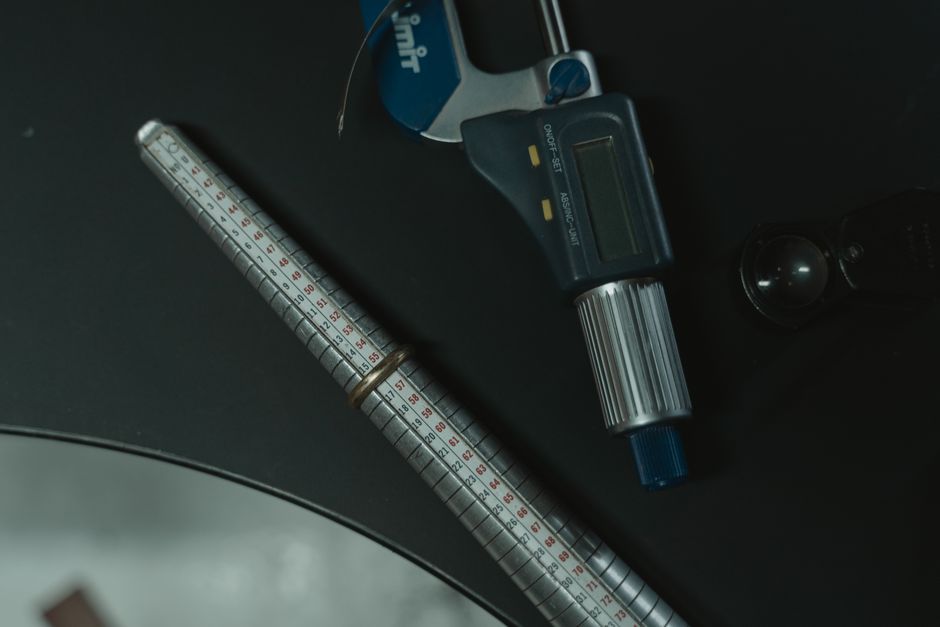
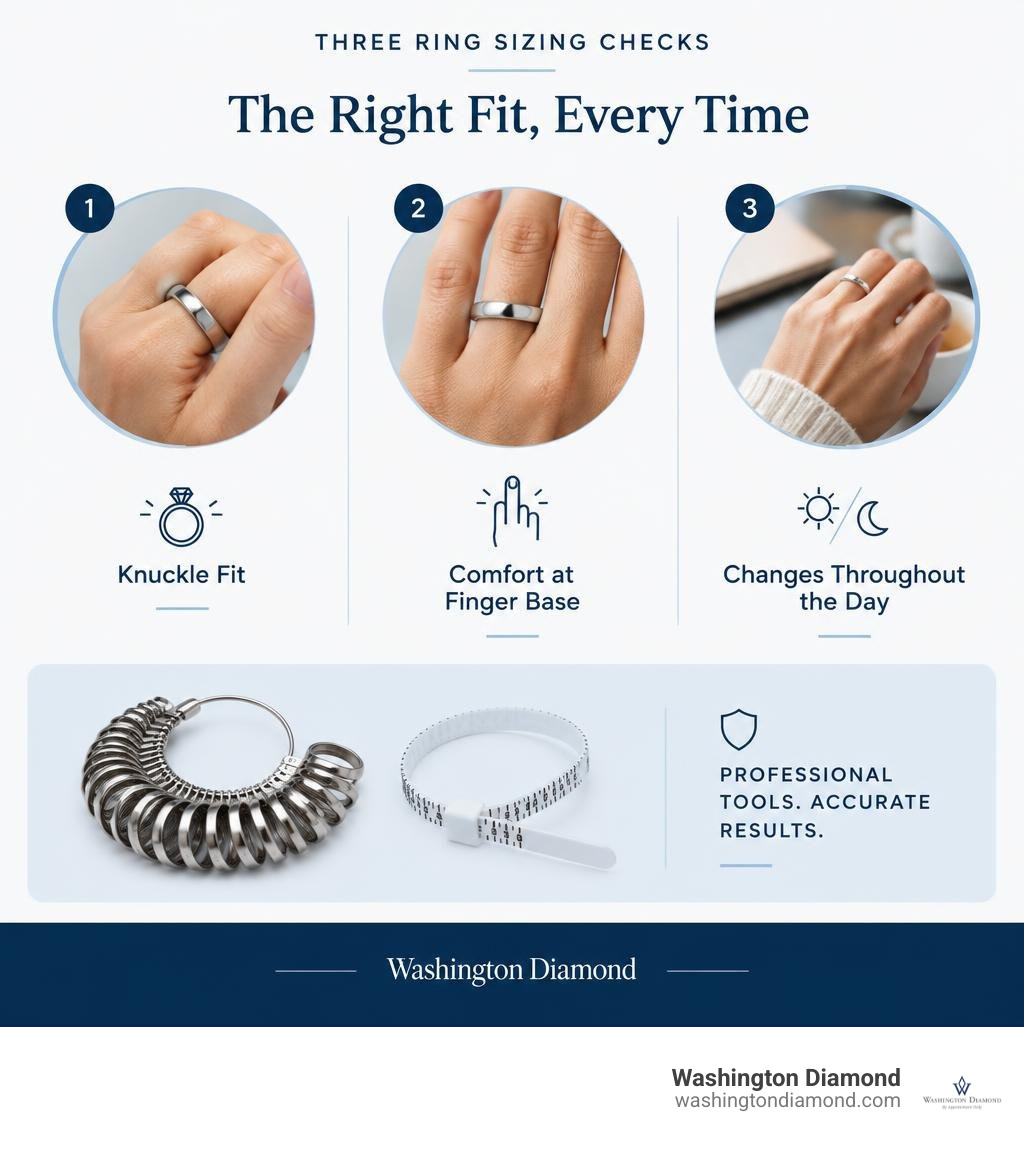
For accurate ring sizing, use a ring gauge or flexible sizer on the finger that will wear the ring:
- Find a size that slides over your knuckle with slight resistance.
- Check that it feels comfortable at the base of your finger and does not slip off easily.
- Try it again later in the day. Finger size can change, and a wide band may fit more snugly than a narrow one.
I'm Tom Daube, a jewelry designer with experience creating custom pieces where ring sizing matters for comfort and fit. I'll walk you through the tools and checks that help you choose a size with confidence.
Essential Tools and Engineering Features in Professional Ring Sizing
Finding the right size starts with using the proper equipment. While DIY methods like wrapping a piece of string or paper around your finger are common on the internet, they are notoriously unreliable. String stretches, paper tears or bends, and neither accounts for how a solid metal band glides over bone and tissue.
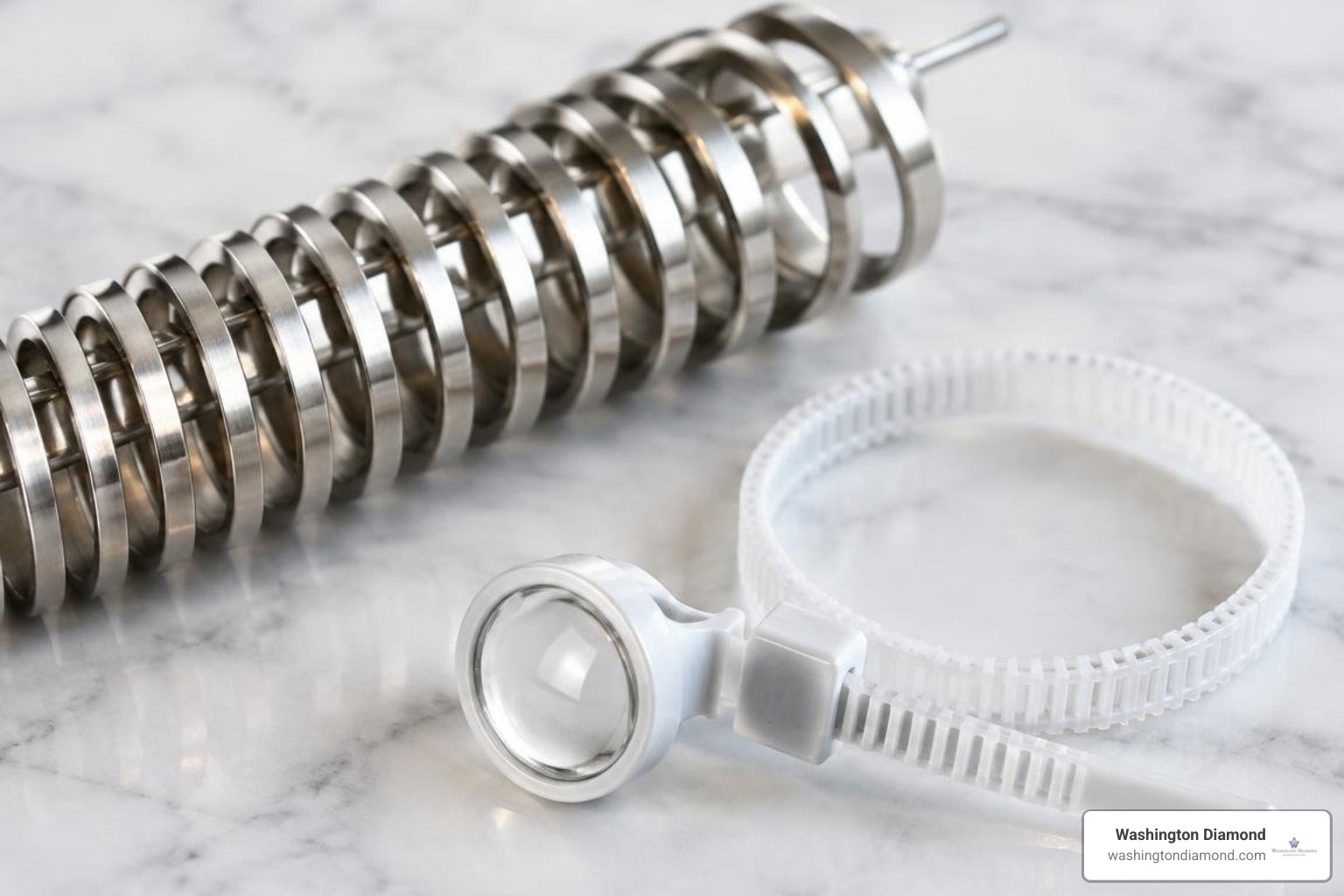
In our studio, we rely on calibrated, professional-grade instruments engineered for exact measurements. If you are measuring at home, consumer-grade kits have become remarkably sophisticated and accessible. For instance, affordable tool sets—such as 27-piece stainless steel kits that retail around $4.99 and boast thousands of positive reviews—bring bench-level precision right to your living room.
| Ring Sizing Tool | Accuracy Level | Standard Size Range | Best Use Case |
|---|---|---|---|
| Stainless Steel Ring Gauges | High | US 0 to 13 (including half sizes) | Measuring standard bands and narrow shanks |
| Flexible Plastic Sizer Belts | Moderate to High | US 1 to 17 (continuous scale) | Quick at-home baseline; broader size spectrum |
| Calibrated Steel Mandrels | Professional Bench | US 1 to 15+ (quarter increments) | Verifying existing circular rings |
| Digital Calipers | Precision Engineering | Millimeter internal diameter | Checking inner roundness and wall thickness |
These physical tools feature specific engineering details that prevent common fitting errors. High-quality metal gauges are stamped with calibrated standard sizes to ensure uniform diameter. Meanwhile, reusable plastic sizing belts often incorporate built-in magnifying lenses over the sizing arrow. This optical aid dramatically improves legibility, ensuring that seniors or anyone with visual difficulties can read small fractional markings without misreading half or quarter sizes.
For deeper technical benchmarks on precision measuring standards, the Gemological Institute of America provides a comprehensive guide on the accurate determination of finger and ring sizes.
The 3-Step Process: How to Measure Finger and Ring Size Accurately
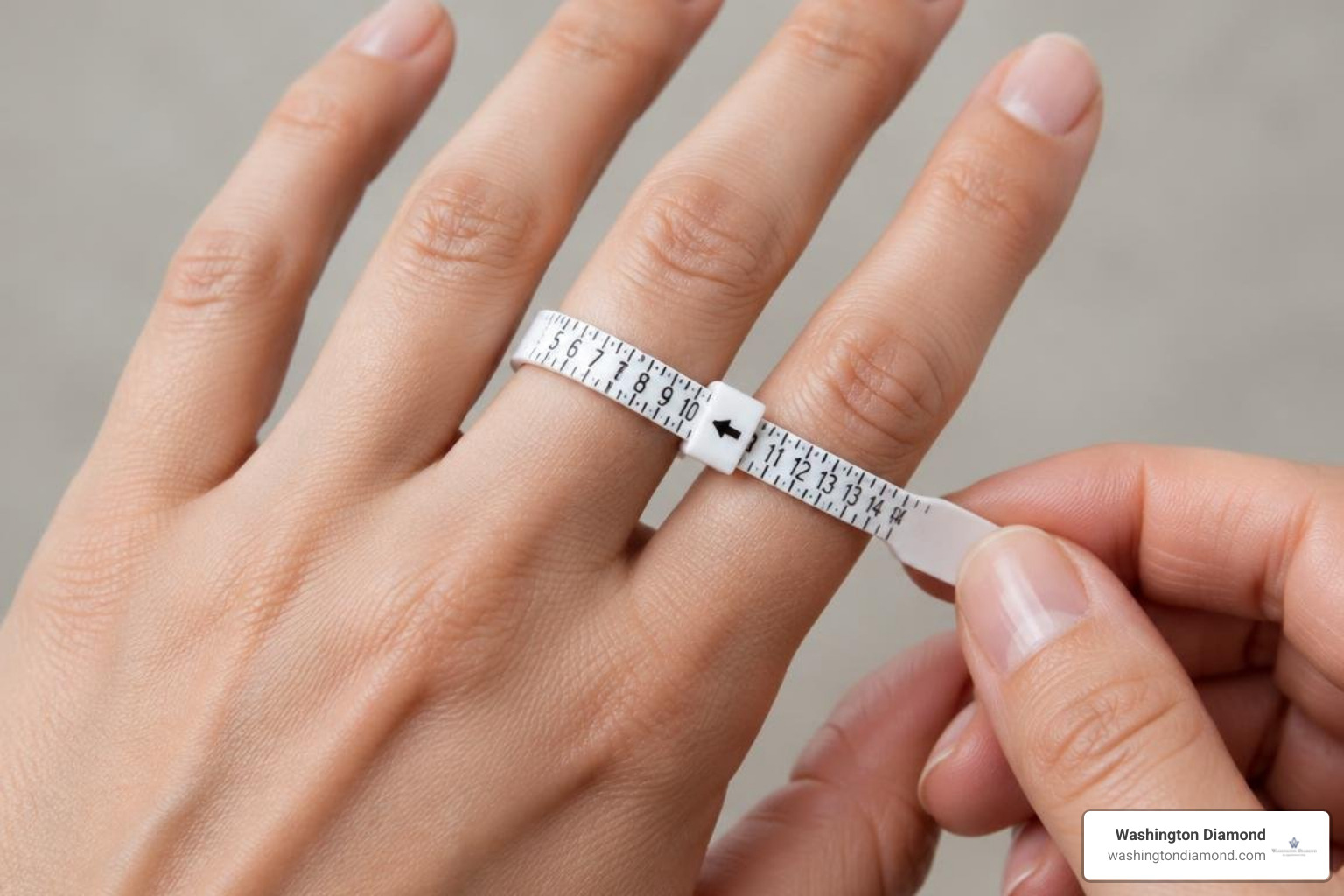
Whether you are preparing to order custom engagement rings or choosing an anniversary gift, following a methodical measurement protocol ensures your ring stays securely on your finger while feeling weightless throughout daily wear.
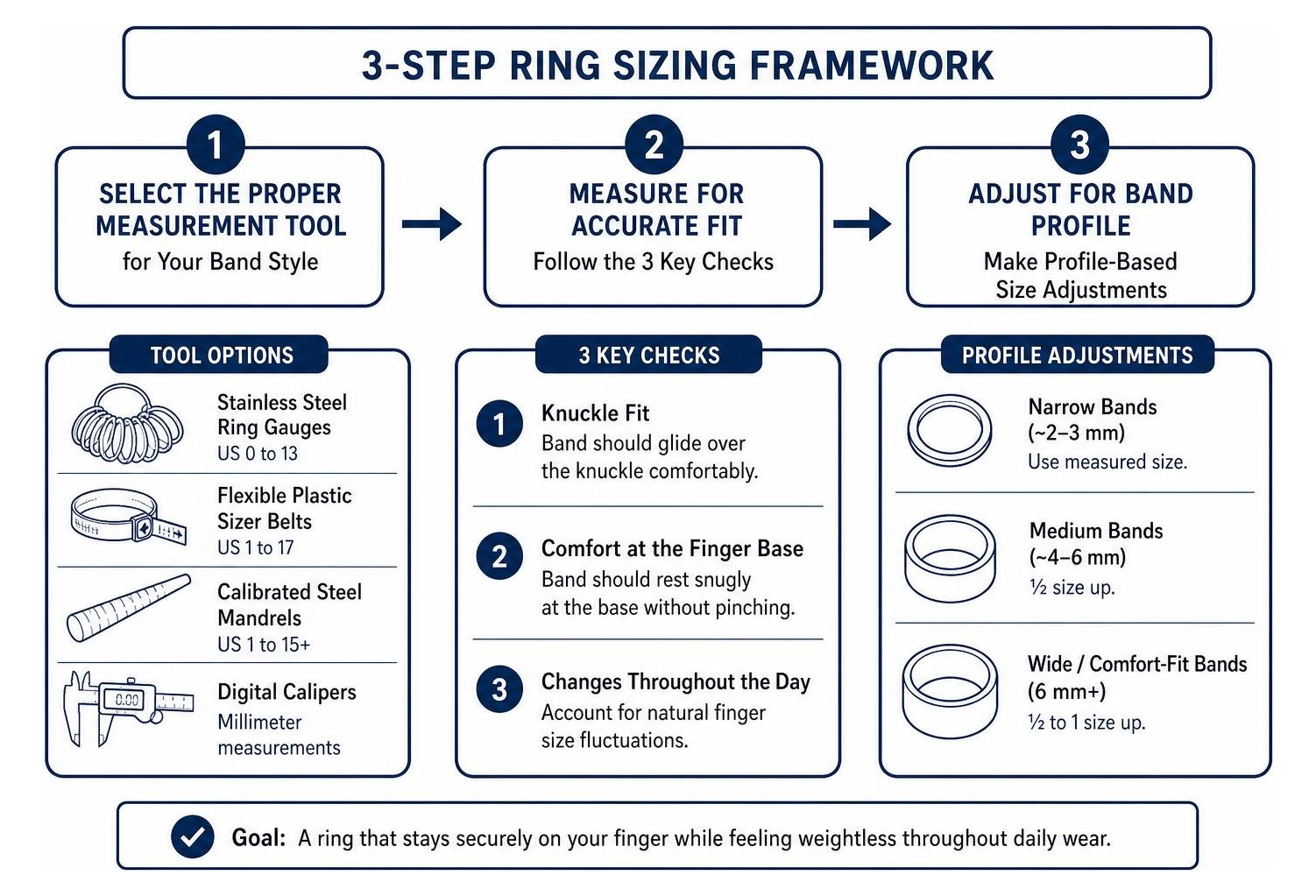
Step 1: Select the Proper Measurement Tool for Your Band Style
First, match your measurement tool to the physical profile of the ring you plan to wear. If you are shopping for a delicate, traditional design like a classic platinum 4 prong engagement ring setting, narrow metal gauge loops (around 2mm to 3mm wide) provide the most true-to-life baseline.
Thread the gauge onto your chosen finger. Slide it down completely to the webbed base where the ring will rest. The gauge should seat comfortably without pinching the skin or creating an unnatural fleshy bulge above or below the band.
Step 2: Account for Knuckles and Temperature in At-Home Ring Sizing
Your finger is not a static cylinder; it is an active, changing part of your body. Temperature, humidity, time of day, and recent physical activity all cause natural swelling and contraction:
- Time of Day: Measure your finger in the late afternoon or evening when your hands have reached their average operational circumference. Morning measurements tend to be smaller unless you experience fluid retention.
- Thermal Expansion: Cold weather shrinks fingers, while warm summer days expand tissue. Ensure your hands are at a comfortable room temperature before taking your reading.
- The Knuckle Test: The ideal size must pass over the widest part of your knuckle with a gentle push and come off with slight, firm resistance. If it slides off without any effort, you risk losing the ring when washing your hands or stepping into cold air.
- Hand Dominance: Always measure the specific hand that will wear the piece. Your dominant hand’s fingers are typically between a half to a full size larger than those on your non-dominant hand due to muscle development.
Step 3: Adjust for Band Width, Profile, and Ring Sizing Variations
The physical geometry of your ring directly impacts how tight it feels against your skin. A narrow 1.5mm wire band feels significantly looser than an 8mm statement band of the exact same inner diameter because wider metal displaces more tissue and creates greater surface friction.
- Wide Bands: As a general rule of thumb, if your band is wider than 5mm or 6mm, you will typically need to increase your measurement by a half size.
- Interior Profiles: A standard flat interior lies flush against the finger across its entire width. Conversely, a 5mm platinum comfort fit band features a domed, convex interior that reduces friction at the edges, making the ring slide on more smoothly and fit slightly looser.
When selecting wedding bands in Northern Virginia, we always evaluate band thickness, stack height, and interior curvature together to pinpoint the ideal fit.
Measuring Existing Rings and Complex Band Geometries
If you are trying to keep a proposal a surprise, measuring a ring your partner already wears on that same finger is a classic strategy. However, this requires careful attention to detail.
Inside Diameter and International Size Conversions
To measure an existing ring at home using an international conversion chart, you must measure the inside diameter (the straight distance across the inner opening) in millimeters:
- Verify Roundness: Rings warp into subtle ovals over years of wear. An out-of-round ring will distort diameter readings.
- Measure the Widest Inner Boundary: Use digital calipers or a high-precision millimeter ruler across the exact center opening, ignoring the outer rim thickness.
- Match with Conversion Standards: A US size 6 measures approximately 16.5 mm in internal diameter (51.8 mm inner circumference), while a US size 7 measures 17.3 mm (54.4 mm inner circumference).
Different countries use different standards: the US and Canada use numerical scales from 0 to 16, the UK and Australia use an alphabetical system (A through Z), and European nations typically use the inner circumference in millimeters.
Sizing Considerations for Open Space and Wide Statement Bands
Non-traditional styles present unique sizing dynamics. Mountings with high-profile center gems or open negative space redistribute weight differently on the hand. If a ring has a heavy top setting, an overly loose shank will cause the head to spin frustratingly to the side.
Similarly, full-eternity bands studded with diamonds around their entire perimeter cannot be resized through traditional cutting and soldering without compromising their stone settings. For complex structural adjustments or heirloom restorations, consulting specialists in jewelry repairs and restoration ensures that delicate structural integrity remains uncompromised.
Frequently Asked Questions About Ring Sizing
How should a ring properly slide over an enlarged knuckle?
If your knuckle is significantly larger than the base of your finger, sizing for the knuckle will leave the ring spinning loosely at the base. To solve this, a jeweler can size the band to clear the knuckle and add interior sizing beads, spring inserts, or a custom hinged shank that locks securely around the narrower base.
Why do wide bands require a larger size than delicate settings?
Wide bands cover more surface area of the finger. This traps more moisture, creates more frictional resistance, and compresses more soft tissue than a thin band. Moving up by a quarter to a half size prevents the band from feeling tight or pinching during natural hand movements.
Can any ring design be resized later if the measurement is off?
Most classic gold, platinum, and silver rings with plain shanks can be easily resized up or down by two to three sizes. However, full-eternity bands, tension-set rings, and bands made from non-precious alternative metals (such as tungsten or titanium) cannot be resized conventionally and must be precision-crafted from the start.
Conclusion
Getting your ring size right does not have to be a guessing game. By using dedicated tools, taking temperature and knuckle clearance into account, and adjusting for band width, you can choose any ring design with total confidence.
At Washington Diamond, we offer private, one-on-one appointments in our Northern Virginia studio, giving you undivided attention to ensure every meaningful piece fits seamlessly for a lifetime of comfortable wear.
Have a question about your jewelry?
We've been helping clients with diamonds, custom design, repairs, appraisals, and more since 1969. Book a private appointment at our Falls Church studio.
Book an AppointmentTrusted since 1969 · Falls Church, VA · 703-536-3600
From the blog
View all


