

Master the Etiquette of Men's Engagement and Wedding Bands
Which Ring Finger Should Men Wear a Wedding Band On?

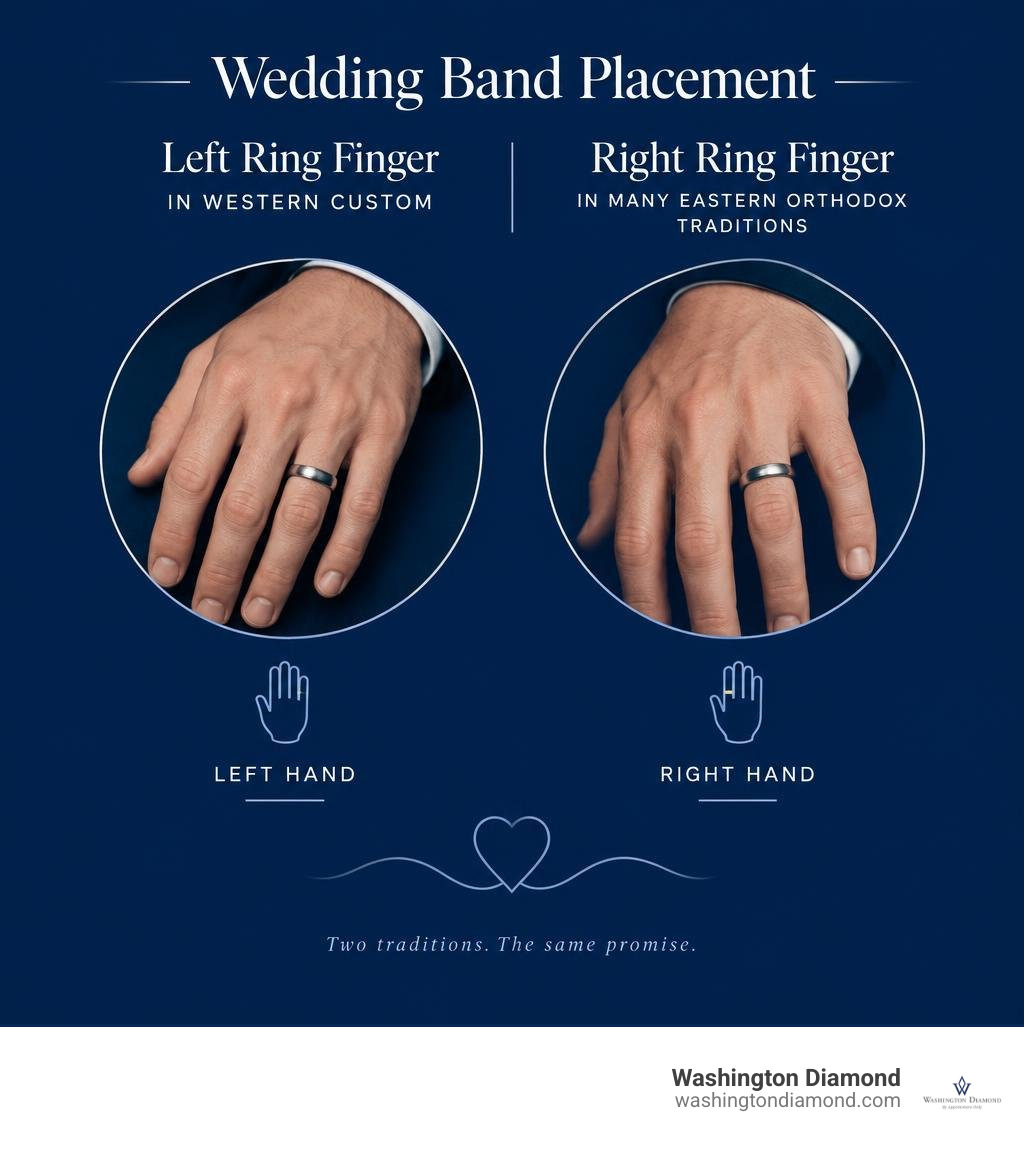
For men's ring finger etiquette, start with your tradition: In the U.S. and much of the West, a wedding band usually goes on the left ring finger. In many Eastern Orthodox traditions, it goes on the right ring finger. For an engagement or wedding band, there is no single rule for every man; choose the custom that matters to you and a fit you can wear comfortably.
I'm Tom Daube, a jewelry designer with experience creating classic and custom pieces. In this men ring finger guide, I'll help you understand the traditions so you can make a choice that feels like your own.
The Meaning Behind the Men Ring Finger: Left Hand vs. Right Hand Traditions
The practice of reserving a specific digit for marriage is steeped in centuries of romance, mythology, and practical utility. To understand why we place such deep emotional value on this finger, it helps to explore the historical origins of the ring finger and the ancient anatomical beliefs that shaped our modern habits.
Centuries ago, ancient Roman and Egyptian scholars believed that a distinct vein ran directly from the fourth finger of the left hand straight to the human heart. Known poetically as the Vena Amoris (the "Vein of Love"), this concept led society to believe that encircling this specific digit with a precious metal band would physically tether two lovers' hearts together.
While modern biology has shown that all fingers share similar vascular structures, the romantic symbolism persisted. It was formally codified in Western liturgy through milestones such as the 1662 Book of Common Prayer. Interestingly, men in Britain and the United States rarely wore wedding bands on a daily basis until the World Wars. During these conflicts, soldiers deployed overseas began wearing simple bands as a comforting reminder of their wives and homes, firmly cementing the practice in everyday civilian life.
Cultural Significance of the Left Men's Ring Finger
In the United States, Canada, the United Kingdom, and across Western Europe, the fourth digit of the left hand remains the gold standard for men's wedding rings and engagement bands.
Beyond its historical connection to the Vena Amoris, placing your ring on the left hand offers significant practical utility. Because roughly 90% of the world's population is right-handed, the left hand serves as the non-dominant hand for most men. Wearing fine jewelry on your non-dominant hand naturally protects the piece from the daily friction, heavy impacts, and scratches that come with manual tasks, operating tools, or typing.
For men who appreciate timeless elegance on their left hand, a classic 14K gold 4mm wedding band offers an understated, traditional aesthetic. Alternatively, if you prefer the weight and cool luster of white metals, a wide domed high polish platinum band delivers enduring strength that resists daily wear.
Eastern Orthodox, Islamic, and Global Customs for the Men's Ring Finger
While Western tradition favors the left hand, millions of men worldwide wear their wedding bands on the right ring finger due to deep-seated religious and cultural practices.
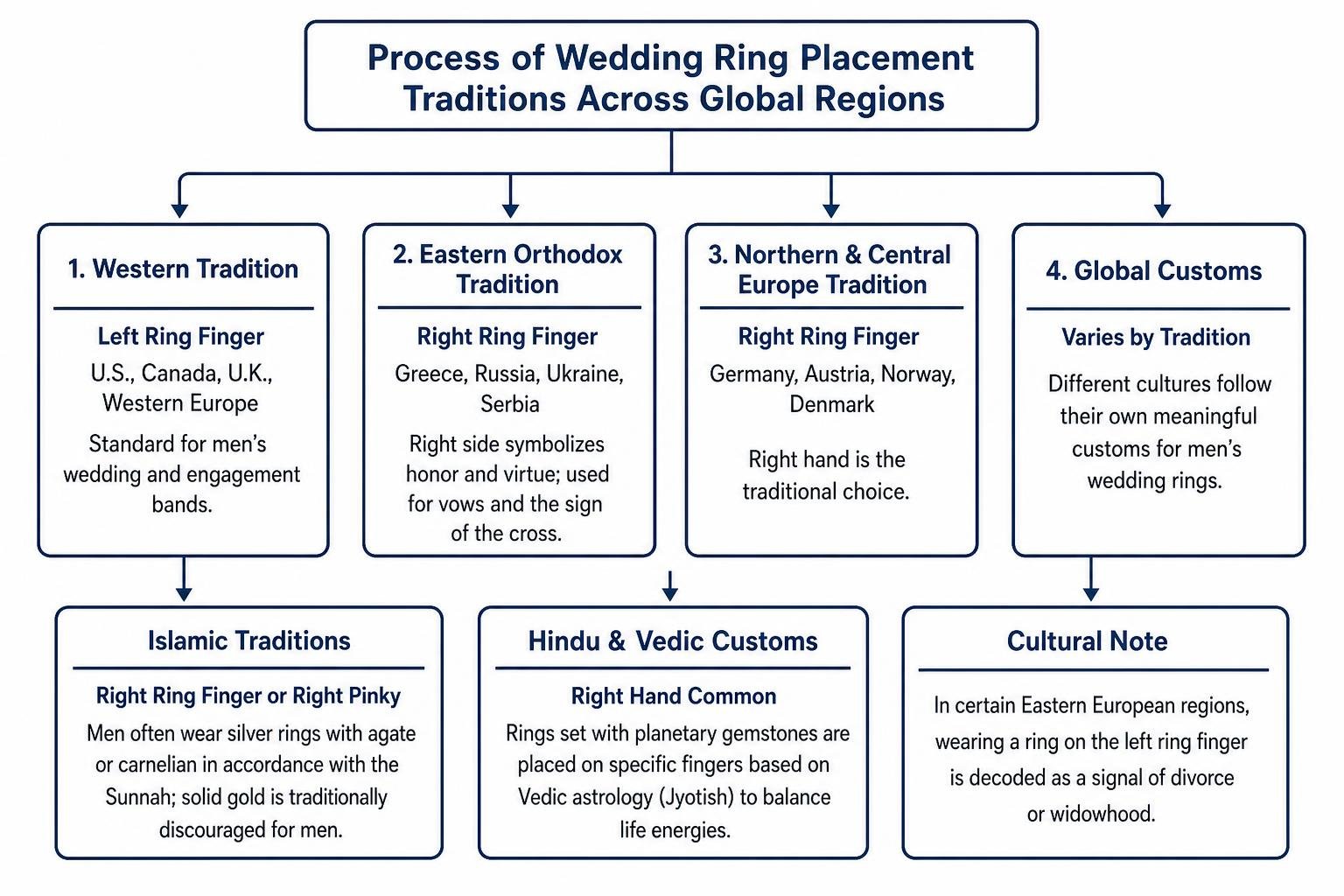
In Eastern Orthodox Christian communities across Greece, Russia, Ukraine, and Serbia, as well as in Northern and Central European nations like Germany, Austria, Norway, and Denmark, the right hand is the standard choice. In these cultures, the right side historically symbolizes honor, virtue, strength, and the hand used to take solemn vows and make the sign of the cross. In fact, in certain Eastern European regions, wearing a ring on the left ring finger is decoded as a signal of divorce or widowhood.
Global customs bring even more nuance to the ring finger:
- Islamic Traditions: Men often wear silver rings set with agate or carnelian on the right ring finger or right pinky in accordance with the Sunnah, adhering to religious guidance that traditionally discourages men from wearing solid gold jewelry.
- Hindu and Vedic Customs: In India, jewelry choices frequently align with Vedic astrology (Jyotish) rather than strict marital status alone. Rings set with specific planetary gemstones are placed on distinct fingers to balance life energies, though right-hand placement is common for married men.
- Jewish Customs: During a traditional Jewish wedding ceremony, the groom places the wedding band on the bride's right index finger—the most visible digit. After the ceremony, spouses typically move their bands to their preferred ring finger.
- Transitional Customs: In countries like Brazil and Turkey, couples wear engagement rings on their right hands and formally shift them to their left hands during the wedding ceremony.
| Region / Culture | Primary Hand for Men's Wedding Band | Cultural & Historical Context |
|---|---|---|
| Western (US, UK, Canada, Western Europe) | Left Hand | Traced to the Vena Amoris myth and non-dominant hand protection |
| Eastern Orthodox (Greece, Russia, Ukraine) | Right Hand | Represents virtue, oath-taking, and blessing vows |
| Northern & Central Europe (Germany, Norway) | Right Hand | Longstanding cultural custom of marital signaling |
| Islamic Traditions | Right Hand (Ring or Pinky) | Often silver bands or gemstone signets aligned with Sunnah practices |
| Brazil & Turkey | Right Hand (Engaged) to Left Hand (Married) | Physical transition during the wedding ceremony |
Symbolism Across All Five Fingers on a Man's Hand
Every digit carries its own subtle psychological and historical message. To truly master ring etiquette, explore the complete symbolism of rings on each finger to ensure your rings reflect your personal style.
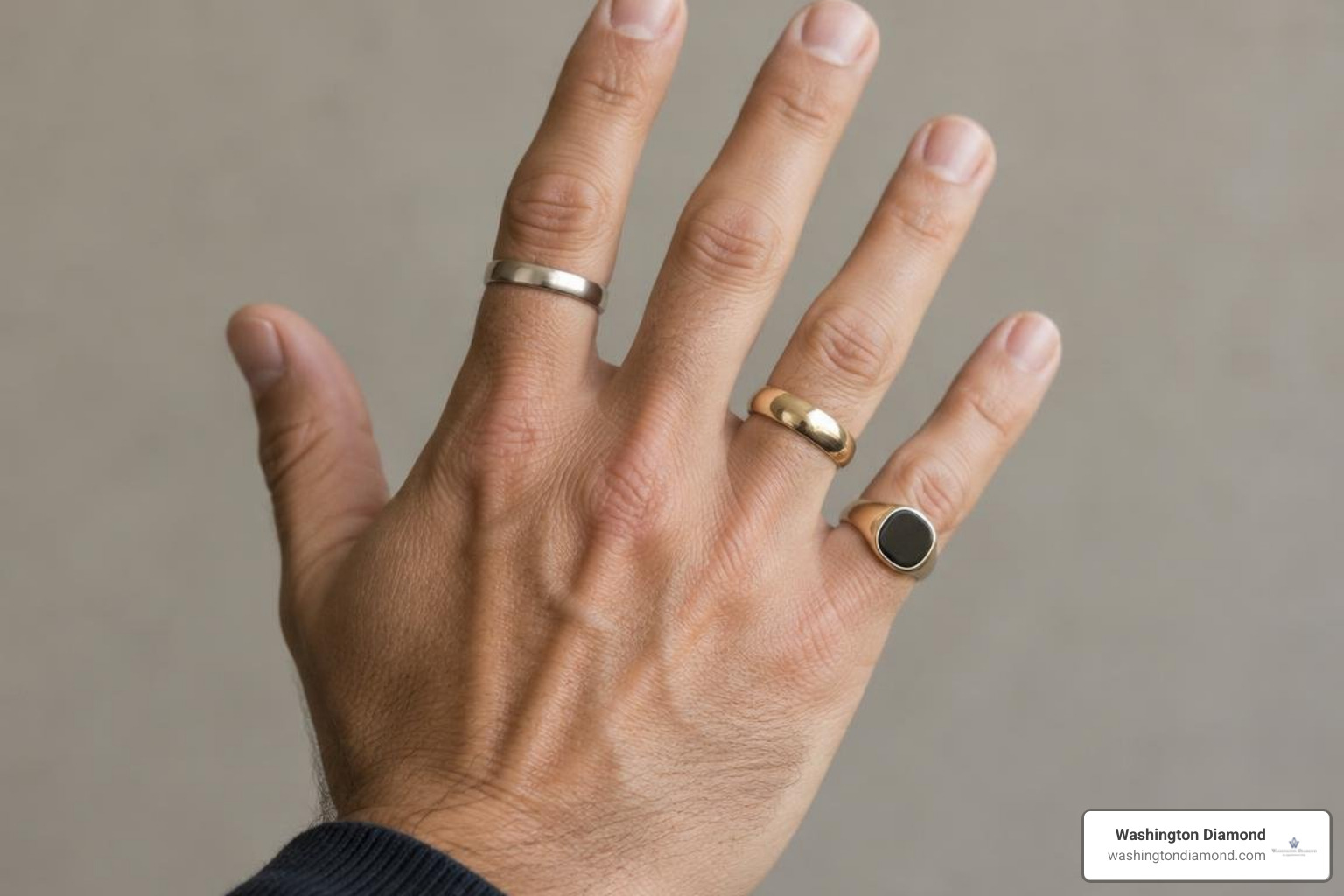
Stylists and jewelry historians often view the hands as two halves of a personality: your dominant hand represents active expression, public communication, and deliberate style statements, while your non-dominant hand represents inner identity, long-term commitment, and permanent values.
Pinky Finger (Mercury): Communication, Crests, and Signet Rings
The pinky finger is associated with Mercury, the Roman god of commerce, financial gain, communication, and intellect. Because the pinky sits on the outer edge of the hand, any ring worn here commands immediate visual attention without interfering with your larger grip.
Historically, the pinky was reserved for gentlemen's signet rings engraved with family crests or personal monograms used to press official wax seals on correspondence. In modern styling, pinky rings remain a classic choice for professional seals, fraternity crests, or vintage-inspired statement rings.
Middle Finger (Saturn): Balance, Individuality, and Black Ace Rings
Associated with Saturn—the planet of discipline, structure, and balance—the middle finger is the hand's central axis. Wearing a ring here symbolizes stability, responsibility, and personal identity.
Because of its central placement, a ring on the middle finger makes a bold statement without necessarily conveying romantic status. In modern identity signaling, a matte black ring worn on the right middle finger is widely recognized as an "Ace ring," a subtle symbol of pride and community within the asexual community.
Index Finger (Jupiter) and Thumb (Mars): Power, Leadership, and Willpower
The index finger is ruled by Jupiter, the king of gods, symbolizing leadership, authority, and status. In Renaissance Europe, certain laws prohibited lower classes from wearing rings on their index fingers to preserve the digit exclusively for nobility and judicial figures. Today, the index finger is the perfect location for family heirloom bands, class rings, or wider statement rings.
The thumb is governed by Mars, the Roman god of war, representing willpower, assertion, and independence. Historically, archers wore heavy thumb rings crafted from jade, bone, or metal to protect their digits when drawing bowstrings. Today, a thumb ring projects confidence and creative freedom.
Choosing the Right Style, Profile, and Metal for Men's Wedding Bands
When selecting a men's ring, understanding the difference between a traditional "ring" and a "band" is essential. A wedding band typically features a uniform width throughout its circumference without a prominent raised stone or decorative face. A fashion or signet ring, by contrast, features a defined top plate, crest, or elevated centerpiece.

Fit is just as important as appearance. Traditional flat-interior rings can trap moisture against your skin. For maximum everyday ease, look for Euro Comfort Fit ® bands, which feature an ergonomic, domed interior surface that slides easily over the knuckle and rests comfortably on the finger throughout the day.
For men who appreciate tailored design, a milgrain edged platinum band provides vintage texture, while a modern sand blasted tantalum wedding band offers a rugged, contemporary matte finish.
Precious Metals vs. Alternative Metals for Everyday Durability
Selecting the right metal depends on your lifestyle, skin sensitivity, and aesthetic preferences:
- Platinum: The gold standard in luxury and durability. Platinum is naturally hypoallergenic, dense, and develops a rich patina over time without thinning or losing metal volume.
- 18K and 14K Gold: Timeless, warm, and prestigious. Gold is available in rich yellow, crisp white, and subtle rose gold hues. A flat 18K yellow gold band gives you clean geometric lines with traditional warmth.
- Tantalum: A rare, slate-blue-gray precious transition metal that is shatterproof, highly scratch-resistant, and completely bio-compatible.
- Tungsten Carbide: Extremely hard and virtually scratch-proof. A durable tungsten wedding band maintains its polished shine indefinitely, making it a reliable option for active lifestyles.
- 316L Stainless Steel & Titanium: Highly corrosion-resistant, sweat-proof, and hypoallergenic metals that resist tarnishing, even in warm, humid climates.
Diamond Accents and Custom Design Details
Modern men's rings frequently incorporate diamonds and textured finishes for added dimension. Flush-set round diamonds or low-profile channel-set baguette diamonds add understated brilliance while sitting safely level with the band's surface.
For example, a sophisticated round brilliant diamond platinum band combines timeless durability with subtle sparkle. If you have a specific vision in mind—such as pairing two distinct metals, incorporating a custom engraving, or integrating meaningful birthstones—exploring a custom engagement ring design allows you to create a piece tailored to your story.
How to Find the Perfect Ring Size and Style Multiple Bands
A great ring should glide smoothly over your knuckle with slight resistance and sit securely at the base of your finger without pinching.
To check your size at home:
- Wrap a narrow, non-stretchy strip of paper around the base of your intended finger.
- Mark the exact point where the paper overlaps.
- Measure the length in millimeters against a ruler to determine your finger's circumference.
- Compare your measurement to standard size charts.
Always measure your fingers toward the end of the day when your hands are warm, as fingers naturally shrink in cold temperatures and swell during physical exertion. If you are choosing a wider band (6 mm to 8 mm), consider ordering a half-size larger to accommodate the extra surface area. If your ring ever feels too loose or tight over time, professional ring resizing ensures a seamless, permanent fit.
Sizing Conversion and Fit Guidelines (US vs. International)
Most American men wear ring sizes ranging from US 8 to 10 (which corresponds to an inner circumference of roughly 57 mm to 62 mm). In international sizing systems, such as in India, these correlate to sizes 17 through 21.
- 54–56 mm Circumference: US Size 7 (Indian 14–15)
- 57–59 mm Circumference: US Size 8 (Indian 16–17)
- 60–62 mm Circumference: US Size 9 (Indian 18–19)
- 63–65 mm Circumference: US Size 10 (Indian 20–21)
- 66–68 mm Circumference: US Size 11 (Indian 22–23)
Rules for Stacking and Balancing Multiple Rings
If you enjoy wearing multiple rings across your hands, keep these fundamental styling rules in mind:
- Distribute Across Both Hands: Avoid crowding three rings onto one hand while leaving the other bare. Balance a wedding band on your left hand with a signet ring or watch on your right.
- Mind Your Proportions: Men with larger hands can easily pull off wide 7–9 mm bands and bold signets, while more slender hands look best with refined 3–5 mm bands.
- Leave Breathing Room: Avoid wearing chunky rings on immediately adjacent fingers (such as the middle finger right next to your wedding band) to prevent the metals from rubbing, scratching, and chafing.
- Coordinate Metal Tones: For a cohesive look, match the metal of your rings to your watch, belt buckle, and cufflinks.
Frequently Asked Questions About Men's Rings
Which hand and finger should an unmarried or engaged man wear a ring on?
An unmarried man can wear fashion, signet, or gemstone rings on any finger he chooses. The index finger, pinky, and thumb are the most common choices for expressive rings because they carry no cultural assumption of marriage.
If an engaged man chooses to wear an engagement band prior to the wedding, he can wear it on his traditional ring finger (left hand in Western cultures) or on the right ring finger, transitioning it during the ceremony.
Can men wear platinum, gold, or steel rings in the shower and gym?
While solid platinum, gold, 316L stainless steel, and titanium are completely waterproof and will not rust in the shower, we recommend removing fine jewelry before working out at the gym.
Heavy knurled barbells, metal dumbbells, and cable machines can easily scratch precious metals, flatten ring bands, or cause painful ring avulsion injuries under heavy loads.
What is the difference between a men's ring and a wedding band?
A wedding band is a specific style of ring designed with a continuous, uniform width around the finger, prioritizing daily comfort and clean symmetry. A broader men's ring encompasses fashion pieces, signets, cocktail rings, and fraternal bands that often feature raised bezels, contrasting textures, or large center stones.
Conclusion
Whether you choose a classic left-hand band honoring the Vena Amoris, a distinguished right-hand band grounded in Eastern Orthodox heritage, or a modern mixed-metal statement ring, your choice should reflect your personal story, values, and daily comfort.
At Washington Diamond, we believe choosing a meaningful ring should be an enjoyable, relaxed experience. At our private, appointment-only studio in Northern Virginia, we provide undivided attention to help you explore custom profiles, premium metals, and comfortable sizing. Explore fine men's wedding bands and custom jewelry with us to design a piece built to last a lifetime.
Have a question about your jewelry?
We've been helping clients with diamonds, custom design, repairs, appraisals, and more since 1969. Book a private appointment at our Falls Church studio.
Book an AppointmentTrusted since 1969 · Falls Church, VA · 703-536-3600
From the blog
View all


