

Certified Lab Diamonds Are a Modern Girl's Best Friend
Why Certified Lab Diamonds Matter for Your Peace of Mind
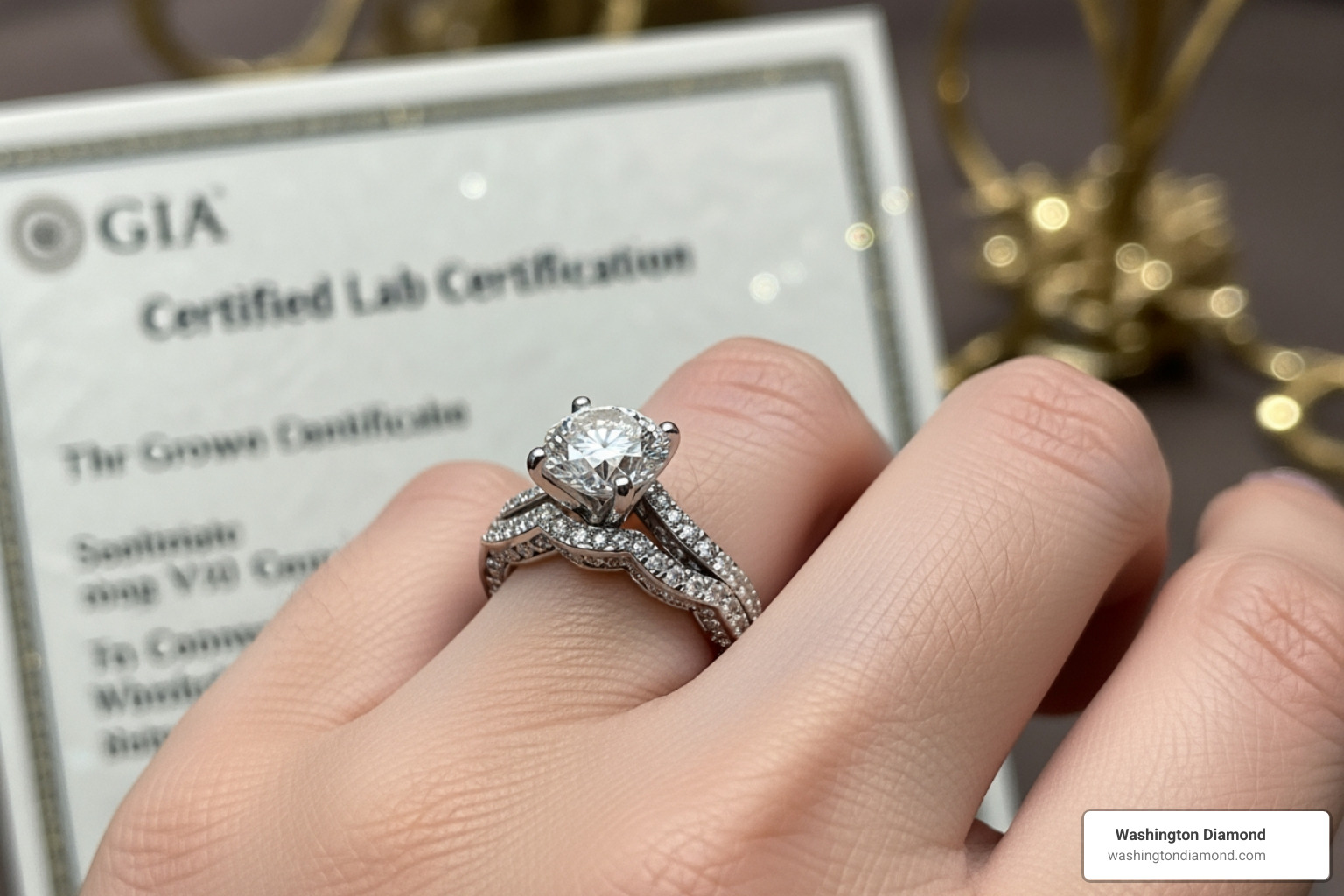
Certified lab diamonds are laboratory-created diamonds that have been evaluated and graded by reputable gemological institutions like GIA (Gemological Institute of America) or IGI (International Gemological Institute). These certifications verify the diamond's quality using the same 4Cs criteria—Carat, Color, Clarity, and Cut—applied to natural diamonds.
Quick Guide to Certified Lab Diamonds:
| What They Are | Why Certification Matters | What to Look For |
|---|---|---|
| Laboratory-grown diamonds chemically identical to natural diamonds | Verifies quality and authenticity | IGI or GIA certification |
| Created using HPHT or CVD methods | Provides detailed grading report | Laser inscription on girdle |
| Graded on same 4Cs as natural diamonds | Ensures transparency for your investment | Report number verification |
| Cost significantly less than natural diamonds | Required for insurance purposes | Detailed 4Cs specifications |
When you're planning a proposal or celebrating a milestone anniversary, the last thing you want is uncertainty about what you're buying. A certified lab diamond gives you confidence that you're getting exactly what you paid for—a genuine diamond with documented quality characteristics.
Unlike natural diamonds that form over billions of years deep in the Earth's mantle, lab-grown diamonds are created in controlled laboratory environments using advanced technology. They're optically, chemically, and physically identical to natural diamonds, with the only difference being their origin. According to GIA, lab-grown diamonds have grown dramatically in popularity over the past decade, with improvements in both size and quality.
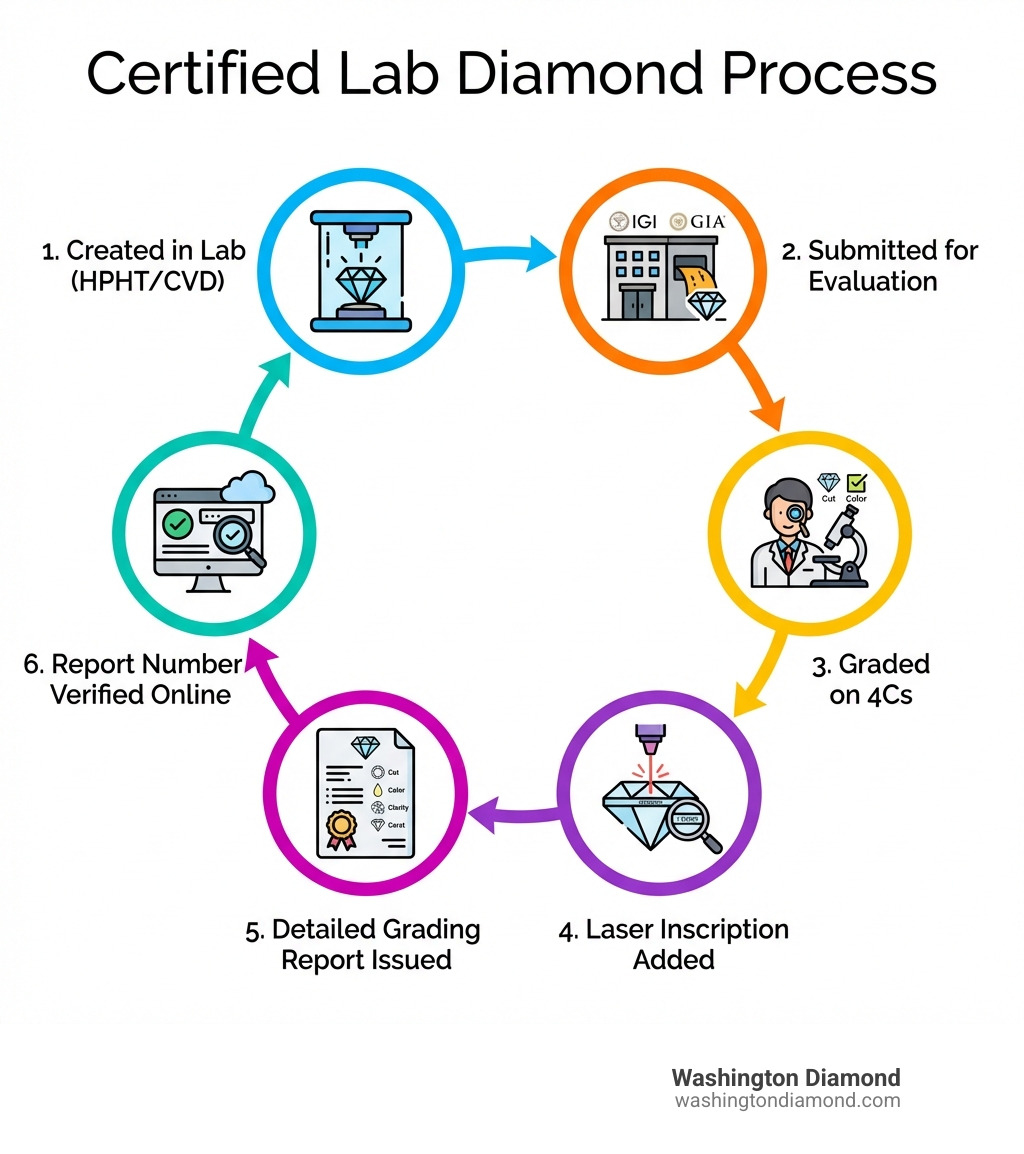
The certification process matters. A grading report from an independent gemological laboratory provides an unbiased evaluation of your diamond's characteristics. It's not just a piece of paper—it's proof of quality that protects your investment and provides peace of mind. The report includes precise measurements, detailed analysis of the 4Cs, and confirmation that your diamond is laboratory-grown through a laser inscription on the girdle.
Without certification, you're buying blind. You have no way to verify claims about color grade, clarity, or cut quality. For high-end jewelry intended for life's most significant moments, that's an unnecessary risk.
I'm Tom Daube, and I've spent my career helping clients enjoy clearly better diamonds through GIA certification and transparent pricing. At Washington Diamond, I specialize in certified lab diamonds with excellent proportions, ensuring you get exceptional quality for your engagement ring or special jewelry piece.
Certified lab diamonds word guide:
Understanding Certified Lab Diamonds and How They Are Made
To understand why certified lab diamonds are such a marvel, we have to look at the science behind the sparkle. These aren't "fakes" or "simulants" like cubic zirconia or moissanite; they are real diamonds. The only thing missing is the dirt and the mining.
There are two primary methods for creating lab-grown diamonds:
- HPHT (High Pressure-High Temperature): This method mimics the intense heat and crushing pressure found 100 miles below the Earth's surface. A small diamond "seed" is placed into carbon and subjected to temperatures of about 1,500 degrees Celsius and 1.5 million pounds of pressure per square inch. This process can even be used to create sentimental "memorial diamonds" from carbon found in hair or ashes.
- CVD (Chemical Vapor Deposition): Think of this like a high-tech 3D printer for diamonds. A diamond seed is placed in a vacuum chamber filled with carbon-rich gas (like methane). When the gas is heated to extreme temperatures, the carbon atoms break apart and rain down onto the seed, growing the diamond layer by layer—much like a stack of pancakes.
While most lab diamonds strive for perfection, some collectors look for unique character. You can learn more about this in our guide to salt and pepper lab diamonds, which features beautiful, natural-looking inclusions that give a stone a "galaxy" appearance.
Why You Should Only Buy Certified Lab Diamonds
Buying an uncertified diamond is like buying a luxury car without a title or a Carfax report. You might think you're getting a deal, but you have no proof of what’s under the hood. For lab-grown diamond engagement rings, certification is the "gold standard" for security.
The International Gemological Institute (IGI) was one of the first major labs to provide full grading reports for lab diamonds. Today, the GIA also provides comprehensive Laboratory-Grown Diamond Reports (LGDR). These certifications ensure that:
- The stone is a real diamond and not a simulant.
- The quality grades (Color, Clarity, Cut) are accurate and unbiased.
- Any post-growth treatments used to improve color are disclosed.
At Washington Diamond, we believe in total transparency. When you visit our Northern Virginia studio, we show you the certificates side-by-side with the stones so you can see exactly why one diamond outshines another.
Verifying Your Certified Lab Diamonds
How do you know the piece of paper in your hand actually matches the diamond in the ring? Modern technology has a clever solution.
Most certified lab diamonds have a microscopic laser inscription on the "girdle" (the widest part of the diamond). This inscription usually includes the report number and a statement like "Laboratory Grown." You can't see it with the naked eye, but under a jeweler's loupe, it’s as clear as a serial number on a high-end watch.
The FTC (Federal Trade Commission) has strict guidelines for how these stones are marketed to ensure consumers aren't misled. Always check that your diamond's laser inscription matches the report number on the physical certificate. You can also verify these numbers on the official GIA or IGI websites to ensure the document is authentic.
The 4Cs: Grading Quality in Lab-Grown Gems
The grading process for certified lab diamonds is identical to that of natural diamonds. Because they are the same material, gemologists use the same universal language: the 4Cs.
| 4C Criteria | Lab-Grown Diamond Application | Why It Matters |
|---|---|---|
| Carat | Available in sizes from 0.05ct to 10.00ct+ | Determines the physical weight and size. |
| Color | Graded D (Colorless) through Z (Light Yellow) | Most buyers prefer D-G for a bright, white look. |
| Clarity | Graded from FL (Flawless) to I1 (Included) | Identifies internal inclusions or surface blemishes. |
| Cut | Graded from Ideal/Super Ideal to Poor | The most important "C" for sparkle and light return. |
When selecting your stone, it's easy to get caught up in the numbers. However, we often tell our clients that there is a strategy beyond the 4Cs. For instance, an "Ideal" cut can make a slightly lower color grade look much whiter and more brilliant.
In the lab-grown world, you can often find "Super Ideal" cuts that offer even better light performance than standard "Excellent" grades found in natural stones. This is because lab diamonds allow for more precision during the cutting process without the pressure to maximize carat weight from a rare, expensive rough stone.
Evaluating Value: Cost and Authenticity
One of the biggest draws of certified lab diamonds is the price tag. Because we don't have to move tons of earth to find them, the cost savings are passed directly to you.
Currently, you can find high-quality lab diamonds for a fraction of the price of natural ones. For example, a 1.00ct Emerald cut diamond with H color and VS1 clarity might be priced significantly lower than its natural counterpart, despite being chemically identical. This allows couples to either save money or "size up" to a much larger center stone than their budget would otherwise allow.
For more information on finding the best deals, check out our guide on where to find the best price lab-grown diamonds online. While online browsing is great for research, many of our Northern Virginia clients find that our complete guide to affordable lab-grown diamonds helps them understand the nuances of pricing before they step into our private studio.
Certification vs. Appraisal: Protecting Your Investment
A common point of confusion for jewelry buyers is the difference between a certification and an appraisal. While they might look similar, they serve very different purposes.
- Certification (Grading Report): This is the "birth certificate" of the diamond. It identifies the technical specs (the 4Cs) and the origin. It does not list a dollar value.
- Appraisal: This document is created by a jeweler or appraiser and assigns a "Retail Replacement Value" to the entire piece of jewelry (including the metal setting). This is what your insurance company needs to set your policy.
Having both is crucial. The certification proves the quality of the diamond, while the appraisal ensures you are covered if the ring is lost or stolen. In the DC and Northern Virginia area, insurance companies readily accept appraisals for certified lab diamonds, treating them with the same professional rigor as natural stones.
For a deeper dive into these documents, visit the Natural Diamond Council's resource on certification.
Frequently Asked Questions about Lab Diamond Grading
Are all lab-grown diamonds certified?
No. Just like natural diamonds, some smaller or lower-quality lab diamonds are sold without certification to keep costs down. However, for a center stone in an engagement ring, we always recommend buying a certified stone. Without that third-party verification, you have no guarantee of the diamond's quality or long-term value.
How can I verify the authenticity of a diamond certificate?
The easiest way is to use the online verification tools provided by the grading lab. Both GIA and IGI have "Report Check" features on their websites. Simply enter the report number found on your certificate, and the lab will show you a digital copy of the original results. If the digital specs don't match your physical paper, that's a major red flag.
Can lab-grown diamonds be appraised for insurance purposes?
Absolutely. Because lab-grown diamonds are real diamonds, they can be appraised for their full retail replacement value. Most insurance companies (like Jewelers Mutual) offer specific policies for lab-grown diamond jewelry. Just ensure your appraiser clearly states the origin of the diamond to avoid any issues during a future claim.
Conclusion
The world of fine jewelry is changing, and certified lab diamonds are leading the way. They offer the perfect blend of modern science, ethical sourcing, and incredible value—all without compromising on the beauty and sparkle that makes a diamond so special.
At Washington Diamond, we understand that buying a diamond is a big decision. That’s why we offer a private, appointment-only studio experience in Northern Virginia. Unlike a busy mall jewelry store, we provide you with undivided attention in a relaxed, no-pressure environment. We’ll help you compare loose diamonds, explain the nuances of their certifications, and help you design a piece of jewelry that tells your unique story.
Ready to find your perfect match? Contact us today to schedule your personalized consultation and see the brilliance of certified lab diamonds for yourself.
Have a question about your jewelry?
We've been helping clients with diamonds, custom design, repairs, appraisals, and more since 1969. Book a private appointment at our Falls Church studio.
Book an AppointmentTrusted since 1969 · Falls Church, VA · 703-536-3600
From the blog
View all


