

Finding Your Perfect 1 Carat Square Diamond Ring
The Best 1 Carat Square Diamond Rings: A Quick Comparison

If you're shopping for a 1 carat square diamond ring, here's a fast overview of what to expect across the most popular options:
| Option | Approximate Price | Best For |
|---|---|---|
| Natural princess cut, traditional retail | $5,000+ | Traditional buyers, in-store experience |
| Natural princess cut, online | $2,000-$8,000 | Value-focused shoppers |
| Lab-grown square diamond | $1,000-$1,300 | Budget-conscious, ethical sourcing |
| Custom square diamond ring | Varies | Unique, personalized designs |
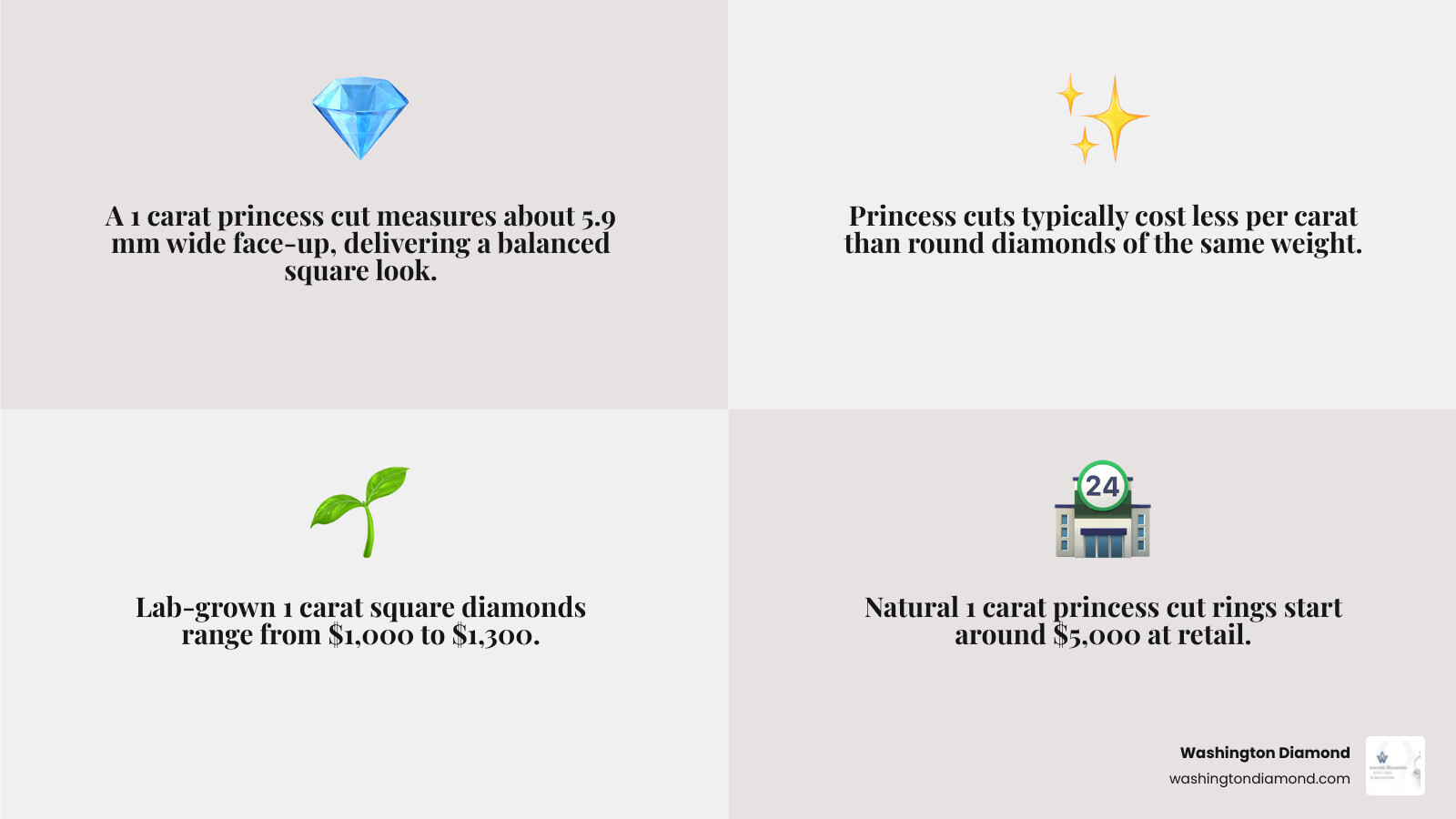
The princess cut - the professional name for a square diamond - is one of the most popular diamond shapes available. It has a clean, geometric look, strong brilliance, and typically costs less per carat than a round diamond of equal weight.
Traditional retail stores often carry large selections of princess cut options, while luxury houses tend to offer more curated assortments at premium prices. Online and direct sellers often offer the same quality for significantly less.
This guide compares the top choices so you can find the right ring without the overwhelm.
I'm Tom Daube, a GIA-certified diamond specialist and jewelry designer with decades of experience helping buyers find the ideal 1 carat square diamond ring - often at prices below listed wholesale. I'll walk you through everything you need to make a confident, informed decision.
Understanding the 1 Carat Square Diamond Ring
When most shoppers say "square diamond," they usually mean a princess cut. That shape has a crisp square outline, pointed corners, and a bright, lively sparkle that feels more modern than a classic round. If round is timeless black tie, princess cut is tailored designer suit with excellent shoes.
A 1 carat square diamond ring is popular because it hits a sweet spot: noticeable size, strong brilliance, and everyday wearability. In a true princess cut, a 1 carat stone is typically about 5.9 mm wide face-up, so it looks balanced and substantial without feeling oversized.
Princess cuts differ from other shapes in a few important ways:
- They have straighter edges and sharper corners than round, oval, or cushion cuts.
- They usually offer excellent sparkle thanks to their faceting pattern and strong light return.
- They often cost less per carat than round diamonds of comparable quality.
- They look distinctly modern and geometric, which many buyers love.
They also pair beautifully with many personalities and aesthetics. If you're still comparing shapes, our guide to The Perfect Diamond Shape for Every Personality is a helpful next step. And if you'd like to browse more styles locally through our private studio experience, visit Diamond Rings in Tysons Corner.
For many couples, this shape offers that little bit of fairy-tale feeling without looking overly traditional. Royal in vibe, architectural in profile, and undeniably sparkly. If you want a quick background on the shape itself, the Princess cut on Wikipedia offers a simple overview of its history and structure.
Visual Profile of a 1 Carat Square Diamond Ring
A carat measures weight, not visible size. One carat equals 200 milligrams, or 0.2 grams. That surprises people all the time because "1 carat" sounds huge, but in reality it's a very wearable center stone size.
For princess cuts, face-up dimensions matter just as much as weight. A well-cut 1 carat princess cut generally appears around 5.9 x 5.9 mm, though exact spread can vary depending on depth and proportions. A stone cut too deep may carry weight where you cannot see it, which means you pay for carat weight without getting the visual size.
If you love clean, centered design, a Solitaire Diamond Ring is one of the best ways to show off this size and shape.
Here is a simple comparison of how common 1 carat shapes tend to face up:
| Shape | Typical Face-Up Size | Visual Impression |
|---|---|---|
| Princess | About 5.9 mm wide | Crisp, square, bright |
| Cushion | Often about 5.5-6.0 mm | Softer square, pillowy |
| Round | About 6.4-6.5 mm diameter | Classic, circular, maximum brightness |
A round diamond often looks slightly larger face-up than a princess cut of the same weight because its diameter is broader. But a princess cut uses its corners and edges to create a bold visual outline, which can make it feel very present on the hand.
One more detail worth knowing: shoppers sometimes hear about table percentage and depth percentage. These proportion measurements affect how bright the stone looks and how large it appears from the top. Princess cuts do not have one magic formula that works for every stone, so we always suggest evaluating the diamond as a whole rather than chasing a single number.
Pros and Cons of the Square Cut
Like every shape, princess cut has strengths and tradeoffs.
Pros:
- Strong brilliance and lively sparkle
- Modern, angular look
- Often lower price-per-carat than round brilliant
- Great fit for solitaire, halo, three-stone, and channel-set styles
- Distinctive shape without being too unconventional
Cons:
- Sharp corners can be more vulnerable to chipping
- Color and inclusions may show a bit more readily than in round diamonds
- Cut quality can vary widely, so careful selection matters
- Needs a protective setting, especially at the corners
That last point is important. We usually recommend V-prongs or another corner-protective design for princess cuts. If you're shopping loose first and setting later, our Loose Diamonds Complete Guide can help you understand what to prioritize.
Quality and Pricing: Natural vs. Lab-Grown
The biggest pricing question we hear is simple: how much should a 1 carat square diamond ring actually cost?
The answer depends on four major things:
- Whether the diamond is natural or lab-grown
- Overall cut quality and beauty
- Color and clarity
- The setting style and metal
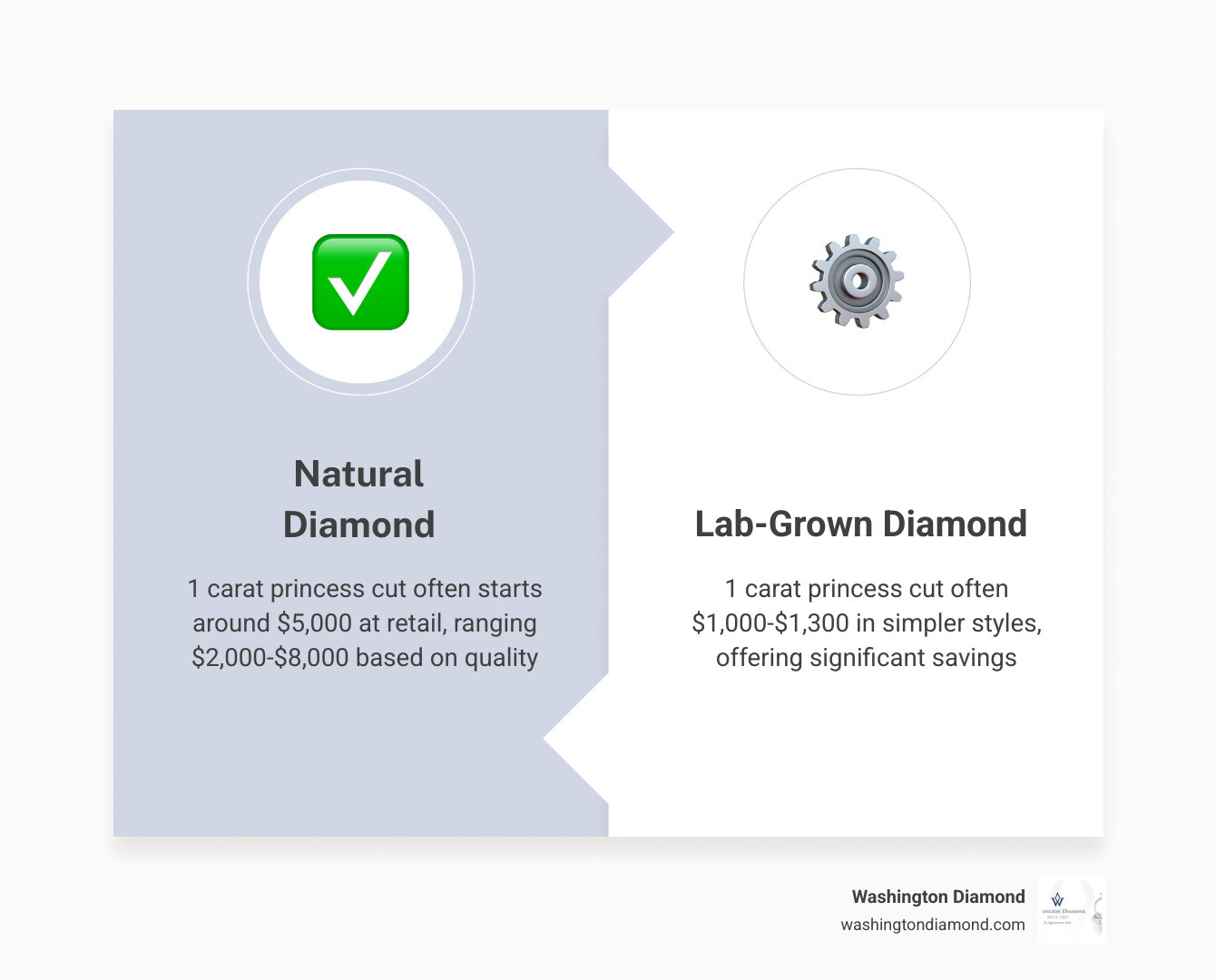
As a broad benchmark in 2026, a 1 carat natural princess cut diamond ring often starts around $5,000 at traditional retail. Online or direct-to-consumer sellers may offer natural options from roughly $2,000 to $8,000 depending on quality. Lab-grown versions are usually much less, often around $1,000 to $1,300 for a 1 carat ring in simpler styles.
Why such a wide range? Because not all 1 carat diamonds are remotely equal.
Cut quality matters enormously. Even though princess cuts are not graded for cut as consistently as rounds, beauty still depends on proportion, polish, symmetry, and light performance. A well-cut stone will look brighter, more lively, and sometimes even larger than a poorly cut stone of the same weight. Our guide Beyond the 4Cs: How to Choose Your Perfect Certified Loose Diamond explains how to evaluate those details in a practical way.
Color also matters a little more in princess cuts than many people expect. Because of the faceting and the open corners, lower color can be easier to notice than in a round brilliant. For many buyers, staying in the near-colorless range is a smart value move, especially in white metals.
Clarity can be similar. Princess cuts may show inclusions more readily than rounds, so eye-clean matters more than chasing a technical grade on paper. We often guide clients toward the sweet spot where the diamond looks clean to the naked eye without paying for microscopic perfection no one will ever see.
If you want to understand pricing logic in more detail, see How to Calculate Price of a Diamond. If you're comparing shape-specific value, our 1 Carat Oval Diamond Price Guide is also useful as a point of reference for how shape changes price.
Natural vs. lab-grown: which is better?
There is no universal "better." There is only better for your priorities.
Choose natural if you want:
- Geological rarity
- Traditional market preference
- A diamond formed by nature over immense time
Choose lab-grown if you want:
- Lower upfront cost
- More size or quality for the same budget
- A modern alternative with the same basic chemical and optical identity as natural diamond
If lab-grown is on your radar, our 1 Carat Man-Made Diamond guide breaks down what to expect. For many buyers, lab-grown makes it possible to step into a better color, cleaner clarity, or more elaborate setting without blowing the budget.
The one thing we do not recommend is buying purely by certificate stats. With princess cuts especially, the actual face-up beauty of the diamond matters. Numbers help. Eyes matter more.
Popular Settings and Metal Choices
One reason the princess cut stays relevant year after year is versatility. It works with almost every major engagement ring style.
The most popular settings for a 1 carat square diamond ring include:
- Solitaire
- Halo
- Three-stone
- Side-stone
- Split-shank
- Channel-set band
- Vintage-inspired settings
- Bridal sets
A solitaire is clean and modern, and it lets the square geometry do the talking. A halo adds extra visual size and sparkle. Three-stone styles give the center stone more presence and symbolic meaning. Channel-set bands echo the diamond's straight lines beautifully.
For a deeper dive into setting structures, read Engagement Ring Settings 101.

Because princess cuts have pointed corners, the setting should protect them. V-prongs are especially common and practical. Bezel settings can also be excellent for active lifestyles because they shield the edges more fully.
Metal choice changes the whole mood of the ring:
- Platinum: bright white, durable, weighty, premium feel
- White gold: crisp and contemporary, popular with princess cuts
- Yellow gold: warm, classic, and a beautiful contrast to a square diamond
- Rose gold: romantic, softer, slightly vintage feel
White metals usually emphasize the icy, geometric look of a princess cut. Yellow gold can make the design feel more timeless and can sometimes be a smart match for near-colorless diamonds. Rose gold is lovely if you want warmth and personality.
Vintage-inspired settings are another great fit. Milgrain edges, engraved details, and halo surrounds soften the sharp shape in a very attractive way. If you like that blend of old-world detail and modern center-stone geometry, our 1 Carat Custom Halo Antique Emerald Cut Engagement Ring offers useful inspiration, even though it features a different cut.
Customizing Your 1 Carat Square Diamond Ring
Customization is where things get fun.
If you're not finding exactly what you want in a ready-made ring, custom design lets you control the details that matter most:
- Square outline preference
- Natural or lab-grown diamond
- Metal color and karat
- Band width
- Prong style
- Hidden halo or classic halo
- Side stones
- Engraving
- Wedding band fit
Our Custom Engagement Rings Ultimate Guide walks through the full process, from inspiration to finished ring.
At Washington Diamond, we work in a private, appointment-only studio in Northern Virginia, which means our clients get undivided attention rather than a rushed counter experience. That matters when you're comparing square diamonds because subtle differences in cut, corner protection, and face-up appearance are much easier to understand in a one-on-one setting.
Custom design often includes CAD rendering before production, so you can review proportions and approve the ring before it's made. This is especially useful for princess cuts, where the relationship between the stone, prongs, and band style has a big impact on the final look.
When customizing, we suggest thinking through these practical questions:
How important is finger coverage? A halo can make a 1 carat center look larger. A thin band can do the same.
Is everyday durability a top priority? Consider platinum, lower-set profiles, and protective prongs or bezel designs.
Do you want modern or romantic styling? Solitaire and sleek three-stone settings feel modern. Milgrain, halos, and rose gold feel softer and more vintage.
Do you want a flush-fit wedding band? Not every engagement ring allows one without a gap, so plan the set together if possible.
Would you like personal details? Engraving, hidden stones, or meaningful proportions can make the ring feel distinctly yours.
Frequently Asked Questions about Square Diamonds
Why is it called a princess cut?
Despite the name, it was not named because actual princesses demanded more sparkle from the royal treasury. The term refers to a square brilliant-style diamond shape known for its elegant, refined appearance. In practice, "princess cut" is the standard jewelry term most people use for a square diamond with sharp corners and brilliant faceting.
Do square diamonds chip easily?
They can be more vulnerable than rounded shapes because of the pointed corners. That does not mean they are fragile in normal wear, but it does mean setting choice matters. We recommend protective V-prongs or bezel-style protection, especially for people with active hands. Regular inspections are also smart to make sure the corners remain secure.
Is a 1 carat square diamond bigger than a round one?
Usually, no. A 1 carat round diamond often faces up slightly larger than a 1 carat princess cut. A typical 1 carat princess cut is about 5.9 mm wide, while a 1 carat round is usually around 6.4 to 6.5 mm in diameter. However, the princess cut's square outline gives it strong presence and a bold look on the finger, so it does not necessarily appear "small." It just looks different.
What quality grades should buyers prioritize?
For princess cuts, we usually suggest prioritizing overall beauty first, then aiming for a near-colorless appearance and eye-clean clarity. Cut quality is crucial even when the grading system is less standardized than for round diamonds. Certification and visual review both matter.
What should buyers check before purchasing?
Make sure you understand:
- Whether the diamond is natural or lab-grown
- The certification
- Face-up dimensions, not just carat weight
- Return or upgrade policies
- How the corners are protected in the setting
- Whether the ring can be resized
- Insurance and maintenance recommendations
If you're comparing stones one by one, our Loose Diamonds Complete Guide is a strong place to start.
Conclusion
A 1 carat square diamond ring offers one of the best combinations of sparkle, structure, and value in fine jewelry. It feels modern but not trendy, bold but still classic, and distinctive without wandering into "what shape is that?" territory.
For many buyers, the best option comes down to a few simple decisions:
- Natural or lab-grown
- Solitaire or halo
- White metal or warm metal
- Ready-made or custom
The right answer is the one that fits your style, budget, and daily life.
If you'd like expert guidance in a private setting, we're here to help. At Washington Diamond, our appointment-only studio experience is designed to give you personalized advice, side-by-side comparisons, and the kind of undivided attention that makes an important purchase feel exciting instead of stressful.
To continue your search, find your dream diamond ring at Washington Diamond.
For additional inspiration beyond this guide, you can explore more of Washington Diamond's educational resources and work directly with our team to compare options in a personalized setting.
Have a question about your jewelry?
We've been helping clients with diamonds, custom design, repairs, appraisals, and more since 1969. Book a private appointment at our Falls Church studio.
Book an AppointmentTrusted since 1969 · Falls Church, VA · 703-536-3600
From the blog
View all


