

Deep Down Truths: Understanding the Natural Earth Mined Diamond
What Is a Natural Earth Mined Diamond — and Why Does It Matter?

A natural earth mined diamond is exactly what it sounds like: a genuine gemstone formed deep within our planet, over billions of years, without any human involvement in its creation.
Here is what you need to know at a glance:
| Feature | Natural Earth Mined Diamond |
|---|---|
| Age | 1 to 3 billion years old |
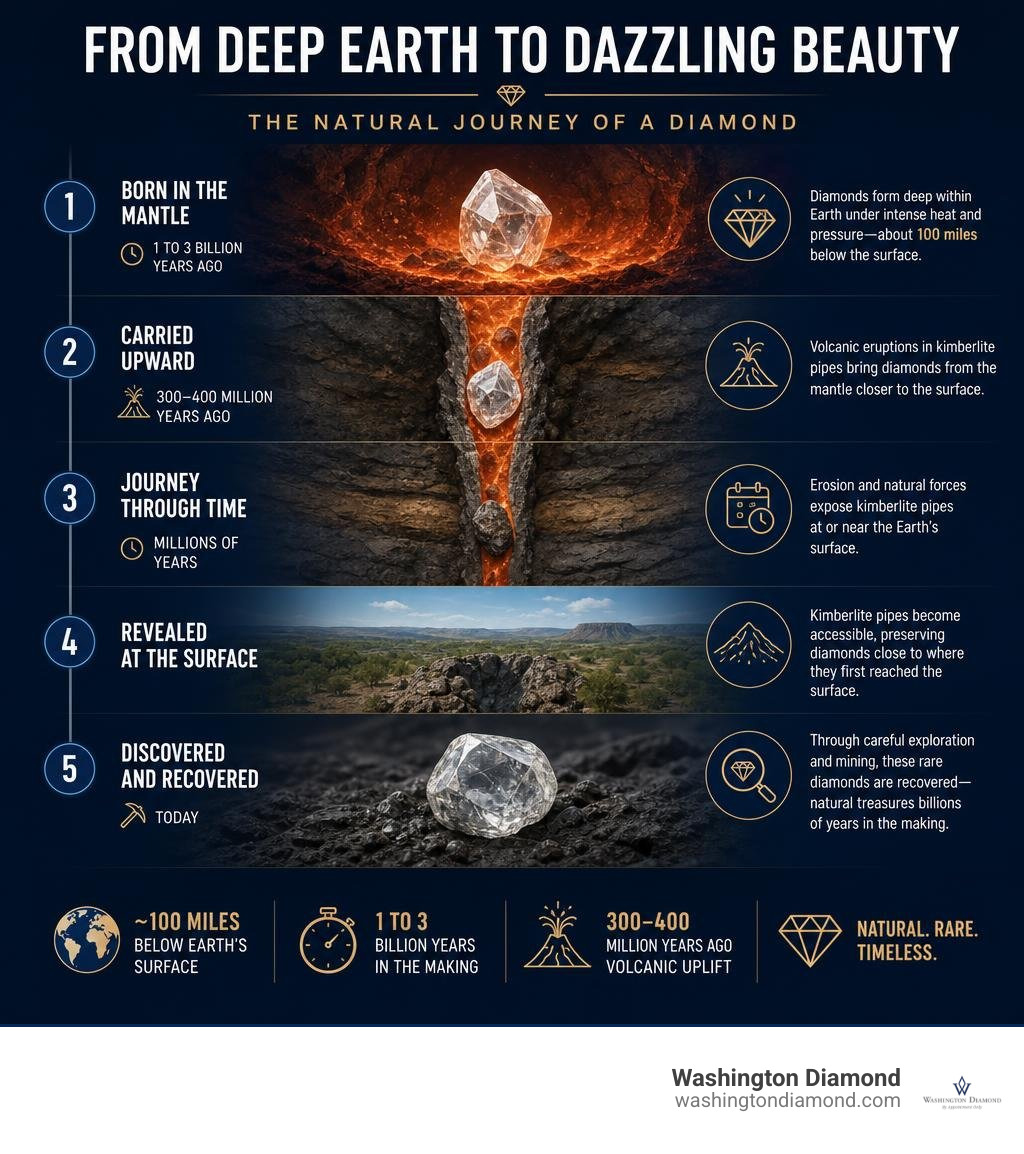
| Formed | ~100 miles below Earth's surface |
| Transported to surface | By volcanic eruptions, 300–400 million years ago |
| Annual global recovery (1 ct+) | Fits inside a single exercise ball |
| Significant mines worldwide | Only 30 in production |
| Detectable from lab-grown? | Yes, using professional instruments |
| Holds resale value? | Yes, ~3% appreciation annually over 35 years |
These stones are genuinely rare. Over the last 140 years, geologists have sampled nearly 7,000 kimberlite pipes — the volcanic rock formations that carry diamonds to the surface — yet fewer than 60 were rich enough to mine commercially. The odds of finding a viable deposit are estimated at less than 1%.
That scarcity is not a marketing story. It is geology.
And yet, natural diamonds are often misunderstood. Questions about their environmental impact, ethical sourcing, and how they compare to lab-grown alternatives are completely fair — and they deserve clear, honest answers backed by data.
I'm Tom Daube, a GIA-certified diamond specialist with decades of experience helping clients find and understand natural earth mined diamonds at prices typically below listed wholesale. The sections ahead will walk you through everything — from how these stones form to how to buy one with confidence.
The Geological Origin and Rarity of a Natural Earth Mined Diamond
To truly appreciate a natural earth mined diamond, we have to look back long before dinosaurs roamed the Earth. These stones are ancient geological time capsules. While a laboratory can synthesize the chemical structure of carbon in a matter of weeks, nature takes its sweet time—usually between one and three billion years.
To understand why these gems hold such a legendary status, we can look to The Legend and Symbolism of the Diamond, which highlights how cultures throughout history have revered their indestructible nature and celestial sparkle.
But how does a natural earth mined diamond actually form, and why are there so few of them? The answer lies in the extreme environments of our planet's mantle and the incredibly low success rate of finding them.
Deep-Earth Mantle Formation vs. Factory Synthesis
Natural diamonds form under mind-boggling physical conditions. They require temperatures ranging from 1,300°C to 1,600°C and pressures so intense they are roughly equivalent to balancing a commercial jet airplane on the tip of your finger. This intense environment exists only in the Earth's mantle, approximately 100 miles below the surface.
One of the most defining chemical differences between natural and factory-grown diamonds is nitrogen. Nitrogen is a natural constituent in about 99% of all earth-mined diamonds, having been absorbed during their billion-year formation process.
Conversely, factory synthesis relies on two main methods:
- High Pressure High Temperature (HPHT): This method uses massive, 50-ton hydraulic presses to mimic the earth's pressure, heating carbon seeds to around 1,300–1,600°C.
- Chemical Vapor Deposition (CVD): This process uses gas chambers heated to 900–1,200°C, where carbon-rich gas rains down atom-by-atom onto a seed plate.
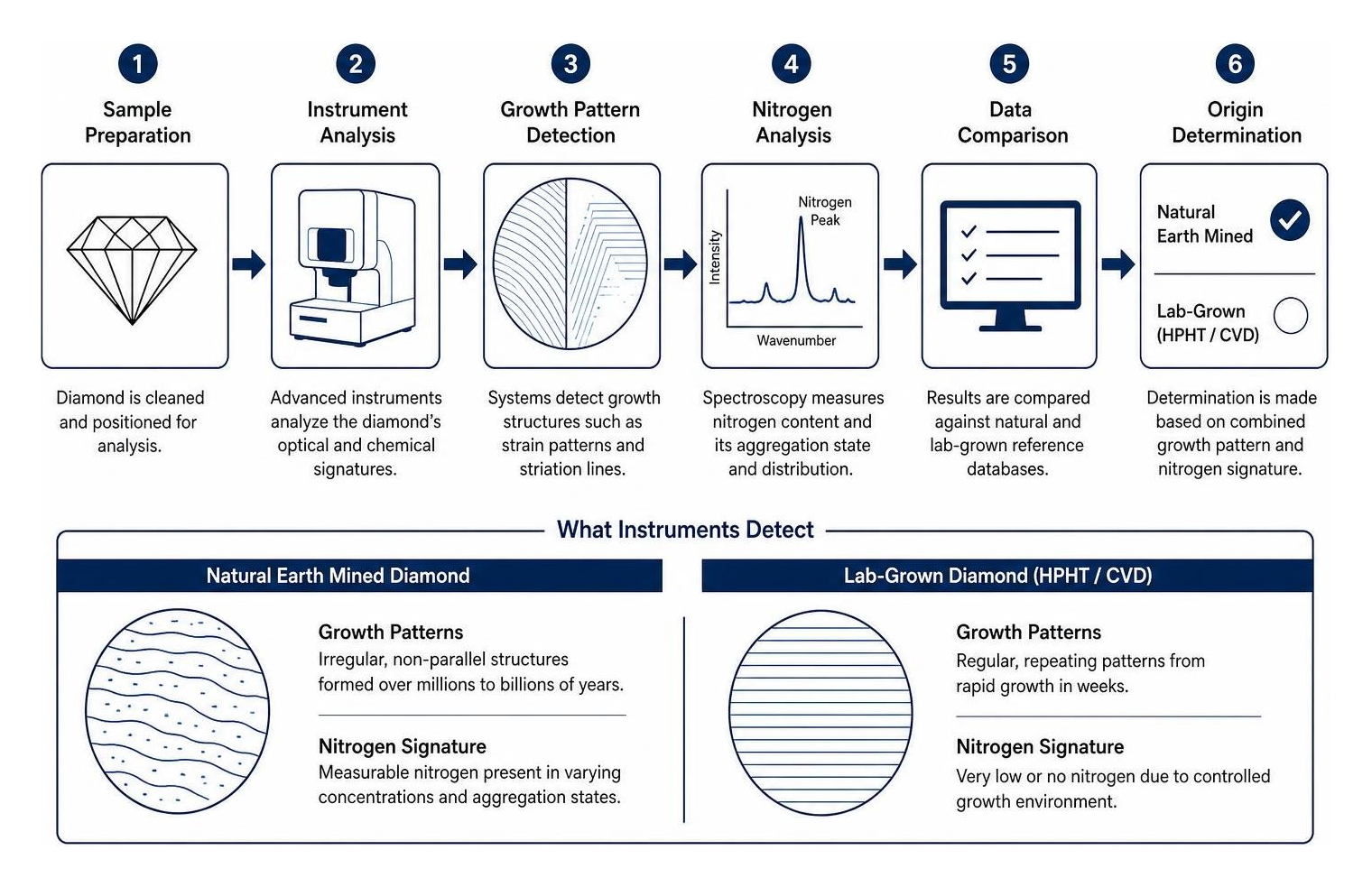
To produce a colorless lab-grown diamond, manufacturers must almost completely eliminate nitrogen from the growth chamber. This lack of natural nitrogen distribution, combined with rapid growth cycles (weeks versus eons), leaves distinct microscopic growth patterns that make it straightforward for modern gemological laboratories to tell them apart.
Cosmic Origins: Popigai Impact Diamonds
While most jewelry-grade diamonds rise from the deep mantle, nature occasionally uses a more dramatic, cosmic method to forge diamonds. About 35 million years ago, a massive asteroid slammed into what is now Siberia, creating the Popigai crater.
The extreme shock metamorphism of this impact instantly converted surface graphite into nano-polycrystalline diamonds (NPD). According to Scientific research on Popigai impact diamonds, these unique stones possess a nano-polycrystalline structure with tiny crystal grains measuring only 5 to 50 nanometers.
Because of this tightly interlocked structure, Popigai diamonds lack the cleavage planes of traditional single-crystal diamonds, making their abrasive properties 1.5 to 2.0 times higher than standard stones. While these ultra-hard impact diamonds are perfect for heavy industrial applications rather than engagement rings, they prove that the geological diversity of natural carbon is incredibly vast.
Historic Discoveries and Extreme Scarcity
The scarcity of gem-quality natural diamonds is staggering. Globally, rough diamond recovery peaked back in 2005 and has been declining ever since; current annual production is expected to remain stable at a modest 115 to 125 million carats, down significantly from the 150 million carats recorded in 2017.
To put this scarcity into perspective:
- The annual global recovery of 1-carat polished diamonds would fit neatly inside a single exercise ball.
- The annual recovery of rare 5-carat diamonds and above would fit inside a standard basketball.
Only 30 significant natural diamond mines remain in active production worldwide, with only 7 classified as Tier 1 deposits (containing over $20 billion in reserves).
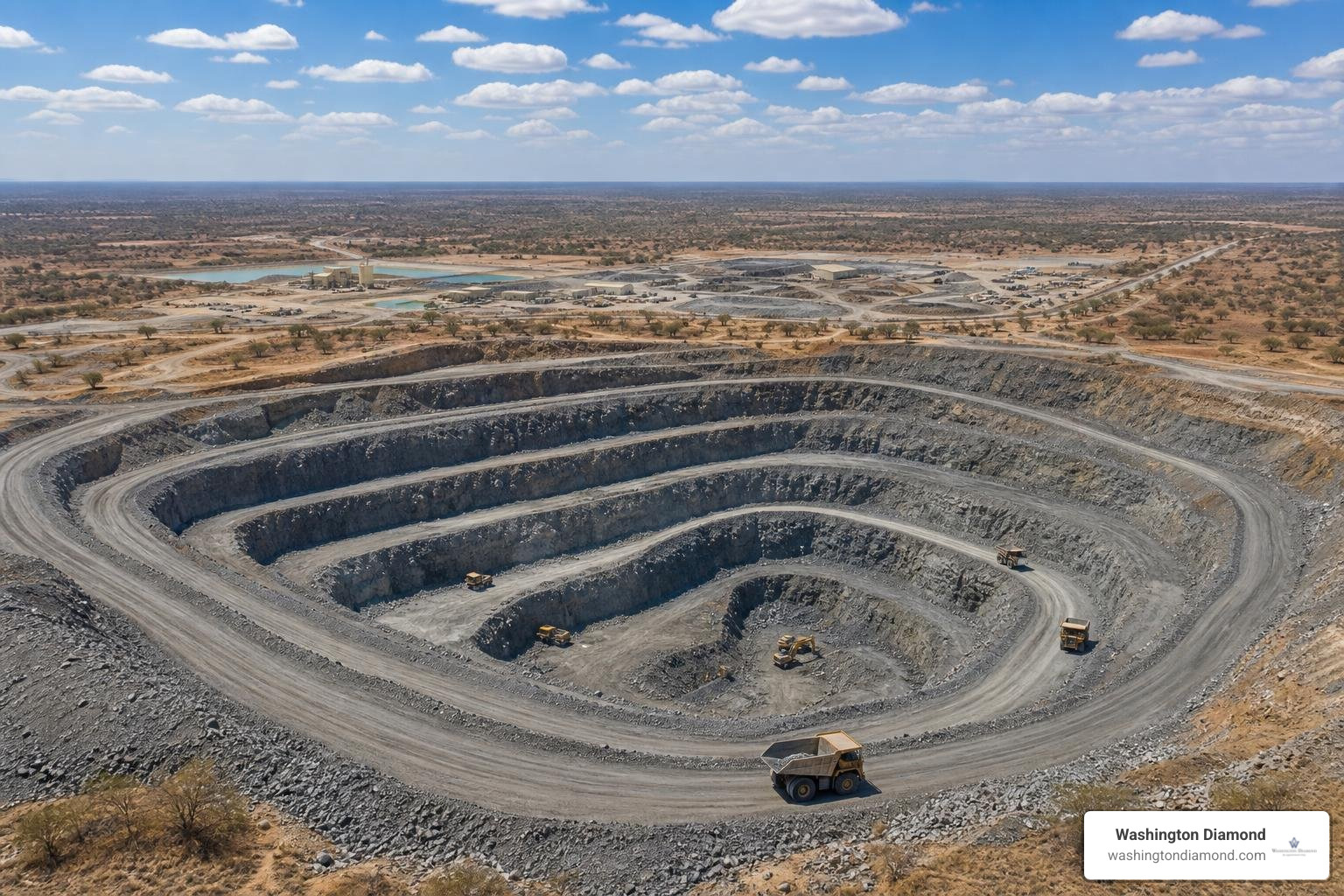
Occasionally, however, these rare deposits yield historic treasures. At the Karowe mine in Botswana, operators recovered an astonishing, unbroken 1,305.4-carat white diamond. As documented in Scientific research on the 1,305-carat Karowe diamond discovery, this marked the tenth time this single, highly productive mine has yielded a stone larger than 1,000 carats. This extraction was made possible by advanced X-ray Transmission (XRT) technology, which identifies massive stones early in the recovery process to prevent them from being crushed by heavy machinery.
Verification, Traceability, and Detecting Lab-Grown Alternatives
Because natural and lab-grown diamonds share the same basic chemical composition, many consumers wonder if they can be easily confused. The short answer is no—not when using professional gemological equipment.
When you are looking to purchase a loose stone, understanding Beyond the 4Cs How to Choose Your Perfect Certified Loose Diamond is crucial. Let's look at how the industry guarantees the identity and origin of every natural stone.
How to Verify a Natural Earth Mined Diamond
Professional gemological laboratories use advanced spectroscopic identification techniques to instantly differentiate natural diamonds from synthetic alternatives. Because lab-grown diamonds are grown rapidly in controlled environments, they display unique growth lines, distinct phosphorescence signatures, and a complete absence of natural nitrogen structures.
To ensure retail transparency, the industry relies on the ASSURE program, an independent testing initiative that evaluates and rates diamond verification instruments. When you work with us at our private Northern Virginia studio, we only reference stones backed by leading laboratories.
As detailed in Scientific research on diamond verification and detection, getting a certified grading report from a trusted, independent institution like the Gemological Institute of America (GIA) is the single most reliable way to guarantee that your diamond is natural.
Traceability Technologies from Mine to Market
The modern diamond pipeline is highly secure, utilizing cutting-edge tracking systems to follow a rough diamond from the moment it is pulled from the earth to its final setting in an engagement ring.
Key traceability initiatives include:
- Rough Mapping and 3D Scanning: Before a rough diamond is cut, its unique internal "fingerprint" is digitally scanned and logged.
- Laser Inscription: Microscopic, invisible-to-the-naked-eye laser inscriptions are placed on the diamond's girdle, matching it directly to its digital grading certificate.
- Blockchain Ledgers: Secure, decentralized digital ledgers record every transfer of ownership, verifying that the stone originated from an ethical, licensed mine.
Environmental Stewardship and the Sustainability Debate

An important part of our mission at Washington Diamond is helping our clients make informed, socially conscious decisions. In recent years, the lab-grown diamond industry has marketed itself as a completely green, "eco-friendly" alternative to natural mining. However, when we look closely at the actual data, the reality is far more nuanced.
If you are weighing these options for an engagement ring, our guide on Lab-Grown Diamond Engagement Rings Ethical Elegance for Your Big Day provides a helpful perspective on balancing modern choices with classic values.
Carbon Footprint and Biodiversity Conservation
It is true that mining requires moving earth, but the natural diamond industry has made massive strides in minimizing its carbon footprint and actively protecting surrounding ecosystems.
Let's look at the verified environmental metrics of Natural Diamond Council (NDC) members:
- Carbon Emissions: The carbon footprint of a 1-carat polished natural diamond is approximately 106.9 kg of CO2 equivalent (Scope 1 and 2 emissions), which is roughly equal to driving 265 miles in a standard medium-sized car or manufacturing a single laptop computer.
- Water and Waste Recycling: Up to 84% of the water used in natural diamond recovery is recycled, and 99% of the physical waste produced is simply natural, non-toxic rock.
- Biodiversity Protection: For every acre of land used for active mining, NDC members protect close to four acres for biodiversity conservation and wildlife protection. This equates to a massive 2,020 square kilometers of protected wild ecosystems—home to thousands of species.
- Responsible Mine Closure: Modern environmental regulations require mining companies to establish comprehensive, pre-funded rehabilitation plans to return the land to its natural state once mining operations cease.
Are Lab-Grown Diamonds Truly More Sustainable?
The claim that lab-grown diamonds are inherently more sustainable overlooks a critical factor: the immense, non-stop energy required to run factory reactors. HPHT and CVD machines must run continuously for weeks at extreme temperatures, drawing massive amounts of electricity.
Consider these key facts:
- Coal Grid Dependency: Over 70% of the world's lab-grown diamonds are mass-produced in China (46%) and India (26%), where the local electrical grids rely heavily on coal (62% and 74%, respectively).
- High Emissions: Because of this reliance on fossil fuels, the average carbon emissions for a single polished carat produced via CVD in India range from 260 kg to 612 kg of CO2 equivalent—significantly higher than a natural stone.
- Mined Raw Inputs: Lab-grown diamonds are not "mining-free." Their production requires graphite, nickel, iron, cobalt, and pyrophyllite, all of which must be mined from the earth.
- Greenwashing Crackdowns: Recognizing these discrepancies, regulatory bodies like the Federal Trade Commission (FTC) have issued strict warnings to lab-grown diamond manufacturers regarding unsubstantiated "eco-friendly" and "sustainable" marketing claims.
Socio-Economic Impact, Ethical Sourcing, and Labor Standards
One of the most compelling arguments for choosing a natural earth mined diamond is the profound positive impact the industry has on developing nations and indigenous communities.
When you purchase an ethically sourced stone, you are supporting local families, schools, and healthcare systems. For our local clients in Northern Virginia, we detail our strict ethical standards in our guide to Conflict-Free Diamonds DC.
Empowering Local Communities and National Economies
Unlike the lab-grown diamond sector, where profits primarily benefit a small group of venture capitalists and factory owners, up to 80% of the rough value of natural diamonds remains within local communities. This wealth flows back in the form of local purchasing, employment benefits, infrastructure investment, taxes, and royalties.
The natural diamond industry supports the livelihoods of approximately 10 million people globally.
These regional impacts are incredibly significant:
- Botswana: Diamonds represent 88% of the country's total exports, contributing 35% of fiscal revenue and 33% of its overall GDP.
- Namibia: The industry generates 20% of Namibia's foreign export earnings, with the country receiving 80 cents of every dollar generated by Debmarine Namibia.
- Canada's Northwest Territories: The diamond industry is the largest private sector contributor to the NWT, representing 24% of its GDP. Since 1996, these mines have provided over 32,000 person-years of local employment and contributed over $24 billion to the economy.
Ethical Sourcing and Conflict-Free Standards
Today, the natural diamond industry is more heavily regulated and transparent than ever before. We encourage our clients to explore What Does Ethically Sourced Actually Mean to understand the global frameworks that protect workers and communities.
The cornerstone of this effort is the Kimberley Process Certification Scheme (KPCS), a joint government, industry, and civil society initiative that has successfully eliminated 99.8% of conflict diamonds from the global supply chain. Additionally, organizations like the Responsible Jewellery Council (RJC) enforce strict, third-party audits covering human rights, labor standards, and safe working conditions.
Market Dynamics: Pricing Trends and Inventory Realities
Understanding the financial realities of your purchase is just as important as understanding its physical beauty. The diamond market has evolved rapidly over the past decade, and knowing what drives these changes will help you make a smart, long-term investment.
To see how market forces shape the value of these gems over time, read our analysis on The Shifting Sparkle What Drives Diamond Values Through the Years.
Value Retention of a Natural Earth Mined Diamond vs. Lab-Grown Depreciation
Because natural diamonds are a finite, scarce resource, they have historically held their value incredibly well, showing an average annual price appreciation of approximately 3% over the last 35 years.
Conversely, lab-grown diamonds have experienced a massive price depreciation. Because factory production capacity is virtually unlimited, the cost of lab-grown diamonds has plummeted. In 2016, a lab-grown diamond cost about 80% of a natural diamond's price; by 2024, that figure dropped to less than 20%, and wholesale prices continue to slide toward the cost of basic manufacturing.
To plan your budget effectively, we recommend consulting our GIA Certified Diamonds Price Guide alongside our Affordable Lab-Grown Diamonds Complete Guide to compare the long-term financial outlook of both options.
Inventory Fluctuations: Stockpiling Myths vs. Market Realities
There is a persistent myth that the diamond industry artificially stockpiles vast quantities of gems to manipulate retail prices. In reality, modern inventory fluctuations are driven by standard market dynamics, supply chain logistics, and macroeconomic cycles.
Mining companies must balance high operational costs with global retail demand. Because rough diamond production is capital-intensive and exploration success rates are so low, supply remains naturally constrained, protecting the intrinsic value of every natural stone on the market.
Frequently Asked Questions About Natural Diamonds
Navigating the diamond market can feel overwhelming, but we are here to make it simple. For more detailed answers, you can read the Scientific research on natural diamond FAQs published by leading industry experts.
How old are natural earth-mined diamonds?
Most natural diamonds are between 1 and 3 billion years old. They formed deep within the Earth's mantle long before the first dinosaurs, making them quite literally the oldest thing you will ever touch.
Do lab-grown diamonds hold their resale value over time?
No. Because lab-grown diamonds can be mass-produced in unlimited quantities, their market value has depreciated significantly. They do not hold secondary or resale value, whereas natural diamonds historically retain their value and appreciate slowly over time.
How does the Kimberley Process guarantee conflict-free diamonds?
The Kimberley Process requires member nations to meet strict criteria and use tamper-proof export certificates to track rough diamonds across international borders, ensuring they are sourced from conflict-free, legitimate mining operations.
Conclusion: Find Your Perfect Match at Washington Diamond
A natural earth mined diamond is more than just a beautiful piece of jewelry; it is a multi-billion-year-old piece of Earth's history, an anchor for local economies worldwide, and a classic symbol of enduring commitment.
At Washington Diamond, we believe that choosing a diamond should be as memorable and joyful as the moment you present it. Located in Northern Virginia, our private, appointment-only studio is designed to give you our undivided attention. We cut out the pressure of traditional retail, offering you a personalized, educational experience to help you find a stunning, certified loose diamond at an exceptional value.
Ready to begin your journey? Read our Loose Diamonds Complete Guide to explore your options, and schedule your private consultation with us today.
Have a question about your jewelry?
We've been helping clients with diamonds, custom design, repairs, appraisals, and more since 1969. Book a private appointment at our Falls Church studio.
Book an AppointmentTrusted since 1969 · Falls Church, VA · 703-536-3600
From the blog
View all


