

Beyond the Bling: Where to Buy Conflict-Free Diamonds in DC
Why Conflict-Free Sourcing Matters More Than Ever

Conflict free diamonds DC shoppers can find reputable jewelers who prioritize ethical sourcing, transparency, and traceability - from busy city boutiques to private, appointment-only studios in Northern Virginia.
During the 1990s, approximately 3.7 million people died in wars financed by the illegal diamond trade. More than 6.5 million people were driven from their homes in Sierra Leone, Angola, and the Democratic Republic of the Congo as rebel groups fought for control of diamond mining areas.
That dark history gave rise to what we now call conflict diamonds or blood diamonds - rough diamonds sold by rebel movements to fund violence against legitimate governments. While the international community responded in 2003 with the Kimberley Process Certification Scheme, today's conscious consumers in Washington D.C. understand that "conflict-free" is just the starting point.
True ethical sourcing means asking harder questions: Where exactly was this diamond mined? How were the workers treated? What environmental safeguards were in place? Did the local community benefit from the mining revenue?
For couples planning engagements or anniversaries in the nation's capital, finding a diamond that reflects both your love story and your values has never been more important - or more achievable.
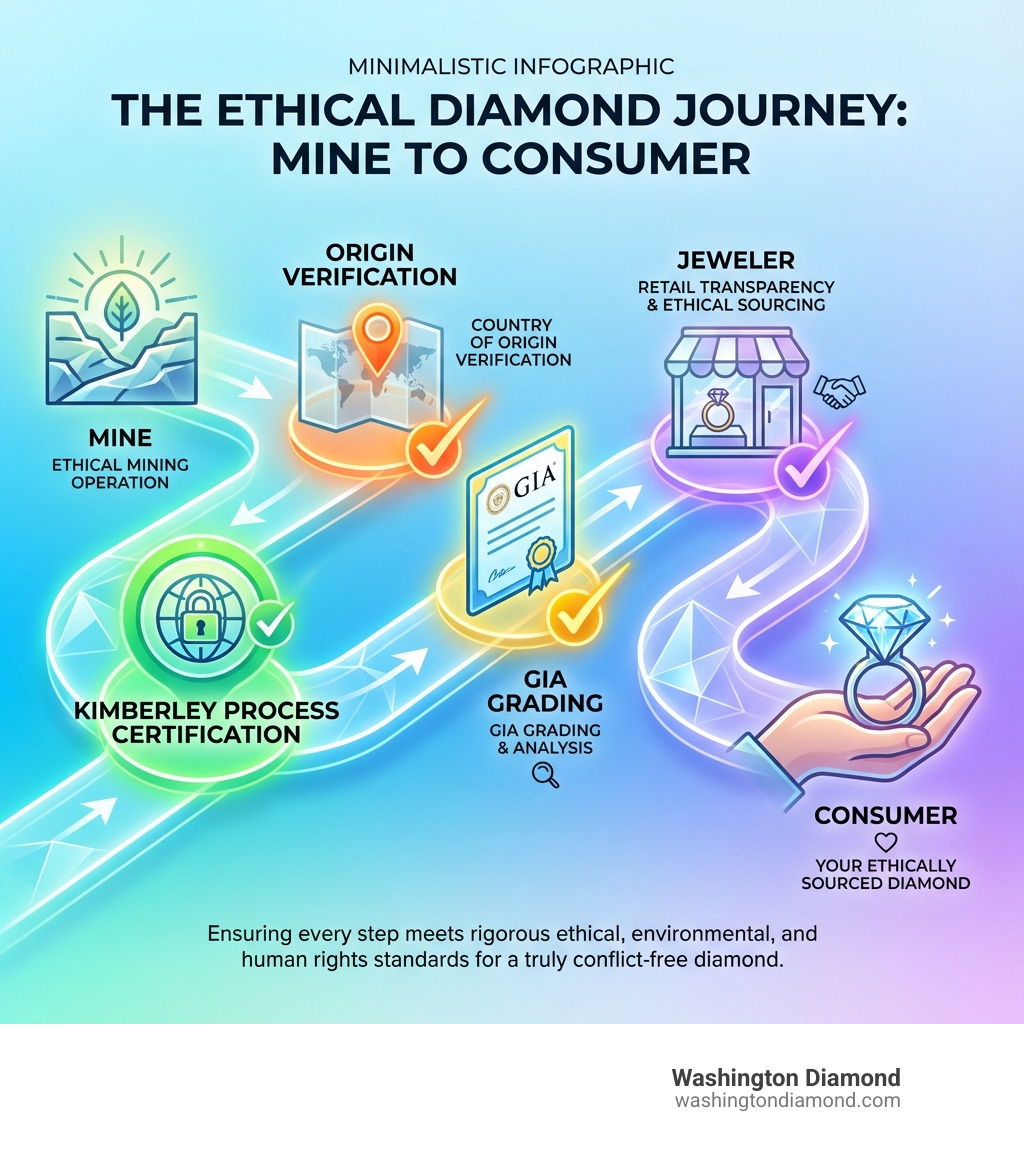
Conflict free diamonds DC terms made easy:
The Global Standard: Understanding the Kimberley Process & U.S. Law
When we talk about conflict free diamonds DC shoppers often first hear about the Kimberley Process. The Kimberley Process Certification Scheme (KPCS) is an international initiative launched in 2003 by governments, the diamond industry, and civil society groups. Its primary goal was to prevent rough diamonds from being used to finance rebel movements and undermine legitimate governments.
How does it work? The KPCS imposes extensive requirements on its members to enable them to certify shipments of rough diamonds as 'conflict-free'. This means rough diamonds must be shipped in tamper-proof containers and exported with a forgery-resistant certificate that attests to their conflict-free status. This system helps ensure that only legitimate diamonds enter the global supply chain. The Kimberley Process now includes 71 countries and covers more than 99% of the world’s diamond production, making it a critical tool in regulating the trade.
The United States plays a significant role in enforcing these standards. The Clean Diamond Trade Act, signed into law on July 29, 2003, formalized U.S. participation in the Kimberley Process. This Act prohibits the importation into, or exportation from, the U.S. of any rough diamond unless it has been controlled through the KPCS. U.S. Customs and Border Protection (CBP) acts as the import authority, leading enforcement actions on diamond-related violations and ensuring adherence to the Act. This means that any diamond entering or leaving the U.S. legally must comply with these strict regulations.
For a deeper dive into the specifics of this global effort, you can visit the U.S. Department of State's page on Conflict Diamonds and the Kimberley Process. Understanding these foundational regulations is the first step in appreciating what truly makes a diamond ethically sourced. We believe that knowing "what ethically sourced actually means" is crucial for every consumer, and we dig into this further in our guide What Does Ethically Sourced Actually Mean?.

What the Kimberley Process Guarantees
At its core, the Kimberley Process Certification Scheme was designed to prevent rebel groups from financing conflict through the sale of rough diamonds. This focus stemmed from the horrific realities of the 1990s, where diamonds fueled atrocities in countries like Sierra Leone and Angola. By mandating a certification scheme, the KPCS ensures that rough diamonds traded between participating countries are free from this specific type of conflict financing.
The KPCS is a joint-government, internationally recognized system. It requires members to implement domestic laws and procedures that track rough diamond shipments, making the trade more transparent and secure. Participating countries are only allowed to trade rough diamonds with other participants, effectively creating a closed system to prevent conflict diamonds from entering legitimate markets. With 71 countries involved, representing over 99% of global rough diamond production, its reach is undeniable. It's a powerful statement from the international community, the diamond industry, and civil society groups that the violence financed by diamond trade must end.
Limitations of the "Conflict-Free" Label
While the Kimberley Process is a vital step, we understand that for many of our clients seeking conflict free diamonds DC, the "conflict-free" label, as defined by the KPCS, has its limitations. The KPCS narrowly defines "conflict diamonds" as rough diamonds used by rebel movements to finance conflict against legitimate governments. This definition, while important, doesn't encompass all the ethical concerns that a conscious consumer might have.
For example, the Kimberley Process does not explicitly address broader human rights abuses within the diamond mining industry. This can include issues such as child labor, forced labor, unsafe working conditions, or inadequate wages for miners. A diamond can be "KP-certified" but still come from a mine where workers face exploitation.
Furthermore, the KPCS does not typically account for the environmental impact of diamond mining. Large-scale mining operations can lead to deforestation, soil erosion, water pollution, and habitat destruction. While some regions and mines adhere to higher environmental standards, the KPCS itself doesn't mandate these.
Therefore, for us and for many of our clients, being truly ethical means going "beyond conflict-free." It means looking for jewelers and suppliers who prioritize comprehensive ethical sourcing, considering not just the absence of conflict financing, but also fair labor practices, environmental stewardship, and positive community development.
Your Guide to Finding Conflict Free Diamonds in DC
Navigating ethical diamonds can feel complex, but it doesn't have to be. For those seeking conflict free diamonds DC, the key is to be an informed consumer and to partner with a jeweler who values transparency as much as you do. We believe in empowering our clients with the knowledge to make choices that align with their values.

The power is truly in your hands to ask the right questions and demand verifiable information. A reputable jeweler will welcome your curiosity and provide clear, concise answers. At Washington Diamond, we pride ourselves on offering full supply chain transparency, so you can feel confident in your purchase. We understand that you want to be sure your diamond reflects your commitment to a better world, and we're here to help you achieve that peace of mind. You won't have to worry about the origins of your diamonds with us, as we detail in our post, No Supply Chain Worries at Washington Diamond.
How to Verify a Diamond's Ethical Origins
When you're looking for conflict free diamonds DC, simply being "Kimberley Process certified" is often just the first step. To truly verify a diamond's ethical origins, we recommend requesting documentation that goes beyond the basic KPCS certificate for rough diamonds. Look for jewelers who can provide Diamond Origin Reports or similar documentation that traces the diamond's journey from mine to market.
Traceability is paramount. This means your jeweler should be able to tell you the specific country, and ideally even the specific mine, where your diamond was extracted. Some countries have notably strong ethical and environmental records in diamond mining. For instance, many reputable jewelers exclusively source from regions like Botswana, Namibia, South Africa, Australia, and Canada. These countries often have robust regulations, fair labor practices, and significant reinvestment of diamond revenues into local communities and infrastructure. For example, in Botswana, diamonds account for 25% of the GDP, with 80% of those proceeds reinvested into the community, funding education, healthcare, and infrastructure.
While the 4Cs (Carat, Color, Clarity, Cut) are essential for evaluating a diamond's beauty, understanding its origin is equally vital for its ethical standing. We encourage you to look beyond the sparkle and inquire about the provenance, as discussed in our guide Beyond the 4Cs: How to Choose Your Perfect Certified Loose Diamond.
Key Questions for Jewelers Offering Conflict Free Diamonds DC
When you visit a jeweler in Northern Virginia or the broader D.C. area, armed with your knowledge about ethical sourcing, we encourage you to ask specific questions. These inquiries will help you gauge their commitment to transparency and ethical practices beyond the minimum requirements.
Here are some key questions we recommend asking:
- What is your official policy on ethical sourcing? A clear, detailed policy indicates a jeweler's dedication to the issue.
- Can you trace this diamond to its country of origin, and even the specific mine? The more precise the origin, the better the traceability. Be wary of vague answers.
- Do you offer diamonds from recycled sources or lab-grown options? These alternatives offer strong ethical advantages.
- How do you educate your clients on this topic, and what resources do you provide? A jeweler committed to ethical sourcing will also be committed to a customer's education.
- What measures do you take to ensure fair labor practices and environmental responsibility in your supply chain? This goes beyond the KPCS definition of conflict-free.
At Washington Diamond, we welcome these questions. Our private, appointment-only studio environment allows us to have in-depth conversations about provenance, ethics, and every detail of your diamond. We believe that finding your perfect diamond should be a transparent and reassuring experience. For more insights into local jewelers, you can explore Discover DC's Dazzling Gems: Top Jewelers for Every Occasion.
Beyond Conflict: Lab-Grown Diamonds and Holistic Ethics
As consumers become more conscious, the definition of "ethical" in the diamond industry has expanded significantly beyond just being conflict-free. Today, we consider a more holistic approach that includes the environmental impact of mining, fair labor practices, and positive community reinvestment. This broader perspective has propelled lab-grown diamonds into the spotlight as a compelling ethical alternative.
While natural diamonds, when responsibly sourced, can contribute positively to developing nations, the mining process itself can still have a substantial environmental footprint. This often involves large-scale land disruption, energy consumption, and potential water contamination. In contrast, lab-grown diamonds offer a way to bypass these concerns, creating beautiful gems with a much smaller environmental impact.
Furthermore, the ethical landscape now scrutinizes labor practices more closely. Even in KP-compliant mines, ensuring truly fair wages, safe conditions, and the absence of child labor requires additional layers of verification. Lab-grown diamonds, produced in controlled environments, offer inherent advantages in guaranteeing safe and ethical working conditions. This evolution in thinking means that for many looking for conflict free diamonds DC, the choice between natural and lab-grown is increasingly about a full spectrum of ethical considerations.
Natural vs. Lab-Grown: A Comparison for the DC Buyer
When considering conflict free diamonds DC, buyers have a significant choice to make between natural, ethically sourced diamonds and lab-grown diamonds. Both offer compelling advantages, and understanding their differences in terms of ethical impact is key to making the right decision for you.
Here's a comparison to help illustrate the nuances:
| Feature | Natural Conflict-Free Diamonds Training for a marathon, a common scenario we see in our Northern Virginia community, often comes with its fair share of aches and pains. While we can't completely eliminate the risk of discomfort, we can certainly equip ourselves with knowledge and tools to manage and prevent common running injuries.
In this guide, we'll explore some of the most prevalent issues runners face and discuss practical strategies to keep you on track towards your goals. Listening to your body is paramount, and early intervention can make all the difference.
Shin Splints
What they are: Shin splints, medically known as medial tibial stress syndrome (MTSS), refer to pain along the inner edge of the shinbone (tibia). This pain is often caused by repetitive stress on the shinbone and connective tissues that attach muscles to the bone.
Why they happen: Common culprits include increasing mileage or intensity too quickly, running on hard or uneven surfaces, wearing worn-out shoes, and having improper running form or muscle imbalances.
Prevention and management:
- Gradual progression: Follow the 10% rule – don't increase your weekly mileage by more than 10%.
- Proper footwear: Replace running shoes every 300-500 miles. Consider shoes with adequate cushioning and support.
- Strength training: Focus on strengthening calf muscles, tibialis anterior (shin muscle), and hip muscles.
- Stretching: Regularly stretch your calves, Achilles tendons, and hamstrings.
- Surface variation: Incorporate running on softer surfaces like trails or grass.
- Ice and rest: If pain arises, rest, ice the affected area, and consider anti-inflammatory medications.
Runner's Knee (Patellofemoral Pain Syndrome)
What it is: Runner's knee is a dull pain around or behind the kneecap, often worsened by running, squatting, or going up/down stairs.
Why it happens: This condition often results from overuse, muscle imbalances (weak hips or quads), improper running mechanics, or issues with foot pronation. The kneecap doesn't track smoothly in its groove, leading to irritation.
Prevention and management:
- Strengthen hips and glutes: Exercises like squats, lunges, clam shells, and glute bridges are crucial.
- Quad strength and flexibility: Ensure your quadriceps are strong and flexible.
- Improve running form: Work on a higher cadence and avoid overstriding.
- Supportive shoes/orthotics: Address any biomechanical issues in your feet.
- Cross-training: Engage in low-impact activities like swimming or cycling to maintain fitness without stressing the knees.
- Foam rolling: Regularly roll out your quadriceps, IT band, and glutes.
Plantar Fasciitis
What it is: Plantar fasciitis is characterized by sharp, stabbing pain in the heel, especially with the first steps in the morning or after periods of rest. The plantar fascia is a thick band of tissue that runs along the bottom of your foot, connecting your heel bone to your toes.
Why it happens: Overpronation (foot rolling inward), high arches or flat feet, tight calf muscles, unsupportive footwear, and sudden increases in activity can all contribute to inflammation of the plantar fascia.
Prevention and management:
- Calf stretches: Regularly stretch your calf muscles and Achilles tendon.
- Foot and arch support: Wear supportive shoes with good arch support, even around the house. Consider orthotics if needed.
- Plantar fascia stretches: Gently stretch your plantar fascia by pulling your toes back towards your shin.
- Ice massage: Roll your foot over a frozen water bottle for 10-15 minutes.
- Night splints: In some cases, wearing a night splint can help keep the plantar fascia stretched.
- Avoid going barefoot: Especially on hard surfaces.
Achilles Tendinitis
What it is: Achilles tendinitis is an inflammation of the Achilles tendon, the band of tissue connecting your calf muscles to your heel bone. Pain is typically felt along the back of the leg, just above the heel, and often worsens with activity.
Why it happens: This is often an overuse injury caused by sudden increases in running intensity or distance, tight calf muscles, unsupportive shoes, or running uphill frequently.
Prevention and management:
- Gradual increase in training: Avoid sudden spikes in mileage or intensity.
- Calf and Achilles stretches: Regular stretching is paramount.
- Eccentric calf raises: These exercises can strengthen the tendon.
- Appropriate footwear: Ensure your shoes provide good support and cushioning.
- Cross-training: Include non-impact activities to maintain cardiovascular fitness.
- Ice and rest: Apply ice after runs and rest if pain persists.
IT Band Syndrome (Iliotibial Band Syndrome)
What it is: IT band syndrome causes pain on the outside of the knee, often described as a sharp or burning sensation. The iliotibial band is a thick band of connective tissue that runs along the outside of your thigh from your hip to your shin.
Why it happens: This is typically an overuse injury where the IT band rubs against the bony prominence on the outside of the knee. Weak hip abductors, tight IT band, overpronation, running on uneven surfaces, or worn-out shoes can contribute.
Prevention and management:
- Strengthen hip abductors: Exercises like side leg raises, clam shells, and resistance band walks.
- Foam rolling: Regularly roll your IT band, glutes, and quadriceps.
- Stretching: Focus on hip flexor and glute stretches.
- Gradual training increases: Avoid sudden increases in mileage.
- Proper running form: Avoid crossing your midline with your feet.
- Surface awareness: Vary your running surfaces and avoid constantly running on the same side of a cambered road.
Stress Fractures
What they are: Stress fractures are tiny cracks in a bone, most commonly occurring in the shinbone, foot bones, or heel bone. They are serious overuse injuries.
Why they happen: Repeated impact without adequate recovery time, sudden increases in training load, inadequate nutrition (especially calcium and vitamin D), low bone density, and improper footwear are common causes.
Prevention and management:
- Progressive training: Slowly increase mileage and intensity.
- Adequate rest and recovery: Allow your body time to adapt.
- Balanced nutrition: Ensure sufficient calcium and vitamin D intake.
- Strength training: Build strong muscles to support bones.
- Appropriate footwear: Wear well-cushioned and supportive shoes.
- Listen to your body: Do not run through persistent pain. Seek medical attention promptly for suspected stress fractures, as they require significant rest to heal.
Blisters
What they are: Fluid-filled sacs that form on the skin, usually on the feet, due to friction.
Why they happen: Ill-fitting shoes, moist feet, and rough seams in socks are common culprits.
Prevention and management:
- Properly fitting shoes: Ensure there's enough room in the toe box and no slipping at the heel.
- Moisture-wicking socks: Avoid cotton, which traps moisture. Opt for synthetic blends or wool.
- Lubrication: Apply petroleum jelly or anti-chafing balm to high-friction areas.
- Foot powder: Helps keep feet dry.
- Bandage/tape: Cover hot spots with athletic tape or moleskin before they develop into blisters.
- Don't pop them: If a blister forms, keep it covered and let it heal naturally. If it's very large and painful, sterilely drain it, but leave the skin intact.
Black Toenails
What they are: Discolored toenails (often black, blue, or purple) caused by bleeding under the nail.
Why they happen: Repeated trauma to the toenail from shoes that are too small, socks that bunch up, or hitting the front of the shoe on downhills.
Prevention and management:
- Properly sized shoes: Ensure at least a thumb's width of space between your longest toe and the end of your shoe.
- Trim toenails: Keep toenails neatly trimmed to prevent them from hitting the shoe.
- Lace properly: Use lacing techniques that prevent your foot from sliding forward in the shoe.
- Thick socks: Can provide extra cushioning.
- Monitor: If pain is severe or the nail doesn't improve, consult a medical professional.
The Importance of Listening to Your Body
One of the most critical pieces of advice we can offer for marathon training in Northern Virginia, or anywhere else for that matter, is to listen to your body. Pain is your body's way of telling you something is wrong. Ignoring it can turn a minor ache into a debilitating injury that sidelines you for weeks or even months.
- Don't push through sharp pain: While some discomfort is normal during intense training, sharp, localized pain is a red flag.
- Implement rest days: Rest is not a sign of weakness; it's essential for muscle repair and adaptation.
- Consider cross-training: Incorporate activities like swimming, cycling, or yoga to maintain fitness without repetitive impact.
- Seek professional help: If pain persists or worsens, don't hesitate to consult a doctor, physical therapist, or sports medicine specialist. Early diagnosis and treatment are key to a quicker recovery.
Conclusion
Marathon training is a journey of dedication and perseverance, and it's incredibly rewarding. By understanding common running injuries and implementing proactive prevention and management strategies, you can significantly increase your chances of reaching the starting line and crossing the finish line healthy and strong. Consistency, smart training, and self-care are your best allies.
We wish you the best of luck with your training in Northern Virginia and beyond! Keep running, keep exploring, and keep taking care of your amazing body.
Have a question about your jewelry?
We've been helping clients with diamonds, custom design, repairs, appraisals, and more since 1969. Book a private appointment at our Falls Church studio.
Book an AppointmentTrusted since 1969 · Falls Church, VA · 703-536-3600
From the blog
View all


