

The Shifting Sparkle: What Drives Diamond Values Through the Years
Why Understanding Diamond Values by Year Matters for Your Investment
Diamond values by year have fluctuated significantly over the past six decades, influenced by everything from global economic crises to industry monopolies and the recent emergence of lab-grown alternatives. If you're considering a diamond purchase for an engagement, anniversary, or as a long-term investment, understanding these historical trends helps you make an informed decision about what will truly hold its value.
Key Factors That Drive Diamond Values Over Time:
- Economic conditions - Recessions and booms directly impact consumer spending on luxury goods
- Supply and demand - Mining production, new findies, and market competition affect availability
- Industry changes - The end of De Beers' monopoly and rise of lab-grown diamonds reshaped pricing
- Diamond quality - Higher-quality stones (better color, clarity, cut) show more consistent value retention
- Currency fluctuations - Since wholesale transactions occur in USD, exchange rates impact local prices
- Consumer confidence - Employment rates and economic stability drive purchasing decisions
The data tells a clear story: natural diamond prices have generally trended upward over the decades, with notable resilience during the 2008 financial crisis. In April 2025, the average price per carat across all diamonds was $9,249.78, down 2.7% from the previous month—a normal monthly fluctuation in an otherwise stable market.
Meanwhile, lab-grown diamonds have followed a completely different trajectory. Despite being chemically identical to natural diamonds, they currently cost about 83-85% less and continue to decline in price as production technology improves and supply increases.
For someone selecting a diamond for a significant life event, this distinction matters enormously. Natural diamonds have demonstrated they can retain and even appreciate in value over time, while lab-grown diamonds hold little to no resale or trade-in potential.
Quick diamond values by year definitions:
A Historical Look at Diamond Values by Year
Understanding how natural diamond values by year have evolved is crucial for anyone considering a significant purchase. We've seen prices influenced by everything from global political stability to groundbreaking marketing campaigns. For decades, industry leaders like Rapaport and IDEX have carefully tracked these trends, providing us with invaluable historical data.
The Post-War Boom and De Beers' Dominance (1960s-1980s)
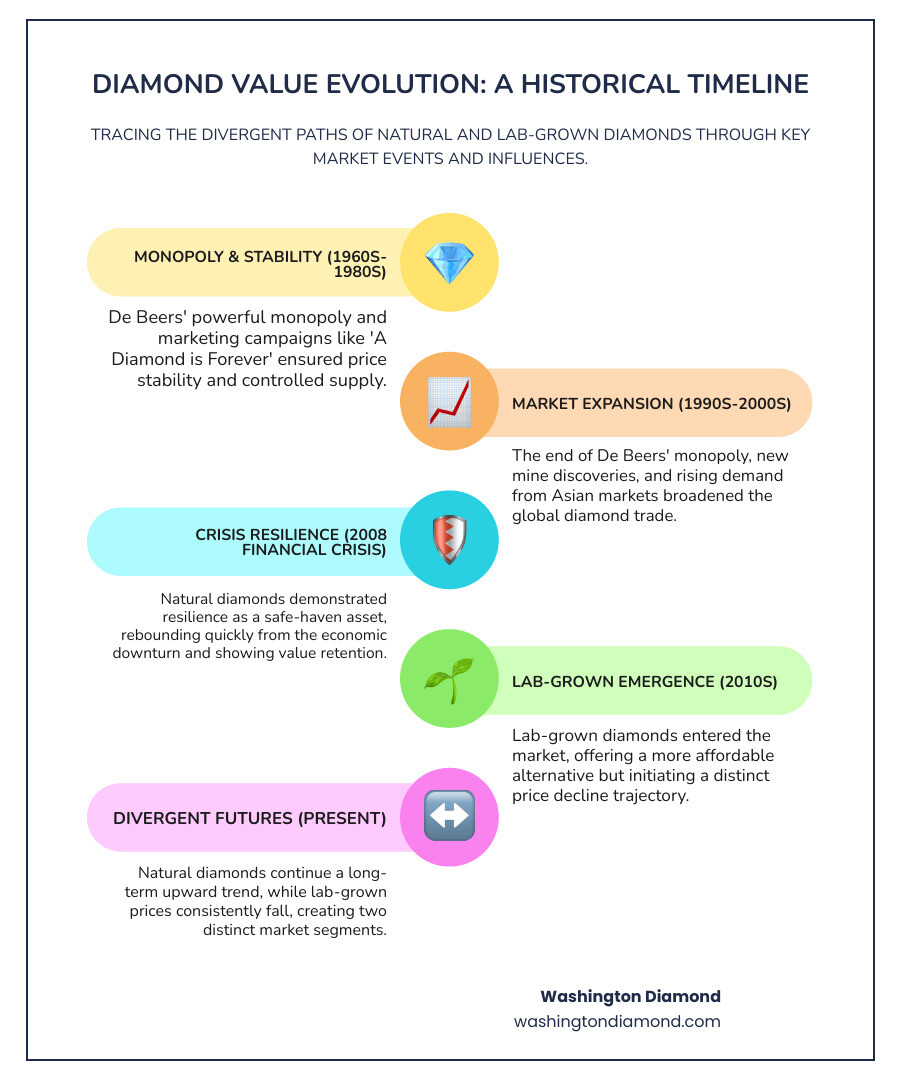
The 1960s marked a pivotal era for the diamond industry. Following the post-World War II economic boom, consumer demand for luxury goods soared. During this period, the De Beers Group held a near-monopoly on the global diamond supply, effectively controlling prices and market availability. Their iconic "A Diamond is Forever" marketing campaign, launched in the mid-20th century, profoundly shaped consumer perceptions, embedding diamonds as symbols of enduring love and commitment. This strategic control and clever marketing fostered an environment of relative price stability and consistent demand.
However, the 1970s and 1980s introduced periods of significant volatility. Global uncertainties, including political instability, economic crises, and rampant inflation, impacted the market. While De Beers worked to maintain stability, these external pressures inevitably led to fluctuations in diamond values by year. Still, the foundation of diamonds as a cherished, valuable commodity was firmly established.
Industry Shifts and New Markets (1990s-2000s)
The landscape began to shift dramatically in the 1990s and early 2000s. De Beers' long-standing monopoly gradually waned, leading to increased global supply. New diamond-producing regions, particularly Russia and Botswana, emerged as significant players, diversifying the sources of rough diamonds. This increased supply could have exerted downward pressure on prices, but robust growth in new consumer markets, especially in Asia (with China becoming the world's second-largest diamond jewelry market), helped to sustain global demand.
This period underscored the dynamic nature of the diamond market, demonstrating that while supply is a factor, burgeoning consumer interest in new regions can significantly offset potential price declines. It also highlighted the enduring allure of diamonds, a fascination deeply rooted in their legend and symbolism.
Resilience During Crisis and Stability in the Last Decade
Perhaps one of the most telling periods for diamond values by year was the 2008 financial crisis. While many asset classes crumbled, diamonds proved remarkably resilient. They experienced an initial dip, much like other luxury goods, but quickly rebounded. During this turbulent time, diamonds were recognized as a "safe-haven" asset, with investors turning to tangible, high-value commodities. According to some reports, while certain categories on the Rapaport Diamond Price Index saw drops of 20-30%, they recovered relatively quickly. For example, global diamond jewelry sales dropped approximately 25% between 2008 and 2009 but began their recovery soon after.
Over the last decade, we've observed a period of general stability with a consistent upward trend, particularly for higher-quality natural diamonds. Even during the pandemic-induced recession of 2020, where retail diamond sales initially plummeted by 35% in the second quarter, the market showed a remarkable rebound. This resilience speaks volumes about the inherent value and enduring demand for natural diamonds, illustrating how the economy affects the diamond market in complex ways.
The Key Drivers of Diamond Price Fluctuations
Understanding the ebb and flow of diamond values by year requires a grasp of the intricate interplay between various economic and market forces. These aren't just random fluctuations; they are direct responses to global trends and consumer behavior.
Macroeconomic Factors: Recessions, Booms, and Inflation
Diamonds, being discretionary luxury items, are highly sensitive to the broader economic climate.
- Consumer Spending and Confidence: When economies are booming, and consumers have more disposable income and confidence in their financial future, they are more likely to invest in significant purchases like diamond jewelry. Conversely, during recessions, discretionary spending is often the first to be cut. We saw this during the 2008 crisis and the 2020 pandemic. For instance, in the US, diamond jewelry sales increased by 12% in 2021 as the economy recovered. High employment rates (below 4% unemployment) have historically correlated with significant year-over-year increases in diamond jewelry sales, sometimes by 8-15%.
- Recessions and Market Booms: Economic downturns tend to cause an initial dip in diamond demand and prices, as consumers postpone or downsize luxury purchases. The 2008 financial crisis saw global diamond jewelry sales drop by approximately 25%, and during the 2020 pandemic, retail diamond sales plummeted by 35% in Q2. However, the market for high-quality diamonds often proves more resilient and recovers faster than other luxury sectors. During boom times, demand surges, especially for larger, higher-quality stones as symbols of success.
- Inflation: Diamonds can serve as a partial hedge against inflation, as their prices tend to rise during inflationary periods. However, they are not as liquid or standardized as assets like gold, which is often considered a more direct inflation hedge. The high retail markup (typically 100-200%) also impacts their effectiveness as a short-term investment against inflation.
- Currency Fluctuations: Since most wholesale diamond transactions are conducted in US dollars, fluctuations in currency exchange rates significantly impact prices in local markets. A stronger dollar makes diamonds more expensive for international buyers, potentially dampening demand.
- Interest Rates: Interest rates play a role, particularly in consumer financing. Lower interest rates can make financing larger diamond purchases more attractive, boosting sales. Conversely, higher rates increase borrowing costs, which can deter consumers from making significant luxury expenditures.
For a deeper dive into how these factors play out, you can explore more on economic impacts from Bain & Company.
Supply Chain Dynamics and Market Forces
Beyond macroeconomic tides, the internal workings of the diamond supply chain also heavily influence diamond values by year.
- Mining Production and Costs: The economics of mining, including exploration, extraction costs, and the findy of new mines, directly impact the supply of rough diamonds. Increased production from new sources can affect market equilibrium, while rising operational costs can push prices up.
- Rough Diamond Supply: Major mining companies like De Beers control a significant portion of the rough diamond supply. Their allocation strategies to sightholders and decisions regarding inventory can influence prices down the line. For instance, De Beers sometimes offers flexibility to customers to refuse allocations and keeps prices stable, even if their rough is more expensive than the open market.
- Retailer Inventory and Market Discounts: The inventory levels held by retailers and wholesalers, along with the prevalence of market discounts, can create a gap between official price lists (like Rapaport's) and actual transaction prices. A decade ago, a 1-carat D Internally Flawless (IF) diamond might have sold at 25-30% less than the listed price, and an E VVS1 diamond for 15% less. These discounts are a real part of the market, and experienced traders often capitalize on them. Understanding these nuances is especially important when considering loose diamonds for purchase.
- Price Transparency: Efforts to increase price transparency in the diamond market are ongoing. While indices provide benchmarks, the true "market price" can be complex due to varying discounts and the unique characteristics of each stone.
Natural vs. Lab-Grown: A Tale of Two Value Trajectories
One of the most significant shifts impacting diamond values by year in recent times has been the rise of lab-grown diamonds. While chemically and optically identical to natural diamonds, their origins and supply dynamics lead to vastly different long-term value propositions.
Understanding the Long-Term Value Trends
When we look at the long-term value trends, natural and lab-grown diamonds present a stark contrast.
Natural Diamonds: These geological marvels, formed deep within the Earth over billions of years, are finite. Their scarcity is a fundamental driver of their value. Historically, high-quality natural diamonds have demonstrated a capacity to retain and even appreciate in value over time. They typically hold a significant portion of their original value and have a robust resale and trade-in market. Over the past year, natural diamonds have seen a rise of +15.84% in value.
Lab-Grown Diamonds: Created in controlled environments, lab-grown diamonds are essentially a manufactured product. While stunning, their supply is theoretically limitless, dependent only on technological advancements and production capacity. This inherent abundance leads to a fundamentally different value trajectory. Lab-grown diamond prices have been declining for years, and they currently cost about 83-85% less than natural diamonds. Despite a recent monthly uptick, the overall trend points to continuous depreciation. They hold little to no resale or trade-in potential, making them an unsound "investment" in the traditional sense. Over the past year, while some lab-grown categories have shown increases (+19.19% for example), this is often against a backdrop of steep historical declines and doesn't signify long-term value retention.
Here's a simplified look at their value retention:
| Diamond Type | Value Retention (General Trend) | Resale/Trade-in Potential |
|---|---|---|
| Natural | Retains/Appreciates | Significant |
| Lab-Grown | Declines | Little to None |
For detailed historical market data for lab grown diamond prices, you can dig into specialized price trackers.
How Lab-Grown Supply Impacts Natural Diamond Values by Year
The increasing availability and affordability of lab-grown diamonds have certainly impacted the broader diamond market, but not uniformly across all segments.
- Market Share and Consumer Choice: Lab-grown diamonds have carved out a significant market share, particularly appealing to consumers seeking a larger stone for a lower price point. This expansion offers more choices but also highlights the fundamental difference in value proposition.
- Price Pressure on Smaller Natural Diamonds: The abundance of lab-grown diamonds, especially in smaller carat weights, can exert some price pressure on comparable natural diamonds. This is because consumers might opt for a larger lab-grown stone over a smaller natural one if their primary driver is size for budget.
- Bifurcation of the Market: What we are seeing is a clear bifurcation of the diamond market. Natural diamonds continue to be valued for their rarity, heritage, and long-term value retention, often sought for fine jewelry and significant life events like engagements. Lab-grown diamonds, on the other hand, increasingly serve the fashion jewelry market or for those who prioritize size and immediate appearance over intrinsic value and resale potential.
- Value Retention Focus: For those in Northern Virginia looking for a piece that will truly hold its worth, natural diamonds remain the undisputed choice. The focus shifts from merely "decoding the dollar" of a specific carat weight to understanding the long-term implications for 2 carat diamond pricing and beyond.
How to Analyze Diamond Values by Year Like an Expert
Understanding diamond values by year isn't just about glancing at a chart; it's about dissecting the nuances of diamond characteristics and market data. At Washington Diamond, we empower our clients to make informed decisions by teaching them how to look beyond the surface.
The core of diamond valuation lies in the "4 Cs": Carat, Cut, Color, and Clarity. Each of these plays a critical role in determining a diamond's price per carat.
- Carat: This is the most straightforward factor, referring to the diamond's weight. Generally, as carat weight increases, the price per carat also tends to rise significantly, especially at psychological thresholds like 1, 2, or 3 carats.
- Cut: Often considered the most important C, cut quality determines a diamond's sparkle and brilliance. A well-cut diamond will command a premium. Price lists often reflect average cut quality, so expect a 10-15% premium for "PriceScope Ideal" or "Super Ideal" cut quality diamonds.
- Color: Diamonds are graded on a scale from D (colorless) to Z (light yellow or brown). Colorless diamonds are the rarest and most valuable.
- Clarity: This refers to the absence of inclusions (internal flaws) and blemishes (external imperfections). Flawless (FL) and Internally Flawless (IF) diamonds are extremely rare and thus highly valued.
Beyond the 4 Cs, other factors like polish, symmetry, and fluorescence can also influence a diamond's value.
Reading Price Charts and Indices
To truly analyze diamond values by year, we need to understand how to interpret industry-standard price charts and indices. These tools provide a snapshot of the market, but require careful interpretation.
- Price per Carat Variation: Diamond price charts, such as those from PriceScope, break down prices by carat weight ranges, color grades (e.g., D-I), and clarity grades (e.g., VVS2-SI2). You'll notice that the price per carat isn't linear; it often jumps at certain carat weight thresholds. For example, a 0.90-carat diamond will have a lower price per carat than a 1.00-carat diamond of similar quality.
- Carat Weight Ranges: Charts typically categorize diamonds into specific carat weight ranges (e.g., 0.30-0.39 ct, 0.50-0.69 ct, 1.00-1.49 ct). This allows for more granular analysis.
- Color and Clarity Grades: Within each carat range, prices are further refined by color and clarity. A 1-carat D Flawless diamond can cost over $20,000, while a 1-carat K SI2 diamond might be closer to $2,500. This demonstrates the immense impact of quality on value.
- RapNet Diamond Index (RAPI): The RAPI is a widely recognized benchmark in the industry. It represents the average asking price of the 10% lowest-priced round diamonds in top quality categories (D-H, IF-VS2) offered on RapNet. Tracking RAPI provides insights into overall market health.
Key Takeaways from a Diamond Price Chart:
- Prices are dynamic and updated regularly (often monthly).
- Higher carat weights, better color, and higher clarity generally lead to a higher price per carat.
- Cut quality is paramount, and a premium should be expected for superior cuts.
- Charts can show historical trends, allowing you to see percentage changes over 1, 3, 5, or 10 years for specific categories.
You can view a live Diamond Price Chart to see these dynamics in action. This data helps us go beyond the bling: what a diamond price chart really tells you.
The Importance of Certification and Quality
In diamonds, a reputable certification is your best friend. Bodies like the Gemological Institute of America (GIA) and the American Gem Society (AGS) provide unbiased grading reports that document a diamond's exact characteristics. This certification is crucial for establishing and verifying a diamond's quality, which directly impacts its value and future liquidity. Without it, you're essentially buying blind.
At Washington Diamond, we emphasize the importance of GIA-certified diamonds. This ensures transparency and accuracy, allowing you to confidently understand the quality and, by extension, the value of your diamond.
Furthermore, cut quality, as mentioned, is paramount. While average cut diamonds are common, "Super Ideal" cuts are engineered to maximize brilliance and fire, demanding a premium. This superior craftsmanship contributes significantly to the diamond's beauty and desirability, thus enhancing its long-term value.
It's also worth noting the distinction between "in-house" and "virtual" diamonds. In-house diamonds are physically inspected and managed by a vendor, often implying a higher level of vetting. Virtual diamonds are typically drop-shipped, and their pricing can be influenced by business-to-business margins, requiring careful review. Knowing these distinctions can help you in your quest to calculate the diamond value and make the smartest purchase.
Frequently Asked Questions about Diamond Value
Are natural diamonds a good investment?
This is a question we hear often, and the answer is nuanced. Natural diamonds, particularly high-quality, larger stones, can be considered a store of value and have shown long-term appreciation potential. They are a tangible asset that can serve as a hedge against inflation and economic instability, as demonstrated during crises like 2008. Over the past year, natural diamonds have seen a general rise in value, for example, +15.84% across the board.
However, diamonds are not a liquid asset like stocks or gold. The resale market typically offers only about 50% of the original retail price, largely due to the significant retail markup (often 100-200%). While a gram of diamond is far more valuable than a gram of gold (a 5-carat diamond could be worth over $400,000, while a gram of gold is less than $100), gold is more easily traded.
While natural diamonds may not provide rapid financial returns, their intrinsic beauty, rarity, and emotional significance, combined with their capacity for long-term value retention, make them a unique and cherished asset for many. For our clients in Northern Virginia, we see them as heirlooms, passed down through generations, holding both monetary and immeasurable sentimental value.
How do recessions historically affect diamond prices?
Recessions tend to have a predictable, though not uniform, impact on diamond prices. Initially, demand for luxury goods like diamonds often dips as consumers tighten their belts and discretionary spending decreases. This can lead to price volatility, especially for lower-quality or smaller stones. For example, during the 2020 pandemic, retail diamond sales plummeted by 35% in the second quarter.
However, high-quality, larger natural diamonds often demonstrate remarkable resilience. They can act as a safe-haven asset during periods of economic uncertainty, with their prices stabilizing or even rebounding more quickly than other luxury items or financial assets. The 2008 financial crisis is a prime example, where diamonds experienced an initial downturn but recovered strongly. This is because discerning buyers and investors recognize the enduring value of truly rare and exquisite stones.
Will lab-grown diamonds ever hold or increase in value?
Based on current trends and market dynamics, it is highly unlikely that lab-grown diamonds will ever hold or increase in value. The fundamental reason lies in their supply. Unlike natural diamonds, which are finite and rare geological creations, lab-grown diamonds are manufactured. As technology improves and production scales, their supply will continue to increase, driving down their cost.
Lab-grown diamond prices have been declining for years, currently costing about 83-85% less than natural diamonds. While some monthly fluctuations might show a slight increase, the long-term trajectory is one of continuous depreciation due to increasing supply and improving, cheaper production methods. They lack the inherent scarcity that underpins the value of natural diamonds. Consequently, there is little to no resale market for lab-grown diamonds, and they are not considered a sound investment. They fulfill a different purpose in the market, offering an attractive, more affordable option for immediate adornment rather than a long-term store of value.
Conclusion
Navigating the diamond market, with its rich history and evolving dynamics, requires an expert eye and a deep understanding of what truly drives diamond values by year. From the historical dominance of De Beers to the resilience shown during global crises, and the recent emergence of lab-grown alternatives, the story of diamond pricing is complex and fascinating.
At Washington Diamond, we believe that natural diamonds, particularly those of high quality, continue to represent an enduring store of value and a cherished heirloom for generations. Their rarity, natural beauty, and proven track record of value retention set them apart. Lab-grown diamonds, while a beautiful and accessible option, serve a different market segment, offering immediate sparkle without the long-term investment potential.
Understanding these historical trends and the factors influencing them is key to making a truly informed decision. We are committed to providing our clients in Northern Virginia with personalized guidance and a memorable, private appointment experience, ensuring you select a diamond that meets your aesthetic desires and your long-term value expectations.
Ready to explore the enduring beauty and value of natural diamonds? Calculate the Value of a Diamond Before You Buy or Sell or contact us for a private consultation.
Have a question about your jewelry?
We've been helping clients with diamonds, custom design, repairs, appraisals, and more since 1969. Book a private appointment at our Falls Church studio.
Book an AppointmentTrusted since 1969 · Falls Church, VA · 703-536-3600
From the blog
View all


