

The Ultimate Lab Diamond Price Tracker for 2025
What the 2026 Lab Diamonds Price Chart Actually Shows
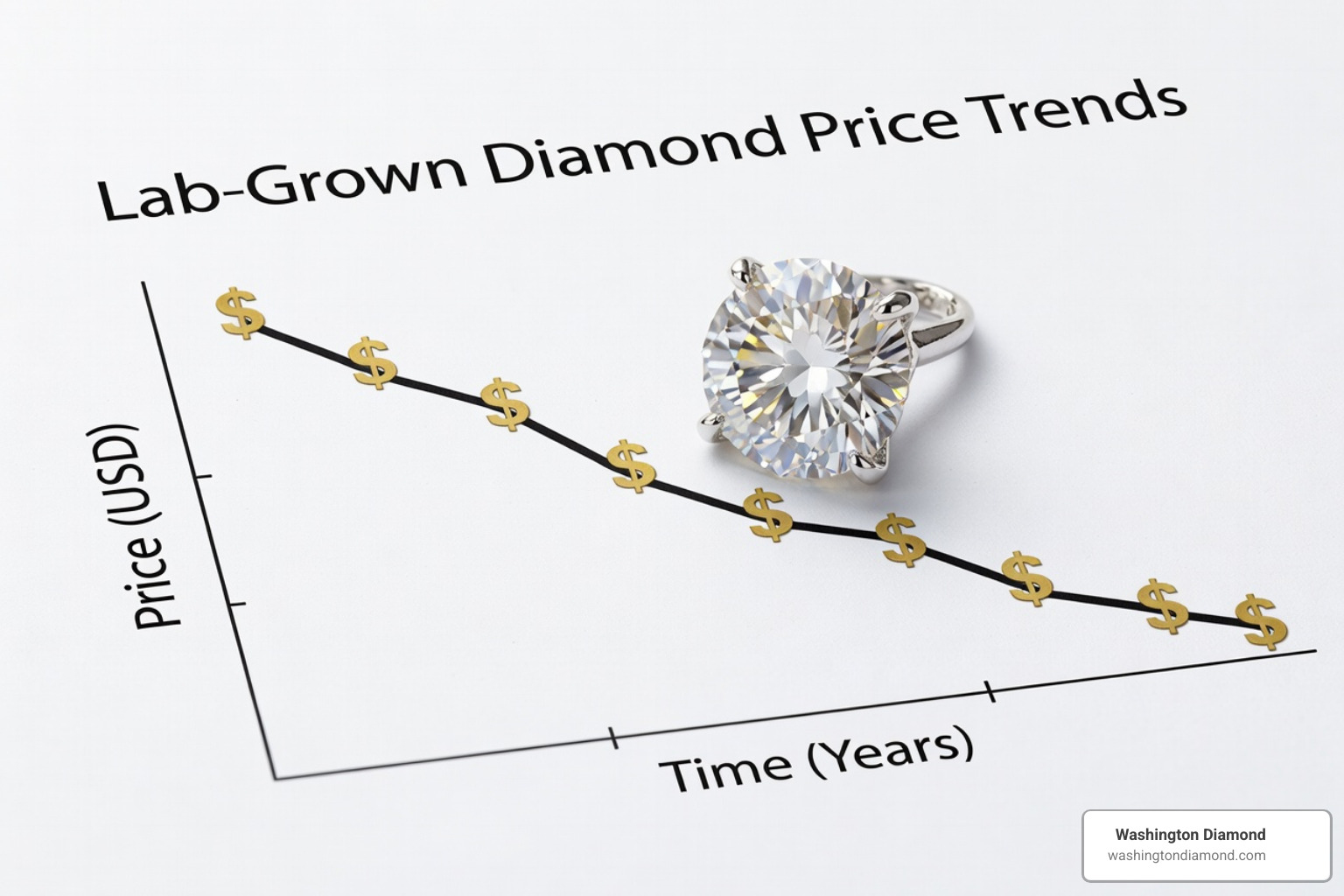
A lab diamonds price chart tracks the current cost of lab-grown diamonds by carat size, shape, color, and clarity — so you can compare prices and spot real value before you buy.
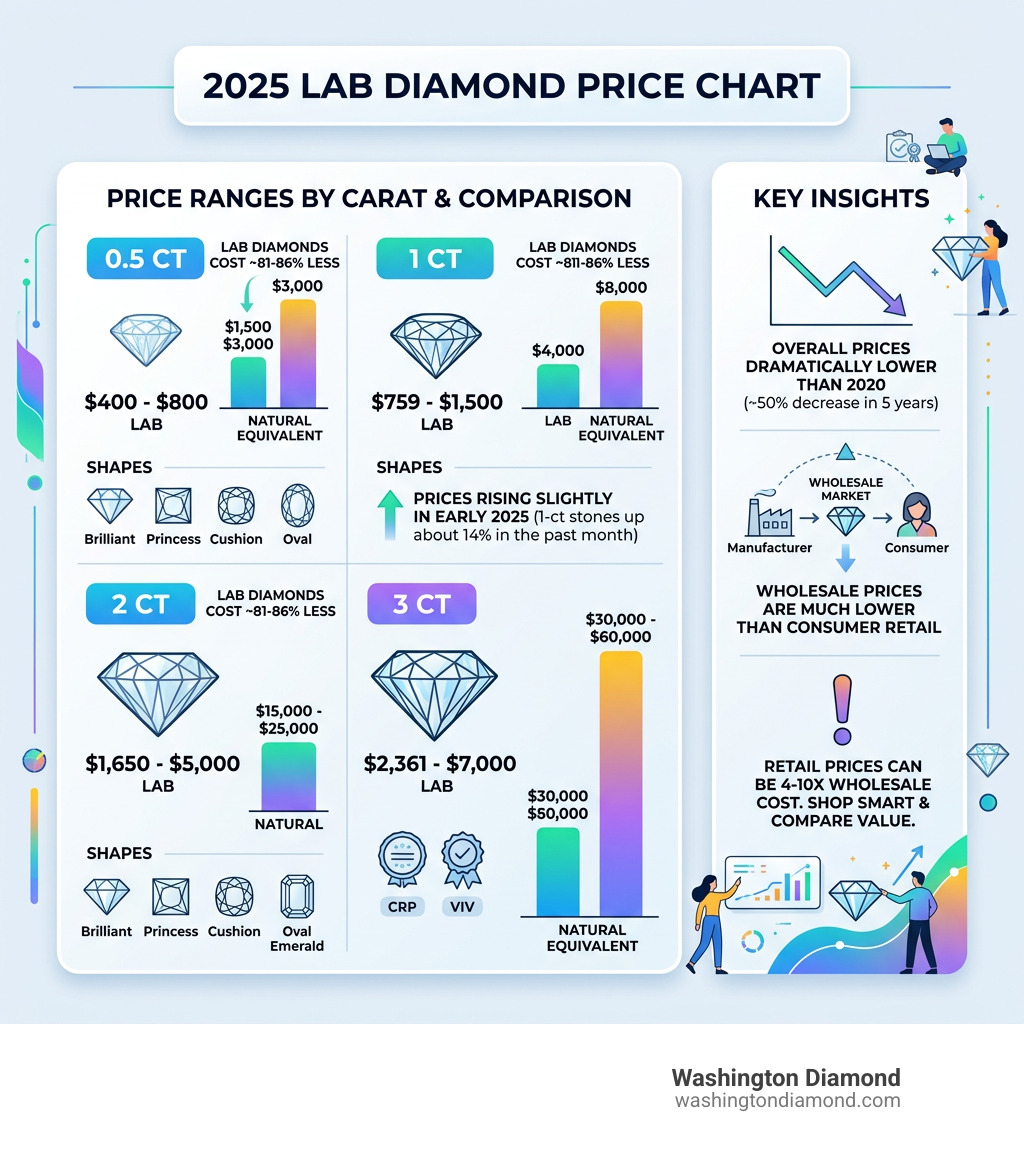
Here's a quick snapshot of where prices stand in 2026:
| Carat Size | Lab Diamond Price Range | Natural Diamond Equivalent |
|---|---|---|
| 0.5 ct | $400 - $800 | $1,500 - $3,000 |
| 1 ct | $759 - $1,500 | $4,000 - $8,000 |
| 2 ct | $1,650 - $5,000 | $15,000 - $25,000 |
| 3 ct | $2,361 - $7,000 | $30,000 - $60,000 |
Key things to know right now:
- Lab diamonds cost roughly 81-86% less than natural diamonds of the same quality
- Prices are rising slightly in early 2026 — 1-carat stones are up about 14% in the past month
- But overall, prices have fallen dramatically since 2021 — roughly 50% lower than they were just five years ago
- Wholesale prices (what jewelers pay) are much lower than what most retailers charge consumers
The price you see at a big-name retailer can be 4 to 10 times higher than the underlying wholesale cost. Understanding that gap is the whole game when buying smart.
I'm Tom Daube, a diamond industry veteran ranked in the top 1% of jewelers nationally, and helping buyers navigate tools like a lab diamonds price chart to find exceptional value is exactly what I do every day. Let's break down everything you need to know to shop with confidence.
Lab diamonds price chart terms made easy:
Understanding the 2026 lab diamonds price chart
When we look at a lab diamonds price chart, we aren't just looking at a single number. We are looking at a complex matrix of data that reflects the "4Cs" (Cut, Color, Clarity, and Carat weight), but with a lab-grown twist. In 2026, the market has matured, and the way we interpret these charts has changed.
The first thing to understand is the "Price Per Carat" metric. Just like buying produce by the pound, diamonds are priced by weight. However, as diamonds get larger, the price per carat doesn't just stay the same—it jumps. This is because growing a high-quality 3-carat diamond is significantly more difficult and takes much longer in a machine than growing three 1-carat diamonds.
Wholesale vs. Retail Reality
There is often a massive disconnect between the wholesale lab diamonds price chart (the prices we see as jewelers) and the retail prices you see online or in malls. For example, recent wholesale data shows that a 3-carat Round diamond with D color and VVS clarity might have a wholesale price of around $180 per carat. That means the total stone cost at the wholesale level is just $540.
However, many "big box" retailers might list that same stone for $3,000 or even $5,000. While every business needs a markup to cover overhead, some markups in the lab-grown world are reaching 10x the actual cost of the stone. At Washington Diamond, we believe in transparency, which is why we help you understand how to calculate diamond price per carat so you aren't overpaying for "brand name" air.
IGI vs. GIA: Does the Certificate Change the Price?
In the lab-grown world, the International Gemological Institute (IGI) is the most common certification body. They were early adopters of lab-grown grading. The Gemological Institute of America (GIA) also grades lab diamonds, but you will notice GIA-certified stones often carry a premium on the lab diamonds price chart. Is a GIA stone "better"? Chemically, no. But because GIA has a reputation for stricter grading standards, buyers often pay a bit more for that peace of mind.
CVD vs. HPHT Production Methods
You might also see mentions of CVD (Chemical Vapor Deposition) and HPHT (High Pressure High Temperature).
- HPHT often results in very high color grades (D, E, F) but can sometimes have a faint blue tint or magnetic properties.
- CVD is generally 5-10% cheaper to produce and is excellent for larger, colorless stones, though it can sometimes have a "grainy" appearance if grown too quickly.
According to GIA research on carat weight, one carat is equal to exactly 0.2 grams. While the weight is the same whether lab or natural, the way the market values that weight is shifting rapidly as technology improves.
1-Carat to 5-Carat Ranges on the lab diamonds price chart
Let’s look at what you can realistically expect to pay in 2026 for high-quality (F+ color, VS1+ clarity) lab diamonds.
- 1-Carat: These are the most popular entry point. Currently, a 1-carat round lab diamond averages about $759, while Ovals are slightly higher at around $827.
- 2-Carat: This size has become the "new standard" for engagement rings in Northern Virginia. You can find excellent 2-carat stones ranging from $1,650 to $5,000 depending on the cut quality. For a deeper dive into this specific size, check out our guide on the average cost of a 2-carat lab-grown diamond.
- 3-Carat: Just a few years ago, a 3-carat diamond was a rare luxury. Today, they are incredibly accessible. Wholesale indices show these at roughly $2,361 for the stone itself, with retail prices often landing between $4,000 and $7,000. We explain this further in decoding the dollar: 2-carat pricing (which applies to larger stones as well).
- 4 to 5-Carat+: For those looking for a "showstopper," 4-carat D VVS1 emerald cuts have been spotted at retail for as low as $800 for the loose stone, though "Ideal" cut rounds in this size will still command a higher premium.
How Shape and Certification Affect the lab diamonds price chart
The shape of the diamond—often called "fancy shapes"—significantly impacts the price.
- Round Brilliant: Usually the most expensive per carat because they waste the most "rough" material during cutting and have the highest demand.
- Ovals and Pears: These often look larger than rounds of the same carat weight. In early 2026, Ovals have seen a price increase of about 6% due to high demand.
- Radiant and Emerald Cuts: These shapes are currently offering some of the best value on the lab diamonds price chart. Radiant cuts, in particular, have seen price fluctuations as Indian CVD production has increased, making them very affordable for those who like a rectangular, sparkly look.
Certification also plays a role in the "markup" you see. A stone with an IGI "Ideal" cut grade is the gold standard for lab diamonds. If you see a stone without a reputable certificate (GIA, IGI, or GCAL), it should be priced significantly lower, but we generally advise against buying uncertified stones as you can't verify what you're actually getting. Learn more about interpreting these details in beyond the bling: what a price chart really tells you.
Why Lab-Grown Diamond Prices are Shifting in 2026
If you’ve been watching the lab diamonds price chart over the last few years, you’ve probably noticed a downward trend. Why is this happening?
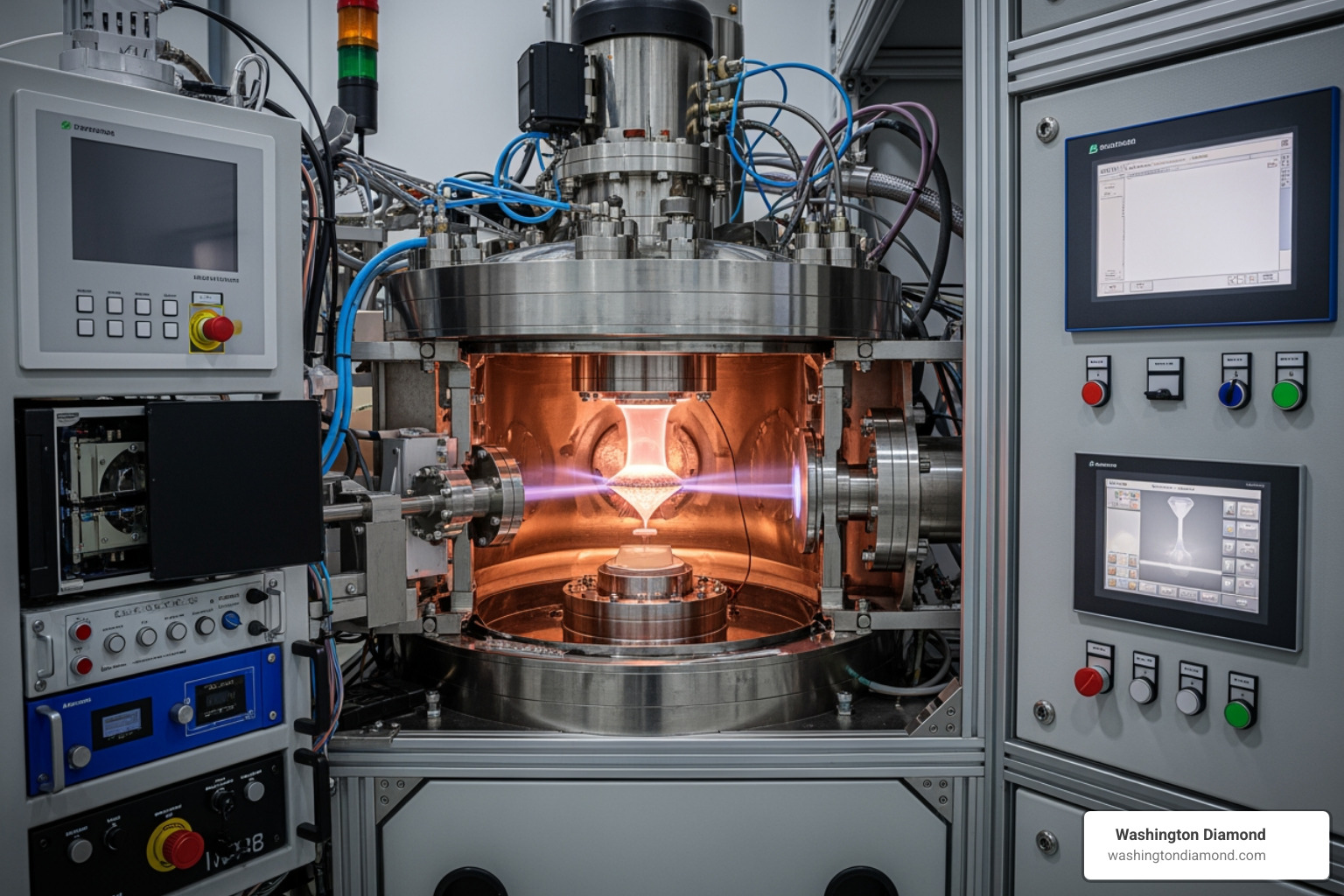
1. Production Efficiency
The technology used to grow diamonds is advancing at a "Moore’s Law" pace. What used to take months now takes weeks. Production costs have dropped by roughly 25% recently because the machines have become more efficient and the "recipe" for growing high-quality carbon crystals has been perfected.
2. The "Indian CVD" Impact
Around 2023, several large diamond-cutting firms in India—who previously only handled natural diamonds—began massive CVD (Chemical Vapor Deposition) lab-grown operations. This flooded the market with high-quality "virtual" inventory, driving prices down through sheer supply.
3. Market Growth and Demand
The worldwide lab-grown diamond market is expected to reach $29.73 billion in 2025 and continue its rapid expansion through 2026, potentially soaring to $97 billion by 2034, according to market research on lab-grown diamond growth. As more people choose lab-grown for their engagement rings, the "prestige" markup is evaporating, leaving prices to be dictated more by manufacturing costs than by artificial scarcity.
4. Tariffs and Supply Chain
In early 2026, we saw a slight "bump" in some prices (up to 14% for 1-carat stones). This is largely due to new tariffs and changes in supply chain logistics. While the "raw" cost of the diamond is low, the cost of getting it from the lab, through a certified grader, and into a retail setting has actually increased slightly.
Lab-Grown vs. Natural Diamonds: The 2026 Value Gap
The gap between lab and natural diamonds has never been wider. In 2026, lab-grown diamonds cost about 81% to 86% less than natural diamonds.
| Feature | Lab-Grown (2ct, F, VS1) | Natural (2ct, F, VS1) |
|---|---|---|
| Average Price | $2,000 - $4,500 | $15,000 - $25,000 |
| Chemical Structure | Pure Carbon (10 Hardness) | Pure Carbon (10 Hardness) |
| Resale Value | 10% - 30% of purchase | 40% - 60% of purchase |
| Origin | Laboratory (2-6 weeks) | Earth's Mantle (1-3 billion years) |
For many couples in Northern Virginia, this price difference is the deciding factor. Choosing a lab diamond allows you to allocate that $15,000+ savings toward a home down payment, a dream honeymoon, or simply a much larger, higher-quality stone than you ever thought possible. Our affordable lab-grown diamonds complete guide explores how to navigate these choices without sacrificing the "wow" factor.
The Resale Reality
It is important to be honest: lab-grown diamonds do not hold resale value like natural diamonds do. While natural diamonds have a robust secondary market, lab-grown diamonds are priced more like high-end electronics. They are a "depreciating asset." You buy them for their beauty, their ethics, and the immediate savings—not as a financial investment. If you are looking for something that will hold its dollar value over decades, a natural diamond is still the way to go. But if you want the most "bling" for your buck today, lab-grown wins every time.
Smart Buying Tips to Maximize Your Budget
Navigating a lab diamonds price chart is easier when you know which "specs" actually matter to the naked eye.
1. Prioritize Cut Above All Else
A diamond's sparkle comes from its cut, not its color or clarity. An "Ideal" or "Excellent" cut stone with slightly lower color (like a G or H) will look much better than a "Fair" cut stone with perfect D color. At Washington Diamond, we always recommend putting 40% of your focus on the cut quality.
2. The "Eye-Clean" Secret
You don't need a "Flawless" diamond. Most inclusions in a VS2 or even a "good" SI1 clarity diamond are invisible to the naked eye. Why pay a premium for "VVS1" when you need a microscope to see the difference? Choosing an eye-clean VS2 stone can save you 20% or more on the lab diamonds price chart.
3. Avoid the "Big Box" Markup
As we mentioned, some retailers charge 5x to 10x the wholesale cost. Look for jewelers who offer a more personalized, transparent pricing model. We've curated some top picks for best price lab diamonds to help you see what fair pricing looks like.
4. Shop Just Under the "Magic Numbers"
Diamond prices jump at whole numbers like 1.0ct, 1.5ct, and 2.0ct. If you find a stone that is 0.92ct or 1.91ct, it will often be 10-15% cheaper than a stone that hits the full carat mark, despite looking identical in size once set in a ring.
For more inspiration on how to style these stones, see our lab-grown engagement rings guide.
Frequently Asked Questions about Lab Diamond Pricing
Why are lab diamond prices falling so fast?
It’s a combination of three things: better technology (it’s cheaper to make them), more competition (more labs are opening), and lower jeweler margins. As lab diamonds become more "mainstream," the massive markups of the early years are being forced down by savvy consumers who check a lab diamonds price chart before they walk into a store.
Do lab-grown diamonds have any resale value?
Currently, the resale market is limited. You can expect to get back about 10% to 30% of what you paid if you sell to a wholesaler or on a secondary platform. This is why we tell our clients: "Buy a lab diamond for the love, not the loot." The "value" is in the money you save upfront.
Is IGI or GIA better for lab diamond certification?
Both are reputable. IGI is the industry leader for lab-grown stones and often provides more detail on the growth method (CVD vs HPHT). GIA is the "gold standard" for natural diamonds and has recently brought that same rigor to lab-grown stones. If the price is the same, go GIA. If the GIA stone is 20% more expensive for the same specs, the IGI stone is likely the better value.
Conclusion
At Washington Diamond, we know that buying an engagement ring is one of the most significant purchases you'll ever make. Whether you're looking at a lab diamonds price chart to save money or to get a larger stone, our goal is to make the process simple and stress-free.
Located in Northern Virginia, our private, appointment-only studio offers you undivided attention. We don't have the high-pressure environment of a mall jewelry store. Instead, we provide a personalized experience where you can see these diamonds in person, compare their sparkle, and make an informed decision with an expert by your side.
Before you make your final choice, we invite you to calculate the value of a diamond before you buy or sell using our expert tools. We are here to ensure that your "meaningful moment" starts with a diamond you love at a price that makes sense.
From the blog
View all


