

Certified or Not? How to Choose the Right Jewelry Appraiser
Why Finding the Right Appraiser for Jewelry Can Make or Break Your Coverage
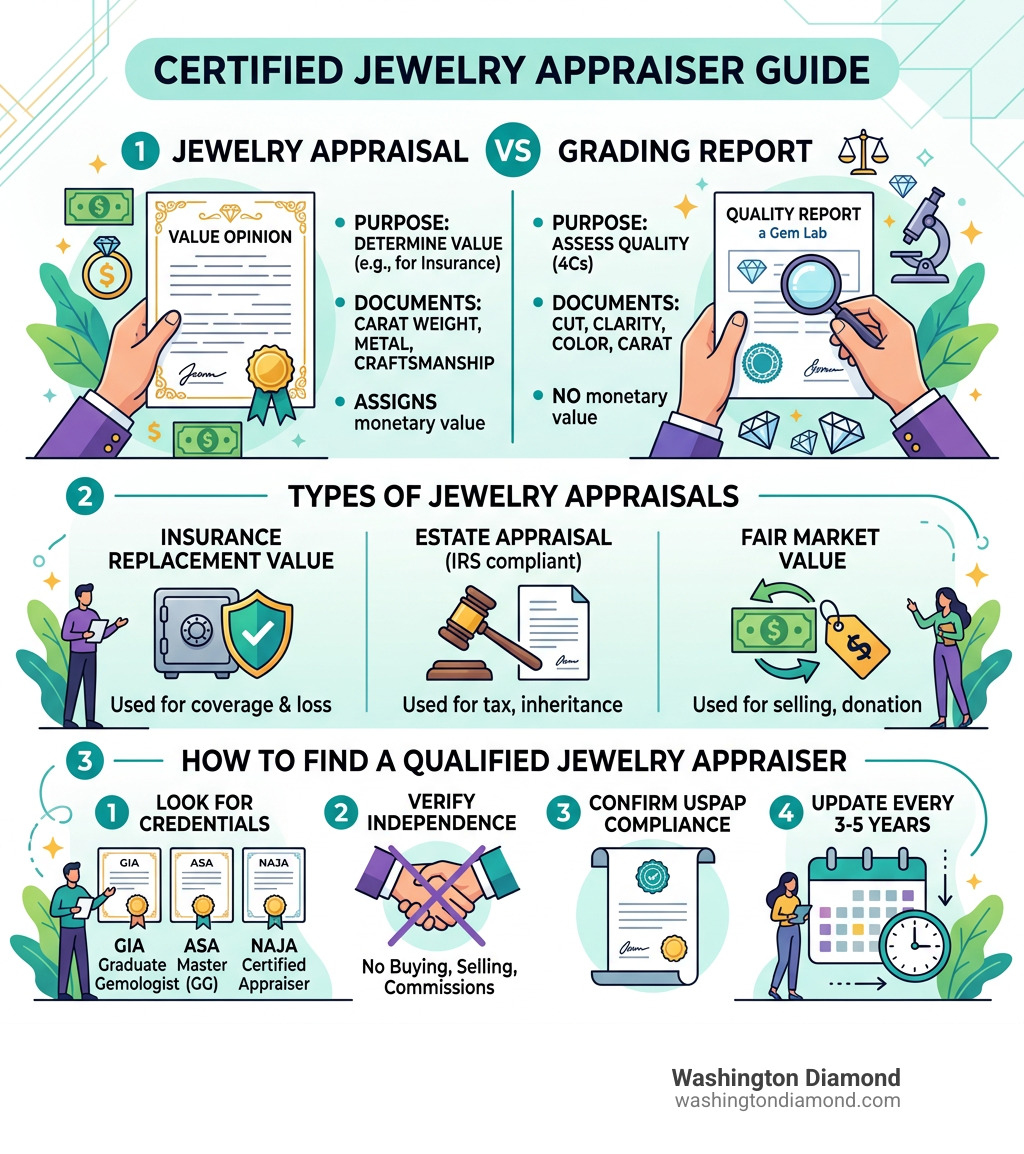
An appraiser for jewelry is a credentialed professional who examines your piece, documents its characteristics, and provides an official written opinion of its value — most often for insurance, estate planning, or resale purposes.
Quick answer — how to find a qualified jewelry appraiser:
- Look for credentials — GIA Graduate Gemologist (GG), ASA Master Gemologist Appraiser, or NAJA Certified Master Appraiser
- Verify independence — your appraiser should not buy, sell, or earn commissions on jewelry they appraise
- Confirm USPAP compliance — especially important for estate and IRS-related appraisals
- Choose the right appraisal type — insurance replacement value, fair market value, or estate appraisal depending on your need
- Update every 3-5 years — jewelry markets shift, and outdated appraisals can leave you underinsured
Most people only think about getting an appraisal after something goes wrong — a lost ring, a disputed estate, a denied insurance claim. By then, it's too late.
Getting the right appraisal, from the right professional, before you need it is one of the smartest moves you can make for any piece of jewelry that matters to you.
I'm Tom Daube, a GIA-certified diamond and jewelry specialist with decades of experience helping clients understand the true value of their pieces — including connecting them with qualified appraisers for jewelry who meet the highest professional standards.
Discover more about appraiser for jewelry:
What is a Jewelry Appraisal and Why is it Important?
At its core, a jewelry appraisal is a professional evaluation of a piece of jewelry to determine its current market value. But it is much more than just a price tag. It is a comprehensive document that serves as a legal and financial record of your asset.
We often see clients confuse an appraisal with a diamond grading report (like those from the GIA). Think of it this way: a grading report describes the "DNA" of a diamond—its 4Cs (Cut, Color, Clarity, and Carat weight)—but it does not assign a dollar value. An appraiser for jewelry takes that grading information, adds the value of the metal, the craftsmanship, and the current market trends, and then provides a formal opinion of value.
Why does this matter?
- Insurance Coverage: This is the most common reason. If your ring is lost or stolen, your insurance company needs a detailed description to replace it with an item of like kind and quality.
- Estate Planning: When settling an estate, an appraisal ensures an equitable distribution of assets among heirs.
- Casualty Loss: If your jewelry is damaged, an appraisal helps determine the financial loss for tax or insurance purposes.
- Resale or Liquidation: If you are looking to sell, you need to know the realistic "fair market value" so you don't get low-balled.
Having a professional appraisal provides peace of mind. To dive deeper into the specifics of what these documents contain, check out our guide on everything you need to know about jewelry appraisals.
Understanding the Main Types of Jewelry Valuations
Not all appraisals are created equal. In fact, if you use the wrong type of valuation for the wrong purpose, you could end up significantly overpaying for insurance or, conversely, getting hit with a massive tax bill.
Retail Replacement Value (Insurance)
This is the most common type of appraisal. It estimates the cost to replace an item with a brand-new version of comparable quality at a typical retail jewelry store. Because it reflects the "full retail" price including labor, branding, and overhead, this value is usually the highest.
Fair Market Value (FMV)
FMV is what a willing buyer would pay a willing seller in the current market, neither being under pressure to act. This is the standard used by the IRS for estate tax evaluations and charitable donations. It is typically lower than retail replacement value because it reflects the "used" or secondary market.
Liquidation Value
Used primarily in divorce settlements or bankruptcy, this reflects the "cash now" value. It is usually the lowest valuation because it assumes the item must be sold quickly, often to a wholesaler or at auction.
To help you distinguish between these, we’ve put together a quick comparison:
| Purpose | Appraisal Type | Market Level | Relative Value |
|---|---|---|---|
| Insurance | Retail Replacement | Retail Store | High |
| Estate Tax / IRS | Fair Market Value | Secondary Market | Medium |
| Charitable Donation | Fair Market Value | Secondary Market | Medium |
| Divorce / Probate | Liquidation Value | Wholesale/Auction | Low |
Whether you are valuing a vintage heirloom or a modern piece, the purpose dictates the price. For more on specific item valuations, read beyond the sparkle: everything you need to know about valuing your wedding band.
How to Find a Qualified Appraiser for Jewelry
Finding an appraiser for jewelry isn't as simple as walking into the nearest mall. In the United States, there are actually no federal laws requiring jewelry appraisers to be licensed or certified. This means anyone can print out a piece of paper and call it an appraisal.
To protect yourself, you must look for specific hallmarks of professionalism. According to the Federal Trade Commission (FTC) guidelines, it is illegal to intentionally over-value jewelry. A trustworthy appraiser will adhere to these ethical standards and provide a rigorously researched report.
We recommend starting your search with professional organizations like the National Association of Jewelry Appraisers. Members of these groups are held to a strict code of ethics and must participate in continuing education. If you want the most unbiased opinion possible, you might consider an independent jewelry appraiser who does not buy or sell jewelry, ensuring their only interest is the accuracy of the report.
Essential Credentials for an Appraiser for Jewelry
When interviewing a potential appraiser for jewelry, look for these "alphabet soup" credentials. They are the industry's way of proving expertise:
- GIA GG (Graduate Gemologist): This is the gold standard for gemological training. It ensures the appraiser can accurately identify stones and detect synthetics or treatments.
- USPAP Compliance: The Uniform Standards of Professional Appraisal Practice are the generally accepted standards for the appraisal profession in the U.S. This is mandatory for appraisals involving the IRS.
- NAJA (National Association of Jewelry Appraisers): Look for titles like "Certified Master Appraiser."
- ASA (American Society of Appraisers): This organization offers the "Master Gemologist Appraiser" (MGA) designation, which is one of the most difficult and prestigious titles to earn.
Ethical Standards and the Role of an Appraiser for Jewelry
The role of an appraiser for jewelry is to be an impartial judge. A major red flag is an appraiser who offers to buy your jewelry after appraising it. This is a clear conflict of interest. If they tell you a ring is worth $5,000 and then offer you $3,000 for it, they have a financial incentive to low-ball the valuation.
Professional appraisers:
- Do not buy or sell jewelry (if they are truly independent).
- Do not charge a fee based on a percentage of the value. This is unethical because it incentivizes them to inflate the price. Instead, they should charge a flat per-item fee or an hourly rate.
- Provide a signed, dated document with a clear statement of the appraisal's purpose.
For those in our local area, finding someone who understands the nuances of the regional market is key. Learn more about unlocking value: expert jewelry appraisal services in DC to find local expertise.
The Appraisal Process: Costs, Timelines, and Expectations
What actually happens during an appraisal? It’s not just a quick glance through a magnifying glass. A professional examination is a detailed process.
The Inspection
The appraiser will start by cleaning your jewelry—dirt can hide chips or affect the color grade of a diamond. They will then use specialized tools like a refractometer, a polariscope, and a binocular microscope to identify the gemstones and assess their quality. They will also test the metal (gold, platinum, or silver) to confirm its purity.
Documentation and Photography
A professional report will include high-resolution digital photographs and plotting diagrams for any major diamonds. This acts as a "fingerprint" for your jewelry, making it much easier to identify if it is ever recovered after a theft.
Costs and Timelines
Pricing varies based on the complexity of the piece and the appraiser's experience. According to industry data:
- Insurance Appraisals: Typically range from $150 to $175 per item. Some appraisers offer a discount for additional items (e.g., $125 for each subsequent piece).
- Estate Appraisals: These are often charged at an hourly rate, usually around $100 per hour, because they often involve sorting through large collections of jewelry to identify what is valuable and what is costume.
- Timeline: A single item appraisal can often be done while you wait in 20-30 minutes, though more complex reports may take 7-10 business days.
Before you book, make sure you're not overpaying by reading don't get ring ripped off: your guide to appraisal costs. If you're ready to move forward, here is how to get diamond appraised the right way.
Frequently Asked Questions about Jewelry Appraisals
How often should I update my jewelry appraisals?
We recommend updating your appraisals every 3 to 5 years. The jewelry market is volatile; the price of gold and the demand for certain gemstones can fluctuate wildly. If your appraisal is 10 years old, you are likely underinsured. If your $10,000 ring now costs $15,000 to replace, your old insurance policy will only pay out the $10,000 limit, leaving you $5,000 short.
Can the same jeweler who sold me the jewelry provide a reliable appraisal?
Technically, yes, many retail jewelers provide a "retail replacement" document at the time of sale. However, for insurance purposes or legal matters, a third-party, independent appraiser for jewelry is often preferred. This eliminates any perceived bias and ensures the valuation stands up in court or during a difficult insurance claim.
What should I bring to my jewelry appraisal appointment?
To get the most accurate valuation, bring any documentation you have:
- Original sales receipts.
- Previous appraisals.
- Grading reports (GIA, IGI, AGS).
- Lab certificates. This history helps the appraiser understand the provenance and specific characteristics of the stones that might not be visible once they are set in metal.
Conclusion
Choosing the right appraiser for jewelry is about more than just numbers—it's about protecting your memories and your financial future. Whether you’re insuring a new engagement ring or settling a family estate in Northern Virginia, the credentials and independence of your appraiser are your best defense against loss.
At Washington Diamond, we believe in a private, personalized experience. Our appointment-only studio in Northern Virginia offers you undivided attention, ensuring that every question you have about your jewelry is answered with expertise and care. We want your jewelry journey to be as memorable as the moments the pieces represent.
Before you make any big moves, use our tools to calculate the value of a diamond before you buy or sell to ensure you have a baseline understanding of your jewelry's worth. Ready for a professional look? We're here to help.
Have a question about your jewelry?
We've been helping clients with diamonds, custom design, repairs, appraisals, and more since 1969. Book a private appointment at our Falls Church studio.
Book an AppointmentTrusted since 1969 · Falls Church, VA · 703-536-3600
From the blog
View all


