

Unlocking Value: Expert Jewelry Appraisal Services in DC
Why Jewelry Appraisal Matters in Washington DC
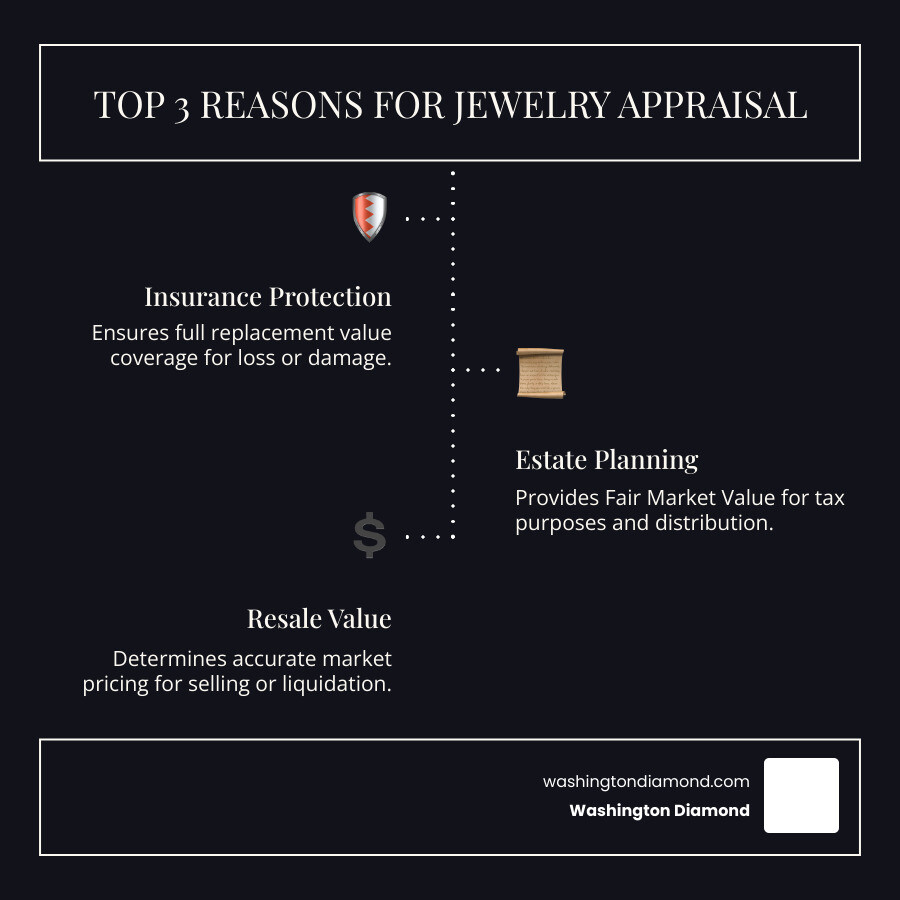
Jewelry appraisal Washington DC services provide expert documentation of your precious pieces' value for insurance, estate planning, and peace of mind. Whether you own an engagement ring, inherited heirloom, or luxury timepiece, a professional appraisal protects your investment.
A jewelry appraisal is more than just a piece of paper with a number on it. It's a detailed professional analysis that documents your jewelry's unique characteristics, quality, and current market value. This documentation becomes essential when you need to insure a new engagement ring, settle an estate, verify an online purchase, or simply understand what you own.
In the Washington DC metro area, qualified appraisers use advanced gemological equipment to examine every detail of your jewelry—from the cut and clarity of diamonds to the purity of precious metals. The resulting appraisal report serves as your proof of value for insurance claims, provides accurate information for estate planning, and gives you confidence in your jewelry investments.
The stakes are real. An undervalued appraisal means your insurance won't cover full replacement costs if something happens. An overvalued one means you're paying unnecessarily high premiums. That's why choosing an experienced, independent appraiser with proper credentials matters so much.
For residents of Washington DC, Northern Virginia, and Maryland, accessing expert appraisal services means working with Graduate Gemologists and certified appraisers who understand both the technical aspects of jewelry evaluation and the specific documentation requirements of insurance companies and legal institutions.
Understanding the Different Types of Jewelry Appraisals
Not all appraisals serve the same purpose, and understanding the difference can save you time, money, and potential headaches down the road. Think of it this way: you wouldn't use a hammer when you need a screwdriver. The same goes for jewelry appraisals—the type you need depends entirely on what you're trying to accomplish.
A proper appraisal report is more than just a dollar figure scribbled on letterhead. It's a detailed document that captures every meaningful characteristic of your jewelry—the quality of the gemstones, the weight and purity of the metals, the craftsmanship of the setting, and any unique features that make your piece special. This documentation becomes your jewelry's "fingerprint," providing a clear record of exactly what you own.
Appraisals for Insurance Replacement
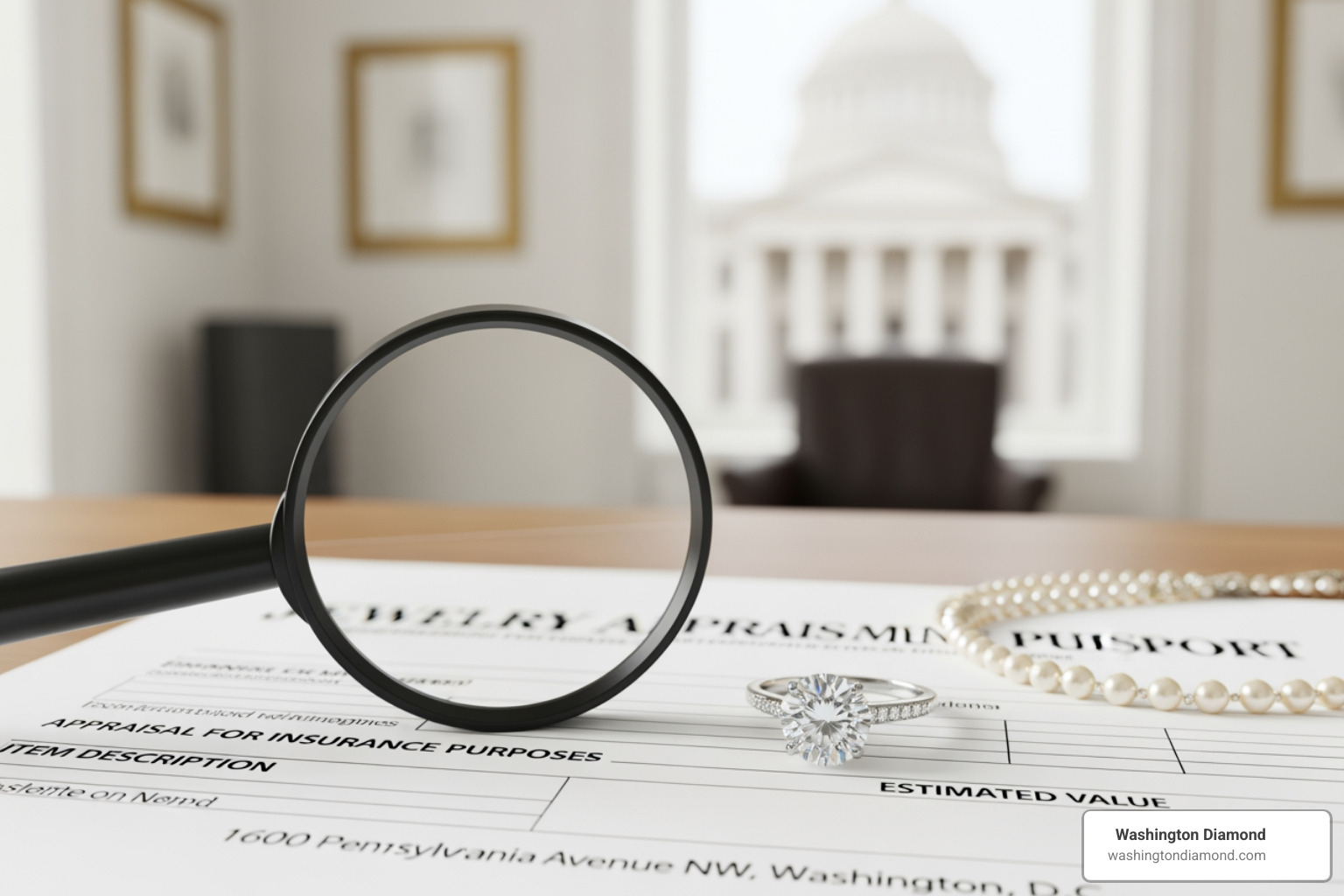
When most people think about getting a jewelry appraisal Washington DC, they're thinking about insurance. And for good reason—it's the most common reason our clients visit us.
Your insurance company needs to know what it would cost to replace your jewelry if something terrible happens. This is called the replacement value, and it represents what you'd pay today to purchase a piece of "like, kind, and quality" from a retail jeweler.
Here's where the details really matter. Your insurance appraisal needs to include precise descriptions of everything—the type and weight of the metal, the exact specifications of each diamond or gemstone (including cut, color, clarity, and carat weight), the style of the setting, and even photographs. These details aren't just paperwork; they're your protection.
Imagine filing a claim without a detailed appraisal. How would you prove what your ring looked like? What quality diamonds it contained? An insurance appraisal gives you that proof of ownership and creates a clear blueprint for replacement. Without it, you're essentially hoping your insurance company will take your word for it—and that rarely ends well.
The value matters too. If your appraisal underestimates your jewelry's worth, you won't receive enough to replace it. If it's inflated, you're paying higher premiums than necessary. A qualified appraiser ensures you're adequately covered without overpaying. For a deeper understanding of how diamond value is determined, check out our guide on how to calculate the value of a diamond.
Appraisals for Estate, Resale, and Legal Needs
Insurance isn't the only reason you might need an appraisal. Life brings many situations where knowing the true value of your jewelry becomes essential.
Estate planning requires a different type of valuation altogether. Instead of replacement value, estate appraisals use Fair Market Value—essentially what a willing buyer would pay a willing seller in an open market, with both parties having reasonable knowledge and neither being forced to complete the transaction. The IRS has specific requirements for estate appraisals, which is why working with a qualified appraiser who understands these regulations is so important for tax purposes.
If you're thinking about selling a piece of jewelry, a Fair Market Value appraisal helps you set a realistic asking price. You deserve to know what your jewelry is actually worth in today's market, not what you hope it might be worth.
Divorce settlements often require neutral, professional valuations to ensure fair distribution of assets. Nobody wants to argue about jewelry values during an already difficult time, which is why an independent appraisal can provide clarity and fairness for both parties.
For charitable donations of significant jewelry pieces, an appraisal determines the value you can claim as a tax deduction. The IRS requires proper documentation, and a qualified appraisal provides exactly that.
Then there's liquidation value, which represents what you'd receive in a quick, forced sale—think selling to a dealer or through an auction. This value is typically much lower than Fair Market Value because you're selling under time pressure rather than waiting for the right buyer.
Each scenario demands its own approach to valuation, and understanding which type you need is the first step toward getting an appraisal that actually serves your purpose.
Appraisal vs. Diamond Certificate: What's the Difference?
We get this question all the time, and it's completely understandable why people confuse the two. Both documents are important, but they tell you very different things about your jewelry.
A diamond grading certificate (sometimes called a grading report) comes from independent gemological laboratories like GIA. It's essentially a detailed report card for a loose diamond, documenting the 4Cs—cut, color, clarity, and carat weight. Think of it as a quality report that describes exactly what the diamond is, down to its most minute characteristics. But here's the key: a certificate does not tell you what the diamond is worth in dollars. It's purely about quality and characteristics.
A jewelry appraisal, on the other hand, assigns an actual monetary value to your piece. The appraiser considers the diamond's quality (often referencing an existing certificate if you have one), but also evaluates the metal type and weight, the craftsmanship of the setting, any additional gemstones, the current market conditions, and the overall design. It's a comprehensive look at the finished piece of jewelry, not just the stones.
Here's an easy way to remember the difference: a certificate tells you what your diamond is, while an appraisal tells you what it's worth. Both documents serve important purposes in protecting your investment. If you're interested in learning more about diamonds themselves, our article on loose diamonds offers valuable insights into what makes each stone unique.
How to Choose an Expert for Jewelry Appraisal in Washington DC
Finding the right person to appraise your jewelry isn't something to take lightly. When you're searching for a jewelry appraisal Washington DC expert, you're looking for someone who will treat your treasured pieces with the care they deserve while providing an accurate, trustworthy valuation. Whether you're in the DC Metro area, Northern Virginia, or Maryland, the right appraiser combines technical expertise with genuine integrity.
The truth is, not all appraisers are created equal. Your grandmother's engagement ring or that luxury watch you've been collecting for years deserves more than a quick glance and a ballpark number. You need someone who truly knows what they're doing.
Key Qualifications for a DC Jewelry Appraiser
When you're vetting potential appraisers, their credentials tell you a lot about what to expect. Think of these qualifications as your safety net—they're proof that the person examining your jewelry has invested serious time and effort into mastering their craft.
A Graduate Gemologist (GG) designation from the Gemological Institute of America is foundational. This isn't a weekend course—it's comprehensive training in identifying, grading, and evaluating gemstones. A GG knows how to look at a diamond or colored gemstone and tell you exactly what you're dealing with.
But gemology alone isn't enough for appraisals. Professional appraisal credentials from organizations like the National Association of Jewelry Appraisers (NAJA) or the American Society of Appraisers (ASA) show that an appraiser understands valuation methodology, not just gemstone identification. These credentials mean they follow the Uniform Standards of Professional Appraisal Practice (USPAP), which keeps appraisals consistent and defensible.
An experienced appraiser also stays current with market changes and new gemological findies. The jewelry world evolves constantly, and your appraiser should evolve with it. For more guidance on selecting qualified appraisers, the Jewelers of America Organization offers helpful resources.
Factors to Consider When Selecting Your Appraiser
Beyond the letters after someone's name, there are practical considerations that matter just as much for your experience and peace of mind.
Client reviews and reputation speak volumes. What are other people saying about their experience? A strong reputation in the Washington DC and Northern Virginia communities isn't built overnight—it comes from years of honest, quality work. Don't hesitate to ask around or check online reviews.
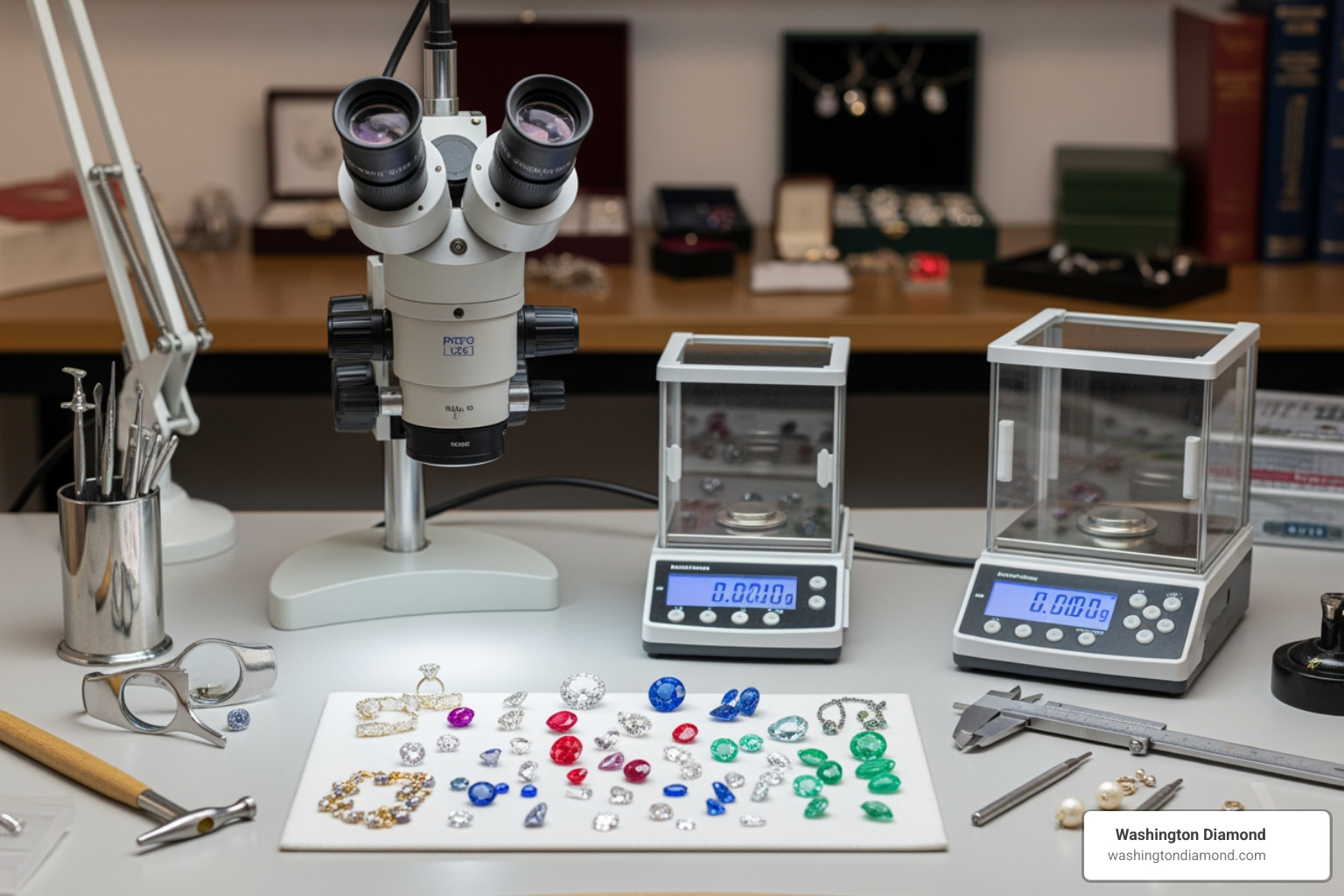
Modern gemological technology makes a real difference in accuracy. Today's appraisers should be using advanced microscopes, precision scales, calipers, and sometimes even spectroscopy equipment. These tools allow for exact measurements and can detect treatments or improvements that significantly affect value. If an appraiser is working with outdated equipment, that's a red flag.
Here's something crucial: independence and ethics. An independent appraiser doesn't buy or sell jewelry themselves. This matters because it eliminates any conflict of interest. When someone offers to buy your jewelry right after appraising it, their valuation becomes suspect. Were they being objective, or were they lowballing you to make a profit? A truly independent appraiser focuses solely on giving you an unbiased opinion. They shouldn't accept referral commissions either—another way conflicts of interest can creep in.
We'll be direct about one more thing: if an appraisal seems suspiciously cheap, there's probably a reason. Quality appraisals require time, expertise, and expensive equipment. Investing in a qualified appraiser means investing in accuracy and reliability—and that's worth every penny when you're protecting valuable assets.
Specialties Offered by Washington Diamond Appraisers
Different types of jewelry require different expertise. At Washington Diamond, our expert appraisers bring specialized knowledge to handle whatever precious items you need evaluated.
Vintage and antique jewelry demands a particular eye. These pieces often carry historical significance and unique craftsmanship that modern jewelry doesn't replicate. Understanding period details, construction methods, and the market for specific eras is essential for accurate valuation.
Luxury watches are their own specialized field. Appraising a fine timepiece involves understanding complex mechanical movements, brand heritage, materials, and authenticity markers. It's a different skill set from traditional jewelry appraisal, and it requires specific training.
Designer pieces carry premiums based on the creator's reputation and market demand. Our appraisers recognize the hallmarks and characteristics of renowned jewelry designers, understanding how their signature styles influence value.
Gemstone identification extends far beyond diamonds. Our gemologists are trained to evaluate the full spectrum of colored gemstones—rubies, emeralds, sapphires, and more exotic stones. We can identify treatments, determine origin when possible, and assess quality factors specific to each gemstone type.
Our private, appointment-only studio in Northern Virginia ensures your pieces receive undivided attention. We're not juggling multiple clients or rushing through evaluations. Your jewelry gets the focused examination it deserves, resulting in comprehensive, accurate appraisals custom to your specific needs.
The Appraisal Process: What to Expect from Start to Finish
Getting a jewelry appraisal Washington DC shouldn't feel mysterious or intimidating. We've designed our process to be transparent and reassuring from beginning to end. Your jewelry matters to you—whether it's a family heirloom or a recent purchase—and we treat it with the respect and care it deserves.
Your Jewelry Appraisal Appointment in Washington DC
The heart of any good appraisal is the in-person examination. This is where expertise meets your treasured pieces, and where we gather the detailed information that makes your appraisal truly valuable.
We work by appointment only at our private Northern Virginia studio. This isn't just about convenience—it means you get our complete, undivided attention. No crowded counters, no distractions, just focused expertise dedicated to understanding and documenting your jewelry.
What should you bring to your appointment? Any paperwork you have is helpful. Previous appraisal reports, diamond certificates from labs like GIA, original receipts, or even family stories about the piece can all contribute to a more complete understanding. Don't worry if you don't have documentation—we can work with the jewelry itself—but these materials give us helpful context and can sometimes speed up the process.
During the examination, we use professional gemological tools to measure and analyze every aspect of your jewelry. Our microscopes reveal details invisible to the naked eye. Precision scales weigh components down to tiny fractions. Calipers measure dimensions with exacting accuracy. We're looking at everything: the cut, color, clarity, and carat weight of diamonds and gemstones; the type and purity of metals; the quality of craftsmanship; any hallmarks or signatures that identify the maker.
We also photograph each piece with high-quality equipment. These images become part of your permanent record and can be crucial if you ever need to file an insurance claim or prove ownership.
Here's something many clients appreciate: you're welcome to stay and watch the entire process. Some people find it fascinating to see their jewelry under magnification or to learn what makes their piece special. Others prefer to return later for their completed report. Either way is fine with us. Your jewelry remains secure and fully insured while in our care.
Understanding Your Official Appraisal Report
Your finished appraisal report is a comprehensive document that tells the complete story of your jewelry. Think of it as a detailed biography combined with a professional valuation.
The report starts with a thorough description of the item itself—not just "gold ring with diamond," but specifics about the setting style, design elements, and any distinctive features that make your piece unique. For gemstones, we document everything: the type of stone, its shape and cut, color grade, clarity characteristics, exact carat weight, and any treatments or improvements. If you have diamonds, you'll see a complete breakdown of the 4Cs.
We identify the metal type and weight, noting whether it's 14K gold, 18K gold, platinum, or another precious metal, along with approximate weight. The high-quality photographs we took during your appointment are included, providing visual documentation that complements the written description.
The stated value is clearly presented, with specific notation about what type of valuation it represents—Insurance Replacement Value, Fair Market Value, or another appropriate standard. This clarity matters because different situations call for different types of value.
Every report includes the appraiser's signature and professional qualifications—typically Graduate Gemologist credentials and professional appraisal certifications. This isn't just formality; it's what gives your appraisal authority with insurance companies, attorneys, and other institutions. The date of appraisal is also noted, which becomes important as time passes and market conditions change.
This report becomes your official record. Keep it somewhere safe—you'll need it for insurance, and it may prove invaluable for estate planning or other purposes down the road.
Appraisal Costs, Timelines, and Updates
Let's talk about the practical details that help you plan.
Most jewelry appraisal Washington DC services cost between $150 and $300 per item. The exact fee depends on several factors: how complex the piece is, how many items you're having appraised, and the appraiser's level of expertise. Some appraisers charge hourly rates, while others charge per piece. Both approaches can be fair, as long as the fee isn't based on a percentage of your jewelry's value—that creates an obvious conflict of interest.
Turnaround time varies with complexity. A straightforward diamond engagement ring might be completed relatively quickly, while an antique brooch with multiple gemstones requiring research into historical context could take longer. We'll always give you a realistic timeline upfront so you know what to expect.
Here's an important question: how often should you update your appraisal? We recommend every 3 to 5 years as a general rule. Why? Because the market doesn't stand still. Precious metal prices fluctuate with global economic conditions. Gemstone values shift with supply, demand, and changing preferences. Even fashion trends can influence replacement costs.
An appraisal from ten years ago might significantly undervalue your jewelry today—meaning your insurance coverage could fall short if you ever need to replace a lost or stolen item. Or it might overvalue it, meaning you're paying higher premiums than necessary. Regular updates keep your coverage aligned with current reality, protecting both your investment and your peace of mind.
Think of periodic re-appraisals as maintenance for your financial protection, similar to updating your home insurance as property values change. It's a small investment that ensures your valuable pieces remain properly protected as time and markets move forward.
Frequently Asked Questions about Jewelry Appraisals
We know you have questions, and we're here to provide clear, straightforward answers. Understanding the nuances of jewelry appraisal is key to making informed decisions about your precious possessions.
Can I get an accurate jewelry appraisal online?
While the convenience of online services is tempting, an accurate jewelry appraisal Washington DC requires an in-person examination by an expert. Online appraisals or estimates, while they can provide a rough idea, simply cannot account for the intricate details that influence true value. Our appraisers use a jeweler's loupe, microscopes, and other specialized tools to thoroughly inspect every facet of your jewelry—from the internal characteristics of gemstones to the subtle hallmarks and overall condition of the setting. Without this physical inspection, it's impossible to note critical details that affect value, and such online valuations are generally not accepted by insurance companies for comprehensive coverage. For an accurate valuation, prioritize an in-person examination by a skilled professional.
What's the difference between Fair Market Value and Replacement Value?
These are two of the most common types of values you'll encounter in an appraisal, and they serve different purposes:
- Replacement Value (Insurance Appraisal): This is the cost to replace an item with a new one of "like, kind, and quality" in the current retail market. It's the value insurance companies use to determine your coverage and potential payout if your item is lost, stolen, or damaged. This value is typically higher as it reflects current retail prices, including manufacturing and retail markups.
- Fair Market Value (Estate/Resale Appraisal): This value represents the price that a piece of jewelry would sell for between a willing buyer and a willing seller, both having reasonable knowledge of the facts, and neither being under any compulsion to buy or sell. It's often used for estate planning, divorces, or when selling a pre-owned item. This value is generally lower than replacement value because it reflects the secondary market.
- Liquidation Value: This is the lowest of the values, reflecting the price an item would fetch if sold quickly, often in a distressed sale situation. It's not typically used for insurance or estate planning but might be relevant in specific, urgent resale scenarios.
The purpose of your appraisal dictates which type of value is appropriate for your report.
How often should I get my jewelry re-appraised?
We advise our clients to have their jewelry re-appraised every 3 to 5 years. There are several compelling reasons for this recommendation:
- Precious Metal Market Changes: The prices of gold, platinum, and other precious metals fluctuate daily based on global economic factors.
- Gemstone Value Fluctuations: The value of diamonds and colored gemstones can also change due to market demand, new findies, or shifts in grading standards.
- Ensuring Adequate Insurance Coverage: An outdated appraisal could mean you're underinsured. If your jewelry has appreciated in value, your insurance payout might not cover the full cost of replacing it. Conversely, if values have decreased, you could be overpaying on premiums. Regular updates ensure your coverage is always accurate and appropriate.
Staying current with your appraisals is a smart way to protect your investment and maintain your peace of mind.
Protect Your Precious Investments with a Professional Appraisal
We've walked through the ins and outs of jewelry appraisals together—from understanding different types of valuations to choosing the right expert and knowing what to expect during the process. Now, let's bring it all home.
A professional jewelry appraisal Washington DC is truly vital for protecting everything you hold dear. Whether it's your grandmother's vintage brooch, the engagement ring that started your life together, or that luxury watch you finally treated yourself to, these pieces deserve proper documentation and protection. An accurate appraisal ensures you're covered if the unexpected happens, gives you clarity when planning your estate, and provides confidence when you need to understand your jewelry's true worth.
Here's what matters most: choosing a qualified DC appraiser is key. Look for independent experts with credentials like Graduate Gemologist designations and professional appraisal certifications. They should use modern gemological equipment, operate without conflicts of interest, and have a solid reputation in the Washington DC, Northern Virginia, and Maryland communities. When your appraiser is both skilled and unbiased, you can trust the valuation completely.
The appraisal process itself provides profound peace of mind. Knowing your treasures are properly documented, accurately valued, and adequately insured lets you enjoy wearing and displaying them without worry. You'll have a comprehensive report that serves as proof of value, detailed descriptions for insurance claims, and documentation for any future needs—whether that's updating coverage, planning your estate, or understanding what you own.
For a comprehensive and personalized jewelry experience, from acquisition to care, a private consultation ensures your treasures are properly valued and maintained. At Washington Diamond, our appointment-only studio in Northern Virginia means you receive our undivided attention. We're here to guide you through every step of protecting your investments, answering your questions, and ensuring your jewelry's true worth is recognized and preserved for generations to come.
And remember, caring for your jewelry doesn't stop at appraisal. Should your valued pieces ever need expert attention—whether it's a repair, restoration, or routine maintenance—we also offer comprehensive Expert Jewelry Repair & Restoration Services in Northern Virginia to keep your cherished items looking their absolute best.
Your jewelry tells your story. Let's make sure it's properly protected.
Have a question about your jewelry?
We've been helping clients with diamonds, custom design, repairs, appraisals, and more since 1969. Book a private appointment at our Falls Church studio.
Book an AppointmentTrusted since 1969 · Falls Church, VA · 703-536-3600
From the blog
View all


