

Don't Get Ring-Ripped Off: Your Guide to Appraisal Costs
Why Wedding Ring Appraisal Cost Matters for Your Investment
Wedding ring appraisal cost typically ranges from $50 to $200 for most rings, though complex pieces with numerous gemstones can cost more. Here's what you need to know:
| Appraisal Type | Typical Cost Range | Best For |
|---|---|---|
| Basic Appraisal | $50 - $150 | Simple bands, single-stone rings |
| Standard Appraisal | $100 - $200 | Most engagement rings, wedding sets |
| Complex Appraisal | $200 - $400+ | Antique pieces, multi-stone designs |
| Per-Item Fee | $95 - $125 per piece | Individual rings |
| Hourly Rate | $150 - $195/hour | Multiple pieces, estate collections |
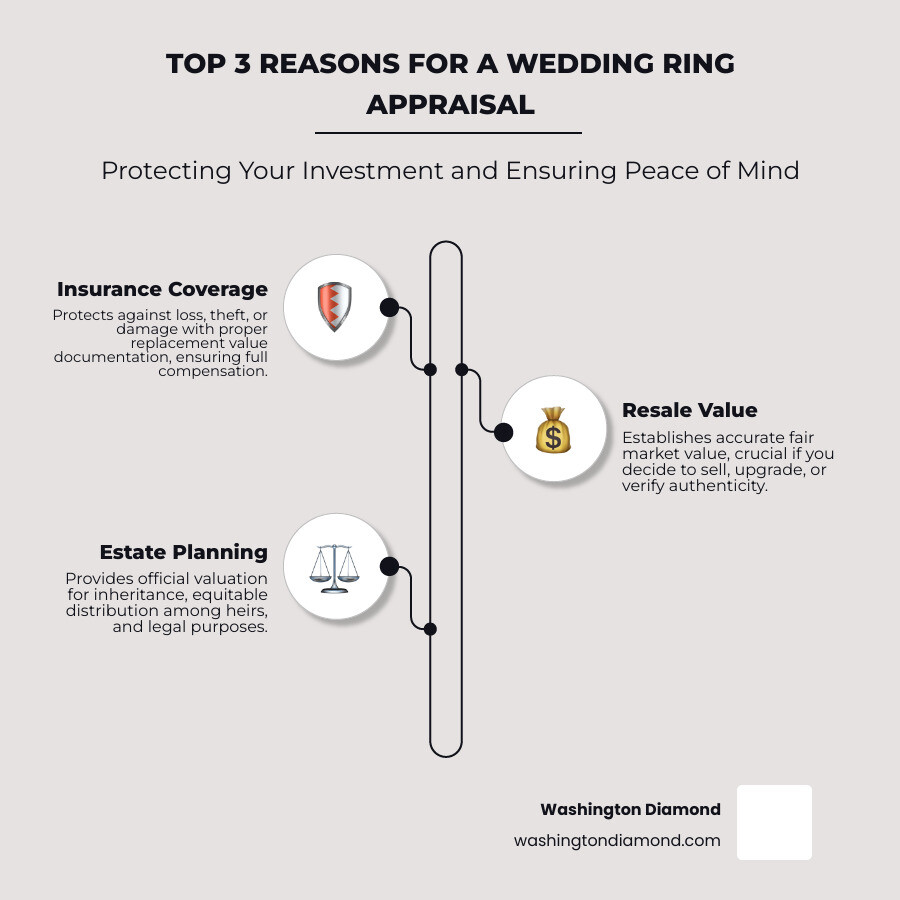
Your wedding ring represents more than a significant financial investment. It's a symbol of your commitment and love. But without proper documentation of its value, you're vulnerable to devastating loss if theft, damage, or loss occurs.
Insurance companies require a professional appraisal to provide coverage for your ring. Homeowners or renters insurance typically covers jewelry only up to $1,500, which may not come close to your ring's actual value. A proper appraisal ensures you can replace your ring with something of equal quality and characteristics if the worst happens.
Beyond insurance, an appraisal protects you in other critical situations. If you're purchasing a vintage ring, an appraisal verifies authenticity and quality. For estate planning, it establishes fair market value. And if you ever decide to sell or upgrade, you'll know exactly what you own.
The average engagement ring costs around $6,000 today. For that kind of investment, spending $100 to $200 for professional documentation isn't just smart—it's essential.
Understanding the Appraisal: More Than Just a Price Tag
Your wedding ring isn't just jewelry—it's a promise, a memory, and a significant investment. To insurance companies, estate planners, and potential buyers, it's a valuable asset that needs proper documentation. A professional appraisal provides this, and it's so much more than a number on a page.
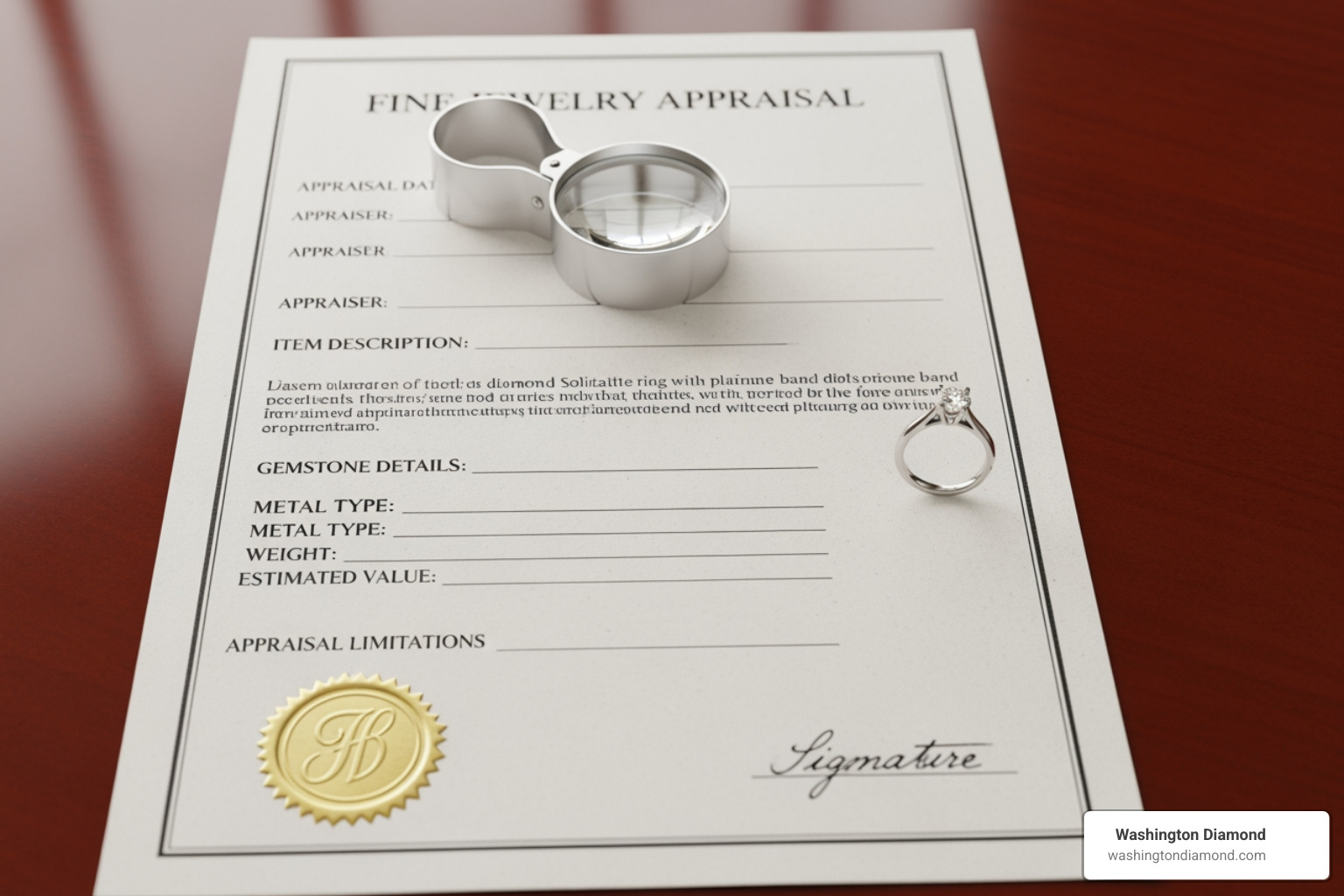
Think of an appraisal as your ring's official biography. It documents every detail that makes your piece unique, from the quality of the gemstones to the type of metal and the intricacy of the craftsmanship. This detailed record serves as proof of what you own and what it's worth.
Jewelry insurance is the most common reason people get appraisals. If your ring is ever lost, stolen, or damaged, you'll need this documentation to file a claim and receive its full replacement value. The appraisal gives your insurance company the specific details they need to provide adequate coverage.
But insurance isn't the only reason. For resale value, an appraisal establishes a fair market price. For estate planning, it prevents disputes by clearly documenting value. And for vintage or heirloom pieces, an appraisal verifies authenticity and uncovers details about its history.
The bottom line? While the wedding ring appraisal cost is relatively modest, the protection and peace of mind it provides is invaluable.
Curious about the components that make up fine jewelry? Learn More info about Loose Diamonds.
What is a Wedding Ring Appraisal?
A wedding ring appraisal is a professional evaluation conducted by a certified gemologist or qualified appraiser. The result is a detailed report that describes your ring's characteristics and assigns a monetary value—typically the replacement value if you needed to purchase a similar item today.
During the appraisal, the expert examines every aspect of your ring. They'll assess the gemstone quality using magnification and specialized equipment, noting characteristics like clarity, color, and cut. They'll identify the metal type—whether it's platinum, 18K yellow gold, or 14K white gold—and verify its purity and weight. The craftsmanship matters too: how well the stones are set, the quality of the prongs, the overall design, and any unique features that add value.
The appraiser documents all of this information in a comprehensive report, complete with measurements, weights, and often photographs. This report establishes the replacement value—what it would cost to recreate your ring with materials and workmanship of equal quality in today's market. This figure is what insurance companies use to determine your coverage amount.
Appraisal vs. Diamond Grading Report
Here's where things can get confusing. Many people think a diamond grading report is the same as an appraisal. They're not—and understanding the difference matters for protecting your investment.
A ring appraisal assigns a dollar value to your complete ring. It looks at everything: the center stone, any accent diamonds or gemstones, the metal, the setting, and the overall craftsmanship. The appraiser considers all these components together and determines what it would cost to replace the entire piece.
A diamond grading report is something entirely different. Issued by gemological laboratories like GIA (Gemological Institute of America), these reports focus solely on the center diamond's characteristics. They document the 4Cs—Carat weight, Color, Clarity, and Cut—with scientific precision. But here's the key: a GIA report doesn't assign any monetary value. It simply describes what the diamond is, not what it's worth.
Think of it this way: the grading report is like a car's specifications sheet (engine size, features, mileage), while the appraisal is like getting that car professionally valued for insurance purposes. Both documents are useful, but they serve different purposes.
The appraisal evaluates the entire ring, while the grading report focuses on just the center stone. For insurance purposes, you need the appraisal. The grading report is helpful supporting documentation, especially for high-value diamonds, but it won't tell your insurance company what to pay if your ring is lost.
When choosing someone to appraise your ring, credentials matter. You can Find a certified appraiser through The American Gem Society to ensure you're working with a qualified professional.
Decoding the Wedding Ring Appraisal Cost
Let's talk numbers. What should you expect to pay for a professional appraisal? While there's no single answer, the wedding ring appraisal cost typically falls between $50 and $200 for most rings. The final price depends on several factors, and for an elaborate piece—like a vintage heirloom with dozens of gemstones—costs can climb to $400 or more.
Most appraisers use one of two pricing models. The flat fee model is common for individual pieces, costing around $95 to $125 for a single ring or $185 to $200 for a matching set. This approach is straightforward, so you know the cost upfront.
The hourly rate model typically ranges from $150 to $195 per hour. This structure is better for multiple pieces, large estate collections, or items needing extensive research, and can be more cost-effective in those cases.
Here's a crucial red flag: avoid any appraiser who charges based on a percentage of your ring's value. This practice is unethical because it creates a financial incentive to inflate the value, which could stick you with unnecessarily high insurance premiums. A professional appraiser charges for their time and expertise, not a cut of the valuation. Always ask about the fee structure upfront.
Key Factors That Influence Your Wedding Ring Appraisal Cost
Several elements come into play when determining how much you'll pay for an appraisal. Understanding these can help you anticipate costs and avoid surprises.
Ring complexity is the biggest factor. A simple solitaire diamond ring or a plain gold band requires far less time to evaluate than an ornate vintage piece with multiple gemstone types, intricate metalwork, or detailed engravings. The more components your ring has, the more time the appraiser needs to carefully examine and document everything. A ring with 50 small diamonds naturally takes longer to assess than one with a single center stone.
The number of gemstones directly impacts the appraisal time and cost. Each stone must be individually identified, measured, and graded. Some appraisers adjust their fees based on stone count—a ring with fewer than 20 gems might fall into one price tier, while a piece with 50 to 99 gems jumps to another, and rings with 100 or more gems cost even more to appraise.
Your appraiser's credentials and experience also affect pricing. Highly qualified professionals with advanced certifications—like a GIA Graduate Gemologist or accredited members of the American Society of Appraisers—typically charge more for their services. But you're paying for specialized knowledge and years of training that ensure an accurate, defensible appraisal. This expertise is worth the investment when you're documenting something as valuable as your wedding ring.
Geographic location plays a role too. Appraisal costs vary by region based on local market rates for professional services. What you'd pay in one area might differ from another, so it's worth researching reputable appraisers in your specific location to understand typical pricing.
Finally, the appraisal's purpose can influence the cost. An insurance replacement value appraisal—which determines what it would cost to replace your ring with something new of comparable quality—often requires the most detailed documentation. Other types, like fair market value appraisals for estate purposes or liquidation appraisals, might have different requirements. Some appraisers even offer simpler verbal valuations at lower rates if you just need a quick estimate without a formal written report.
If you're curious about how diamond characteristics affect overall value, Decoding the Dollar: Your Guide to 2-Carat Diamond Pricing offers deeper insights.
Can You Get a "Free" Appraisal?
The word "free" is always appealing, especially when it comes to services that typically cost money. But when it comes to ring appraisals, "free" usually comes with some important caveats.
The most common scenario for a complimentary appraisal is when you purchase a new ring from a reputable jeweler. Many jewelers—ourselves included—provide a complimentary appraisal with your purchase. This helps you secure insurance coverage right away and gives you peace of mind about your investment. These appraisals are legitimate, performed by certified professionals, and perfectly suitable for insurance purposes.
Some jewelry insurance companies also offer to cover the cost of an appraisal when you purchase a policy through them. These are typically valid appraisals conducted by qualified professionals in their network.
However, be cautious about "free appraisal" offers that seem designed primarily to get you through the door. Some jewelers use free appraisals as a sales tactic, hoping to convince you that your current ring is worth less than you think so you'll upgrade or purchase something new. If you're getting a free appraisal from someone who also wants to sell you jewelry, make sure the appraiser is truly independent in their assessment.
You've probably also seen online AI tools and apps that promise instant, free valuations. Just upload a photo of your ring, and within seconds, you get a value estimate. These can be fun to try and might give you a rough ballpark figure, but they're essentially educated guesses based on algorithms and photo analysis. They're not suitable for official use—insurance companies, legal proceedings, and estate matters all require a detailed, in-person examination by a certified appraiser. Think of online tools as a preliminary estimate at best, not a replacement for professional documentation.
For anything that truly matters—insurance coverage, estate planning, or legal purposes—invest in a proper appraisal from a qualified professional. The modest cost is well worth the protection and accuracy you'll receive.
The Appraisal Process: From Finding an Expert to Final Report
Understanding why you need an appraisal and what it costs is the first step. The next is the process itself, which is a straightforward journey to get a reliable valuation of your most meaningful jewelry.
When you bring your ring to a professional appraiser, they'll conduct a thorough examination using specialized tools like a jeweler's loupe, microscope, and precision scales. They will measure every dimension, check for damage, verify the metal, and assess the quality of any gemstones. This hands-on inspection is what makes a professional appraisal so valuable and cannot be replicated by online tools.
The timeline varies with your ring's complexity. A simple solitaire might be appraised while you wait, sometimes in under an hour. However, an intricate vintage piece might need to be left with the appraiser for a few days to allow for proper research. This extra time ensures accuracy, which is what ultimately protects your investment.
How to Find and Choose a Qualified Appraiser
Choosing the right appraiser is one of the most important decisions you'll make in protecting your ring. Not every jeweler is a qualified appraiser, and not every appraiser has the same level of expertise or credentials.
Your best bet is to seek out independent appraisers who don't buy or sell jewelry, or reputable jewelers who employ certified gemologists on staff. Independent appraisers often provide an extra layer of objectivity since they have no financial interest in your ring beyond providing an accurate valuation. At Washington Diamond, we understand how important this expertise is, which is why we work with certified professionals who prioritize accuracy above all else.
When you're vetting potential appraisers in Northern Virginia, credentials matter. The most respected certifications include GIA Graduate Gemologist (GG), which represents extensive training from the Gemological Institute of America in diamond and colored stone grading. The Accredited Senior Appraiser (ASA) designation from the American Society of Appraisers indicates high-level expertise in personal property valuation, including jewelry. And the Certified Gemologist Appraiser (CGA) from the American Gem Society demonstrates a rigorous commitment to both ethics and gemological knowledge.
Don't be shy about asking questions before you hand over your precious ring. A qualified appraiser will welcome your curiosity. Ask about their jewelry appraisal education and training. Find out what certifications they hold and how long they've been providing appraisals. It's perfectly reasonable to ask how many appraisals they complete annually, which gives you a sense of their experience level.
Most importantly, confirm their fee structure upfront and make absolutely sure it's not based on a percentage of your ring's value. That's a red flag that suggests a conflict of interest. You should also ask what will be included in your final appraisal document so there are no surprises.
For additional guidance on finding qualified professionals, you can Learn about the National Association of Jewelry Appraisers.
What's Included in the Final Appraisal Document?
When your appraisal is complete, you'll receive a comprehensive document that serves as your ring's official biography. This isn't just a receipt with a number on it. A professional appraisal report is typically several pages long and detailed enough to satisfy any insurance company, legal requirement, or future buyer.
Your report will start with a detailed description of the item itself. This includes the type of jewelry and a thorough physical description of the mounting, covering everything from the style and design to any identifying marks or personal engravings that make your ring unique.
You'll find precise measurements and weight listed, including the band width, setting height, and the exact weight of the precious metal measured in grams or pennyweights. For your gemstones, the appraiser will provide complete grading information. If you have a diamond, this means a detailed breakdown of the famous 4Cs: Carat weight, Color grade, Clarity grade, and Cut grade. For other gemstones like sapphires or emeralds, you'll see the species, variety, shape, cutting style, dimensions, weight, color description, clarity assessment, and any treatments that have been applied.
The report will confirm your metal content, verifying whether you have platinum, 18K gold, 14K white gold, or another precious metal, along with its purity. There will be information about the manufacturing method, noting whether your ring was cast or hand-fabricated, which can affect both value and durability.
One of the most important elements is the photograph. Your appraisal should include clear, high-resolution images of your specific ring, often from multiple angles. This visual record helps identify your exact piece if you ever need to file a claim.
The report will clearly state the monetary value assigned to your ring, specifying what type of value it represents. Most commonly, this will be "Retail Replacement Value for Insurance Purposes," which is what it would cost to replace your ring with something of equal quality and characteristics at current market prices.
Finally, you'll see your appraiser's signature and credentials, along with the date of the appraisal. This signature certifies that a qualified professional has examined your ring and stands behind the valuation.
This level of detail is what protects you. If your ring is ever lost, stolen, or damaged, your insurance company has all the information they need to replace it with something truly comparable. You won't be left arguing about quality or settling for less than what you lost.
To better understand the craftsmanship that goes into creating these detailed pieces, you can See how an engagement ring is made.
Frequently Asked Questions about Ring Appraisals
Getting your wedding ring appraised can feel like unfamiliar territory, and we know you probably have questions. Over the years, we've helped countless couples in Northern Virginia understand the ins and outs of ring appraisals. Here are the most common questions we hear, along with honest, straightforward answers to help you feel confident about the process.
How often should I get my wedding ring appraisal updated?
Here's the thing about ring values: they're not set in stone. We generally recommend updating your wedding ring appraisal every three to five years, even though your ring's actual quality hasn't changed one bit.
Why? Because the market is constantly shifting. Metal prices for gold and platinum can swing dramatically based on global economic conditions. Gemstone values, particularly for diamonds, fluctuate with supply and demand. A ring that was appraised at $5,000 seven years ago might cost $7,000 to replace today with an identical piece.
Inflation quietly erodes the purchasing power of older appraisals too. If something happens to your ring and your insurance policy is based on that outdated $5,000 appraisal, you'd only receive $5,000—leaving you responsible for the $2,000 gap. That's a painful surprise no one wants.
Many insurance companies actually require updated appraisals periodically to maintain accurate coverage. It's their way of ensuring the policy limits reflect current market realities. Think of it as a small investment that protects your much larger one. Regular updates give you peace of mind that you're truly covered.
Does a higher appraisal value mean my ring is "better"?
This is one of the biggest misconceptions we encounter, and it's worth clearing up. A higher appraisal value doesn't necessarily mean your ring is "better" in any absolute sense—especially if that value seems unusually high compared to similar rings.
Remember our discussion about red flags? A reputable appraiser charges for their expertise and time, not a percentage of the value. Some less scrupulous appraisers might inflate values, which can actually hurt you in several ways.
Higher insurance premiums are the most immediate problem. Insurance companies calculate your premiums based on the appraised value. An inflated appraisal means you're paying more each month for coverage you don't actually need. Over the years, that adds up.
There's also the issue of replacement value versus resale value. An appraisal typically reflects what it would cost to replace your ring new at retail prices. This is almost always significantly higher than what you could sell the ring for on the secondary market. An inflated appraisal can create unrealistic expectations if you ever consider selling.
The true quality of your ring isn't determined by a number on paper. It's determined by the actual characteristics: the 4Cs of your diamond, the purity of the metal, the craftsmanship of the setting. Our focus is on accuracy, not impressive numbers. We believe in providing honest, defensible appraisals that reflect true replacement value—nothing more, nothing less. That's what protects you properly without costing you extra in premiums.
How long does a wedding ring appraisal take?
The timeline for a wedding ring appraisal varies quite a bit, depending on what you're having appraised and how busy the appraiser is.
For simple items—like a plain wedding band or a straightforward solitaire diamond ring—the actual examination might only take about an hour. Many appraisers, including us, can offer while-you-wait appointments for these simpler pieces. You can sit comfortably, perhaps enjoy a cup of coffee, and leave with your appraisal in hand the same day.
Complex pieces are a different story. If your ring has multiple gemstones, intricate vintage details, or unusual characteristics that require research, the process takes longer. These pieces might need several hours of careful examination, plus additional time for documentation and research. For these, you'll typically use a drop-off service, leaving your ring with the appraiser and picking it up a few days later—sometimes up to a week for particularly complex items.
If you're having multiple items appraised at once, like an entire collection or a full wedding set plus other jewelry, the timeline naturally extends. The good news is that many appraisers offer slight discounts for multiple pieces since they can work more efficiently.
When you schedule your appraisal with us, we'll always give you a realistic estimate of the turnaround time. If you have a deadline—maybe you need the appraisal to activate your insurance policy by a certain date—just let us know. We'll do everything we can to accommodate your timeline without compromising the meticulous attention your ring deserves.
Conclusion: Protecting Your Symbol of Love
Your wedding ring isn't just a beautiful piece of jewelry; it's a sparkling, tangible symbol of your unique love story and commitment. It holds countless memories and represents a future filled with shared dreams. Because it means so much, it deserves the very best care and protection you can give it. That's where understanding the wedding ring appraisal cost and the entire appraisal process comes in – it's a small step that brings enormous peace of mind.
Think of a professional appraisal as your ring's personal bodyguard. Life is full of unexpected twists and turns, and things like loss, theft, or accidental damage can happen to anyone. With an accurate, up-to-date appraisal, you're not just hoping for the best; you're prepared. It's the official document your insurance company needs to ensure that, should the unthinkable happen, you can replace your cherished ring with something of truly comparable quality and characteristics. No more worrying about being under-covered or settling for less than what you had.
But an appraisal does so much more than just protect your investment for insurance purposes. It provides incredible clarity for other important life moments too. If you're planning your estate, it helps ensure your precious heirlooms are valued fairly. If you've inherited a vintage piece, it can confirm its authenticity and uncover fascinating details about its history. And should you ever decide to sell or upgrade, you'll have a clear, official benchmark of its worth, empowering you to make informed decisions.
Choosing the right professional for this important task is key. Look for someone with recognized credentials, a reputation for integrity, and transparent pricing – never someone who bases their fee on a percentage of your ring's value! Here at Washington Diamond, we understand the deep emotional and financial value your wedding ring holds. Our personalized, appointment-only approach means your piece receives our undivided, meticulous attention, ensuring you receive a reliable and defensible valuation. Don't let an outdated or inaccurate appraisal leave your precious symbol of love vulnerable; protect it with the precision and care it truly deserves.
To better understand your diamond's worth, learn how to calculate the value of a diamond before you buy or sell.
Get an appraisal from a jeweler you can trust.
We examine your piece in person, explain what affects its value, and provide documentation you can use for insurance, estate planning, or resale. Serving DC-area clients since 1969.
Book an AppraisalIndependent jewelry appraisals · Falls Church, VA since 1969
From the blog
View all


