

The Weight of Wealth: Diamond 1 Gram Price Explained
What Is the Diamond 1 Gram Price in 2026?
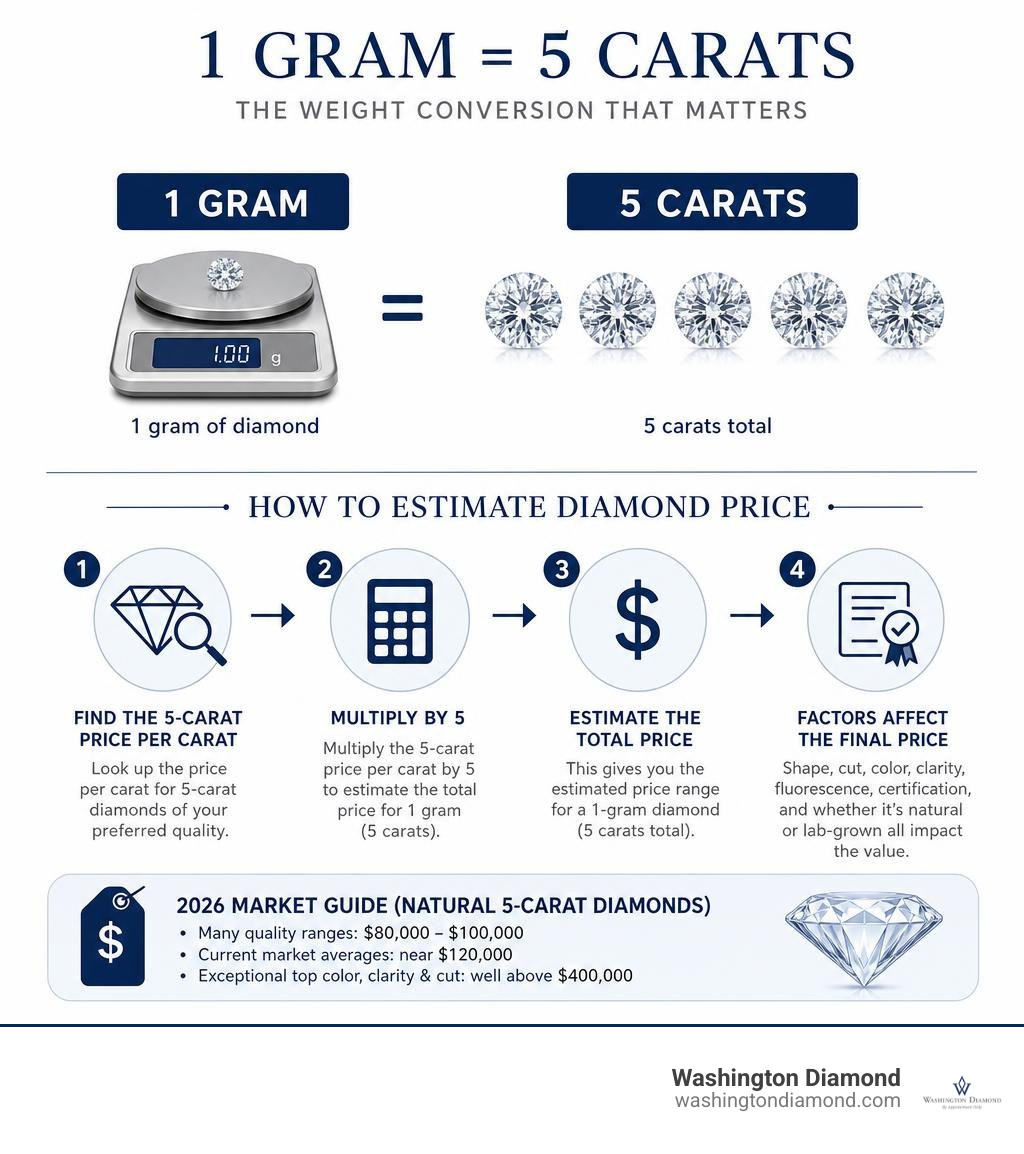
A 1-gram diamond equals 5 carats. To estimate its value, multiply the diamond's 5-carat price per carat by 5 - not the price of a 1-carat stone. In current 2026 market conditions, a natural 5-carat diamond may cost roughly $80,000 to $100,000 in many quality ranges, while current market averages for 5-carat natural diamonds are near $120,000. Exceptional round diamonds with top color, clarity, and cut can cost well above $400,000.
The gap exists because large, fine diamonds are much rarer than smaller ones. Shape, cut, color, clarity, fluorescence, certification, and whether the stone is natural or lab-grown can each move the final price by thousands or far more. A lab-grown 5-carat diamond is often substantially less expensive than a comparable natural stone.
I am Tom Daube, a jewelry designer and diamond specialist focused on GIA-certified diamonds with excellent proportions, custom jewelry, recutting, and trade-up guidance. In this guide to diamond 1 gram price, I will help you turn a carat-based quote into a smarter, clearer value estimate.
Diamond 1 gram price terms to learn:
Understanding Current Diamond 1 Gram Price and Valuation
To make sense of diamond valuation by weight, we first have to understand the metric carat. The international gemstone trade adopted the metric carat in 1907: exactly 200 milligrams, or 0.20 grams. Consequently, a single gram of diamond equals exactly 5.00 carats.
When shopping for precious metals like gold or platinum, pricing scales linearly by gram. If 1 gram of gold costs $85, 10 grams will cost $850. Diamonds, however, behave entirely differently. Diamond pricing relies on an exponential curve determined by weight brackets and extreme scarcity.
Because the price per carat increases significantly as the diamond crosses major weight thresholds, a single 5-carat (1-gram) gemstone commands a vastly higher price per carat than a standard 1-carat stone. As we break down in our guide on how to calculate price of a diamond, you cannot simply multiply the cost of a smaller stone by five.
| Weight Category | Average Natural Price / Carat | Total Estimated Price |
|---|---|---|
| 0.50 Carat (0.10 g) | $2,140 | $1,070 |
| 1.00 Carat (0.20 g) | $3,676 | $3,676 |
| 2.00 Carat (0.40 g) | $8,561 | $17,122 |
| 3.00 Carat (0.60 g) | $13,687 | $41,061 |
| 5.00 Carat / 1 Gram | $23,925 | $119,627 |
Note: Data reflects general market averages as of August–September 2026 for mid-to-high quality commercial natural diamonds.
Why 1 Gram Costs Far More Than Five 1-Carat Stones
Why doesn't a 1-gram diamond simply cost five times the price of a 1-carat stone? The answer comes down to nature and yield.
In the earth's mantle, microscopic diamond crystals are relatively common, but geologic conditions rarely allow a gem-quality crystal to grow large enough to yield a polished 5-carat finished gem. Recovering a rough stone capable of producing a clean, well-proportioned 1-gram polished diamond requires mining hundreds of tons of rock.
When international exchanges publish benchmark lists or local market updates—such as daily wholesale rates seen in indices like the Delhi Diamond Price - India Prices—they categorize stones into strict weight tiers. When a diamond crosses the 5.00-carat threshold, it enters an elite collector category where per-carat pricing jumps exponentially. Five separate 1-carat stones (totaling 1 gram) will run between $18,000 and $25,000 combined, whereas a single 1-gram crystal easily commands $80,000 to well over $120,000.
How to Calculate the Value of a 1-Gram Diamond
Valuing a 1-gram stone requires professional trade tools and standardized methodologies. Wholesale dealers, gemologists, and appraisers rely on benchmark pricing grids—most notably the Rapaport Diamond Report—which list baseline prices per carat categorized by shape, color, clarity, and carat bracket.
To calculate the value of a loose 1-gram stone:
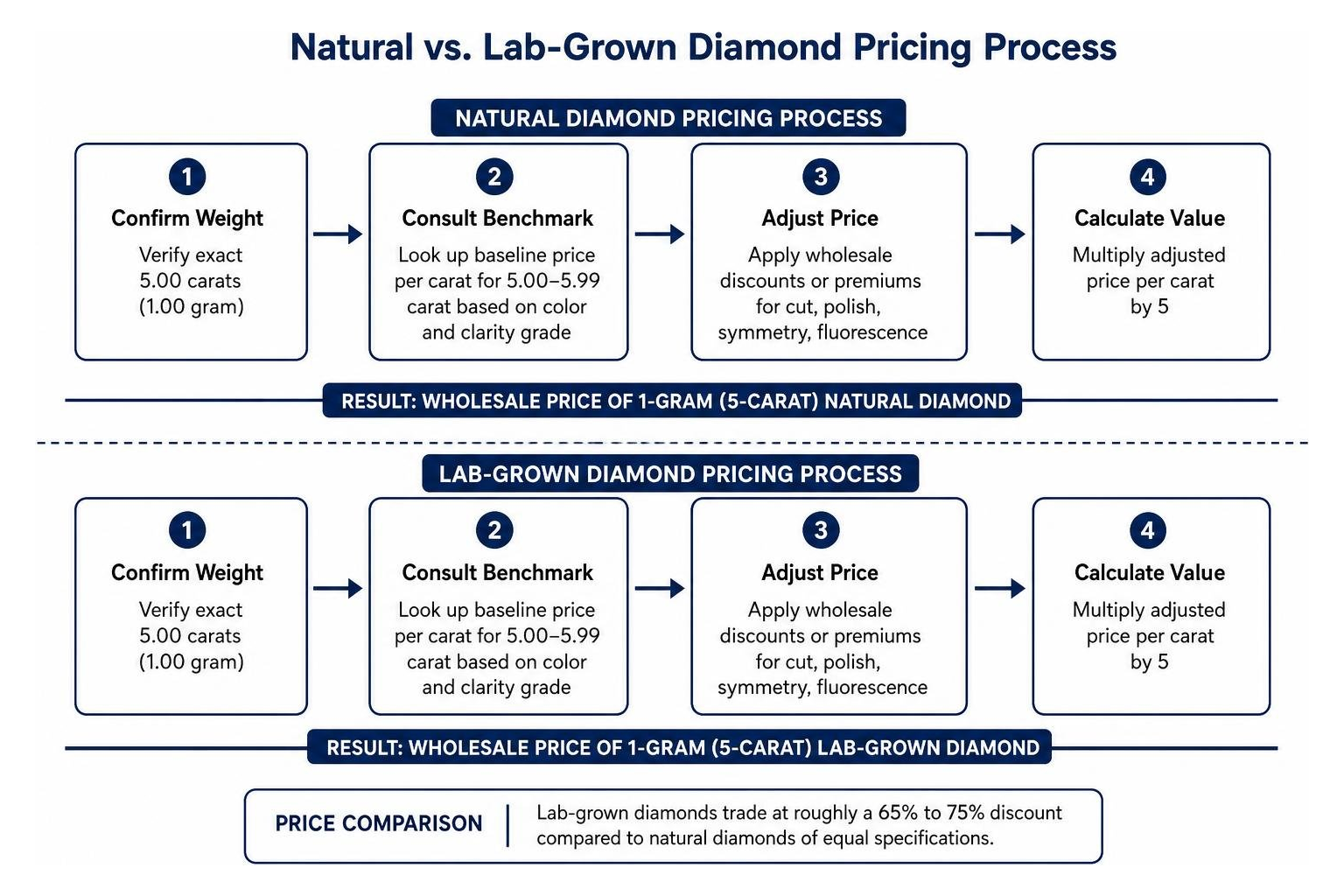
- Determine the Exact Metric Weight: Confirm on a calibrated gemological scale that the stone weighs 5.00 carats (1.00 gram).
- Consult Benchmark Price Grids: Look up the baseline price per carat for a 5.00–5.99 carat category stone according to its specific color and clarity grade.
- Apply Wholesale Discounts or Premiums: Adjust the baseline price based on cut precision, polish, symmetry, and fluorescence.
- Multiply by Carat Weight: Multiply the final adjusted price per carat by 5.
If you are evaluating stones independently, using the diamond value calculator: your secret weapon for smart buying provides a strong baseline before you sit down with a certified gemologist.
How the 4Cs Impact Diamond 1 Gram Price
At the 5-carat mark, every subtle grade variation on the GIA scale swings the valuation by tens of thousands of dollars:
- Cut Quality: Cut precision is the single most influential factor for brilliance and light return. An "Ideal" or "Excellent" cut commands a 10% to 20% premium over poorly proportioned stones that leak light through the pavilion.
- Color Grade: Ranging from D (colorless) to Z (light tint). The jump from an E color to a D color in a 5-carat stone can increase the price by over 20%, whereas a warm K-color stone will trade at a significant discount.
- Clarity Grade: Because a 5-carat diamond features a large table facet (often exceeding 7 to 8 mm across), inclusions are much more visible to the naked eye. While an SI1 clarity grade might be eye-clean on a 1-carat stone, a 1-gram diamond typically requires a VS2 grade or higher to ensure no distracting internal flaws.
- Shape and Geometry: Round brilliant diamonds command the highest price per gram because cutting them from rough octahedron crystals results in the highest amount of wasted material. Fancy shapes like ovals, cushions, and emerald cuts offer lower per-carat prices and unique visual spreads. You can explore how cut shapes reflect individual styles in our guide to the perfect diamond shape for every personality.
Natural vs. Lab-Grown Diamond 1 Gram Price Differences
Technological advancements in Chemical Vapor Deposition (CVD) and High-Pressure High-Temperature (HPHT) synthesis have made large lab-grown diamonds readily accessible.
Lab-grown diamonds are chemically, physically, and optically identical to mined diamonds. However, because lab-grown diamonds can be produced in commercial quantities without geological scarcity, their pricing structure is entirely different:
- Price Gap: In 2026, lab-grown diamonds trade at roughly a 65% to 75% discount compared to natural stones of equal specifications.
- 1-Gram Comparison: While a fine natural 1-gram diamond averages $100,000 to $120,000, an equivalent 5-carat lab-grown diamond can typically be purchased between $4,000 and $7,500.
For a deeper look into selecting loose stones across both categories, browse our loose diamonds complete guide.
2026 Market Trends for 5-Carat (1-Gram) Stones
The luxury diamond landscape in 2026 reflects shifting consumer habits and refined market segments. While smaller natural diamonds (0.50 to 1.50 carats) have seen price moderation over recent years—tracked across platforms like 1 Carat Round Diamond Price—ultra-large natural diamonds (5 carats and above) have demonstrated stronger price resilience.
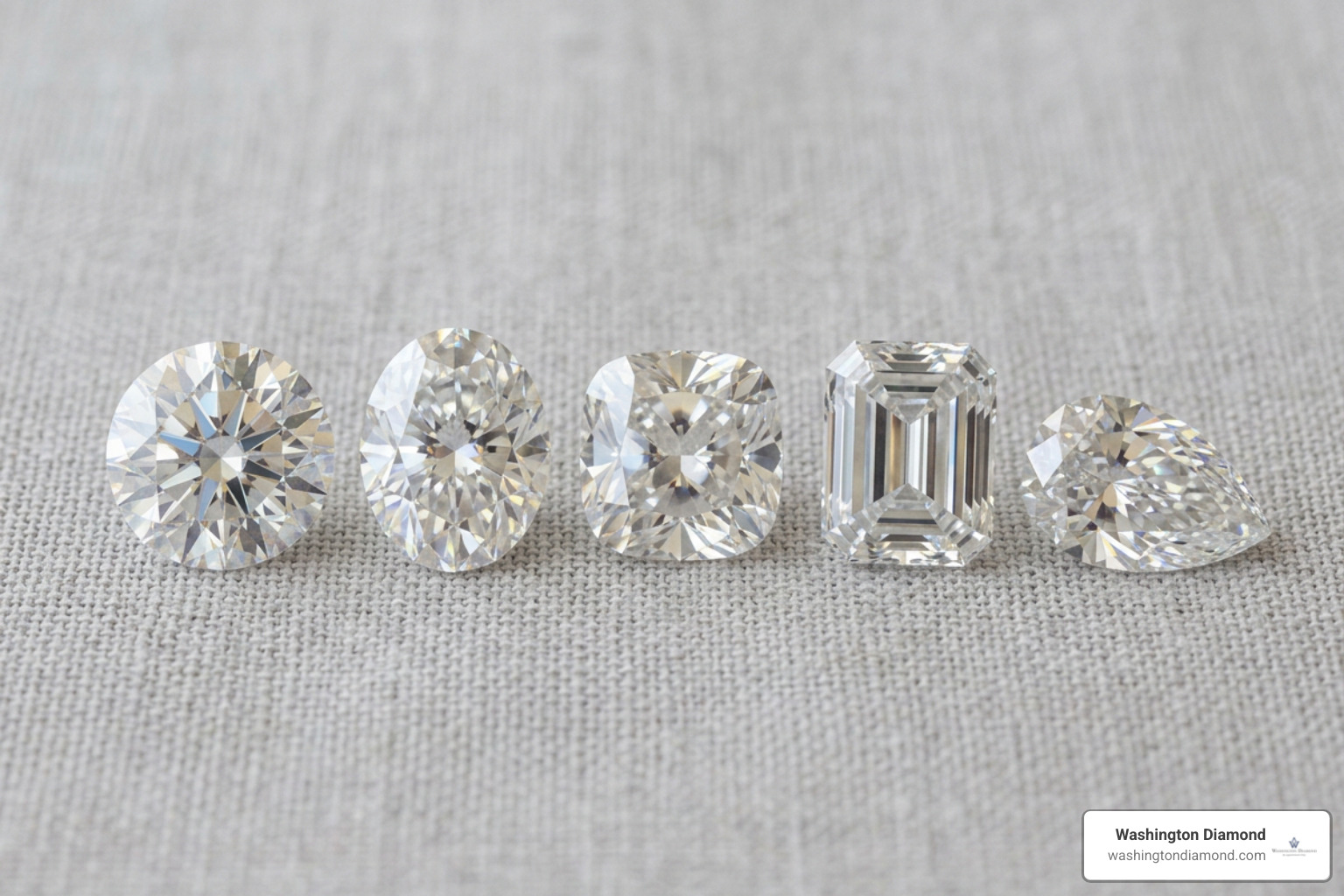
High-net-worth buyers continue to view top-tier 5-carat natural diamonds as portable tangible assets and legacy family heirlooms. Concurrently, average bridal center stones have shifted toward customized luxury designs, which we analyze thoroughly in our average engagement carat guide 2026.
Resale Value Expectations for 1-Gram Diamonds
When selling a diamond on the secondary market, realistic expectations are essential:
- Retail vs. Wholesale: Retail prices include costs such as cutting, certification, setting craftsmanship, store overhead, and retail margins.
- Buyback Percentages: If you liquidate a 1-gram natural diamond through trade buyers or jewelers, offers generally fall between 40% and 60% of the original retail purchase price, reflecting current wholesale market cash value.
- Preserving Value: Stones accompanied by original GIA or AGS grading dossiers and displaying excellent proportions consistently retain the highest percentage of their initial value.
Frequently Asked Questions About Diamond Weight and Pricing
How much is 1 gram of diamond worth compared to 1 gram of gold?
A single gram of pure 24-karat gold currently trades below $100. By contrast, a single 1-gram (5-carat) natural diamond of fine color and clarity commands an average price near $120,000, and can exceed $400,000 for top-tier collector stones (D-Flawless). Diamond weight carries one of the highest value-to-mass ratios of any commodity on earth.
How many carats are in a 1-gram diamond?
There are exactly 5 carats in a 1-gram diamond. The metric conversion rate is fixed at 1 carat = 0.20 grams (200 milligrams).
Where can I buy or sell certified 1-gram loose diamonds?
You should always buy or sell large diamonds through established, credentialed jewelers who deal in GIA-certified stones and provide transparent valuation reports. Explore our curated selection of loose diamonds to review current inventory and certified options.
Conclusion
Understanding the true value of a 1-gram diamond requires looking past simple scale weight to evaluate the interplay of rarity, the 4Cs, and current wholesale market indices. Because a 1-gram diamond represents an elite 5-carat gem, its acquisition is a meaningful milestone that deserves dedicated attention, transparent data, and professional guidance.
At Washington Diamond, we serve clients throughout Northern Virginia from our private, appointment-only studio. We provide undivided attention and unbiased diamond education to help you find or design exceptional bespoke engagement rings and legacy fine jewelry. Schedule an appointment with our gemological team to explore our loose diamond collection in a welcoming, private setting.
Have a question about your jewelry?
We've been helping clients with diamonds, custom design, repairs, appraisals, and more since 1969. Book a private appointment at our Falls Church studio.
Book an AppointmentTrusted since 1969 · Falls Church, VA · 703-536-3600
From the blog
View all


