

Decoding the Cost of 1 to 3 Carat Man Made Diamonds
Why a 1 Carat Man Made Diamond Is the Smarter Choice Right Now

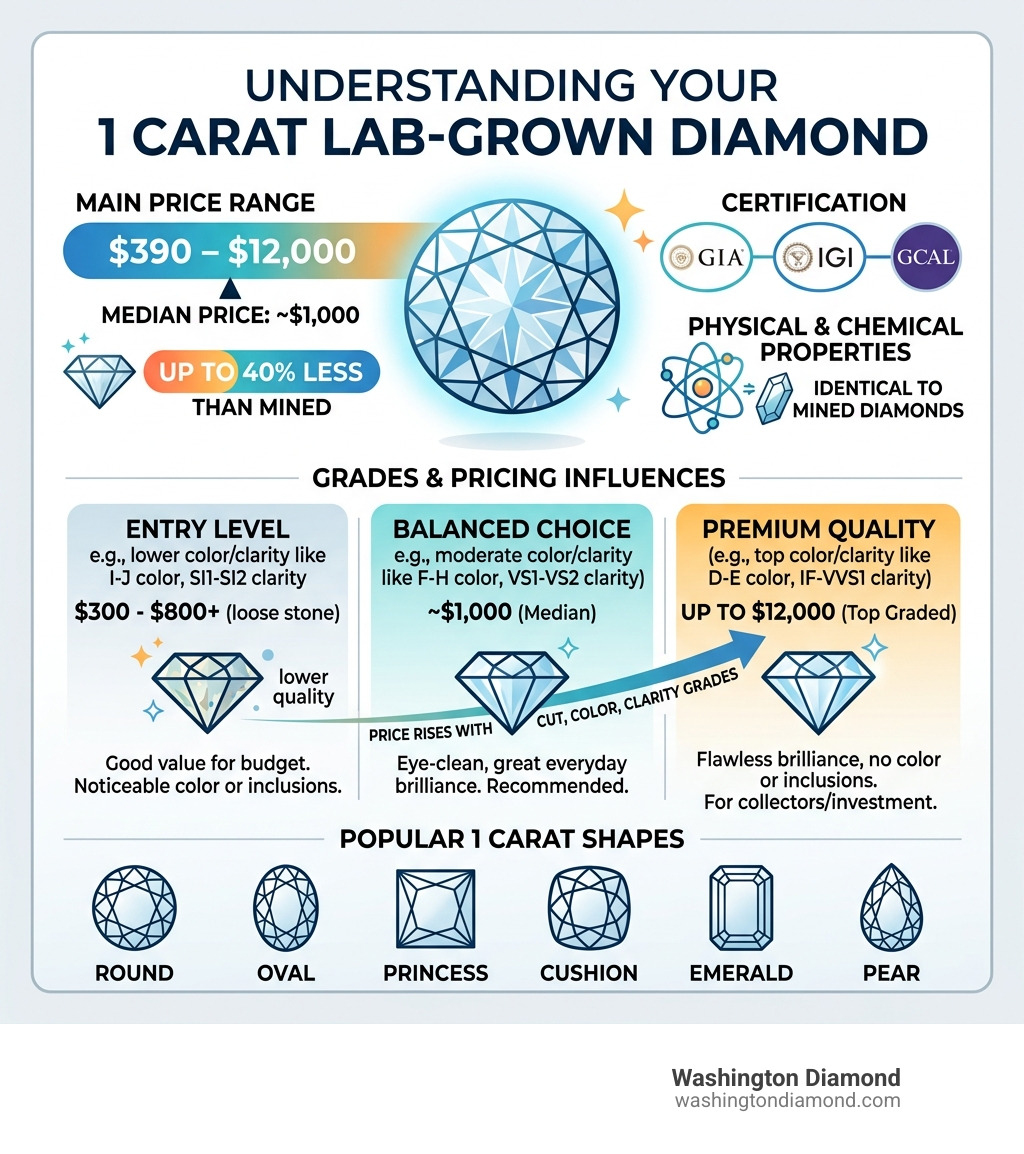
A 1 carat man made diamond gives you everything a natural diamond offers — the same brilliance, hardness, and beauty — at a fraction of the cost. Here's a quick snapshot of what to expect:
| Detail | Range |
|---|---|
| Price (1 carat lab-grown) | $390 – $12,000 (median ~$1,000) |
| Price vs. natural diamond | Up to 40% less |
| Physical/chemical properties | Identical to mined diamonds |
| Certification | GIA, IGI, GCAL |
| Popular shapes | Round, Oval, Princess, Cushion, Emerald |
The price range is wide because cut, color, and clarity move the needle significantly. A high-quality 1 carat loose stone typically runs between $300 and $800, while premium-graded stones with top certifications can go higher.
Lab-grown diamonds aren't imitations. They're real diamonds — made of pure carbon, grown in a controlled environment, and graded by the same standards as mined stones. The only difference is where they came from.
Whether you're shopping for an engagement ring, a milestone gift, or simply the best value for your budget, understanding how carat size affects cost is the first step to making a confident decision.
I'm Tom Daube, a GIA-certified diamond expert and jewelry designer ranked in the top 1% of jewelers nationally, and I've helped countless clients find the perfect 1 carat man made diamond at prices well below standard wholesale. In the sections below, I'll walk you through exactly how pricing works from 1 to 3 carats — so you can shop with clarity.
Simple 1 carat man made diamond word guide:
Understanding the 1 Carat Man Made Diamond: Quality and Creation
When we talk about a 1 carat man made diamond, we are talking about a stone that is chemically, physically, and optically identical to one pulled from the earth. These are not "fakes" like cubic zirconia or moissanite. They are composed of pure carbon atoms arranged in a crystal structure so hard that only another diamond can scratch it.
The journey of a lab-grown diamond begins with a "seed"—a tiny sliver of a pre-existing diamond. From there, scientists use one of two primary methods to grow the stone.
The science of diamond growth
There are two main ways we "cook" a diamond in the lab:
- HPHT (High Pressure High Temperature): This method mimics the crushing pressure and intense heat found deep within the Earth's mantle. The carbon seed is placed in a large press and subjected to temperatures over 1,400°C and pressures of about 1.5 million pounds per square inch.
- CVD (Chemical Vapor Deposition): This is a more modern approach where the diamond seed is placed in a vacuum chamber filled with carbon-rich gas (like methane). A plasma reactor breaks down the gas molecules, and the carbon "rains" down onto the seed, building the diamond layer by layer, atom by atom.
Whether it’s a standard brilliant stone or something more unique like those found in our Salt Pepper Lab Diamonds Your Guide To Their Unique Charm And Creation, the result is a breathtaking gem. For a deeper dive into how these are authenticated, check out our Certified Lab Diamonds Complete Guide.
Comparing lab-grown to natural mined diamonds
If you were to put a 1 carat man made diamond next to a mined diamond under a jeweler's loupe, you wouldn't be able to tell them apart. They share:
- Chemical Identity: Both are 100% carbon.
- Visual Appearance: They have the same fire, scintillation, and brightness.
- Refractive Index: 2.42 (the way light bends through the stone).
- Thermal Conductivity: They both move heat in the same way, which is why standard "diamond testers" will identify lab diamonds as "real."
The only way to distinguish them is through specialized laboratory equipment that can detect tiny growth patterns or the absence of nitrogen, which is common in mined stones.
Pricing Breakdown: From 1 to 3 Carat Diamonds
One of the most exciting parts of the lab-grown revolution is the pricing. Because the supply chain is shorter and we aren't moving tons of earth to find a single stone, the savings are passed directly to you.
| Carat Weight | Typical Lab-Grown Price Range | Median Price |
|---|---|---|
| 1.00 Carat | $390 – $2,500 | $1,000 |
| 2.00 Carat | $1,200 – $6,000 | $2,800 |
| 3.00 Carat | $3,500 – $15,000 | $6,500 |
As you can see, the price doesn't just double when you go from 1 to 2 carats; it grows exponentially. However, compared to mined diamonds—where a 3-carat stone of high quality could easily cost $50,000 or more—the value of lab-grown is undeniable. You can explore more specifics in our Lab Diamonds Price Chart or see the Average Cost Of A 2 Carat Lab Grown Diamond for a comparison.
Factors influencing the 1 carat man made diamond price
Not all 1-carat stones are priced equally. The "4Cs" still rule the roost here:
- Cut: This is the most important factor. An "Ideal" or "Super Ideal" cut will reflect the most light and hide imperfections.
- Color: Diamonds are graded from D (colorless) to Z (light yellow). Most of our clients opt for the D-F range for that icy white look.
- Clarity: This measures internal "inclusions." For a 1 carat man made diamond, we usually recommend "Eye-Clean" stones (VS1 or VS2), where you can't see any flaws without a microscope.
- Certification: Stones graded by the GIA or IGI carry a small premium because they have been strictly vetted by third-party experts.
For more tips on saving money without sacrificing sparkle, see our Affordable Lab Grown Diamonds Complete Guide.
Value comparison of 2 and 3 carat stones
While a 1 carat man made diamond is the "classic" size, many couples in Northern Virginia are now looking at 2 and 3-carat options because they are finally within reach. A 3-carat lab diamond is rare to produce perfectly, which is why the price jumps, but it still offers a "wow factor" that was previously reserved for the ultra-wealthy.
Selecting the Perfect 1 Carat Man Made Diamond
Choosing a diamond is about more than just looking at a price tag. It's about how the stone speaks to you. A 1-carat diamond is approximately 6.5mm in diameter (if it's a round cut), which provides a significant presence on the hand without feeling overly bulky.

Popular shapes for a 1 carat man made diamond
The shape you choose can actually change how large the diamond appears:
- Round Brilliant: The most popular and classic. It offers the most sparkle.
- Oval Cut: These are very trendy right now because their elongated shape makes the finger look slimmer and the stone look larger than a round of the same weight.
- Princess Shape: A modern, square cut with sharp corners.
- Emerald Elegance: A "step-cut" that emphasizes clarity and a sophisticated, hall-of-mirrors effect.
If you are looking to Buy Lab Grown Diamonds in DC & Arlington, Virginia, it's important to see these shapes in person to see which one fits your style. You can also browse our Loose Diamonds Complete Guide for more inspiration.
Certification and grading standards
We always recommend buying a 1 carat man made diamond that comes with a report from a reputable lab like the IGI (International Gemological Institute) or the GIA (Gemological Institute of America). These reports act as a "birth certificate" for your diamond, confirming its 4Cs and its lab-grown origin. Many lab diamonds also feature a microscopic laser inscription on the girdle that matches the certificate number—a great feature for insurance and security. Learn more about choosing the right stone in Beyond The 4Cs How To Choose Your Perfect Certified Loose Diamond.
Ethical and Environmental Benefits of Lab-Grown Diamonds
For many of our clients, the choice to go with a 1 carat man made diamond isn't just about the wallet—it's about the conscience.
Environmental impact comparison
Mining a single carat of diamond can require the removal of up to 250 tons of earth. In contrast, lab-grown diamonds are created in controlled environments with a significantly lower physical footprint.
- Land Displacement: Lab diamonds use a fraction of the land compared to open-pit or underground mines.
- Water Usage: Lab processes are increasingly efficient, often using recycled water systems.
- Energy: Many modern labs are moving toward renewable energy sources, such as solar or wind, to power their reactors.
Social and ethical considerations
When you choose a lab-grown stone, you are choosing a 100% conflict-free origin. There is no guesswork about the labor conditions or the "blood diamond" history of the stone. It’s a modern choice for a modern couple. You can read more about this in our article on Lab Grown Diamond Engagement Rings Ethical Elegance For Your Big Day or explore Lab Grown Engagement Rings.
Frequently Asked Questions about Man Made Diamonds
Buying a diamond is a big deal, and we get a lot of questions at our Northern Virginia studio. Here are the most common ones.
Can you tell the difference with the naked eye?
Absolutely not. Even seasoned gemologists cannot tell the difference between a high-quality 1 carat man made diamond and a mined one without advanced laboratory tools. Under a standard jeweler's loupe, the inclusions and crystal structures look exactly the same.
Is a 1 carat diamond a good size for an engagement ring?
Yes! A 1-carat diamond is considered the "gold standard" for engagement rings. It is large enough to be eye-catching and "iconic" in its proportions, yet it’s practical enough for everyday wear. It fits beautifully into solitaire, halo, or three-stone settings. For those in our area, you might find that Dc Northern Vas Best Kept Secret Lab Grown Engagement Rings That Dazzle offers some incredible local inspiration.
How do I clean and maintain my lab-grown diamond?
Since they are physically identical to mined diamonds, the care is the same.
- Cleaning: Use a mild solution of dish soap and warm water. A soft-bristled toothbrush is perfect for getting under the setting where oils and lotions build up.
- Maintenance: We recommend bringing your ring in every six months for a "check-up" to ensure the prongs are tight and the stone is secure.
- Durability: You can wear your diamond every day. It is the hardest substance on earth and won't cloud or fade over time.
Conclusion
The shift toward the 1 carat man made diamond represents a new era of luxury—one where beauty, ethics, and value finally align. Whether you are looking for a classic round brilliant or a trendy oval, the lab-grown market offers an incredible variety of Loose Diamonds to suit any style.
At Washington Diamond, we believe the process of choosing a diamond should be as special as the moment it celebrates. That’s why we operate as a private, appointment-only studio in Northern Virginia. We provide a quiet, personalized environment where you can get undivided attention and expert guidance without the pressure of a traditional retail floor.
If you’re ready to see the brilliance of a lab-grown stone for yourself, we invite you to book a consultation. We’ll help you decode the specs, compare the costs, and find the stone that perfectly reflects your story. For more information on where to start, check out our Top Picks Where To Find The Best Price Lab Grown Diamonds Online.
From the blog
View all


