

Ultimate Checklist to Verify Natural Diamond Authenticity
Fundamental Science: Properties and Structure of Earth-Formed Diamonds
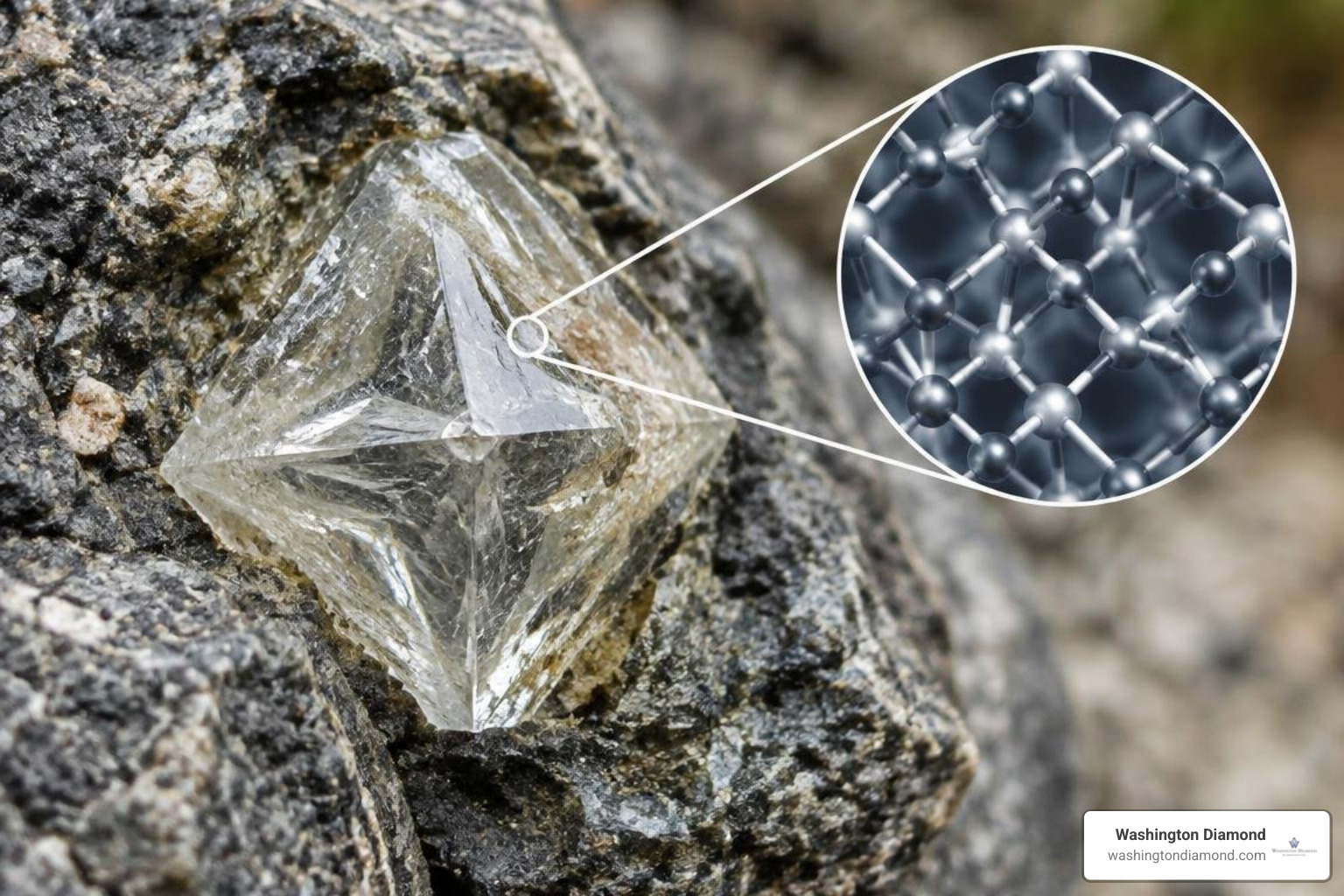
To verify a natural diamond, start with a concise, actionable checklist: inspect the stone under 10x magnification for natural mineral inclusions and single refraction without facet doubling, use thermal and electrical testers to separate diamond from common simulants, and match any girdle laser inscription to an accredited laboratory registry. These steps directly address authenticity before moving into the scientific background of why natural diamonds command such enduring admiration.
Understanding why natural diamonds command such enduring admiration begins with their unique physical and chemical architecture. Diamond is a distinct crystalline allotrope of carbon where every single carbon atom shares strong covalent bonds with four neighboring atoms. This dense, rigid tetrahedral arrangement gives the mineral an extraordinary compressive yield strength of 130–140 GPa alongside complete chemical inertness at standard room temperatures. It resists almost all acids and corrosive reagents, making it virtually indestructible during regular wear.
With a specific density ranging between 3.50 and 3.53 g/cm³, a diamond packs carbon atoms more tightly than graphite, its softer elemental sibling. The fundamental physics governing these atomic bonds dictate how light moves through the stone, how it disperses heat, and why it behaves differently from every imitation under professional laboratory analysis. For an in-depth dive into these mineralogical metrics, exploring Diamond on Wikipedia reveals how extreme subterranean forces dictate its unique atomic behavior.
Geological Formation of Natural Diamonds
Natural diamonds are ancient geological treasures. The vast majority formed deep within the Earth’s upper mantle at depths between 150 and 250 kilometers, though rare "super-deep" specimens originate hundreds of kilometers further down. Within these subterranean zones, immense lithospheric pressures (often exceeding 45 to 60 kilobars) combine with temperatures ranging from 900°C to well over 1,300°C to force carbon atoms into an ultra-dense cubic crystal system.
Geochronology studies show that most natural diamonds crystallized between 1.0 billion and 3.5 billion years ago, long before terrestrial plant life existed. These ancient crystals remained stored in the deep, stable roots of continental plates—known as cratonic lithosphere—until volatile, supersonic volcanic eruptions torn through the crust.
These explosive magma pathways created carrot-shaped vertical intrusions called kimberlite pipes and lamproite deposits. Because the magma traveled rapidly to the surface, the diamonds were spared from graphitizing into common carbon. Over millions of years, erosion washed some of these mineral-bearing rocks into rivers and coastlines, creating rich alluvial deposits where diamonds were first gathered by ancient civilizations.
Crystal Lattice, Hardness, and Optical Physics
The rigid, face-centered cubic lattice of a diamond accounts for its standing as the hardest known natural substance, holding the definitive rating of 10 on the Mohs scale. It is roughly 58 times harder than corundum (sapphire and ruby), the next hardest natural mineral class. However, hardness denotes resistance to scratching, not infinite toughness; diamonds possess four distinct octahedral cleavage planes along which they can split if struck with sufficient force at an exact angle.
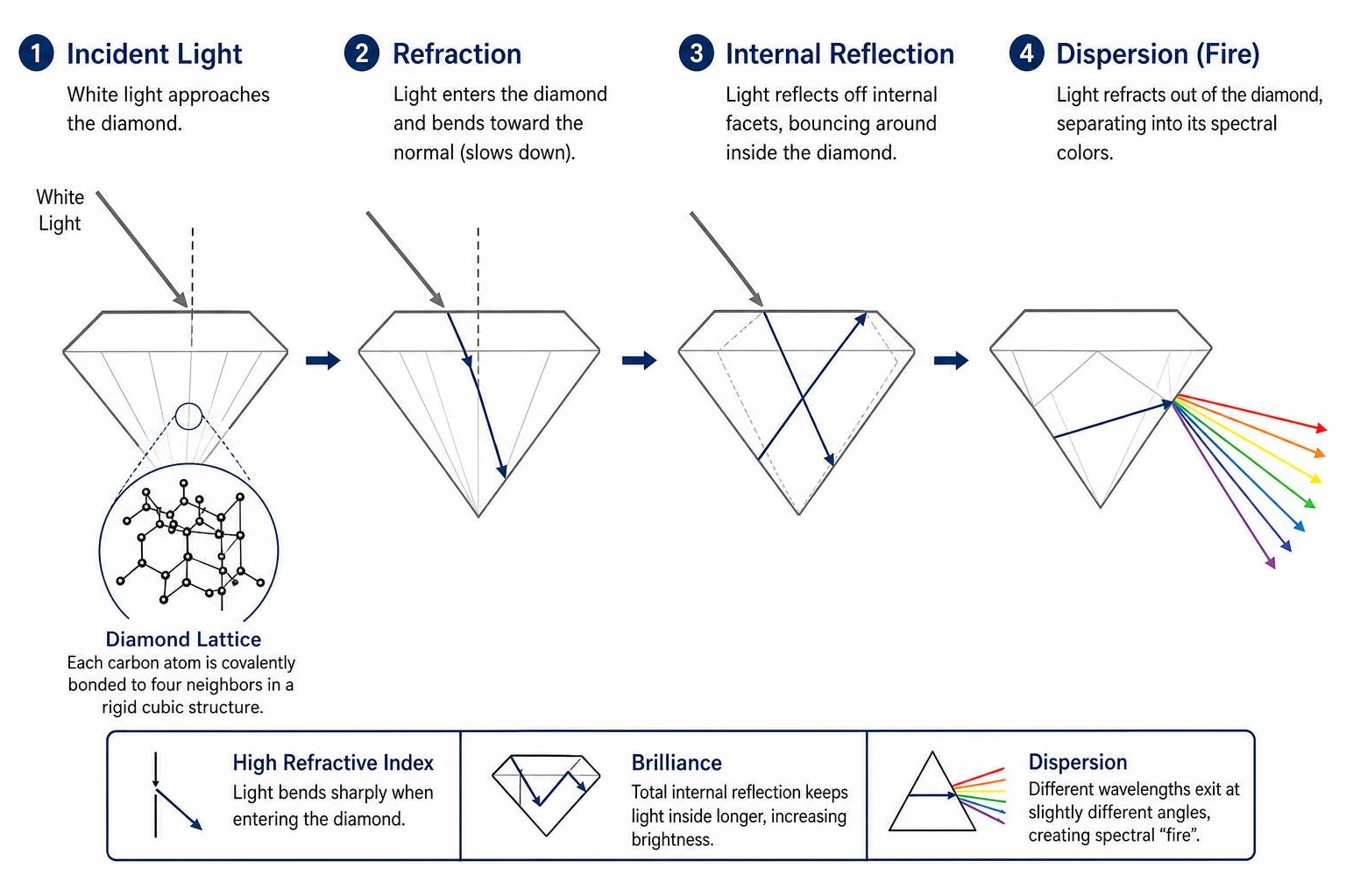
Optically, diamonds interact with light like no other gem material:
- Refractive Index (RI): Diamond boasts a high refractive index of 2.418 (measured at 500 nm), meaning light slows down significantly and bends sharply upon entering the stone, creating intense brilliance.
- Optical Dispersion: A dispersion value of 0.044 separates white light into its spectral rainbow components, producing the vibrant "fire" prized in fine jewelry.
- Thermal Conductivity: Diamonds conduct heat better than any other natural solid, with values reaching 2,000 to 2,500 W/m·K. This property allows diamonds to draw heat away instantly, a characteristic utilized in high-pressure physics experiments involving diamond anvil cells as well as microelectronic heat spreaders.
Step-by-Step Checklist to Authenticate Natural Diamonds
Verifying an unmounted or mounted gem requires a structured approach that moves from basic physical observations to advanced spectroscopic analysis. Whether you are reviewing an heirloom or validating a new acquisition, an expert inspection ensures every structural signature aligns with natural formation. If you require formal documentation for insurance or estate purposes, professional diamond appraisal services provide independent, certified documentation of identity and market replacement value.
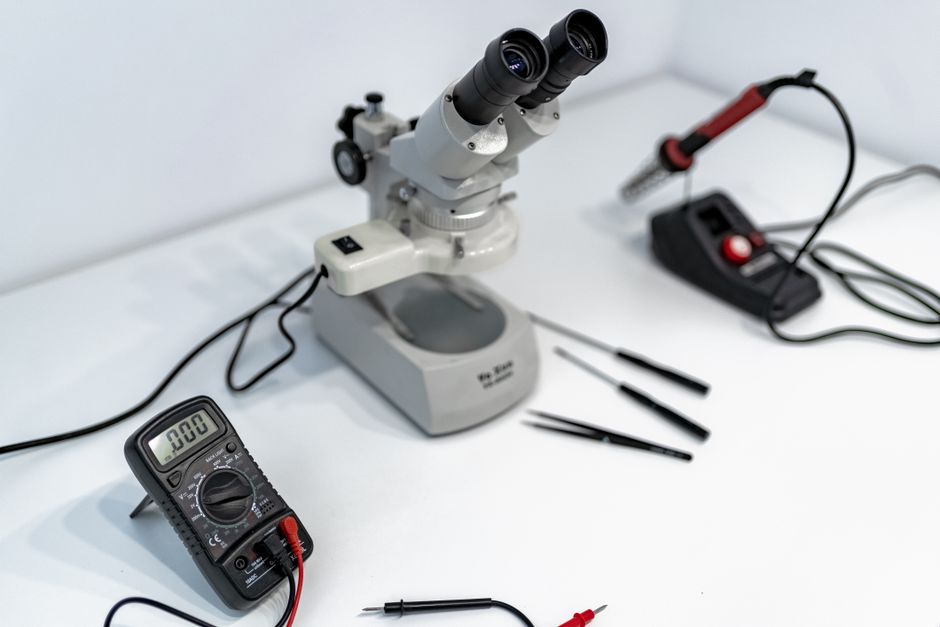
Visual Inspection: Inclusions, Cleavage, and the GIA 4Cs
Under a 10x achromatic gemological loupe or stereo microscope, natural diamonds reveal diagnostic growth characteristics that artificial stones struggle to replicate convincingly.
- Natural Mineral Inclusions: Mined diamonds often trap microscopic mineral crystals during their billions of years in the mantle. Identifying tiny inclusions of green diopside, red pyrope garnet, dark chromite, or olivine proves natural crystallization.
- Growth Features and Trigons: Uncut crystal surfaces and rough girdle facets often display microscopic triangular growth cavities or raised structures known as "trigons."
- Cleavage and Fracture Signatures: Stepped, flat cleavage planes along octahedral directions distinguish diamonds from glass or cubic zirconia, which exhibit curved, conchoidal fractures.
- Facet Junction Sharpness: Due to their Mohs 10 hardness, diamond facets meet at razor-sharp edges without the rounded borders or abrasions common on softer simulants.
- Evaluating the Four Cs: Assessing cut, color, clarity, and carat weight provides a structured profile of the stone. Familiarizing yourself with The Four Cs helps establish expected market benchmarks, while the Natural Diamonds | Diamond Stone – GIA C overview details how grading standards protect consumer transactions worldwide.
Thermal, Electrical, and Spectroscopic Testing
Handheld testers and desktop analytical machines evaluate physical properties that cannot be faked by surface treatments alone.
| Diamond & Simulant Types | Thermal Conductivity | Electrical Conductivity | Refractive Index (RI) | Photoluminescence / UV Reaction |
|---|---|---|---|---|
| Natural Type Ia (98% of mined) | Extremely High (2000+ W/m·K) | Non-Conductive (Insulator) | 2.418 (Single Refraction) | Inert to Medium Blue under Longwave UV |
| Natural Type IIb (Rare Blue) | Extremely High | Semi-Conductive (Boron-rich) | 2.418 (Single Refraction) | Variable; often red phosphorescence |
| Lab-Grown (CVD) | Extremely High | Non-Conductive (except doped) | 2.418 (Single Refraction) | Distinct strain patterns; green/orange fluorescence |
| Lab-Grown (HPHT) | Extremely High | Non-Conductive (except doped) | 2.418 (Single Refraction) | Strong phosphorescence under Shortwave UV |
| Moissanite (SiC) | Very High | Moderately Conductive | 2.65–2.69 (Double Refraction) | Inert to faint greenish-yellow |
| Cubic Zirconia (ZrO₂) | Very Low (Thermal Barrier) | Non-Conductive | 2.15–2.18 (Single Refraction) | Inert to chalky yellow-green |
While basic thermal probes instantly separate cubic zirconia from real diamonds, they register moissanite as diamond due to moissanite's high heat transfer. Dual-probe multi-testers add an electrical conductivity check to catch standard moissanite. However, advanced laboratory spectroscopy—such as Fourier-Transform Infrared (FTIR) Spectroscopy and Photoluminescence (PL) Spectroscopy—is required to definitively distinguish natural diamonds from lab-grown counterparts by analyzing aggregated nitrogen bonds.
Distinguishing Natural Stones from Simulants and Synthetics
Navigating modern diamond verification means understanding the difference between simulants (materials that mimic diamond appearance) and synthetics (man-made crystals sharing identical chemical composition). Before making transactional decisions, tools that help you calculate the value of a diamond before you buy or sell clarify why physical origin directly shapes market liquidity and replacement pricing.
Identifying Common Simulants: Moissanite, CZ, and Zircon
Simulants imitate the optical appearance of diamonds but possess fundamentally different chemical formulas and crystal structures.
- Moissanite (Silicon Carbide): Moissanite is doubly refractive. When viewing the facet junctions through the crown under magnification, you will notice distinct doubling of the back facets. Moissanite also exhibits a much higher dispersion (0.104) than natural diamond (0.044), producing an unmistakable rainbow "disco-ball" flash.
- Cubic Zirconia (CZ): CZ is significantly heavier than natural diamond. A cubic zirconia stone measuring the same dimensions as a 1.00-carat diamond weighs approximately 1.65 to 1.70 carats due to its higher specific gravity (5.6–6.0 g/cm³). CZ is also much softer (8.5 Mohs), displaying rounded facet edges, scratches, and a lack of true optical depth over time.
- White Zircon and White Sapphire: Natural white zircon features high birefringence (double refraction) and brittle, abraded facet edges. White sapphire lacks diamond's dispersion and displays a duller, watery luster due to its lower refractive index of 1.76.
Distinguishing Lab-Grown Alternatives from Natural Diamonds
Lab-grown diamonds are real diamonds chemically, crystallographically, and optically, but they grow in days or weeks rather than over billions of years in the mantle. As a result, they carry distinct microscopic signatures:
- HPHT (High Pressure High Temperature): HPHT growth uses molten metal catalysts (iron, nickel, cobalt). Under high magnification, microscopic metallic flux inclusions may appear as opaque, reflective flecks. Under cross-polarized filters, HPHT stones lack the typical "cross-hatch" or "tatami" strain patterns seen in ancient natural diamonds.
- CVD (Chemical Vapor Deposition): CVD diamonds grow layer-by-layer in low-pressure plasma chambers, often resulting in subtle banded strain patterns and internal brown or greyish undertones prior to post-growth heating.
- Luminescence Testing: Under deep shortwave ultraviolet light, synthetic stones often exhibit strong persistent phosphorescence (glowing after the UV source is extinguished), whereas standard natural Type Ia diamonds typically fluoresce blue under longwave UV and rarely phosphoresce.
Consumers exploring different fine jewelry avenues can explore engagement rings lab diamonds to compare structural origin details, pricing structures, and setting options side by side.
Verification Beyond the Gem: Grading Reports, Provenance, and Ethical Sourcing
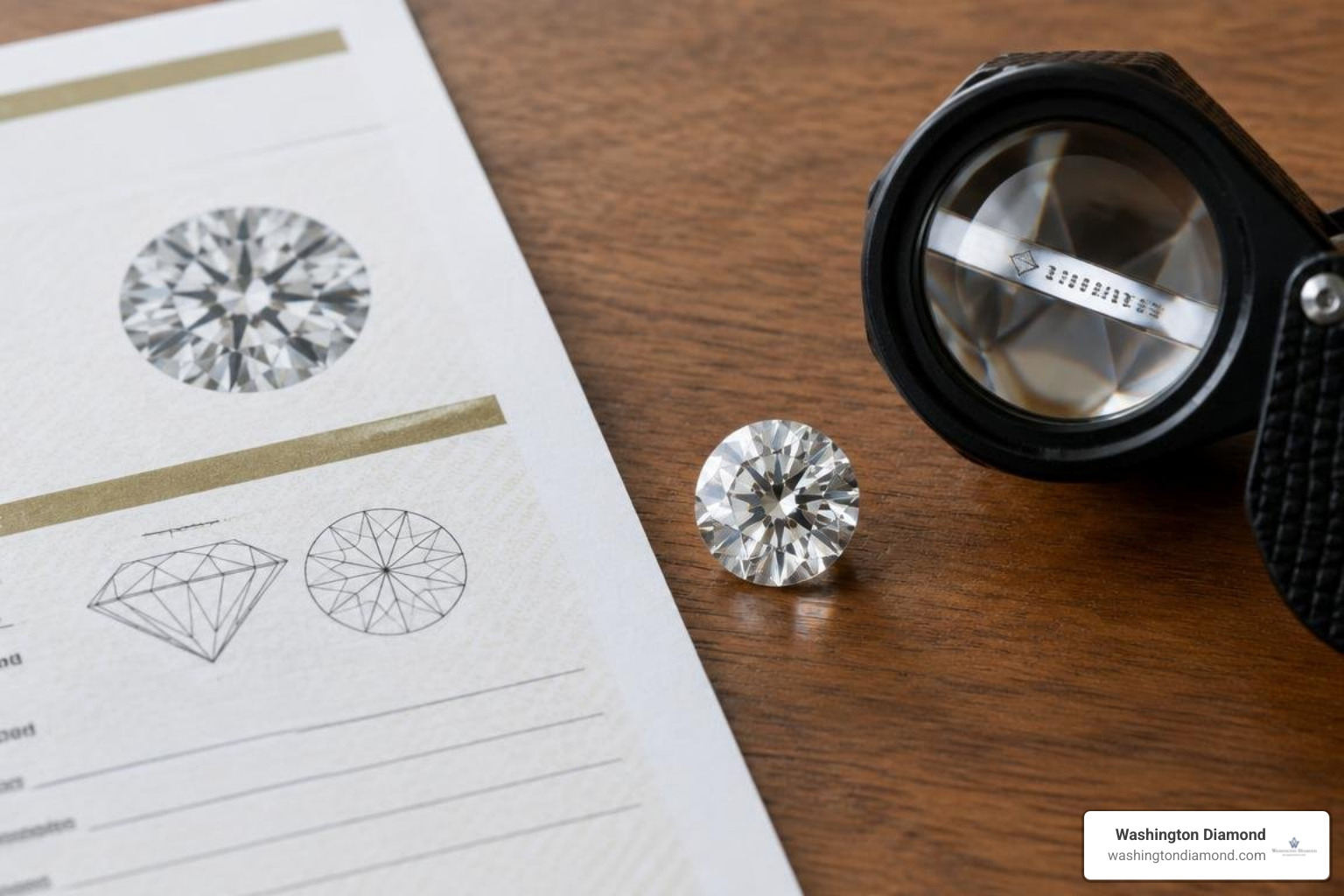
Physical screening of the gemstone must always be supported by official paper and digital validation. A stone's documentation confirms that its physical dimensions, clarity layout, and structural classifications match an established database record.
Reading Laboratory Certification and Inscription Registry
A grading report from an internationally recognized, accredited gemological laboratory—such as the Gemological Institute of America (GIA)—is the gold standard of diamond authentication. To ensure your documentation matches the gemstone:
- Examine the Girdle Inscription: Using a microscope at 20x to 40x magnification, locate the microscopic laser inscription on the diamond's perimeter (girdle). Match the unique serial number directly to the grading certificate.
- Verify via Online Registry: Never rely solely on printed paper. Input the certificate number directly into the issuing laboratory’s official online database or scan the secure QR code to confirm that the carat weight, dimensions, color grade, and clarity map (plot) match precisely.
- Match the Clarity Plot Map: A diamond’s internal inclusions serve as its geological fingerprint. Compare the locations of microscopic feathers, crystals, and pinpoints plotted on the certificate diagram against the physical inclusions visible under your gemologist's microscope. For an overview of how these factors influence retail positioning, review our GIA certified diamonds price guide.
Origin Tracing and Ethical Supply Chains
Diamond verification extends beyond physical authenticity to the integrity of the supply chain. In 2026, the international diamond market relies on strict regulatory oversight alongside digital provenance systems.
- The Kimberley Process Certification Scheme (KPCS): Established to eliminate the trade in conflict gems, the KPCS mandates that rough diamond shipments travel in tamper-resistant containers accompanied by government-validated certificates.
- System of Warranties: Downstream manufacturers and retailers provide affirmative declarations on every invoice, confirming their rough and polished inventory originates from legitimate, conflict-free sources.
- Blockchain Traceability: Leading diamond producers now implement digital ledger platforms, tracking an individual rough crystal from its original mine site through cutting, polishing, and laboratory grading.
Consumers seeking clarity on sustainable procurement practices can review what does ethically sourced actually mean to understand how responsible mining initiatives support regional communities across primary producing nations like Botswana, Canada, Namibia, and South Africa.
Frequently Asked Questions About Diamond Authenticity
Can a standard diamond tester distinguish natural diamonds from lab-grown diamonds?
No. A basic handheld thermal or thermal/electrical diamond tester is designed solely to confirm whether a stone has the thermal conductivity of diamond material. Because lab-grown diamonds possess the identical chemical composition, crystal lattice, and thermal properties as earth-mined diamonds, standard testers will register lab-grown diamonds as "real diamond."
Differentiating natural diamonds from lab-created stones requires dedicated laboratory-grade screening devices that measure nitrogen aggregation states, shortwave UV fluorescence patterns, and photoluminescence spectra.
What are the most reliable physical indicators of a natural diamond during visual inspection?
The most definitive physical indicators include:
- Mineral Inclusions: The presence of ancient, naturally occurring mineral inclusions such as pyrope garnets, green chromian diopsides, or olivine crystals.
- Single Refraction without Doubling: Clear, single refraction of light without the split facet junctions seen in birefringent simulants like moissanite or zircon.
- Natural Growth Patterns: Trigons (triangular growth pits) on natural unpolished surfaces or traditional "tatami" strain patterns visible under cross-polarized light microscopy.
- Sharp, Pristine Faceting: Facet junctions that meet in crisp, sharp points with zero abrasions, rounded edges, or mold seams.
How do nitrogen and boron impurities affect diamond verification?
Diamond types are categorized based on trace chemical impurities integrated into their carbon lattice during crystal growth:
- Type Ia Diamonds: Contain aggregated nitrogen atoms. This represents roughly 98% of all natural mined diamonds. Aggregated nitrogen absorbs blue light, occasionally producing faint yellow tones, and causes the classic blue fluorescence seen under longwave UV light. CVD and HPHT growth methods cannot economically recreate these complex nitrogen aggregations.
- Type Ib Diamonds: Contain isolated, single nitrogen atoms. Rare in nature (under 0.1%), this distribution produces intense canary yellow body colors and is common in certain synthetic growth processes.
- Type IIa Diamonds: Contain virtually no detectable nitrogen impurities. They are chemically the purest diamonds and account for only 1–2% of natural production. Many lab-grown CVD diamonds are Type IIa, prompting immediate secondary spectroscopic testing when encountered.
- Type IIb Diamonds: Contain trace boron impurities, which impart a natural blue hue (such as the famous Hope Diamond) and make the stone electrically semi-conductive.
Conclusion
Authenticating natural diamonds requires a careful combination of physical observation, scientific testing, and verified laboratory documentation. By checking for natural crystal inclusions, confirming single refraction, using calibrated thermal and electrical instruments, and cross-referencing laser inscriptions against accredited laboratory registries, you can proceed with total confidence in your investment.
At Washington Diamond, we believe choosing a diamond should be an educational, transparent, and completely pressure-free experience. At our private, appointment-only studio in Northern Virginia, our specialists offer you undivided attention and expert guidance, allowing you to examine fine natural diamonds up close under professional gemological microscopes.
Whether you are designing a bespoke engagement ring or selecting a meaningful gift, we invite you to explore our loose diamonds complete guide and schedule a personalized consultation to discover the remarkable beauty of earth-born diamonds.
Have a question about your jewelry?
We've been helping clients with diamonds, custom design, repairs, appraisals, and more since 1969. Book a private appointment at our Falls Church studio.
Book an AppointmentTrusted since 1969 · Falls Church, VA · 703-536-3600
From the blog
View all


