

The Art of Micro Pavé: Unveiling Its Intricate Beauty
The Brilliance Behind the Micro Pavé Setting

A micro pave setting is a jewelry technique where dozens — sometimes hundreds — of tiny diamonds, each weighing less than 0.01 carats, are set so closely together that the metal holding them nearly disappears. The result is a surface that looks completely paved with light.
Here's a quick breakdown of what makes micro pavé distinctive:
| Feature | Micro Pavé Setting |
|---|---|
| Diamond size | Typically under 1.2mm diameter, often under 0.01 carats each |
| Metal visibility | Minimal — prongs measured in microns |
| Visual effect | Continuous, seamless sparkle across the surface |
| Setting tool | High-powered microscope required |
| Common uses | Engagement ring bands, halos, eternity bands |
| vs. standard pavé | Smaller stones, less visible prongs, more refined look |
The word pavé comes from French, meaning "paved" — the same word used for cobblestone streets. And once you see a micro pavé ring catch the light, that name makes perfect sense. Every tiny stone acts like a mirror, bouncing light in every direction.
I'm Tom Daube, a GIA-certified diamond specialist and jewelry designer with decades of experience helping clients find exceptional pieces — including those featuring micro pave settings — at prices that make sense. In the guide below, I'll walk you through everything you need to know before making this important decision.
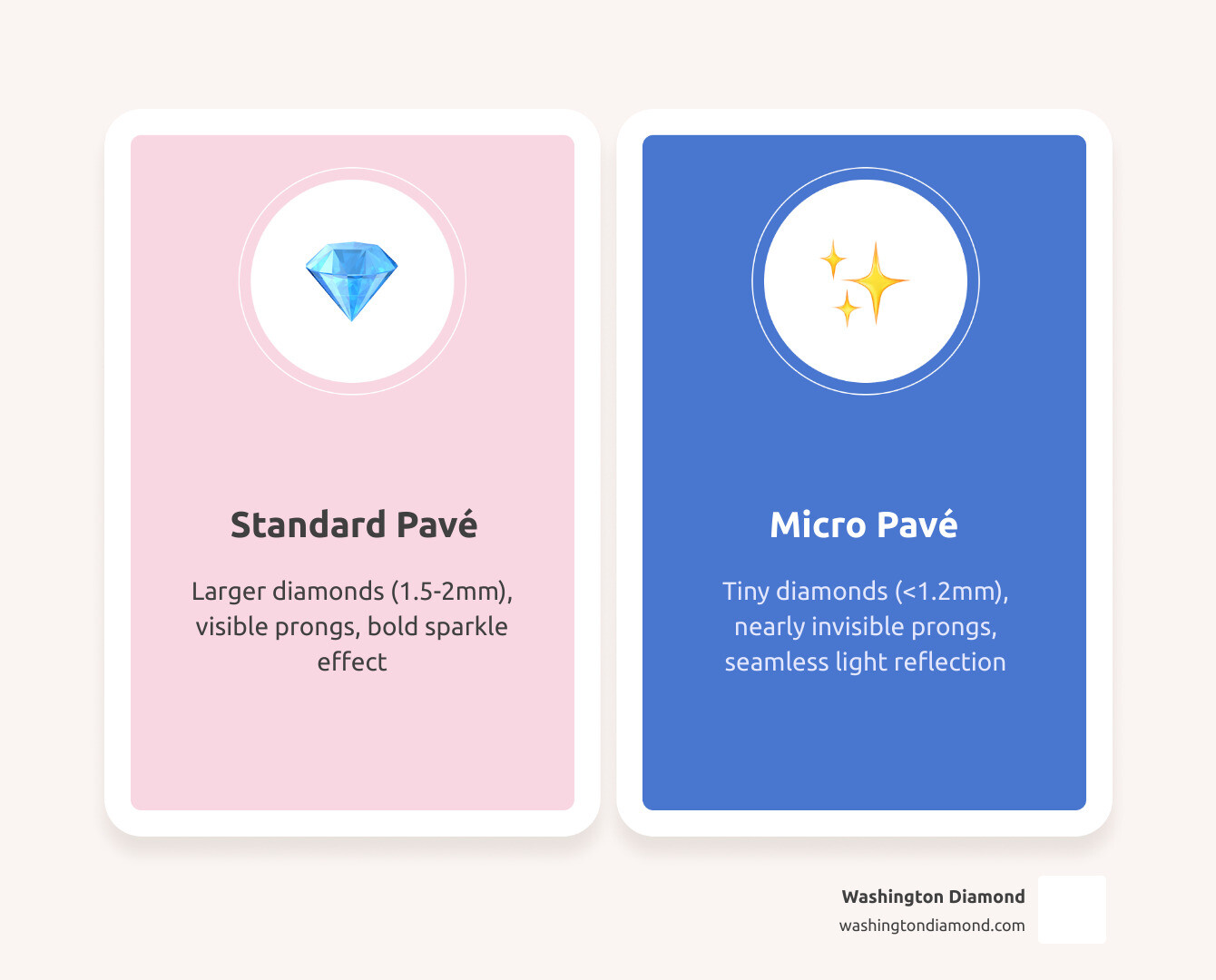
Simple Micro pave setting word guide:
What is a Micro Pave Setting?
At its core, a micro pave setting is a high-precision art form. While traditional pavé uses small diamonds to add sparkle to a band, micro pavé takes this to a microscopic level. We are talking about diamonds so small they are often compared to grains of sand. In a true micro pavé piece, the diamonds are typically less than 1.2mm in diameter. Some of the most delicate designs use stones as small as 0.7mm—sizes so scarce they are often sold by the individual piece rather than by total carat weight.
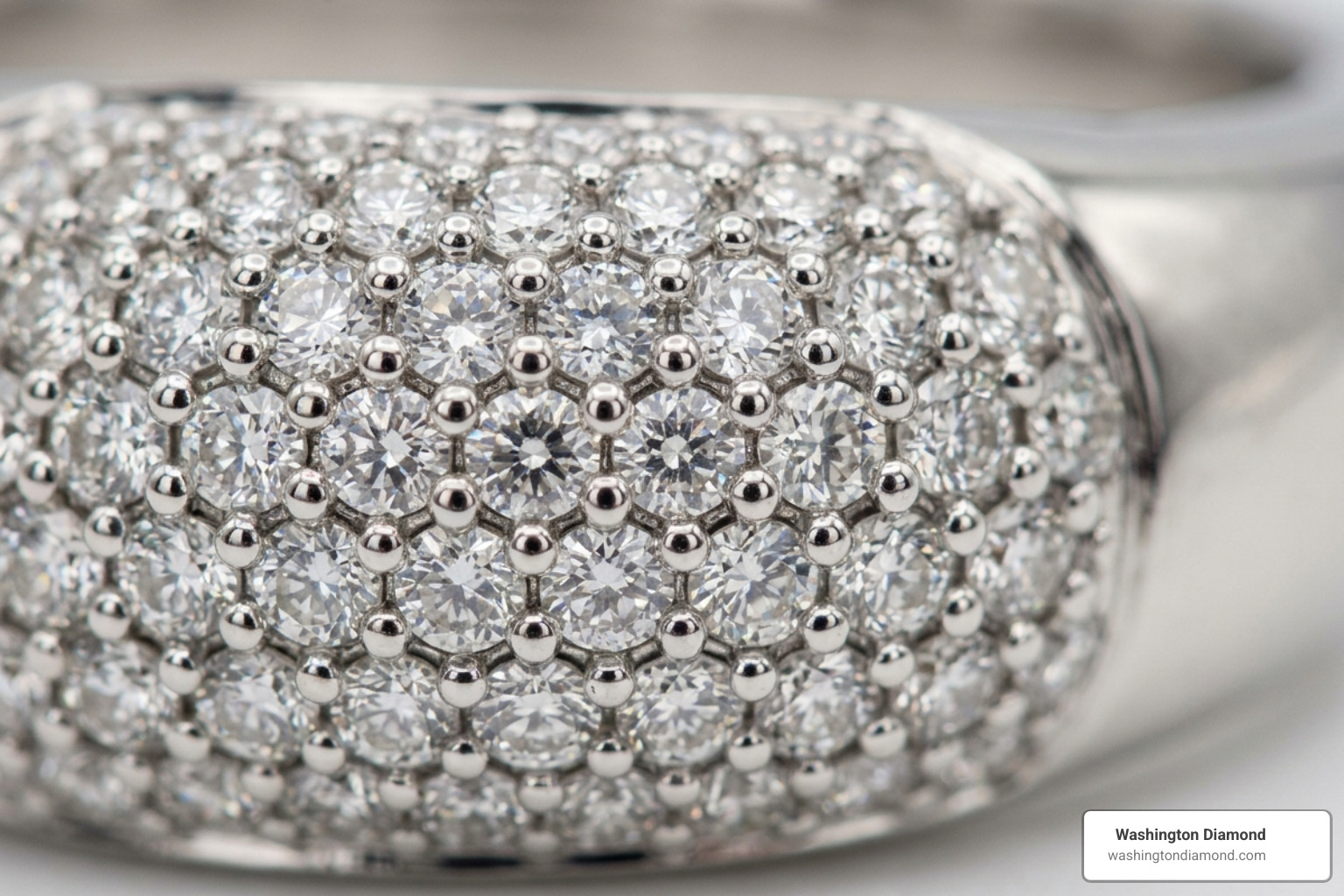
When you look at a ring with this setting, you shouldn't see "metal with diamonds in it." Instead, you should see a "field of diamonds" where the metal is merely a supportive ghost in the background. This technique allows us to encrust almost any surface of a ring—the shank, the bridge, and even the prongs—with light. For a deeper dive into how this fits into the broader world of settings, check out our pave-engagement-setting-complete-guide.
Distinguishing Micro Pavé from Traditional Pavé
The primary difference between these two lies in the scale of the materials and the prominence of the metal. In a traditional pavé setting, the diamonds usually weigh between 0.01 and 0.02 carats each. The prongs (or "beads") holding them are visible to the naked eye, giving the ring a slightly more textured, "cobblestone" appearance.
In contrast, a micro pave setting utilizes "melee" diamonds that weigh less than 0.01 carats. Because the stones are so uniform and tiny, the jeweler can set them in a honeycomb pattern that maximizes diamond coverage and minimizes metal. The result is a seamless, silky-smooth surface that feels like a ribbon of light on the finger.
The Evolution of Pavé Craftsmanship
The concept of "paving" jewelry with stones isn't new—it has roots going back centuries—but the micro version is a relatively modern marvel. In the 1940s, pavé settings became highly fashionable, though they were limited by the hand-cutting technologies of the time. The 1970s saw a revival, but the true "micro" revolution happened in the late 1980s and 90s.
Advances in automated faceting allowed for the mass production of perfectly uniform, tiny diamonds. Combined with the introduction of CAD-CAM (Computer-Aided Design and Manufacturing), jewelers could suddenly design settings with mathematical precision. Today, we use these technologies to pre-drill holes and pre-form tiny prongs, allowing for intricate 3D designs that were once thought impossible. You can learn more about these advancements in our guide to engagement-ring-settings-101.
The Craftsmanship and Tools of the Micro Pave Setting
Creating a micro pave setting is not a task for the faint of heart—or the shaky of hand. It requires a master setter who spends hours hunched over a high-powered binocular microscope. At this level of jewelry making, we don't measure in millimeters; we measure in microns.
The process begins with a solid strip of metal. The setter must drill pilot holes, open them to the exact diameter of the stones, and then "raise" tiny beads of metal from the surrounding surface to lock the diamonds in place. If the pressure is too high, the tiny diamond chips. If it’s too low, the stone will eventually fall out. It is a delicate balance of force and finesse.
Essential Tools for the Master Setter
To achieve this level of detail, a jeweler's workbench looks a bit like a miniature machine shop. Here are the tools we use to bring a micro pave setting to life:
- Beeswax: Used to temporarily pick up and position the tiny stones before they are set.
- Gravers: Sharp, chisel-like tools used to cut the metal and move it into place to form prongs.
- Cone and Hart Burs: Specialized drill bits used to create the perfect "seat" for the diamond's pavilion (the bottom part).
- Beading Tools: Small concave tools used to round off the tops of the metal prongs, making them look like tiny, polished silver or gold beads.
Selecting Diamonds for a Micro Pave Setting
Not all small diamonds are created equal. When we select stones for a micro pave setting, we look for consistency. If one stone is slightly off-color or a different height, it ruins the "seamless" effect.
We generally recommend diamonds with SI clarity or better and a color grade of G-I to ensure the band looks white and bright without breaking the bank. Interestingly, there is a choice between "single-cut" and "full-cut" diamonds.
- Single-cut diamonds have 17 facets. They are often preferred by high-end watchmakers because their larger facets create broader, crisper flashes of light in tiny sizes.
- Full-cut diamonds have the traditional 57 facets. These provide that classic "disco ball" scintillation that many brides love.
Whether you choose a 3-row-micro-pave-engagement-ring or a single delicate row, the quality of these tiny "melee" stones is what determines the final sparkle.
Popular Designs and Visual Characteristics
The magic of the micro pave setting is its versatility. It can make a thin band look like it’s made entirely of diamonds, or it can be used to add "hidden" details that only the wearer knows are there. One of the biggest advantages? It makes the center stone look significantly larger. By surrounding a 1-carat diamond with a micro pavé halo, you create a continuous plane of reflection that tricks the eye into seeing a much bigger sparkler.
Iconic Micro Pavé Styles
We see several styles that consistently capture the hearts of our clients in Northern Virginia:
- Halo Settings: A "frame" of micro pavé diamonds surrounding the center stone.
- Eternity Bands: Diamonds that go all the way around the finger, offering a "never-ending" sparkle.
- Cathedral Arches: Using micro pavé on the "shoulders" of the ring that rise up to meet the center stone, adding architectural grandeur.
- Three-Sided Shanks: Why settle for diamonds on top? This style puts diamonds on the top and both sides of the band, so the ring sparkles from every possible angle.
For those considering a custom piece, our custom-engagement-rings-ultimate-guide offers more inspiration on how to incorporate these elements.
Ethical Considerations and Material Sourcing
The how is just as important as the what. At Washington Diamond, we ensure all our diamonds are sourced through the Kimberley Process, preventing "conflict diamonds" from entering our supply chain.
We also see a growing trend in lab-grown melee. Because micro pavé requires so many stones (a single ring can have 100 to 200 diamonds), using lab-grown diamonds can significantly lower the price while maintaining the exact same physical and optical properties as mined diamonds. We also prioritize recycled precious metals to ensure your symbol of love has a minimal environmental footprint.
Durability, Maintenance, and Practicality
Let’s have a heart-to-heart: a micro pave setting is delicate. When you have hundreds of tiny diamonds held in place by metal beads the size of a needle point, things can happen. It is not uncommon for a stone to fall out over the course of a lifetime—not because the ring was "cheaply made," but because the setting is inherently fine.
Is Micro Pavé Suitable for Everyday Wear?
Yes, but with a caveat. If you are someone who works with your hands, spends a lot of time at the gym, or has a very active lifestyle, you need to be mindful. A hard knock against a granite countertop or a weight bar can displace one of those tiny prongs.
We recommend annual professional inspections. During these visits, we use our own microscopes to check every single stone. If a prong is starting to lift, we can tighten it before the diamond disappears. Think of it like the 10,000-mile oil change for your car—it keeps everything running smoothly.
How to Clean and Care for Micro Pavé
You don't need fancy chemicals to keep your micro pavé shimmering like a disco ball. In fact, simple is better:
- The Soak: Submerge the ring in lukewarm water mixed with a few drops of mild dish soap (like Dawn).
- The Scrub: Use a very soft-bristled toothbrush to gently whisk away lotion, oils, and dirt from the tiny crevices.
- The Rinse: Rinse thoroughly under warm running water (make sure the drain is plugged!).
- The Dry: Pat dry with a lint-free cloth or let it air dry on a paper towel.
Pro Tip: Avoid ultrasonic cleaners at home. The high-frequency vibrations can actually shake the tiny diamonds loose from their settings if the prongs are already slightly worn.
Frequently Asked Questions about Micro Pavé
Why are micro pavé settings more expensive than standard pavé?
It’s all about the labor. Setting 150 diamonds under a microscope takes significantly longer than setting 20 larger diamonds by hand. You are paying for the expertise of a master setter who can ensure symmetry and smoothness across a tiny surface.
Is it common for stones to fall out of a micro pavé setting?
It is more common than in a bezel or prong setting. However, because the stones are so small (melee), they are relatively inexpensive to replace. Most high-quality jewelers (including us!) offer maintenance plans to handle these minor repairs.
Can you resize a full eternity micro pavé band?
Generally, no. Because the diamonds go all the way around, cutting the band to change the size would compromise the structural integrity of the entire setting, likely causing stones to pop out. If you love the micro pavé look but think your size might change, we recommend a "3/4 pavé" design which leaves a small section of plain metal at the bottom for resizing.
Conclusion
The micro pave setting is the ultimate expression of "hidden" luxury. It transforms a simple piece of jewelry into a shimmering tapestry of light. While it requires a bit more care than a plain gold band, the visual payoff is unparalleled.
At Washington Diamond, we believe the process of choosing a ring should be as beautiful as the ring itself. Our private, appointment-only studio in Northern Virginia is designed to give you the undivided attention you deserve. We don't just sell jewelry; we help you craft the artifacts of your life's most meaningful moments.
Ready to see the "disco ball" effect in person? Discover the perfect sparkle for your world and let us help you find the micro pavé design that speaks to you.
From the blog
View all


