

The Definitive Guide to Fancy Diamonds
What Are Fancy Diamonds? A Quick Answer

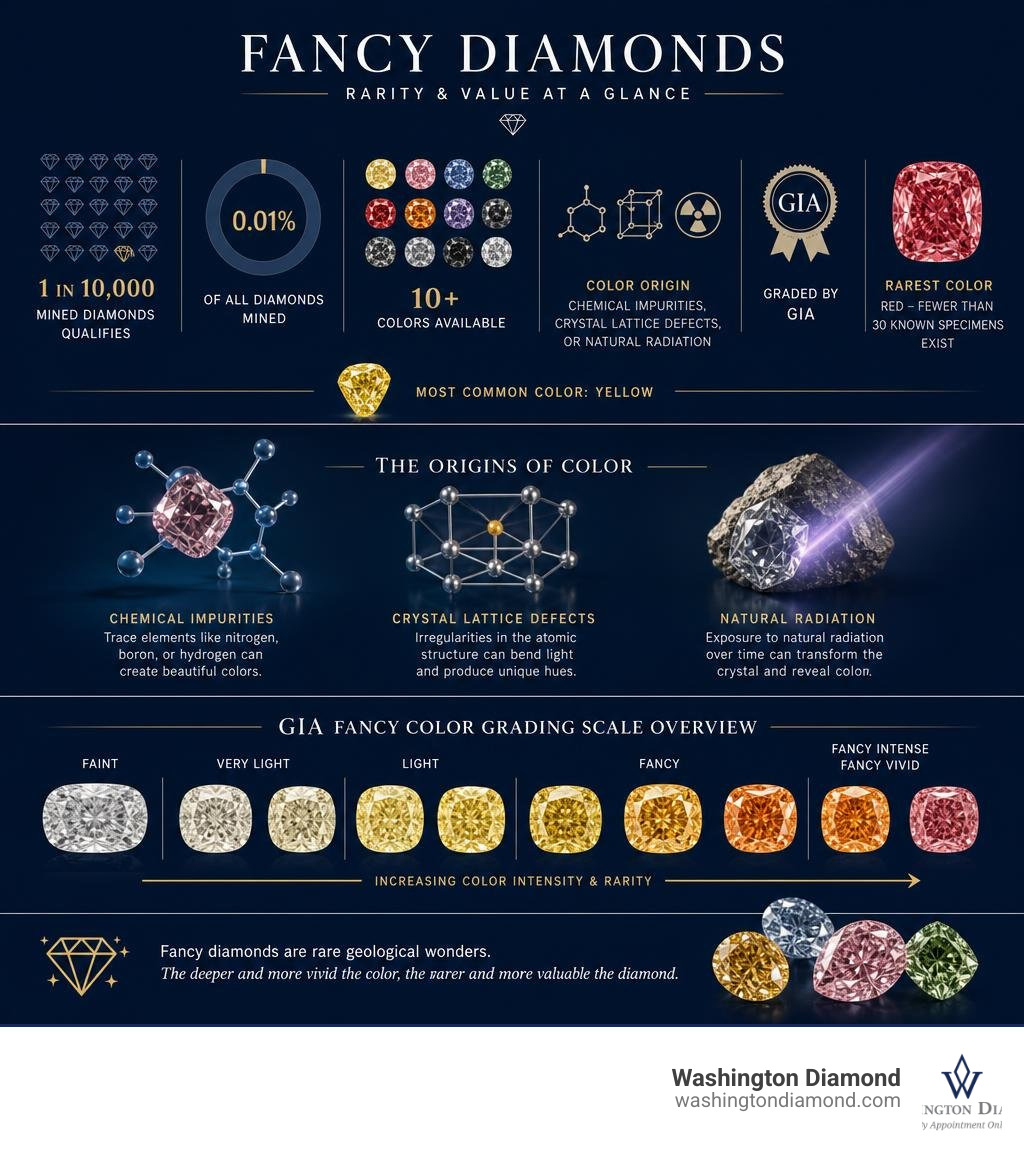
Fancy diamonds are natural diamonds that display a distinct, visible color — going well beyond the standard white-to-yellow range most people picture when they think of diamonds.
Here's what you need to know at a glance:
| Feature | Fancy Diamonds |
|---|---|
| Rarity | Only 1 in 10,000 mined diamonds qualifies |
| Share of all diamonds mined | Just 0.01% |
| Colors available | Yellow, pink, blue, green, red, orange, purple, gray, black, white, and more |
| Color origin | Chemical impurities, crystal lattice defects, or natural radiation |
| Grading authority | GIA (Gemological Institute of America) |
| Rarest color | Red — fewer than 30 known specimens exist |
| Most common color | Yellow |
These stones are prized not despite their color, but because of it. The deeper and more vivid the hue, the rarer — and more valuable — the diamond.
As one famous industry observation puts it: "If gems are the flowers of the mineral kingdom, fancy color diamonds are the orchids." That quote captures something real. These are not simply colored stones. They are geological accidents of extraordinary rarity, formed over billions of years under conditions that may never repeat.
Whether you're drawn to a soft blush pink for an engagement ring or a saturated vivid yellow as a milestone gift, understanding what makes these stones special will help you make a confident, informed choice.
I'm Tom Daube, and I've spent my career helping people find GIA-certified diamonds — including fancy diamonds — at prices consistently under listed wholesale, with a focus on custom, timeless designs. In the guide below, I'll walk you through everything you need to know, from how these stones are graded to what to look for when buying one.
Understanding the Rarity and Value of Fancy Diamonds
To truly appreciate fancy diamonds, we have to look at how they differ from the traditional white diamonds most of us are familiar with.
Standard colorless diamonds are graded on the GIA’s D-to-Z color scale. On this scale, "D" represents a completely colorless stone—the absolute peak of purity and value in the traditional market. As you move down the alphabet toward "Z", the diamond displays increasing traces of yellow or brown. In the traditional white diamond world, these hints of color are considered structural imperfections, and they cause the value of the stone to drop.
However, once a diamond's color surpasses the "Z" grade—displaying a rich, distinct, and unmistakable hue—it crosses the threshold into the realm of fancy diamonds. Suddenly, the rules of the D-to-Z scale no longer apply. The presence of color is no longer a detractor; it is the ultimate prize.
The sheer mathematical rarity of these stones is staggering. Only 1 in 10,000 diamonds mined around the globe possesses enough natural color to qualify for a "fancy" designation. This means fancy color diamonds represent a microscopic 0.01% of all mined diamonds.
How does this happen? It all comes down to beautiful geological accidents. While a perfect colorless diamond is made entirely of carbon atoms arranged in a flawless crystal structure, fancy colored varieties are the result of chemical impurities, atomic anomalies, or environmental factors during their formation deep within the Earth.
For instance, the presence of nitrogen creates sunny yellow tones, while boron introduces oceanic blues. In other cases, intense pressure deep underground distorts the carbon crystal lattice itself, giving rise to romantic pinks and ultra-rare reds. To explore the deep history and legends surrounding these incredible stones, you can read about The Legend and Symbolism of the Diamond.
How Fancy Colored Diamonds Are Graded
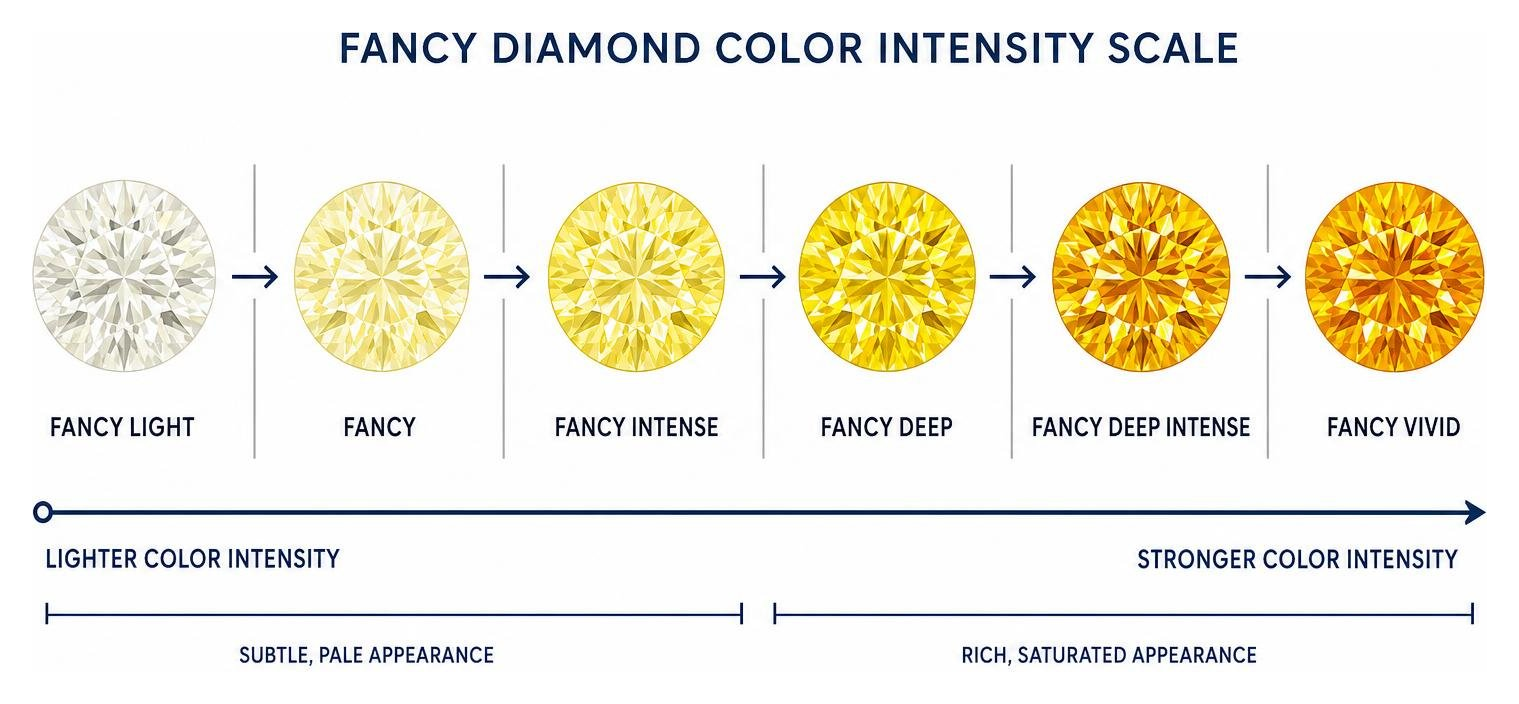
When it comes to grading fancy diamonds, the process is highly specialized and differs significantly from standard white diamond evaluation. The Gemological Institute of America (GIA) uses a dedicated grading system designed to assess the quality and value of colored stones based on three key dimensions: hue, tone, and saturation. You can learn more about the laboratory's approach through the GIA overview of colored diamond grading.
- Hue: This is the primary color of the diamond (e.g., yellow, pink, blue, or green). It also accounts for any secondary modifying colors, such as a "purplish pink" or a "greenish blue."
- Tone: This refers to how light or dark the diamond appears.
- Saturation: This is the strength, depth, or purity of the color.
Unlike colorless diamonds, where clarity is a primary driver of value, the clarity grade takes a back seat when evaluating a fancy colored stone. Because deep, saturated colors naturally mask internal inclusions, a fancy diamond with an SI1 or SI2 clarity grade can still look absolutely flawless to the naked eye.
However, graders do look out for unique internal features like "color graining." This is a type of inclusion caused by microscopic irregularities in the crystal growth, which can sometimes appear as subtle lines or waves of color inside the stone.
Carat weight also behaves differently in the fancy color market. Because large colored crystals are incredibly rare, the price-per-carat curve bends upward far more steeply than it does for white diamonds. While finding a 1-carat fancy colored diamond is a feat, finding one with intense, saturated color is a true miracle. In fact, the chance of finding an intense color fancy diamond is a mere 1 in 25,000.
| GIA Color Intensity Grade | Description | Rarity Level |
|---|---|---|
| Fancy Light | A soft, delicate whisper of color | Uncommon |
| Fancy | Clear, recognizable color | Rare |
| Fancy Intense | Highly saturated, bright, and vibrant | Very Rare |
| Fancy Vivid | The pinnacle of saturation; deeply rich and striking | Extremely Rare |
| Fancy Deep / Fancy Dark | Medium to dark tone with rich, deep color | Extremely Rare |
The Spectrum of Colors and Their Origins
Every color in the fancy diamond spectrum tells a story of a unique geological journey. Let's look closer at how these magnificent hues are created.
The Spectrum of Yellow Fancy Diamonds
Yellow diamonds are the most widely recognized and beloved of all fancy diamonds. Their beautiful golden color is caused by the presence of nitrogen atoms trapped inside the carbon crystal structure during formation. When light passes through the diamond, the nitrogen absorbs blue light, reflecting a warm yellow spectrum back to our eyes.
Often referred to as "canary yellow" or canary diamonds due to their bright, avian hues, these stones are highly sought after for engagement rings and statement jewelry. While yellow diamonds are the most common of the fancy colors—making up the largest portion of colored diamond discoveries—they are still exceptionally rare compared to standard white diamonds. To understand what makes these sunny gems so captivating, read our dedicated guide on Canary Diamond Yellow.
The Unmatched Allure of Pink and Red Fancy Diamonds
Pink and red diamonds are among the most mysterious and coveted treasures on Earth. Unlike yellow or blue diamonds, their color is not caused by trace chemical elements. Instead, scientists believe that pink and red hues are the result of "plastic deformation"—a process where immense heat and pressure deep within the Earth distort the diamond’s crystal lattice, causing it to absorb green light and reflect pink or red.
For decades, the premier source of the world's finest pink diamonds was the famous Argyle mine in Western Australia. Since its closure, the global supply of natural pinks has become incredibly limited, driving their value to historic heights.
Red diamonds represent the absolute pinnacle of rarity. They are so scarce that the GIA issued absolutely no lab reports for pure red diamonds between the years 1957 and 1987. Most natural red diamonds are very small, typically weighing less than 0.5 carats, making any sizeable specimen an museum-worthy artifact.
Blue, Green, and Other Exotic Hues
Beyond yellows and pinks lies a world of incredibly rare and exotic shades:
- Blue Diamonds: These oceanic gems owe their color to boron impurities. Because boron is incredibly scarce in the Earth's mantle where diamonds form, natural blue diamonds are exceptionally rare and almost always carry a light grayish or greenish undertone.
- Green Diamonds: Green diamonds are geological marvels formed when a diamond crystal is exposed to natural radiation from surrounding rocks over millions of years. This radiation knocks carbon atoms out of their normal positions in the crystal lattice, changing how the stone absorbs light. Because this radiation usually only penetrates the outer surface of the rough crystal, natural green diamonds are incredibly difficult to cut without losing their color. Fewer than 10 out of every 10,000 fancy colored diamonds are green. To learn more about their pricing and collectibility, check out our guide on the Green Diamond Price Per Carat.
- Chameleon Diamonds: These fascinating stones possess temporary thermochroic or photochroic properties, meaning they actually change color (typically from an olive green to a bright yellow-bronze) when heated or kept in total darkness for an extended period.
How Shape, Cut, and Fluorescence Affect Appearance
When cutting a traditional white diamond, the lapidary's goal is to maximize sparkle and brilliance, which often means using a round brilliant cut. However, with fancy diamonds, the cutter’s primary goal is completely different: they want to maximize and intensify the stone’s natural color.
This is why you will rarely see a fancy colored diamond cut into a round shape. Round cuts are designed to return light quickly, which can actually dilute and wash out natural color. Instead, cutters favor fancy shapes with deeper pavilions, such as radiant cuts, cushion cuts, and pear shapes.
These elongated shapes and deep facets allow light to bounce around inside the stone for a longer period before reflecting back to the eye. This extended light path concentrates and dramatically intensifies the face-up color appearance of the diamond.
In the case of green diamonds, the preservation of color requires extreme precision. Because natural radiation often only colors the very outer "skin" of the rough diamond, cutters will go to great lengths to preserve as much of the natural rough skin as possible around the girdle of the polished stone.
Fluorescence is another factor that can influence a fancy diamond's appearance. While strong fluorescence in a white diamond is sometimes viewed as a negative, medium to strong blue fluorescence in a yellow diamond can actually soften its appearance, while in other colors, it can add a unique visual depth.
To find out which diamond cut aligns best with your personal style and design vision, explore our guide on The Perfect Diamond Shape for Every Personality.
Key Considerations for Buyers and Investors
If you are considering purchasing a fancy colored diamond as a personal treasure or an investment piece, there are several critical factors to keep in mind:
- Prioritize GIA Certification: Because natural fancy diamonds are so valuable, the market contains treated or artificially colored stones. A GIA certificate is non-negotiable. It provides definitive proof of the diamond's natural origin and verifies that its color has not been artificially enhanced through laboratory treatments like irradiation or high-pressure high-temperature (HPHT) processing.
- Understand Investment Potential: High-quality, naturally saturated fancy diamonds—particularly pinks, blues, and reds—have historically shown incredible value retention and appreciation due to their extreme scarcity. If you are looking for long-term investment potential, focus on stones with strong color saturation (Fancy Intense or Fancy Vivid).
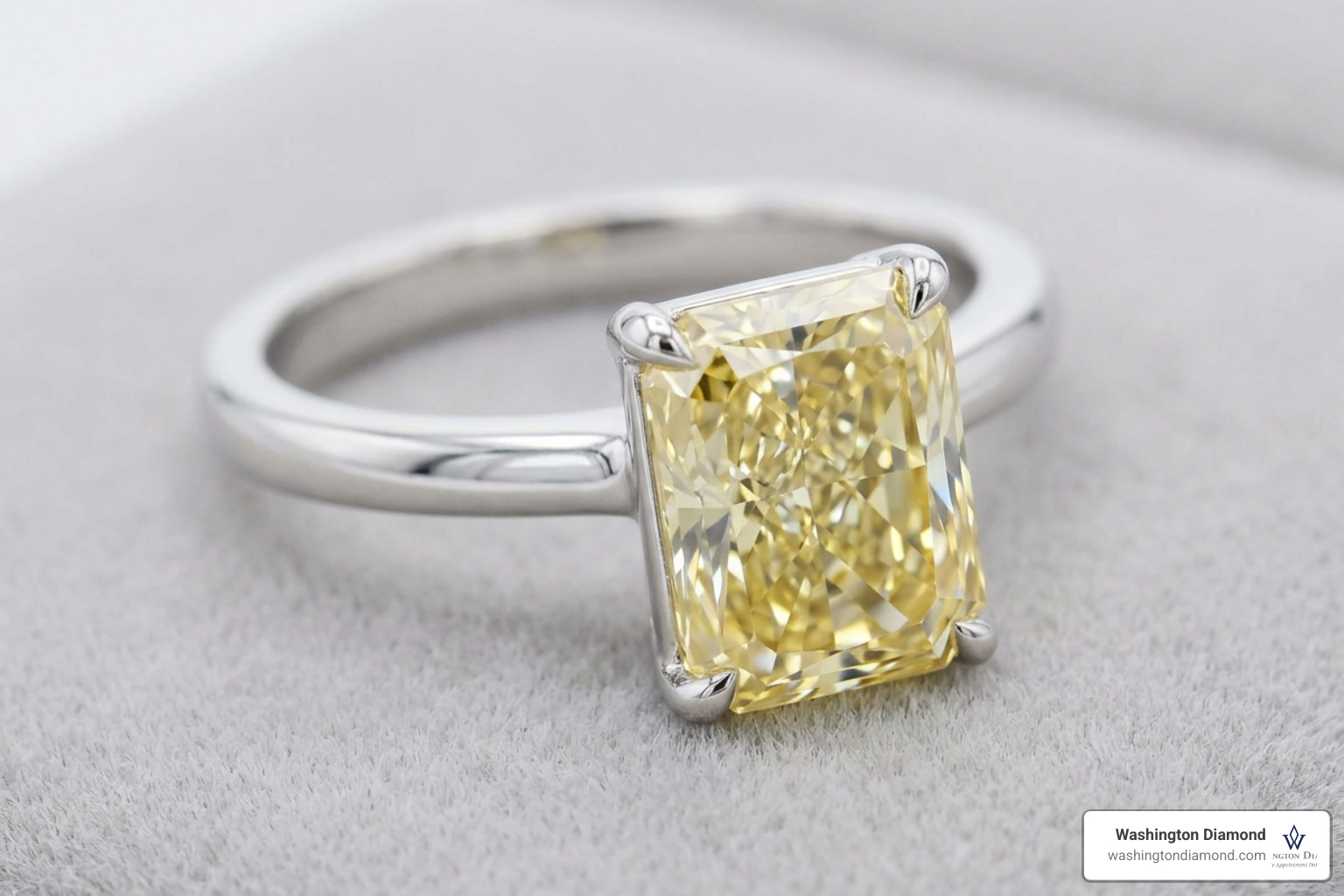
- Choose the Right Setting: The metal and setting style you choose can dramatically impact how your diamond's color looks. Placing a yellow diamond in a yellow gold cup or yellow gold prongs can make its color look even richer. Surrounding a colored diamond with a halo of small, brilliant white diamonds is another excellent way to make the central hue pop.

At Washington Diamond, we specialize in helping our clients navigate this highly specialized market. From our private, appointment-only studio in Northern Virginia, we provide a personalized, pressure-free environment where you can explore loose colored diamonds.
Whether you are looking to source a rare pink diamond or want to design a bespoke canary yellow engagement ring, we guide you through every step of the process to ensure your custom piece is crafted to absolute perfection.
Frequently Asked Questions
Are colored diamonds more expensive than white diamonds?
In most cases, yes. Because fancy colored diamonds represent just 0.01% of all mined diamonds, their rarity commands a premium. However, the price depends heavily on the specific color.
While rare pinks, blues, and greens can cost tens or hundreds of thousands of dollars per carat, more common fancy colors like brown (often marketed as champagne or cognac) or soft yellow can actually be comparable in price to high-quality colorless diamonds, making them an excellent, character-rich entry point.
What is the rarest colored diamond?
Red diamonds are indisputably the rarest colored diamonds in the world. With fewer than 30 pure red specimens known to exist globally, they are incredibly difficult to find, and almost all of them weigh less than 0.5 carats. The closure of the Argyle mine in Western Australia—which was the primary source of these ultra-rare stones—has made them even scarcer and more valuable.
Can lab-grown diamonds be colored?
Yes, modern laboratory technology allows scientists to create colored diamonds by introducing trace elements or using specialized treatments during the growth process. While lab-grown colored diamonds offer a highly vibrant and budget-friendly alternative, they do not possess the natural geological rarity or investment value of a stone formed over billions of years in the Earth's mantle.
If you love the look of unique, non-traditional diamonds but want a natural stone with plenty of organic character, you might also consider exploring salt and pepper diamonds. Learn more in our guide to Salt & Pepper Lab Diamonds: Your Guide to Their Unique Charm and Creation.
Conclusion
Fancy diamonds are truly some of the most breathtaking creations on Earth. They represent a flawless marriage of geological history, extreme rarity, and vibrant personal expression. Whether you are captivated by the sunny warmth of a yellow diamond, the romantic blush of a pink, or the dramatic elegance of a black diamond, choosing one of these stones is a beautiful way to celebrate life's most meaningful moments.
If you are ready to begin your search, we invite you to experience the Washington Diamond difference. In our private, appointment-only studio in Northern Virginia, we offer you our undivided attention, guiding you through our extensive collection of loose stones and custom jewelry designs. From classic settings to unique creations like Black Diamond Bezel Earrings, we are here to help you bring your vision to life.
To take the first step, schedule your personalized consultation with us today, or dive deeper into diamonds by reading Explore Loose Diamonds with Our Complete Guide.
Have a question about your jewelry?
We've been helping clients with diamonds, custom design, repairs, appraisals, and more since 1969. Book a private appointment at our Falls Church studio.
Book an AppointmentTrusted since 1969 · Falls Church, VA · 703-536-3600
From the blog
View all


