

The Definitive Guide to Natural Diamond Engagement Ring Quality & Price
How to Choose Natural Diamond Engagement Rings for Quality and Value

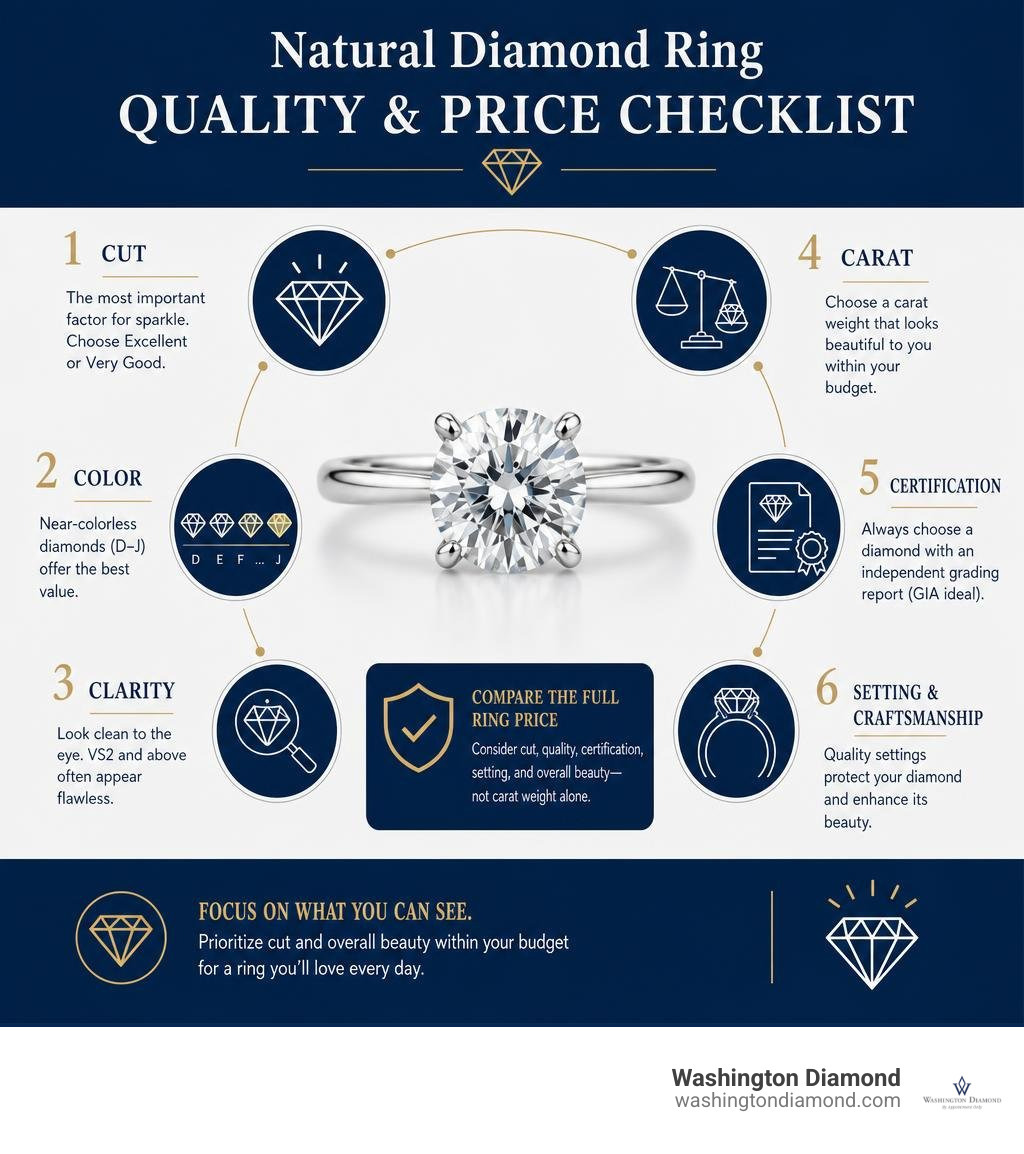
The best natural diamond engagement rings balance excellent cut, a trusted grading report, and a budget that prioritizes what you can see. Start with cut, because it drives sparkle; then choose a color, clarity, and carat weight that look beautiful to your eye. Confirm the diamond's natural origin and quality with an independent report, ideally from GIA, and compare the full ring price rather than carat weight alone.
Natural diamonds formed deep within Earth over billions of years, then reached the surface through volcanic activity. That rare geological history, combined with durability and long-standing cultural meaning, makes them a traditional choice for proposals and future heirlooms.
Price can vary widely. Two diamonds with the same carat weight may look very different - and cost very different amounts - because cut quality, color, clarity, shape, certification, and setting all matter. A natural diamond may also retain more resale appeal than many alternatives, though no engagement ring should be purchased solely as a financial investment.
I am Tom Daube, a GIA-trained diamond professional, jewelry designer, and diamond recutting specialist with deep experience helping clients compare natural diamond engagement rings for beauty, quality, and price. In this guide, I will break down what matters most so you can buy with confidence and avoid paying for qualities that do not improve the ring you see every day.
Quality Drivers in Natural Diamond Engagement Rings
When you hold a finished ring, you are admiring one of nature’s most extraordinary triumphs. Long before a gem arrives in a jewelry case, pure carbon undergoes intense heat and pressure between 90 and 150 miles below the Earth’s surface. Over one to three billion years, those carbon atoms organize into a rigid, three-dimensional crystal lattice. Deep-source volcanic eruptions eventually transport these crystals toward the surface inside magma columns known as kimberlite pipes.
This geological miracle means every natural diamond carries an authentic, organic history that simply cannot be replicated by factory machines. In our private Northern Virginia studio, we walk clients through how this unique crystal structure directly influences fire, brilliance, and everyday durability.
| Quality Tier | Cut Grade | Color Range | Clarity Range | Visual Impact & Value Sweet Spot |
|---|---|---|---|---|
| Collector / Elite | Excellent / Ideal | D – F (Colorless) | FL – VVS2 | Purest crystalline perfection; commands top market premiums. |
| Smart Luxury (Recommended) | Excellent / Ideal | G – I (Near Colorless) | VS1 – SI1 (Eye-Clean) | Optimal balance; looks identical to flawless tiers to the naked eye at substantial savings. |
| Value-Oriented | Very Good | J – K (Faint Tint) | SI2 – I1 | Warmer tone best paired with yellow gold; noticeable inclusions requiring careful selection. |
Evaluating the 4 Cs: Cut, Color, Clarity, and Carat
Understanding how the 4 Cs interact helps you direct your budget toward the features that truly elevate beauty:
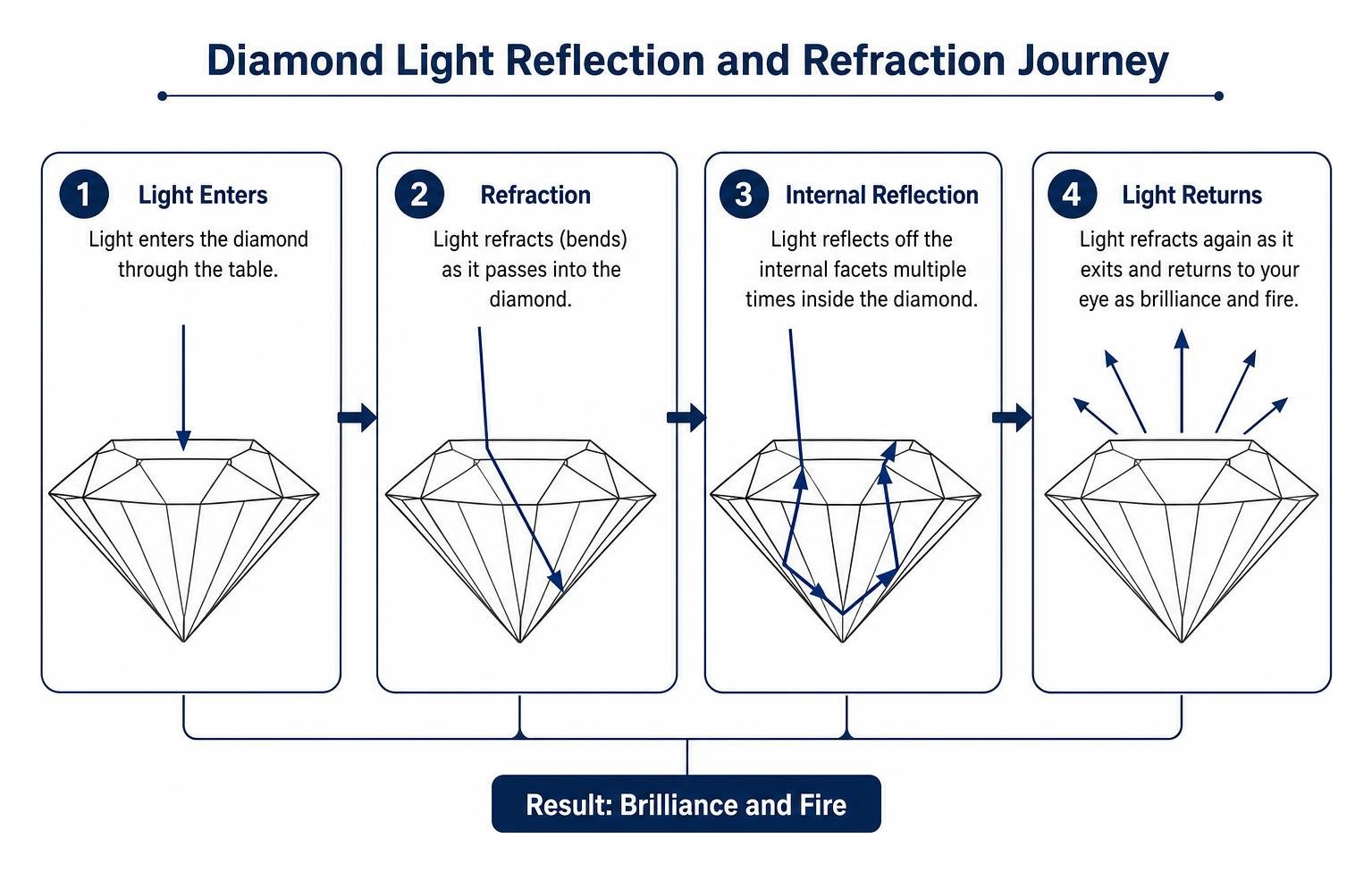
- Cut: Cut is the master metric. It dictates how light enters the stone, bounces off the interior facets, and reflects back as sparkle (brilliance) and rainbow flashes (fire). An exceptionally cut stone can even make a diamond look visibly larger than a poorly proportioned stone of heavier carat weight.
- Color: Diamonds are graded on an alphabetical scale from D (colorless) to Z (light yellow or brown). For white gold or platinum, stones in the G–I range provide exceptional value because they appear bright white face-up without the premium attached to D–F grades.
- Clarity: This measures internal inclusions and surface blemishes. Selecting an "eye-clean" VS1 to SI1 diamond ensures that any microscopic characteristics remain completely invisible without a magnifying loupe.
- Carat Weight: Diamond weight is measured in carats, but carat refers to mass, not direct visual footprint. Choosing slightly under whole-number benchmarks (such as a 1.90ct instead of a 2.00ct) can yield significant savings with zero noticeable difference in size.
To understand how mounting designs affect these stones, explore our comprehensive Engagement Ring Settings Education.
Certification and Grading: Why Independent Verification Matters
Never purchase a center stone based on subjective vendor claims alone. Unbiased laboratories like the Gemological Institute of America (GIA) provide objective evaluations that verify a diamond is natural, unenhanced, and correctly graded.
A genuine GIA report lists precise measurements, proportion diagrams, and clarity mapping, often accompanied by a micro-laser inscription on the diamond's girdle. To see current market trends across certified tiers, consult our GIA Certified Diamonds Price Guide. Beyond quality, authentic certification guarantees ethical provenance verified through the international Kimberley Process.
Diamond Pricing, Budgeting, and Value Retention
The natural diamond market operates on finite global resources. In 2022, global rough diamond production reached approximately 120 million carats, only a fraction of which meets the exacting clarity and color criteria required for fine bridal jewelry.
Because mining, extracting, and master-cutting natural rough requires immense capital and expertise, natural diamonds account for over 90% of the global diamond engagement ring market by total value. Explore our curated selection of Diamond Engagement Rings Washington to compare market pricing in person.
Cost Breakdown of Natural Diamond Engagement Rings
Today, approximately 80% of engagement rings sold in the United States feature a natural diamond center stone, with the average national expenditure hovering between $5,500 and $6,000.
A standard ring budget splits between the loose center gem (typically 70% to 85% of total cost) and the precious metal mounting (15% to 30%). If you are shopping locally, browse our showcase of Engagement Rings Washington to see how various carat weights pair with customized settings.
Long-Term Resale Value and Market Longevity
Unlike lab-created stones that face steep depreciation as mass-manufacturing scales up, natural diamonds benefit from organic scarcity and steady consumer demand. Nearly 70% of modern couples prefer natural diamonds for their engagement rings specifically due to tradition and long-term value retention.
While retail jewelry should never be treated like a short-term stock trade, natural gems serve as meaningful generational heirlooms that hold inherent intrinsic worth across decades.
Setting Styles and Custom Ring Designs

Selecting the right precious metal mounting transforms a loose diamond into an enduring symbol of your commitment. Platinum offers unrivaled density and hypoallergenic security, while 18k yellow gold and rose gold provide warm, romantic contrast. Review our guide to Engagement Ring Settings 101 to compare band widths and prong architectures.
Modern Setting Styles for Natural Diamond Engagement Rings
Bridal designs continue to evolve, blending heritage silhouettes with sleek modern lines:
- Three-Stone Rings: Representing past, present, and future, multi-stone settings amplify finger coverage. The 1.72ct Diamond Platinum Three Stone Oval Engagement Ring showcases remarkable brilliance by flanking a central oval with matching side stones.
- Refined Solitaires: A minimalist profile places all visual emphasis on cut perfection. Designs like the Platinum Solitaire 6-Prong Crown Head Engagement Ring Setting deliver timeless security.
- Trilogy Configurations: Intricate accenting, such as the Arista Three Stone 0.53 Carat Diamond Platinum Four Prong Engagement Setting, brings vintage-inspired romance to the forefront.
- Two-Tone Accents: Mixing metals provides striking visual depth, as seen in the Shared Prong Single Row Diamond Engagement Ring.
- Pavé Solitaires: For subtle sparkle along the band, the Classic 0.20 Carat Diamond Platinum Four Prong Engagement Setting offers delicate elegance.
Bespoke Ring Creation and Custom Craftsmanship
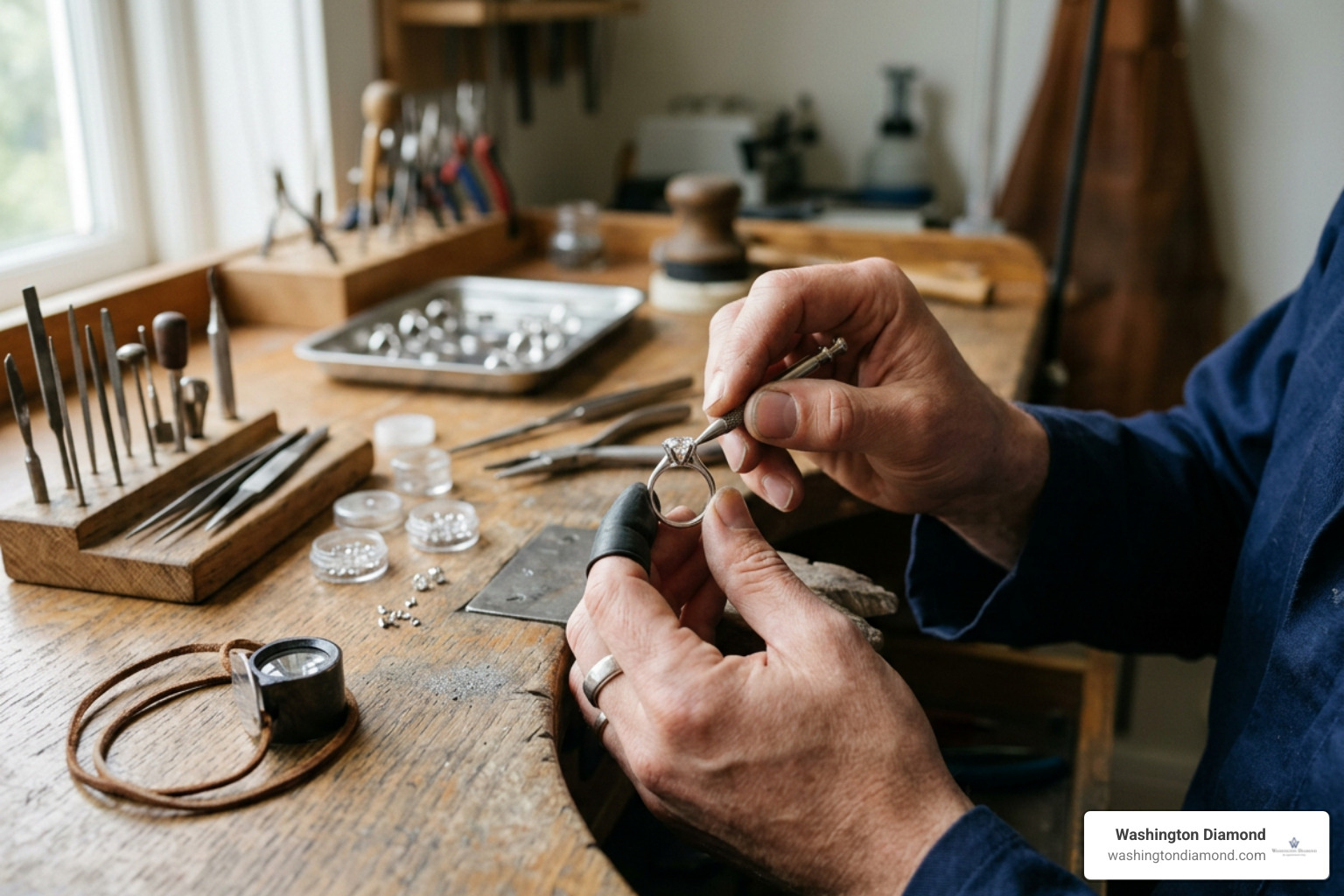
When an off-the-shelf setting does not fully express your personal story, custom design allows you to craft a one-of-a-kind ring from the ground up. Through our private, appointment-only process, we utilize high-precision 3D CAD modeling and artisan benchwork to tailor every contour to your center diamond.
Learn more about our collaborative workflow through Custom Engagement Ring Design and explore options for Custom Engagement Rings Tysons Corner. For an in-depth regional perspective on ring curation, read Your Guide to Unforgettable Diamond Rings in Washington DC.
Frequently Asked Questions About Natural Diamonds
How do natural diamonds hold their value over time?
Natural diamonds maintain stable secondary market appeal because global deposits are finite and challenging to extract. While retail markup means a ring is not a speculative liquid asset, authentic earth-mined diamonds hold inherent value and historical market demand that manufactured alternatives do not match.
What is the average cost of a natural diamond engagement ring in 2026?
Couples spend an average of $5,500 to $6,000 for a finished ring in the United States. However, prices vary widely depending on personal preferences—ranging from $2,500 for a modest, beautifully cut solitaire to $25,000+ for large, premium-grade collector diamonds.
How can buyers verify that a natural diamond is ethically sourced?
Work exclusively with reputable jewelers who provide third-party laboratory reports (such as GIA) and adhere to the Kimberley Process Certification Scheme and the System of Warranties. These international frameworks track diamonds from mine to market to ensure conflict-free origins.
Conclusion
A natural diamond engagement ring represents an extraordinary intersection of geological history, master craftsmanship, and personal commitment. By prioritizing cut quality, selecting an eye-clean clarity and near-colorless grade, and working with verified grading reports, you can maximize your budget while securing a diamond of breathtaking beauty.
At Washington Diamond, we believe choosing an engagement ring should be an intimate, pressure-free experience. Our private, appointment-only studio in Northern Virginia offers you undivided, one-on-one attention as we guide you through loose diamonds and custom mountings tailored to your exact vision.
To explore all aspects of selecting your dream ring, visit our complete guide to diamond rings in 2026 and schedule your private consultation with our diamond specialists today.
Have a question about your jewelry?
We've been helping clients with diamonds, custom design, repairs, appraisals, and more since 1969. Book a private appointment at our Falls Church studio.
Book an AppointmentTrusted since 1969 · Falls Church, VA · 703-536-3600
From the blog
View all


