

Put a Ring on It 1900s Style with These Gorgeous Edwardian Engagement Ring Designs
The Timeless Appeal of Edwardian Engagement Ring Styles
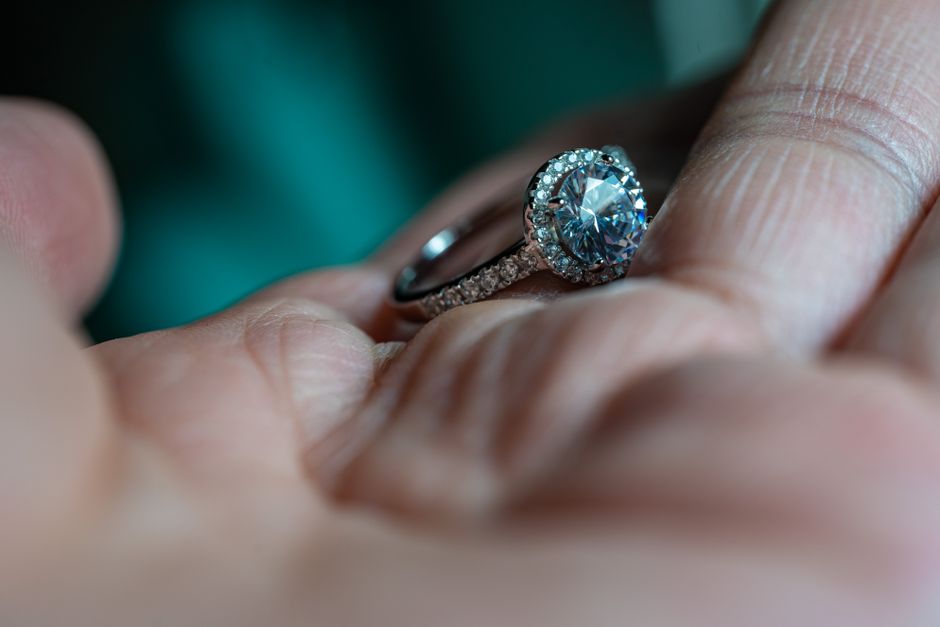
Edwardian engagement ring styles are among the most elegant and distinctive in jewelry history. Produced between 1901 and 1920, these rings are instantly recognizable by their delicate platinum lacework, intricate filigree, and luminous old European cut diamonds.
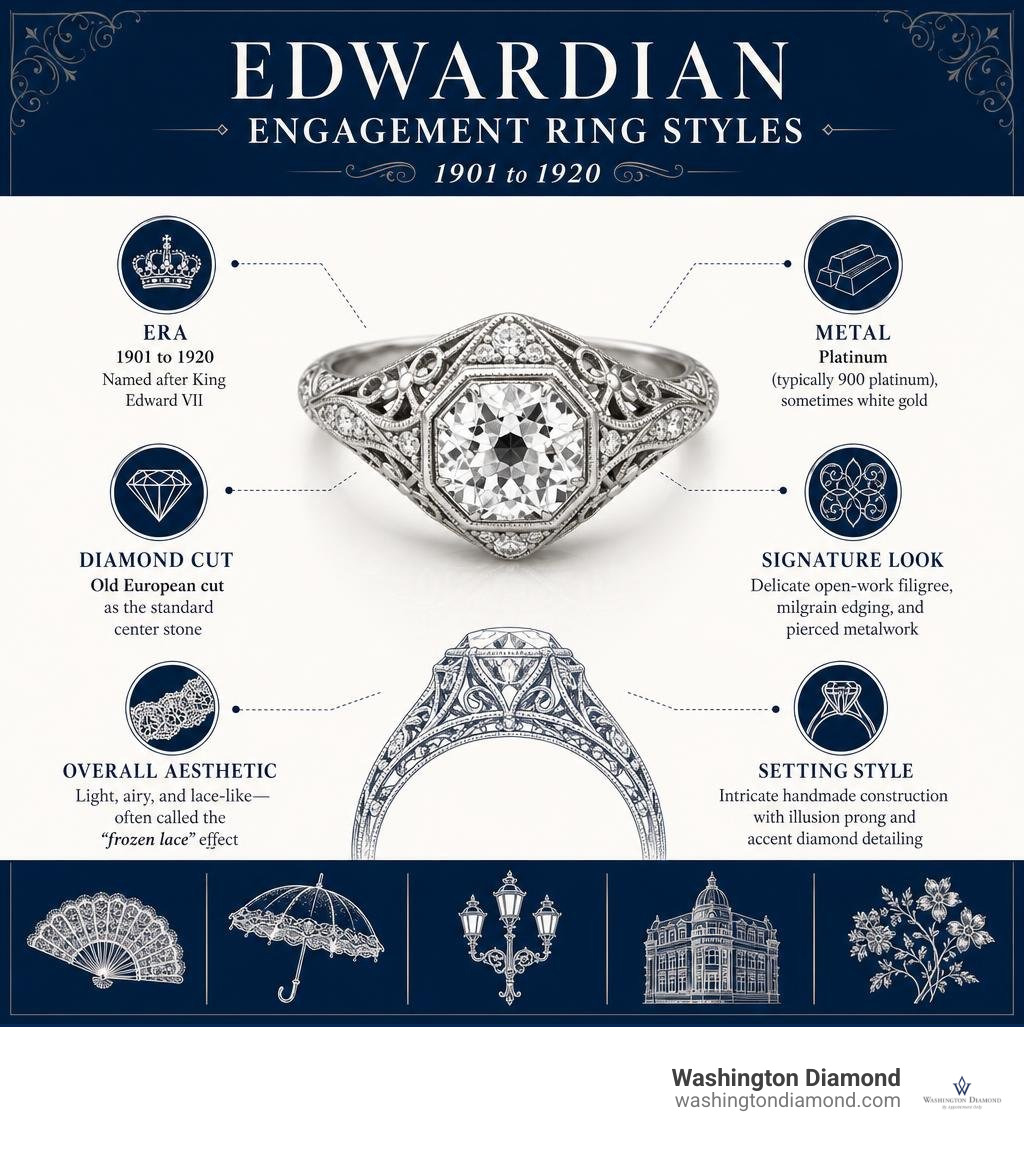
Here is a quick snapshot of what defines an Edwardian engagement ring:
- Era: 1901 to 1920, named after King Edward VII
- Metal: Platinum (typically 900 platinum), sometimes white gold
- Diamond cut: Old European cut as the standard center stone
- Signature look: Delicate open-work filigree, milgrain edging, and pierced metalwork
- Overall aesthetic: Light, airy, and lace-like — sometimes called the "frozen lace" effect
- Setting style: Intricate handmade construction with illusion prong and accent diamond detailing
This era coincided with the Belle Époque — a period of optimism, elegance, and refined taste across Europe and North America. That cultural mood shows up directly in the jewelry: these rings feel less like metal and stone, and more like wearable art.
I'm Tom Daube, a GIA-certified diamond specialist and jewelry designer with decades of experience helping clients find and create fine, classic pieces — including authentic and custom Edwardian engagement ring styles. Whether you're exploring antique originals or a bespoke modern recreation, this guide covers everything you need to know.
Defining the Era: What Are Edwardian Engagement Ring Styles?
To understand Edwardian engagement ring styles, we have to take a quick trip back to the turn of the 20th century. Named after King Edward VII and his fashionable wife, Queen Alexandra, the Edwardian era (spanning roughly 1901 to 1920) was a time of high society, grand garden parties, and a general sense of lighthearted sophistication.
This cultural shift heavily influenced jewelry design. While previous generations favored heavier, darker, and more imposing jewelry, Edwardian aristocrats wanted pieces that felt light, airy, and ethereal. They wanted jewelry that would perfectly complement the pastel silks, lace dresses, and feather boas popular in high-society salons.
The defining breakthrough of Edwardian jewelry was the "platinum revolution." Prior to this era, working with platinum was incredibly difficult because of its exceptionally high melting point. However, the invention of the oxyacetylene torch in the early 1900s changed everything. For the first time, jewelers had a tool hot enough to easily melt and manipulate platinum.
Because platinum is incredibly strong and does not easily tarnish, artisans realized they could pull and stretch the metal into incredibly thin, wire-like threads without sacrificing structural integrity. This allowed them to create the "frozen lace" effect—settings that looked like delicate embroidery or spun sugar, yet were strong enough to safely hold precious diamonds.
Victorian vs. Edwardian Engagement Ring Styles
To truly appreciate the airy lightness of the Edwardian aesthetic, it helps to compare it to the era that came right before: the Victorian era (1837 to 1901).
Named after Queen Victoria, Victorian jewelry was heavily influenced by the Queen’s personal life. Her early years with Prince Albert brought romantic, sentimental motifs like snakes (symbolizing eternal love), flowers, and hearts, usually set in warm yellow gold or rose gold. When Albert passed away in 1861, the jewelry transitioned into a heavier, darker "Grand Period" dominated by black onyx, jet, and deep red garnets.
In contrast, the Edwardian era abandoned the heavy, sentimental gold styles in favor of a monochromatic, all-white aesthetic. Platinum and white diamonds became the ultimate status symbols. Instead of the chunky, cushion-shaped old mine cut diamonds favored by the Victorians, Edwardian jewelers embraced the more symmetrical old European cut.
To help visualize this stylistic evolution, here is a quick comparison of the two eras:
| Design Element | Victorian Era (1837–1901) | Edwardian Era (1901–1920) |
|---|---|---|
| Primary Metals | Yellow gold, rose gold, silver-topped gold | Platinum (solid 900), white gold |
| Common Diamond Cuts | Old mine cuts, rose cuts | Old European cuts, single cuts |
| Aesthetic Philosophy | Rich, heavy, romantic, and sentimental | Light, airy, monochromatic, and lace-like |
| Key Motifs | Snakes, hearts, ivy leaves, celestial stars | Bows, garlands, tassels, laurel wreaths |
| Metalwork Techniques | Repoussé, heavy carvings, claw prongs | Pierced metalwork, fine filigree, milgrain |
For a deeper dive into how these two eras compare and how their histories intertwine, check out the guide on Victorian and Edwardian Engagement Ring Styles Explained.
Hallmark Features of Edwardian Ring Design
If you are looking at an antique ring and trying to determine if it is a genuine Edwardian piece, there are several key craftsmanship techniques to look out for. These features require an immense level of skill, and they are what make these rings so highly coveted by collectors today.
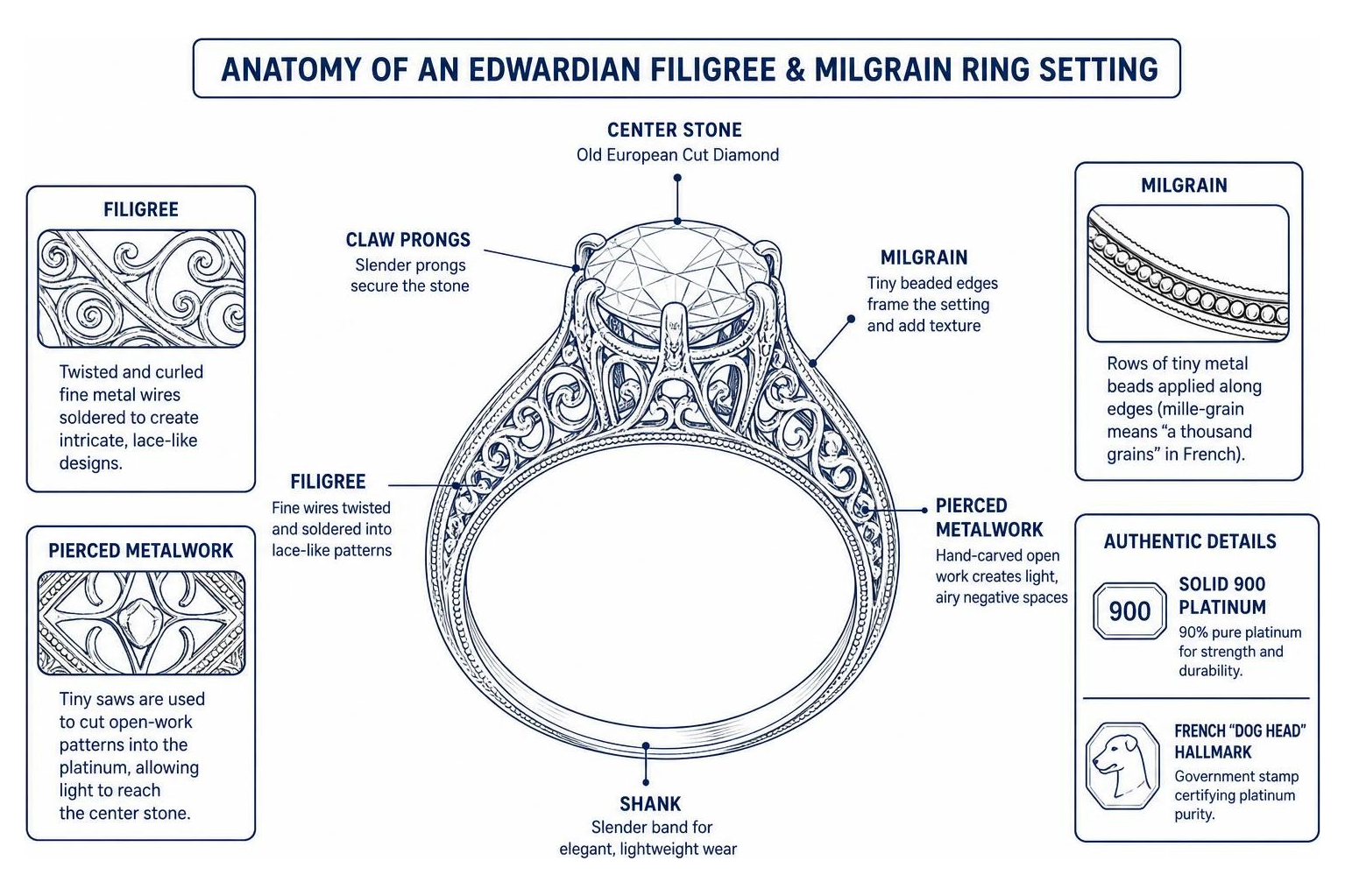
- Filigree: This technique involves twisting and curling incredibly fine threads of precious metal (usually platinum) and soldering them onto the jewelry piece. It creates intricate, lace-like patterns that make the metal look weightless.
- Milgrain: Derived from the French mille-grain, meaning "a thousand grains," milgrain is a decorative technique where tiny, uniform beads of metal are applied along the edges of a setting. It frames the design beautifully and adds a subtle, vintage texture that catches the light.
- Pierced Metalwork: Rather than casting a solid piece of metal, Edwardian jewelers used tiny saws to hand-carve intricate open-work patterns directly into the platinum. This created geometric and floral negative spaces, allowing light to flood the center stone from all angles.
- Solid 900 Platinum: High-end Edwardian rings were crafted from solid 900 platinum (90% pure platinum mixed with 10% iridium or copper). This alloy was strong enough to support the era's microscopic metalwork.
- French "Dog Head" Hallmark: If you are lucky enough to find an authentic Edwardian piece of French origin, look closely at the outer shank under a jeweler's loupe. The French government stamped authentic platinum pieces with a tiny hallmark of a dog's head to certify its purity.
Key Design Elements of Edwardian Engagement Ring Styles
Beyond the metalwork, Edwardian engagement ring styles are defined by how they showcase their stones.
Unlike modern rings that often lift the diamond high above the finger in a simple four-prong setting, Edwardian rings favored lower profiles and integrated settings. A very popular style was the illusion prong setting, where a central diamond was set into a square or hexagonal platinum frame. This frame made the circular diamond appear larger and more geometric.
Additionally, jewelers rarely left any metal undecorated. They frequently used tiny single-cut accent diamonds (small round diamonds with only 17 or 18 facets) to fill in the spaces between the filigree patterns. This created a continuous surface of soft, glittering sparkle rather than the blinding flash of modern brilliant cuts.
Popular motifs of this era were inspired by classical 18th-century French court designs. You will often see delicate bows, flowing garlands, tassels, and laurel wreaths hand-engraved or pierced into the metalwork.
If you are curious about how these settings compare to modern alternatives, read our comprehensive guide on Engagement Ring Settings 101 or explore the micro-details of vintage-style accenting in our Pave Engagement Setting Complete Guide.
Antique Diamond Cuts and Gemstones of the 1900s
The diamonds used in genuine Edwardian rings have a completely different personality than the ones you see in jewelry stores today.
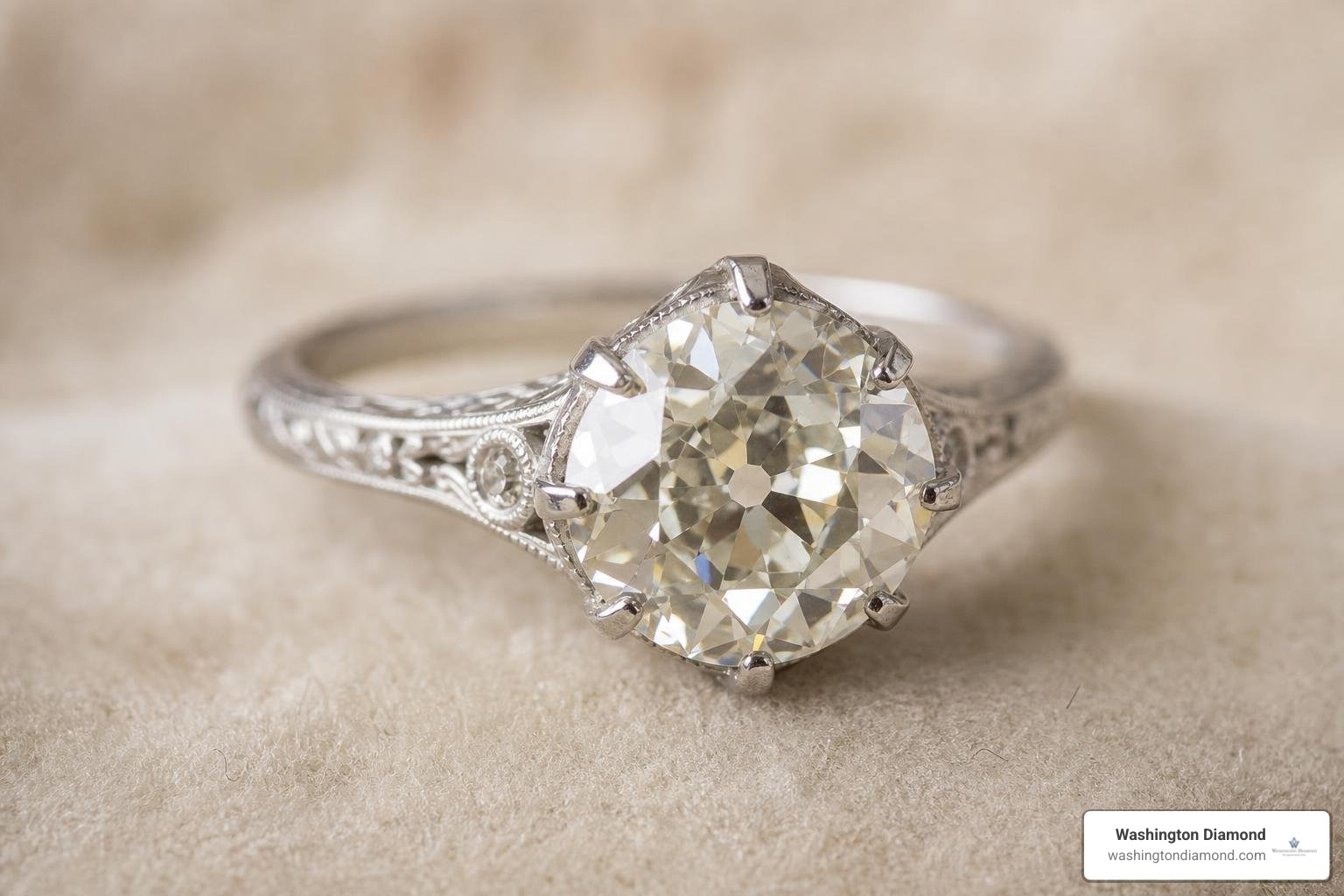
During the early 1900s, diamonds were still cut entirely by hand. Cutters did not have modern computer-aided lasers; instead, they relied on their eyes and decades of experience to bring out the stone's beauty.
The reigning king of the Edwardian era was the Old European Cut (OEC). As the direct predecessor to the modern round brilliant cut, the OEC features 58 facets, but its proportions are quite different:
- It has a smaller table (the flat facet on top).
- It features a higher crown (the top portion of the diamond).
- It has a larger culet (the flat facet at the very bottom tip of the diamond, which looks like a tiny circle when viewed through the top).
These proportions mean that while modern diamonds are engineered to maximize white light return (brilliance) under harsh artificial lighting, Old European cuts were designed to glow under soft candlelight. They throw off blockier, broader flashes of colored light (fire) and have an incredibly romantic, warm presence.
To see a beautiful real-world example of this, you can look at the Edwardian Platinum GIA 1.29ctw Diamond Solitaire Engagement Ring Auction. This stunning, authentic 1910s French piece features a center Old European cut diamond weighing 1.17 carats with a VS2 clarity and a slightly warm L color, beautifully accented by six single-cut diamonds in a solid 900 platinum setting.
In the Edwardian era, diamonds with a slight hint of warmth (such as J, K, or L color grades) were highly prized because they looked incredibly rich when set in bright, white platinum. If you want to find out which vintage or modern diamond shape matches your personal style, check out our guide on The Perfect Diamond Shape for Every Personality.
Buying Guide: Authenticating and Caring for Antique Edwardian Rings
Shopping for an authentic antique Edwardian ring is an exciting treasure hunt, but it requires a careful eye. Because these rings are over a century old, you want to make sure you are getting the real deal and that the ring is structurally sound enough for daily wear.
When evaluating a potential antique purchase, keep these authentication tips in mind:
- Look for Hand-Crafted Irregularities: Authentic Edwardian rings were made entirely by hand. Under a magnifying loupe, you should see very slight, charming irregularities in the milgrain beads or the symmetry of the filigree. If the lines are absolutely, mathematically perfect, the ring was likely made using modern 3D printing and casting techniques.
- Verify the Marks: Look for historical hallmarks. In addition to the French "Dog Head" stamp for platinum, British pieces will have specific town and date letters, while American pieces might be stamped "PLAT" or "950 PLAT."
- Insist on Certification: If the ring features a diamond over 1.00 carat, ensure it comes with an independent grading report from a reputable lab like the GIA. This certifies that the stone is a genuine antique cut and has not undergone modern treatments.
Sizing and Maintenance Considerations for Antique Rings
Before you fall in love with a 115-year-old ring, you must consider the practicalities of sizing and maintenance.
Because Edwardian rings often feature intricate, pierced metalwork and filigree that wraps all the way around the band, resizing them can be incredibly challenging. If a ring needs to be sized up or down by more than one full size, the process can distort the delicate open-work patterns or put pressure on the accent diamond settings. Always consult an expert jeweler who specializes in antique restoration before purchasing.
Additionally, while platinum is highly durable, a century of wear can take a toll. Prongs can wear down, and the tiny metal beads holding accent stones in place can flatten out. We highly recommend having any antique ring inspected by a professional at least twice a year to ensure all stones are secure.
For a detailed look at how to safely care for and resize historic jewelry, explore our guides on Passing Down the Sparkle A Guide to Resizing Your Family Heirloom Ring and From Antique to Resized Your Ultimate Guide to DC Jewelry Services.
Recreating the Magic: Modern Edwardian-Style Custom Rings
What if you absolutely love the delicate, romantic look of Edwardian engagement ring styles, but you want a ring that is completely brand new, structurally perfect, and tailored to your exact finger size?
The wonderful news is that modern custom jewelry design allows us to recreate the magic of the 1900s while utilizing modern engineering for added durability.
At Washington Diamond, we combine advanced CAD (Computer-Aided Design) technology with old-world hand-craftsmanship. We can design a digital model of your dream ring—incorporating classic Edwardian elements like bows, garlands, and milgrain borders—and then have our master bench jewelers hand-engrave the fine details and hand-set the stones.
When building a custom period-inspired ring, you can choose to use an authentic, ethically sourced antique Old European cut diamond, or opt for a modern cut diamond set in a vintage-inspired mounting. You also have your choice of metals: while solid platinum is the historical standard, high-purity 18K white gold is a beautiful, bright alternative.
To learn more about how we bring these gorgeous custom designs to life in our Northern Virginia studio, take a look at our Custom Design Engagement Ring Guide and discover how we work with white metals in White Gold Wonders How to Create Your Own Bespoke Masterpiece.
Frequently Asked Questions about Edwardian Rings
Are Edwardian engagement rings durable enough for daily wear?
Yes! Because Edwardian rings were primarily crafted from platinum, they are remarkably durable. Platinum does not wear away over time like gold does; instead, it merely shifts or "displaces" when scratched, creating a lovely, soft patina. However, because of the delicate nature of fine filigree and open-work, we recommend removing your ring before doing heavy manual work, gardening, or exercising. Regular prong inspections are key to keeping the stones safe.
What is the difference between an Old European cut and a modern round brilliant cut?
While both cuts have 58 facets and a round shape, they handle light differently. A modern round brilliant cut is engineered with a flat top (large table) and specific angles to maximize white light reflection (brilliance). An Old European cut has a smaller top, a taller crown, and a larger open culet at the bottom. This hand-cut design produces broader, slower flashes of colored light (fire) that look incredibly beautiful in dim, warm lighting.
How can I tell if an Edwardian ring is authentic?
Look for clues of handmade construction, such as tiny, non-uniform details in the milgrain and filigree. Authentic rings will also feature period-correct metal stamps (like the French "Dog Head" or early 20th-century purity marks) and will show a gentle, natural wear pattern (patina) rather than the ultra-bright, polished look of modern cast jewelry. Having the piece evaluated by an independent, GIA-certified appraiser is the best way to guarantee authenticity.
Conclusion
There is something undeniably magical about Edwardian engagement ring styles. They represent a golden age of jewelry design where craftsmanship reached its absolute peak, turning solid metal into delicate, wearable lace.
Whether you are drawn to the rich history of an authentic antique piece or want to capture that vintage romance in a custom-designed ring made just for you, we are here to help. At Washington Diamond, our private, appointment-only studio in Northern Virginia offers a highly personalized, undivided experience. We will sit down with you, explore different diamond cuts, and help you find or create a masterpiece that will be cherished for generations.
Ready to find your perfect ring style? Schedule a private consultation with us today, and start your journey by exploring our comprehensive guide on Engagement Ring Settings 101.
Have a question about your jewelry?
We've been helping clients with diamonds, custom design, repairs, appraisals, and more since 1969. Book a private appointment at our Falls Church studio.
Book an AppointmentTrusted since 1969 · Falls Church, VA · 703-536-3600
From the blog
View all


