

Your Diamond's Value, Instantly: A Guide to Free Online Calculators
Understanding Your Diamond's Worth in Minutes
A free diamond appraisal calculator is an online tool that estimates your diamond's value based on its characteristics—carat weight, color, clarity, and cut. By comparing your diamond's details against millions of real-time prices from online jewelers, it generates a "Fair Price Estimate," much like a Zestimate for real estate.
Quick Answer: How to Use a Free Diamond Appraisal Calculator
- Gather your diamond's details - Shape, carat, color, clarity, and cut (from a GIA or AGS certificate).
- Input the information into the calculator's online form.
- Review your estimate - You'll receive a retail price range in seconds.
- Understand the limitations - The estimate is a starting point, not a certified appraisal.
Whether you're curious about an heirloom's value, checking your engagement ring's worth, or researching a purchase, these calculators offer a quick, pressure-free way to understand what your stone might be worth. No appointments, no salespeople—just straightforward information. The catch? They provide estimates, not official appraisals, and can't assess your diamond's unique visual appeal. But for a quick reality check, they're an excellent first step.
What is a Diamond Appraisal Calculator and How Does It Work?
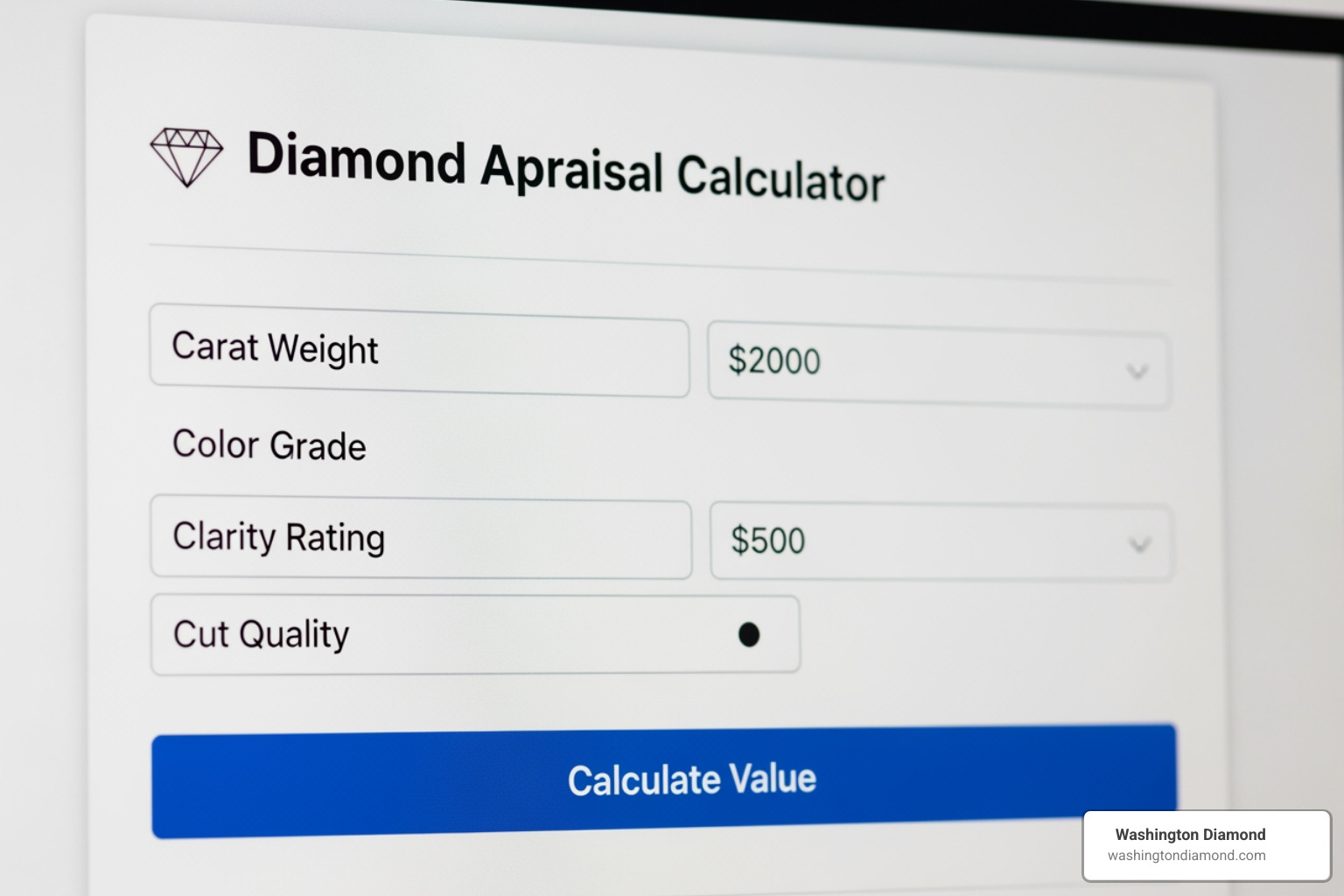
A free diamond appraisal calculator works by tapping into vast databases of current market prices, often updated daily. Using sophisticated algorithms, it compares your diamond's details against millions of historical and real-time sales data points. This allows it to generate an estimate that reflects current market trends, such as recent shifts in natural or lab-grown diamond prices. It's a fantastic way to quickly understand the market, whether you're looking to buy, sell, or just satisfy your curiosity. To truly understand its potential, it’s wise to Calculate the Value of a Diamond Before You Buy or Sell.
The Information You'll Need
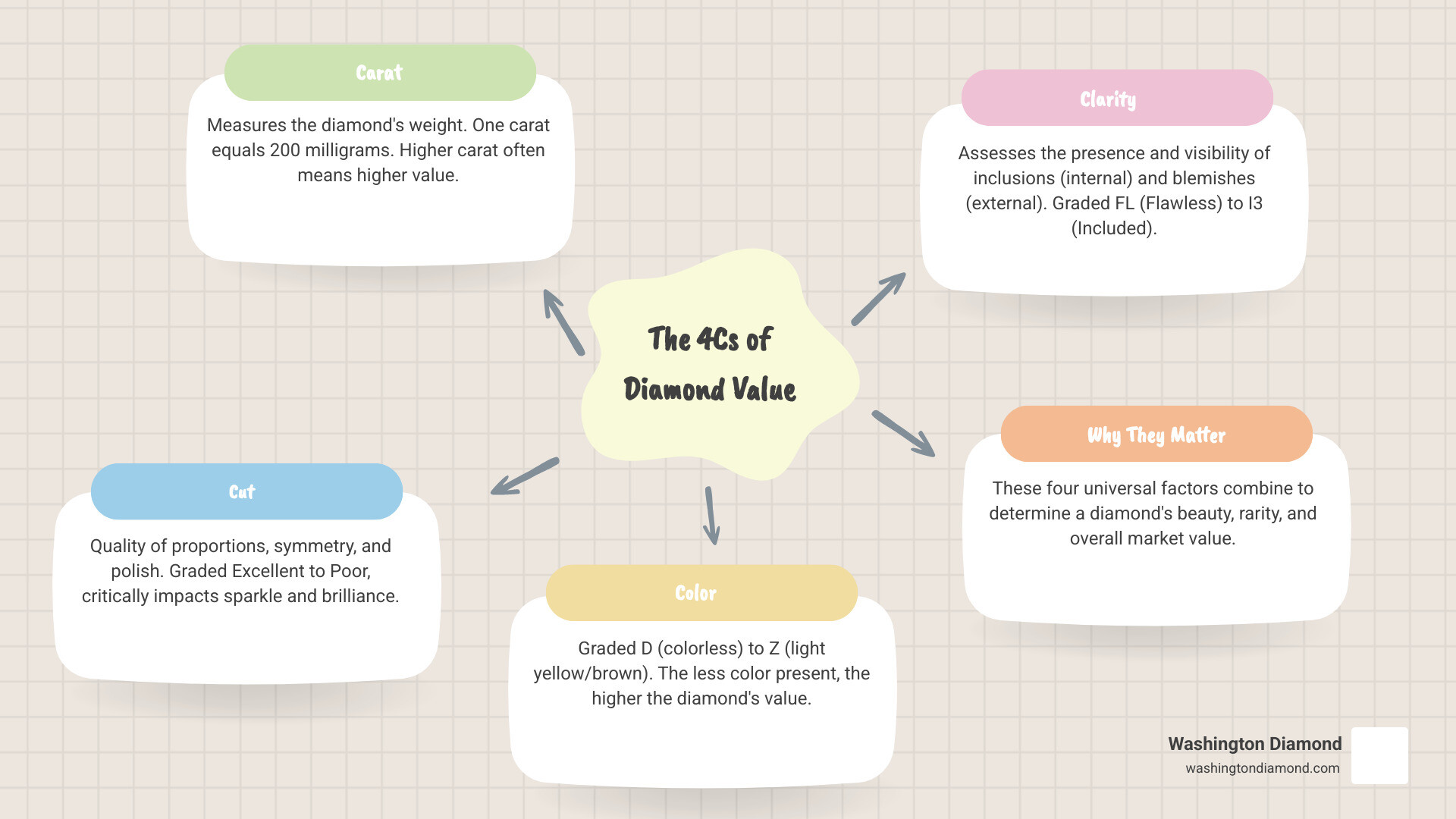
To get an accurate estimate, you'll need the "4Cs" and shape of your diamond. The most reliable source for this is a grading report.
- Carat Weight: The diamond's weight, measured in carats (e.g., 1.50 ct).
- Color Grade: A grade from D (colorless) to Z (light yellow/brown).
- Clarity Rating: A grade for internal flaws (inclusions) and external blemishes, from Flawless (FL) to Included (I3).
- Cut Quality: How well the diamond's facets interact with light, graded from Excellent to Poor.
- Diamond Shape: Round, princess, emerald, oval, etc. Round brilliants are often the most valuable.
- Lab Report/Certification: A report from a reputable lab like the Gemological Institute of America (GIA) or the American Gem Society (AGS) provides an unbiased assessment. Without it, any estimate is less precise.
Accuracy and Limitations
While useful, a free diamond appraisal calculator has limitations. It provides a good ballpark figure but isn't a substitute for a professional appraisal.
Accuracy Assumptions:
- No Fluorescence: Prices often assume the diamond has no fluorescence.
- Excellent Cut: Estimates are typically based on diamonds with Excellent cut grades.
- GIA Report: A GIA lab report is often a baseline assumption.
Key Limitations:
- Estimate vs. Appraisal: It's an estimate, not a legally recognized document.
- Visual Appeal: A calculator can't "see" your diamond's unique brilliance or the nature of its inclusions.
- Treatments: It may not account for value-altering treatments like fracture filling.
- Setting Value: The calculator focuses on the loose diamond, not the jewelry setting.
A calculator is a powerful tool for initial research, but it's not the final word. For concerns about official valuation costs, see our guide on Don't Get Ring Ripped Off: Your Guide to Appraisal Costs.
How to Use a Free Diamond Appraisal Calculator: A Step-by-Step Guide
Using a free diamond appraisal calculator is straightforward, but taking a moment to gather the right information will ensure you get the most accurate estimate possible. Think of it as preparing for a treasure hunt—you need the map and the right tools!
Step 1: Gather Your Diamond's Key Details
The first and most crucial step is to arm yourself with precise information about your diamond. We're talking about the specifics that make your diamond unique.
Here's what you'll need:
- Shape: Round, Oval, Princess, Emerald, Pear, Cushion, Marquise, Asscher, Radiant, or Heart. This is often the easiest to identify!
- Carat Weight: Look for this on your diamond's grading report (e.g., 1.05 ct, 2.50 ct). If you don't have a report, a jeweler can accurately weigh it. When entering, aim for accuracy to two decimal places.
- Color Grade: This will be a letter from D (colorless) to Z (light yellow/brown). GIA's scale is the industry standard.
- Clarity Rating: This will be an abbreviation like FL, IF, VVS1, VVS2, VS1, VS2, SI1, SI2, I1, I2, or I3. Again, your grading report is your best friend here.
- Cut Quality (for Round Diamonds): This is graded as Excellent, Very Good, Good, Fair, or Poor. This applies primarily to round brilliant diamonds, though fancy shapes have polish and symmetry grades.
- Certificate (GIA, AGS, etc.): Knowing which laboratory graded your diamond is important, as grading standards can vary. GIA and AGS are the most respected.
If you have a diamond grading report (often called a certificate), all this information will be clearly listed. If not, it's a good idea to have your diamond examined by a professional jeweler or appraiser in Northern Virginia to get these details accurately. For instance, if you're trying to figure out the Decoding the Dollar: Your Guide to 2 Carat Diamond Pricing, having these specifics is paramount.
Step 2: Use Washington Diamond's Free Diamond Appraisal Calculator
Once you have your diamond's details at hand, the next step is to input them into an online calculator. While we don't have a direct calculator link in this article, imagine a user-friendly interface on our website where you could easily enter your diamond's characteristics.
Here's how you would typically proceed:
- Steer to the Calculator: You'd find a prominent link or section on our website dedicated to our free diamond appraisal calculator.
- Select Diamond Type: First, you might choose between "Natural Diamond" or "Lab-Grown Diamond," as their pricing structures are quite different.
- Choose Shape: Select the correct shape of your diamond from a dropdown menu.
- Enter Carat Weight: Type in the exact carat weight.
- Select Color, Clarity, and Cut: Use dropdown menus or sliders to choose the corresponding grades for your diamond.
- Specify Other Details (if available): Some advanced calculators might ask for additional details like polish, symmetry, fluorescence, or even the grading lab. The more details you provide, the more refined your estimate will be.
- Click "Calculate" or "Get Estimate": With a simple click, the calculator processes your input.
Within seconds, the calculator would present you with an estimated value or a price range for your diamond. This process is designed to be quick, intuitive, and completely free. We encourage you to use such a tool to Calculate the Value of a Diamond Before You Buy or Sell and stay informed about market trends. You can even use it over time to track how your diamond's estimated value changes with the market.
Step 3: Understand Your Estimate: Retail vs. Resale Value
Receiving an estimate from a free diamond appraisal calculator is exciting! But it's crucial to understand what that number actually represents. There's a significant difference between a diamond's retail value, its resale value, and its potential loan value.
- Retail Value: The number you get from most online calculators is typically an estimate of the retail price for a similar diamond. This is what you might expect to pay if you were buying that diamond today from an online or traditional jeweler. These estimates usually reflect the lowest available retail price for comparable diamonds, based on extensive market data.
- Resale Value: This is the price you might receive if you sell your diamond. Unfortunately, diamonds, like cars, typically lose a significant portion of their value after an initial retail purchase. Based on industry analysis, the current resale value for a diamond is often around 50% of the lowest available retail price for a similar diamond. So, if a calculator gives you a retail estimate of $10,000, your resale value might be closer to $5,000. This drop is due to several factors we'll discuss shortly.
- Loan Value: Some specialized calculators, particularly those offered by companies that provide asset-based loans, can also give you an estimate of what your diamond might be worth as collateral for a loan. This value is often lower than the resale value, as it accounts for the lender's risk and overhead.
It's important to set realistic expectations. While it's tempting to hope for a high number, the "50% resale rule" is a widely observed industry reality. Your calculator estimate gives you a fantastic starting point, but always factor in this distinction. For a deeper dive into what your diamond might be worth, especially if it's set in a ring, you might be interested in What's Your Bling Worth? Calculate Your Diamond Ring's Value Online.
Online Calculator vs. Professional Appraisal: Knowing the Difference
While a free diamond appraisal calculator is a handy tool, it's not a substitute for a professional appraisal. Think of it as the difference between getting a quick online assessment of your car's trade-in value versus having a certified mechanic perform a thorough inspection and valuation. Both are useful, but they serve different purposes.
Here's a comparison to help clarify:
| Feature | Online Diamond Calculator | Professional Appraisal |
|---|---|---|
| Cost | Free | Typically $75-$150+ (per item, depending on complexity) |
| Accuracy | Good ballpark estimate; based on market data & averages | Highly accurate; based on physical inspection, expert judgment, and current market conditions |
| Purpose | Curiosity, initial buying/selling research, budgeting | Insurance, estate planning, legal matters, high-value sales, collateral for loans |
| Format | Digital estimate (price range) | Formal, signed document with detailed description, photos, and valuation basis |
| Assessment | Input-based (4Cs, shape); cannot assess visual nuances | Physical inspection (magnification, light performance), identification of treatments, assessment of visual appeal beyond grades |
| Legal Standing | None | Legally recognized document |
When to Use a Calculator
A free diamond appraisal calculator shines in specific situations where speed and a general idea of value are more important than a legally binding document.
You should definitely turn to a calculator when you're:
- Simply Curious: Ever wondered what your grandmother's diamond might be worth? A calculator is perfect for satisfying that curiosity without any commitment.
- Doing Pre-Selling Research: Before you even think about putting your diamond on the market, a calculator can give you a realistic expectation of its value, helping you set a fair asking price or negotiate confidently.
- Budgeting for a Purchase: If you're looking to buy a diamond, using a calculator to estimate the value of different options can help you compare prices and ensure you're getting a fair deal. It’s truly The Diamond Value Calculator: Your Secret Weapon for Smart Buying.
- Tracking Market Trends: Since prices fluctuate, checking your diamond's estimated value periodically can give you insights into broader market movements.
- Learning More About Diamonds: Inputting different characteristics into a calculator can be an educational exercise, helping you understand how each of the 4Cs impacts value.
For these purposes, a calculator is an invaluable, risk-free, and convenient tool.
When You Need a Professional Appraiser
While calculators are great for quick estimates, there are times when only a professional appraisal will do. These are situations where a detailed, expert, and legally recognized valuation is required.
You absolutely need a professional appraiser when:
- For Insurance Purposes: Your insurance company will require a formal appraisal to properly insure your diamond against loss, theft, or damage. This ensures you're adequately covered.
- For Estate Settlement: When distributing assets in an estate, a professional appraisal provides an objective valuation of diamonds, ensuring fair division among heirs.
- Selling High-Value Items: If you're selling a particularly valuable or unique diamond, a professional appraisal adds credibility and can help you get the best possible price.
- For Legal Verification: In cases of divorce, inheritance, or other legal proceedings, an official appraisal serves as a crucial, unbiased document.
- For Collateral Loans: If you plan to use your diamond as collateral for a loan, lenders will always require a physical appraisal by a recognized expert to verify its authenticity and value.
- You Have Loose Diamonds: For Loose Diamonds, especially uncertified ones, a professional appraisal is essential to accurately determine their 4Cs and overall quality.
A professional appraiser, like those we trust here in Northern Virginia, has the expertise, equipment, and market knowledge to carefully examine your diamond, identify any treatments, and provide a comprehensive valuation that stands up to scrutiny. They offer the peace of mind that comes with an expert's eye.
Frequently Asked Questions about Diamond Valuation
We get a lot of questions about diamond valuation, and that's perfectly normal! It's a complex topic with many nuances. Let's tackle some of the most common ones.
Can I use a calculator estimate for selling my diamond or getting a loan?
A free diamond appraisal calculator estimate is an excellent starting point when considering selling your diamond or using it as collateral for a loan, but it's rarely sufficient on its own.
Think of it this way: the calculator gives you a strong general idea of market value, which can empower you with negotiation knowledge. If you're selling, knowing the retail estimate helps you understand what a fair offer might look like. If you're seeking a loan, having an estimate can give you a preliminary idea of how much you might be able to borrow.
However, lenders and professional buyers will almost always require a physical, certified appraisal from an independent expert. This is because they need to:
- Verify the diamond's authenticity and characteristics in person.
- Identify any treatments or improvements that might affect value.
- Assess the diamond's actual visual appeal, which numbers alone can't convey.
- Obtain a legally recognized document for their records.
So, use the calculator to educate yourself and prepare, but be ready to follow up with a professional appraisal for any formal transaction.
How accurate are online diamond calculators?
Online diamond calculators are generally quite accurate for providing a ballpark figure of a diamond's retail value. Their strength lies in their ability to process vast amounts of current market data and identify pricing trends.
Here's why they're good, and where they fall short:
- Good for Market Averages: They excel at averaging prices for diamonds with standard characteristics (e.g., no fluorescence, excellent cut, GIA report). If your diamond fits these general parameters, your estimate will likely be quite close to the actual retail market.
- Data-Driven: Many use machine learning and proprietary databases updated daily with millions of diamond prices, making them highly responsive to market shifts.
- Cannot Assess Visual Nuances: The biggest limitation is that a calculator cannot physically inspect your diamond. It relies solely on the data points you provide. It can't tell if your "VS2" clarity diamond has an inclusion that's particularly visible or if its "Excellent" cut truly makes it sparkle exceptionally. These subjective visual factors can influence a diamond's real-world value.
- Vary by Tool: The accuracy can also vary slightly between different calculator tools, depending on the size and quality of their underlying databases and algorithms.
For a quick, general idea of value, they are very reliable. But for the definitive word on your specific diamond, especially considering its unique visual characteristics, a professional's eye is irreplaceable. We believe in providing you with every tool to Calculate the Value of a Diamond Before You Buy or Sell effectively.
Why is my diamond's resale value so much lower than its retail price?
This is a question many diamond owners ask, and it's a common point of confusion. The significant difference between a diamond's retail purchase price and its resale value (often around 50% or less of retail) is due to several intertwined factors inherent to the diamond market:
- Retail Markup & Jeweler Margins: When you buy a diamond from a retail store, the price includes a substantial markup to cover the jeweler's operational costs (rent, staff, marketing), profit margins, and the cost of inventory. This markup is built into the initial sale price but is not recoverable when you sell.
- "Used" Market Perception: While diamonds don't physically "wear out," they become "used" in the market sense once they leave the retail channel. Buyers on the secondary market often expect a significant discount compared to buying new.
-
C2B (Consumer-to-Business) vs. C2C (Consumer-to-Consumer) Sales:
- C2B: When you sell to a diamond buyer or jeweler, they need to buy at a wholesale or below-wholesale price to make a profit when they eventually resell it. They also incur costs for inspection, potential recertification, and marketing.
- C2C: Selling directly to another consumer might yield a higher price than selling to a dealer, but it comes with its own challenges, such as establishing trust, verifying authenticity, and navigating the transaction safely.
- Liquidity: Diamonds are not as liquid as, say, gold. Finding the right buyer for your exact diamond can take time and effort. Buyers for specific diamond characteristics are not always readily available, which can drive down prices.
- Trust and Certification: Buyers on the secondary market are often wary of uncertified diamonds or those from less reputable labs. A GIA or AGS certificate helps, but the buyer still needs to trust the seller.
- Hidden Costs: The original retail price often includes the cost of the setting, design, and brand name, which may not translate directly to the value of the loose diamond when resold.
Understanding these dynamics helps explain why the price you might get from a free diamond appraisal calculator (which estimates retail value) will likely be much higher than an actual offer you receive when selling. It's a reality of the market, and knowing it helps you manage expectations. For insights into how online buyers assess your diamond's value when you're looking to sell, you might want to learn more about the process of an Online Diamond Appraisal Calculator .
Conclusion: From Online Estimate to Expert Valuation
We hope this guide has demystified the free diamond appraisal calculator for you. These online tools are incredibly powerful for a quick, initial understanding of your diamond's potential value. They leverage vast databases and sophisticated algorithms to provide you with a convenient, no-pressure estimate, helping you satisfy your curiosity, research potential purchases, or prepare for a sale.
However, as we've explored, calculators are just the first step. They provide an estimate, not a certified appraisal, and cannot account for the unique visual nuances that make each diamond sparkle in its own way. For situations requiring legal documentation, insurance coverage, or a definitive valuation for high-value transactions, the expertise of a professional appraiser is simply irreplaceable.
At Washington Diamond, we understand the emotional and financial significance of your precious pieces. That's why we offer a private, appointment-only studio experience in Northern Virginia, ensuring you receive our undivided attention and a truly memorable, personalized consultation. Whether you're using an online tool to get a preliminary idea or seeking a comprehensive, expert valuation, we're here to guide you with clarity and care.
Ready to take the next step in understanding your diamond's worth? We encourage you to Calculate the value of a diamond before you buy or sell and then reach out to us for the personalized insights only a trusted expert can provide.
From the blog
View all


