

What is an Emerald Cut Diamond? Unveiling Its Mesmerizing Play of Light
Why the Emerald Cut Diamond Captivates Jewelry Connoisseurs
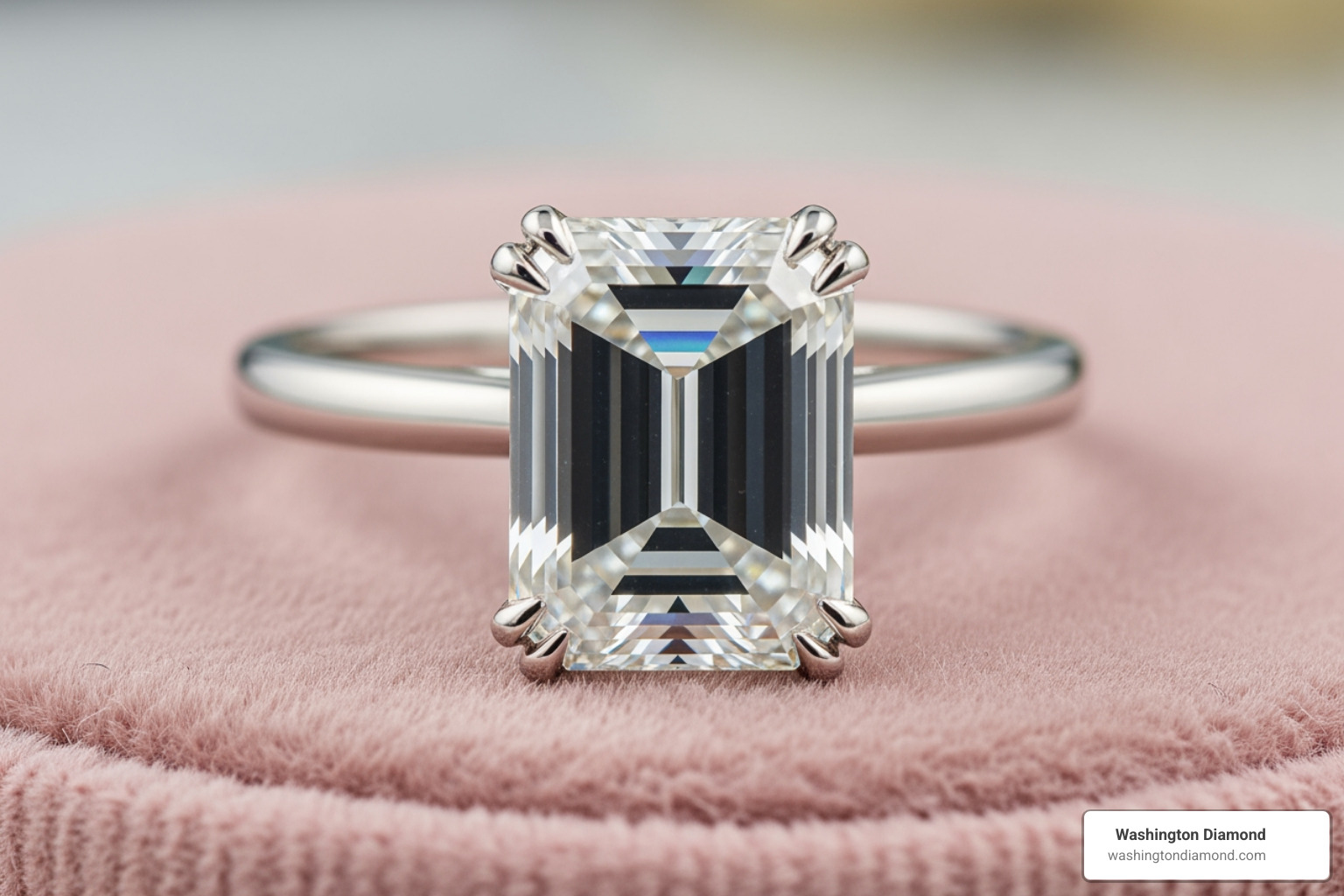
An Emerald cut diamond is a rectangular step-cut diamond with beveled corners, featuring long, parallel facets that create a distinctive "hall of mirrors" effect rather than the fiery sparkle of brilliant cuts. Originally developed in the 16th century for cutting emerald gemstones, this neat shape was later adapted for diamonds and rose to prominence during the Art Deco era.
Quick Facts About Emerald Cut Diamonds:
- Shape: Rectangular with beveled corners (some nearly square)
- Facet Style: Step-cut with 49+ facets arranged in concentric rows
- Visual Effect: "Hall of mirrors" or "staircase" look with dramatic light and dark planes
- Popularity: Fourth most popular diamond shape (4.5% of searches)
- Price: Approximately 33% less expensive than equivalent round brilliant diamonds
- Best For: Those who value understated elegance and sophistication over maximum sparkle
When Angelina Jolie debuted her engagement ring featuring a large emerald cut diamond center stone, it reminded the world why this cut has captivated royalty and celebrities for generations. From Grace Kelly to Beyoncé, the emerald cut's clean lines and architectural beauty have made it the choice of those seeking something truly distinctive.
The key difference? While brilliant cuts maximize sparkle through numerous small facets, the emerald cut showcases a diamond's clarity and produces prismatic flashes of light through its long, narrow facets. This creates an neat gleam rather than fiery brilliance—a sophisticated look that turns heads for entirely different reasons.
But here's what many buyers don't realize: the emerald cut's large, open table acts like a window into the stone, making inclusions and color more visible than in other cuts. This means you'll need to pay closer attention to clarity and color grades to ensure your diamond looks flawless—and that's where expert guidance becomes invaluable.
The Defining Characteristics of an Emerald Cut Diamond
This section explains the unique visual properties that set the Emerald cut diamond apart from all other diamond shapes.
The Step Cut and the 'Hall of Mirrors' Effect
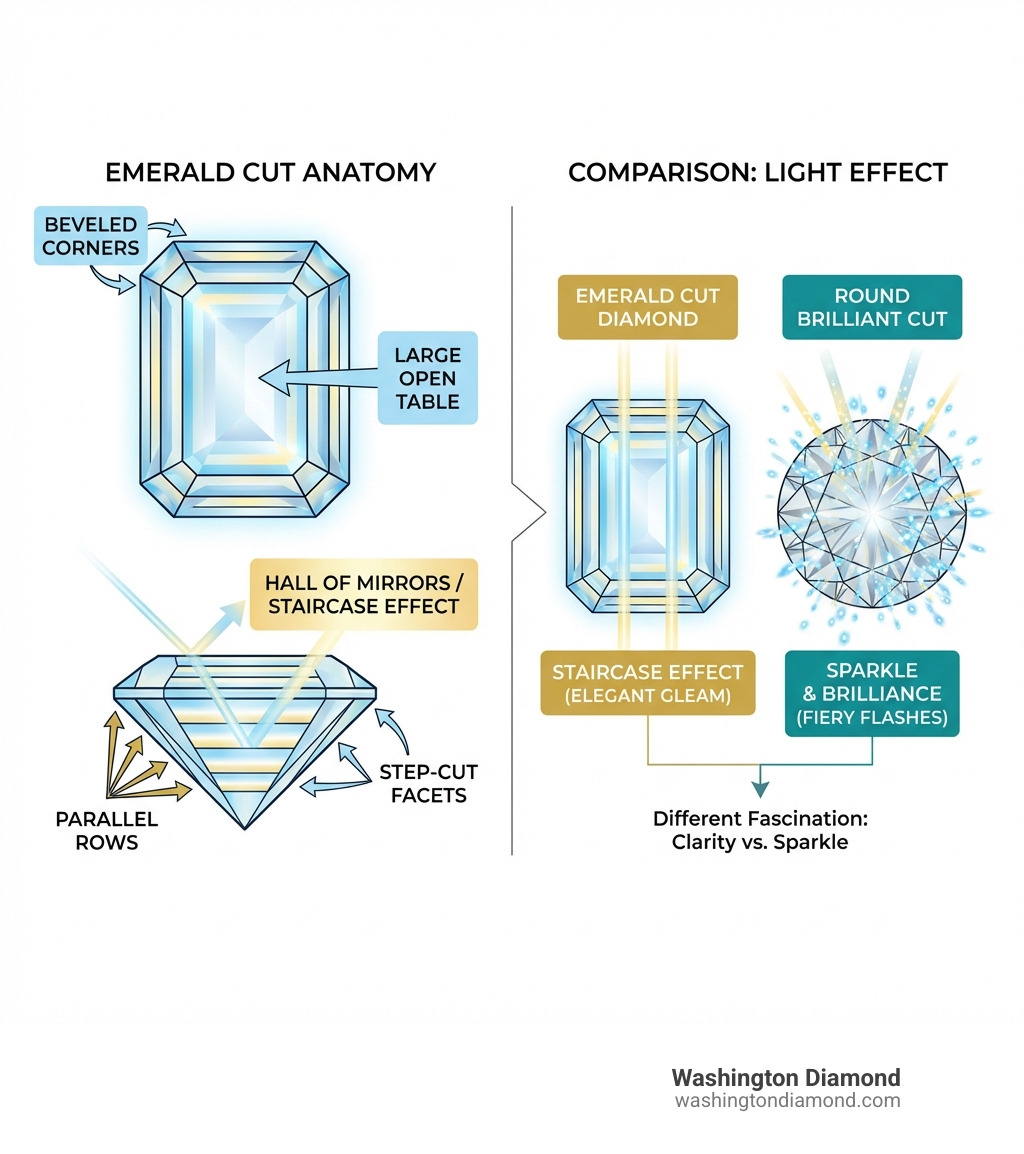
At the heart of the Emerald cut diamond's unique appeal is its "step-cut" faceting. Unlike the numerous, small, kite-shaped facets of brilliant cuts designed to maximize sparkle, the emerald cut features fewer, larger, and concentric rows of facets. These facets are parallel to the girdle, creating a distinct "staircase" effect. When light enters these long, flat planes, it's reflected and refracted in broad flashes, creating a mesmerizing interplay of light and dark areas. We often refer to this as the "hall of mirrors" effect.
This visual phenomenon is what gives the Emerald cut diamond its neat gleam, a captivating characteristic that is entirely different from the fiery brilliance and scintillation of a round brilliant. Instead of a scattered sparkle, you get dramatic, crisp flashes of light that highlight the diamond's purity and depth. While an Emerald cut diamond can have 49 facets or more, their rectilinear arrangement contributes to this unique prismatic reflection rather than intense, fiery scintillation. This is why we say they produce a gleam, not a sparkle, showcasing exceptional clarity and a distinctive look when set in fine jewelry. For a deeper dive into how this facet pattern affects light performance, the GIA provides excellent insights on The Elegant Emerald Cut Diamond.
Shape, Silhouette, and Proportions
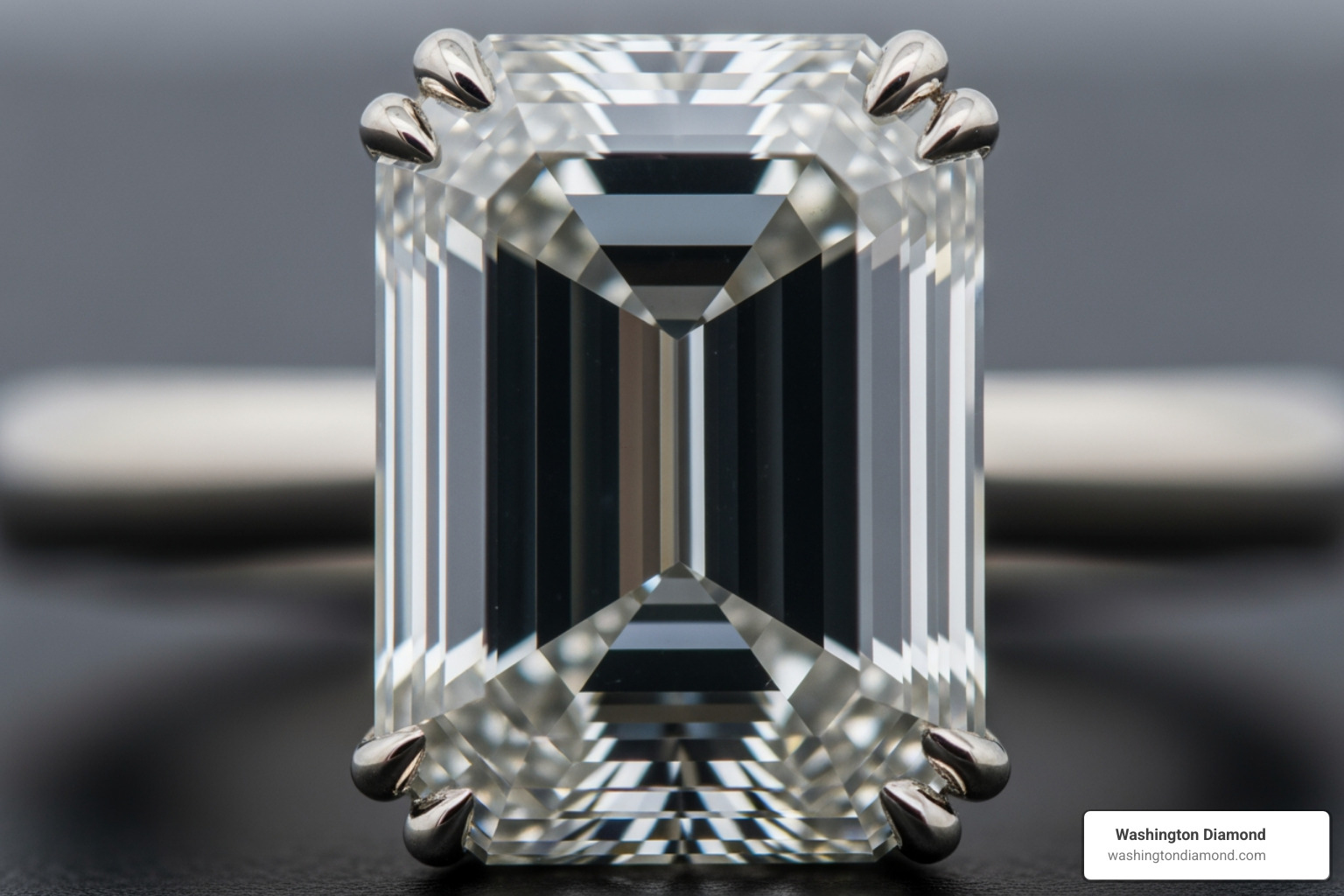
The Emerald cut diamond is instantly recognizable by its distinctive rectangular shape and signature beveled corners. These clipped corners aren't just for aesthetics; they also improve the diamond's durability, protecting it from chipping, which is particularly important for a stone with such prominent edges. The overall silhouette is clean, geometric, and sophisticated, a hallmark of its Art Deco heritage.
One of the most crucial aspects when selecting an Emerald cut diamond is its length-to-width (L:W) ratio. This ratio determines how elongated or square the diamond appears. While personal preference plays a significant role, certain ratios are considered classic and visually appealing. For instance, a length-to-width ratio of around 1.35 is very popular, and the vast majority of our clients looking for an Emerald cut diamond select a stone with a ratio between 1.28 and 1.45. If you prefer a more elongated look, you might lean towards the higher end of this range (e.g., 1.40-1.50). For those who favor a nearly square appearance, ratios closer to 1.00-1.05 are available, though they are less common for a traditional Emerald cut diamond.
Beyond aesthetics, the elongated shape of an Emerald cut diamond offers a fantastic optical illusion: it tends to appear larger than other diamond shapes of the same carat weight. This is because its large table and spread-out facets give it a greater surface area when viewed from above, making it a wonderful choice if you're looking for maximum visual impact without necessarily increasing your budget for a higher carat weight.
How to Choose the Perfect Emerald Cut Diamond
Choosing an Emerald cut diamond requires a different approach than brilliant cuts. Here’s what you need to know to select a truly exceptional stone.
Navigating Clarity and Color in an Emerald cut diamond
Due to its unique step-cut faceting and large, open table, an Emerald cut diamond acts like a clear window into the stone. This means that clarity and color grades manifest quite differently compared to brilliant cuts, and often require a stricter selection process.
Clarity Considerations: Because the facets are long and rectilinear, they don't hide inclusions as effectively as the fragmented sparkle of brilliant cuts. Any internal imperfections, or inclusions, become much more visible in an Emerald cut diamond. This is a critical point: lower clarity diamonds, where inclusions might be masked in a round brilliant, will show those imperfections quite clearly in an emerald cut. Therefore, we generally recommend aiming for a clarity grade of VS2 (Very Slightly Included) or higher to ensure the diamond is "eye-clean," meaning no inclusions are visible to the naked eye. For larger stones, you might even consider VS1 or VVS grades to be absolutely certain of a flawless appearance. Prioritizing clarity here is key to avoiding common mistakes and ensuring your Emerald cut diamond truly gleams. You can learn more about how to select your perfect diamond by checking out our guide on Beyond the 4Cs: How to Choose Your Perfect Certified Loose Diamond.
Color Considerations: Similarly, the step-cut style of an Emerald cut diamond is less forgiving when it comes to color. Its broad, open facets reveal the diamond's natural body color more easily than brilliant cuts, which can disperse color more effectively. This means a color grade that might appear perfectly white in a round brilliant could show a subtle yellowish tint in an emerald cut. For this reason, we often recommend a color grade of G or H for excellent value, as these stones typically appear colorless when mounted. If you desire absolute icy perfection, a D-F grade is ideal, but be prepared for a higher price point. It's worth noting that color will be more obvious in an Emerald cut diamond than it would be in an equivalent radiant cut, so choosing wisely here is crucial.
Ideal Proportions, Pricing, and Common Pitfalls
Beyond clarity and color, the overall proportions of an Emerald cut diamond are paramount to its beauty and light performance. Even with the highest clarity and color, a poorly cut emerald can look dull or lifeless.
Ideal Proportions: While GIA doesn't provide cut grades for fancy shapes like the emerald cut, we look at specific proportion ranges to ensure optimal beauty.
- Table Percentage: The table is the large, flat top facet. For an Emerald cut diamond, we recommend a table percentage between 61-68%. Interestingly, the most popular table percentage for emerald cuts in our data is a tie between 64% and 65%.
- Depth Percentage: The depth percentage relates to the overall height of the diamond. An ideal depth percentage for an Emerald cut diamond typically falls between 61-68%. Our data shows that the most popular depth percentage is a tie between 68.4% and 68.5%.
- Length-to-Width Ratio: As discussed, a ratio between 1.28 and 1.45 is generally preferred, with 1.35 being the most popular, offering a balanced and neat rectangular silhouette.
Pricing: One of the most attractive aspects of the Emerald cut diamond is its relative affordability. They are one of the least expensive diamond shapes and typically cost about 33% less than equivalent round cut diamonds. This difference can vary based on carat weight, color, and clarity, but it generally holds true. This means you can often get a larger or higher-quality Emerald cut diamond for the same budget you might spend on a smaller or lower-grade round brilliant.
Common Mistakes to Avoid: When purchasing an Emerald cut diamond, there are specific pitfalls to watch out for:
- Ignoring Clarity: As we've emphasized, the step cut is unforgiving. Avoid stones with obvious inclusions, especially those visible on the large, open table. A VS2 or higher is a safe bet.
- Visible 'Black Box' Effect: A poorly cut Emerald cut diamond can display an undesirable dark box pattern around its center, which detracts from its beauty. Look for a diamond that exhibits the desired 'hall of mirrors' aesthetic instead.
- Poor Symmetry: The clean, geometric lines of an Emerald cut diamond demand excellent symmetry. Any asymmetry will be immediately noticeable and can make the diamond appear lopsided or "off."
- Skimping on Color: While you don't necessarily need a D color, going too low on the color scale (e.g., K, L) can result in a noticeable yellow tint, especially in larger stones. Aim for G or H for a beautiful, near-colorless appearance.
Natural vs. Lab-Grown Emerald Cut Diamonds
In today's market, you have the exciting choice between natural and lab-grown Emerald cut diamonds. Both offer the same stunning aesthetic, but with distinct differences in origin and price.
Key Differences:
- Origin: Natural diamonds are formed deep within the Earth over billions of years, a marvel of geological processes. Lab-grown diamonds, on the other hand, are created in controlled laboratory environments using advanced technology that mimics the natural diamond-growing process.
- Price: Lab-grown Emerald cut diamonds are typically significantly more affordable than their natural counterparts, often allowing buyers to acquire a larger stone or a higher clarity/color grade for the same budget.
Identical Properties: Chemically, physically, and optically, a lab-grown Emerald cut diamond is identical to a natural one. They possess the same brilliance, hardness, and light-reflecting properties. A gemologist with specialized equipment is usually required to distinguish between the two.
Ethical Considerations: Many choose lab-grown diamonds for their perceived ethical and environmental benefits. They offer a transparent origin and are often promoted as a more sustainable choice. However, natural diamonds from reputable sources, like those we offer in Northern Virginia, are also ethically sourced and come with certifications guaranteeing their conflict-free status. The choice between natural and lab-grown often comes down to personal values, budget, and preference. We dig deeper into this topic in our guide on Lab-Grown Diamond Engagement Rings: Ethical Elegance for Your Big Day.
Emerald Cut vs. Other Diamond Shapes
See how the Emerald cut diamond's unique step-cut design compares to other popular fancy shapes.
Emerald vs. Radiant Cut
While both the Emerald cut diamond and the Radiant cut are rectangular (or square) and often seen in engagement rings, their facet patterns create vastly different visual effects.
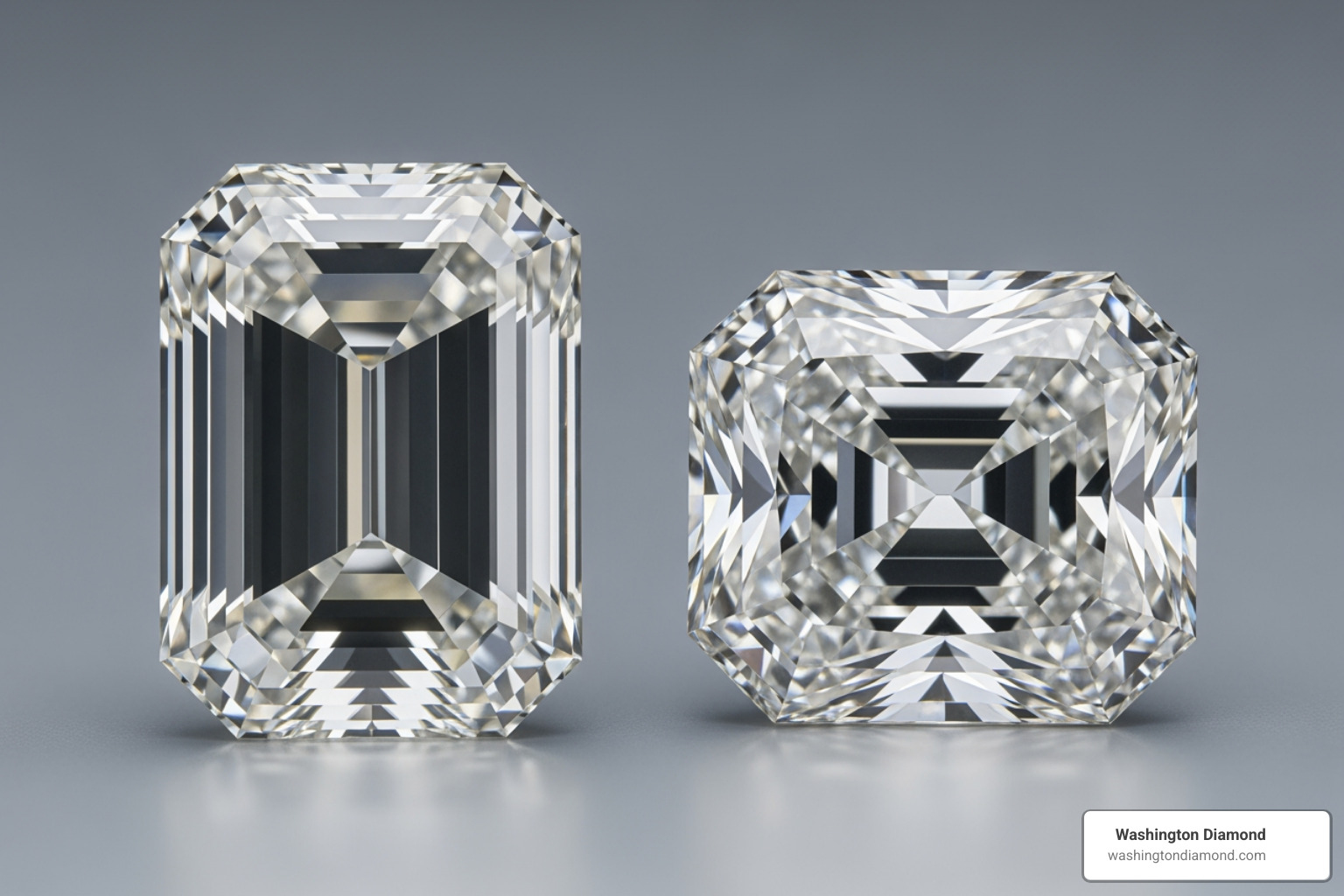
- Facet Style: The Emerald cut diamond is a pure step cut, characterized by its long, parallel facets that create the "hall of mirrors" effect. The Radiant cut, however, is a modified brilliant cut, featuring a hybrid facet pattern that combines the neat outline of an emerald with the fiery sparkle of a round brilliant. It has triangular and kite-shaped facets, often resulting in a "crushed ice" look.
- Sparkle: An Emerald cut diamond offers a sophisticated gleam and dramatic flashes of light. A Radiant cut, with its brilliant faceting, provides much more scintillation and fire, designed for maximum sparkle.
- Clarity/Color Visibility: Because of its open table and step facets, an Emerald cut diamond is less forgiving, meaning inclusions and body color are more visible. Radiant cuts, with their busy facet pattern, are excellent at hiding inclusions and dispersing color, making them a good option if you prioritize sparkle and want to save a bit on clarity or color grades.
Emerald vs. Asscher Cut
The Asscher cut is often described as the "square cousin" of the Emerald cut diamond, and for good reason. GIA even defines the Asscher as a square cut emerald, highlighting their close relationship.
- Shape: The most obvious difference is shape. An Emerald cut diamond is rectangular, with a length-to-width ratio typically greater than 1.10. The Asscher cut is distinctly square, with a length-to-width ratio usually between 1.00 and 1.05.
- Visual Effect: Both are step cuts, meaning they both exhibit the captivating "hall of mirrors" effect with broad flashes of light rather than brilliant sparkle. However, the Asscher cut often has a slightly smaller table and a higher crown, which can improve its unique geometric patterns and create a slightly different play of light.
- Clarity/Color Visibility: Like the Emerald cut diamond, the Asscher cut's open facets mean that clarity and color are more easily revealed. Therefore, similar clarity and color considerations apply when choosing an Asscher.
Here’s a quick comparison table to summarize the key differences:
| Attribute | Emerald Cut | Radiant Cut | Asscher Cut |
|---|---|---|---|
| Shape | Rectangular (L:W typically 1.28-1.45) | Rectangular or Square (L:W varies) | Square (L:W typically 1.00-1.05) |
| Facet Style | Step Cut (long, parallel facets) | Modified Brilliant Cut (hybrid, triangular/kite) | Step Cut (concentric, square facets) |
| Sparkle | Gleam, "Hall of Mirrors," dramatic flashes | High brilliance, fire, "crushed ice" | Gleam, "Hall of Mirrors," distinct geometric flashes |
| Clarity Visibility | High (inclusions more visible) | Medium/Low (inclusions less visible) | High (inclusions more visible) |
| Color Visibility | High (body color more apparent) | Medium/Low (color dispersed more effectively) | High (body color more apparent) |
Styling, History, and Iconic Rings
From Art Deco origins to modern red carpets, the Emerald cut diamond has a rich history and timeless appeal.
The Best Settings for an Emerald cut diamond
The clean lines and distinct shape of an Emerald cut diamond make it incredibly versatile, complementing a variety of settings. The right setting can improve its elegance and highlight its unique play of light.
- Solitaire Setting: This is perhaps the most classic choice for an Emerald cut diamond. A simple solitaire setting, whether in white gold, yellow gold, or platinum, allows the diamond to be the undisputed star. Its minimalist design perfectly complements the emerald cut's understated elegance, letting its geometric beauty shine.
- Three-Stone Setting with Tapered Baguettes: For a truly sophisticated and Art Deco-inspired look, pairing an Emerald cut diamond with tapered baguette side stones is an exquisite choice. The straight, clean lines of the baguettes echo the emerald cut's geometry, creating a harmonious and neat design.
- Halo Setting: While the Emerald cut diamond isn't known for its fiery sparkle, a delicate halo of smaller diamonds can add a touch of brilliance and make the center stone appear even larger. This setting blends classic elegance with a touch of modern glamor.
- Bezel Setting: For a sleek, contemporary aesthetic and added protection, a bezel setting can be a fantastic option. The metal rim encircling the entire diamond provides security and a smooth, modern look that perfectly frames the emerald cut's clean silhouette.
Choosing the right setting is a personal journey, and we're here to help you explore the options. Our guide on Engagement Ring Settings 101 offers even more inspiration.
A Brief History and Famous Wearers
The Emerald cut diamond boasts a fascinating history that dates back centuries. Its origins are tied to the 16th century, when diamond cutters developed the technique specifically for cutting emerald gemstones, which are prone to chipping. The cut allowed for greater stability and prevented breakage. Its neat, symmetrical form was eventually adapted for diamonds, bringing forth a new era of sophisticated sparkle.
The Emerald cut diamond truly rose to prominence during the Art Deco era of the 1920s and 1930s. Its geometric precision and clean lines perfectly embodied the architectural and streamlined aesthetic of the time, becoming a symbol of modern luxury and sophisticated taste.
Today, the Emerald cut diamond continues to be a favorite among celebrities and fashion icons, cementing its status as a timeless classic.
Some of its most famous wearers include:
- Grace Kelly: Her iconic 10.47-carat Emerald cut diamond engagement ring from Prince Rainier III of Monaco is legendary.
- Elizabeth Taylor: Known for her extraordinary jewelry collection, Taylor owned several stunning emerald cut pieces, including a magnificent 33.19-carat Krupp diamond.
- Beyoncé: Her stunning 18-carat flawless Emerald cut diamond engagement ring from Jay-Z brought the cut firmly into the modern pop culture spotlight.
- Amal Clooney: George Clooney proposed to Amal with a breathtaking 7-carat Emerald cut diamond ring, showcasing its enduring appeal.
These notable wearers underscore the Emerald cut diamond's ability to combine classic elegance with a distinct, personal statement.
Frequently Asked Questions about Emerald Cut Diamonds
Do emerald cut diamonds sparkle?
This is a common question, and the answer is nuanced. Yes, Emerald cut diamonds absolutely "sparkle," but their sparkle is distinctly different from that of brilliant-cut diamonds like rounds or princesses. Instead of a fiery, fragmented scintillation, Emerald cut diamonds produce dramatic flashes of light, creating what we call the mesmerizing "hall of mirrors" effect. These are broad, bold flashes of light and dark planes, rather than numerous tiny pinpoints of light. It's an neat gleam, a sophisticated play of light that highlights the diamond's clarity and purity, rather than its "fire." If you're looking for an understated, architectural beauty, the emerald cut's unique light performance is truly captivating.
Do emerald cut diamonds look bigger?
Yes, they often do! The elongated shape and large, open table of an Emerald cut diamond contribute to an impressive visual size. When viewed from above, an emerald cut often appears larger than other diamond shapes of the same carat weight, especially compared to a round brilliant. This is because a significant portion of its carat weight is distributed across its top surface area, creating a more expansive look on the finger. This characteristic makes the emerald cut an excellent choice if you desire a diamond with substantial presence without necessarily having to increase your budget for a higher carat weight.
Are emerald cut diamonds a good value?
Absolutely! Emerald cut diamonds are generally considered a fantastic value in the diamond market. As we mentioned, they are typically more affordable per carat than round brilliant diamonds, often costing about 33% less for an equivalent carat weight. This means you can often acquire a larger or higher-quality Emerald cut diamond for the same budget you might allocate for a smaller round diamond.
However, it's important to remember the unique characteristics of the emerald cut. Because its open facets reveal inclusions and color more readily, you might need to invest a bit more in higher clarity (VS2 or higher) and color (G-H or higher) grades to ensure an eye-clean and beautifully colorless appearance. While this might slightly offset the initial per-carat savings, the overall value for the visual impact and sophisticated aesthetic of an Emerald cut diamond remains exceptional. It's a shape that offers significant presence and timeless elegance without breaking the bank.
Conclusion: Is the Emerald Cut Right for You?
The Emerald cut diamond is a testament to neatness, sophistication, and a truly unique play of light. Its clean, geometric lines, dramatic "hall of mirrors" effect, and understated elegance set it apart from all other diamond shapes. Offering excellent value, often at a significantly lower price point than round brilliants, it presents an appealing option for those seeking a distinctive and impactful diamond.
This cut is often chosen by individuals who possess a confident, classic, and discerning personality. It speaks volumes without needing to shout, appealing to those who appreciate refined taste and architectural beauty over overt sparkle. However, as we've explored, the nuance of selecting a top-tier Emerald cut diamond — paying close attention to proportions, clarity, and color — makes expert guidance invaluable. To truly appreciate its beauty and ensure you find a stone with the perfect proportions and mesmerizing light performance, a personalized consultation is highly recommended.
At Washington Diamond, we understand the intricacies of selecting such a unique and captivating diamond. Our private, by-appointment consultations in Northern Virginia ensure you receive our undivided attention, allowing us to guide you through every aspect of choosing an Emerald cut diamond that perfectly reflects your vision. We believe in creating a memorable and personalized experience, helping you unveil the mesmerizing play of light in your ideal stone.
Explore our curated collection of Loose Diamonds to begin your journey with us.
From the blog
View all


