

Why We Are Totally Crushing on These Quilted Diamond Bracelets
The Quilted Diamond Bracelet Trend You Need to Know About

A crushed diamond bracelet is one of the most distinctive jewelry styles making waves in fine jewelry right now — and for good reason. Unlike traditional diamond bracelets where stones sit in prong or bezel settings, the "crushed" look comes from deeply faceted, quilted metal links that catch and scatter light in every direction, mimicking the shimmer of real diamonds.
Quick answer: What is a crushed diamond bracelet?
- A bracelet featuring textured, multi-faceted links (often quilted or geometric) that reflect light like crushed diamonds
- Can be made from sterling silver, 14k or 18k gold, with or without actual diamond accents
- Creates a diamond-like sparkle through surface geometry — not just stone count
- Ranges from budget-friendly silver styles (under $100) to luxury designer versions (reaching $14,000 and up)
- Suitable for everyday wear and special occasions, depending on metal and construction
The appeal is simple: you get maximum sparkle without needing a row of diamonds set in every link. The design does the work.
I'm Tom Daube, a GIA-certified diamond expert and custom jewelry designer with decades of experience helping customers find the perfect crushed diamond bracelet and other fine jewelry pieces. In this guide, I'll walk you through every style, price point, and quality detail worth knowing before you buy.
What Is a Crushed Diamond Bracelet?
At its core, a crushed diamond bracelet is a bracelet designed to look brilliantly sparkly through metalwork, texture, and faceting. In many cases, the bracelet may not be covered in diamonds at all. Instead, the links are carved, quilted, angled, or polished so that light bounces across the surface in a way that resembles the flash of tiny diamonds.
That is why this style feels so modern. It blends the visual drama of diamond jewelry with the practicality of a textured metal bracelet. Some versions are all-metal. Some include small diamond accents. And some luxury interpretations combine quilted metal with real diamonds for a richer, high-jewelry effect.
The “quilted” look is especially important here. Rather than a smooth, flat surface, the bracelet has raised sections, grooves, and mirrored planes. When the wrist moves, the bracelet glitters from those surfaces instead of relying only on gemstone fire.
How a crushed diamond bracelet differs from classic diamond bracelets
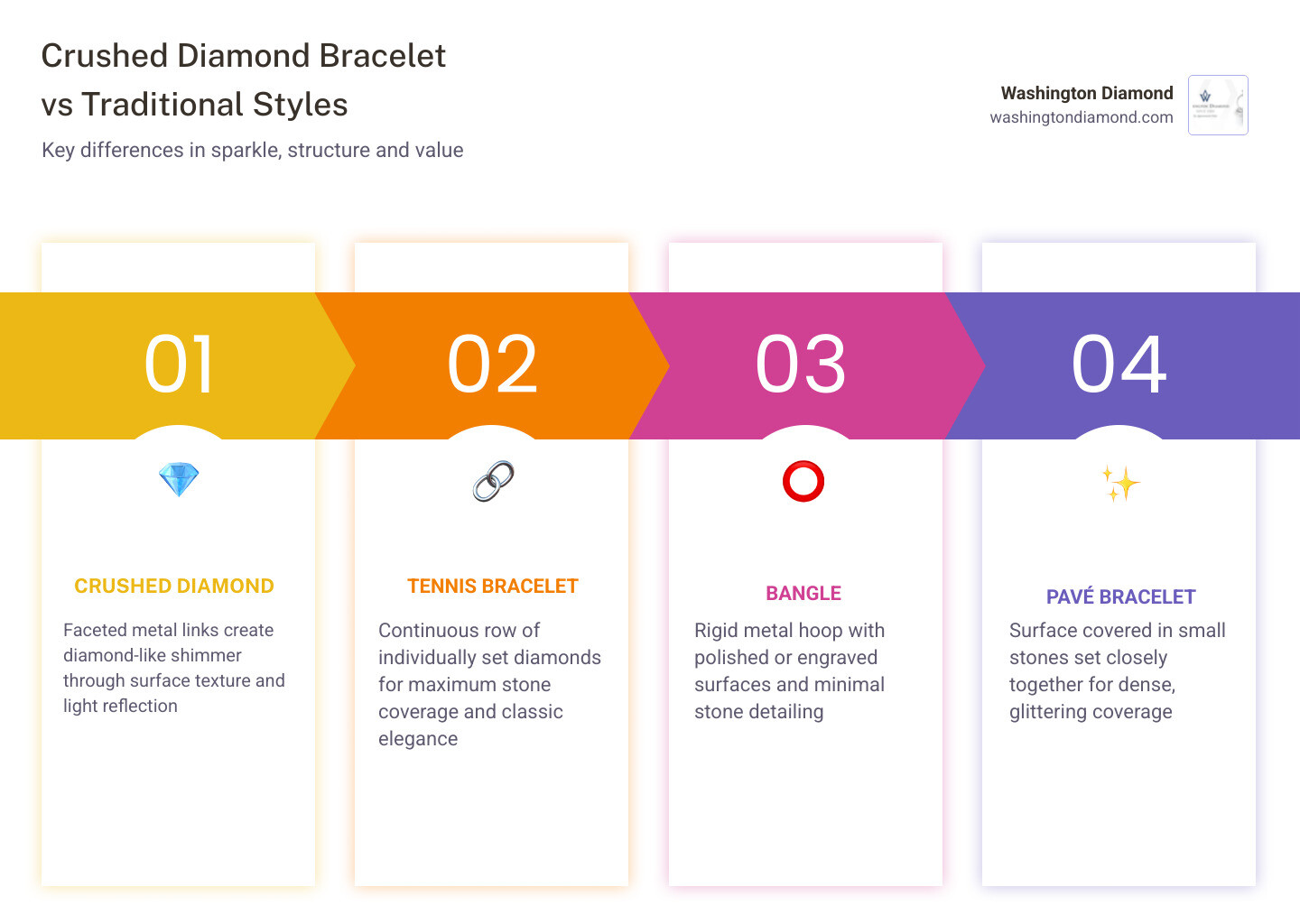
Traditional diamond bracelets are usually built around the stones themselves.
- A tennis bracelet uses a line of individually set diamonds, often uniform in size
- A bangle may have diamonds channel-set, pavé-set, or spaced across a rigid frame
- A pavé bracelet uses many tiny stones set closely together so very little metal shows
- A link diamond bracelet often highlights stone settings within each link
A crushed diamond bracelet flips that formula. The metal becomes the star.
Instead of asking, “How many diamonds are in this bracelet?” the better question is, “How is the surface engineered to reflect light?” That can make these bracelets more accessible in price, easier to style casually, and visually interesting even when the total carat weight is low or zero.

Why quilted finishes create a “crushed” look
The “crushed” effect comes from geometry.
Think of a smooth gold bracelet as a calm lake. Now think of a quilted, faceted bracelet as sunlight hitting rippled water. The second one flashes more because there are more angles for light to hit.
Quilted finishes create that effect through:
- Engraved or sculpted facets
- Polished ridges and recessed sections
- Slightly domed surfaces that create dimension
- Repeating patterns that catch light from multiple directions
- Link movement that changes reflection as the bracelet shifts
In luxury versions, the quilted pattern can be paired with small brilliant-cut diamonds to enhance the effect even further. High-end designer interpretations of this style often feature dozens of brilliant-cut diamonds set into 18k gold, with prices reflecting the premium craftsmanship and brand prestige. These pieces show how the quilted texture itself is a major part of the design language, even when real diamonds are present.
How the Crushed Diamond Bracelet Look Is Made
The beauty of a crushed diamond bracelet is that the sparkle can come from many different combinations of material and finish. We see this style in sterling silver, solid gold, white gold, yellow gold, rose gold, and mixed-metal looks. Some designs are minimalist and all-metal. Others add pavé or diamond accents for extra flash.
Materials, finishes, and settings to expect
Here are the most common materials shoppers will encounter in 2026:
- 925 sterling silver
- 14k gold
- 18k gold
- White gold with rhodium finish
- Yellow gold
- Rose gold
- Gold vermeil or plated fashion styles
- Solid precious metal with lab-grown or natural diamond accents
Sterling silver remains one of the most approachable entries into this look. One silver crushed-style bracelet in the research was priced at 9,300 RSD, made in Italy from 925 sterling silver, with size options of 17 cm, 19 cm, and 21 cm. That tells us something important: this look is not reserved only for high jewelry. The surface design can deliver a diamond-like shimmer at a much lower cost than a fully diamond-set bracelet.
At the fine-jewelry end, 14k and 18k gold are the most common. White gold often gets rhodium plated for a bright white finish. Yellow gold gives the pattern warmth and depth. Rose gold softens the geometric look and can feel especially elegant in quilted designs.
Some bracelets also include real diamonds, either natural or lab-grown. Those stones may be pavé-set into the links, scattered as accents, or used to outline the textured pattern.
How the crushed chain style creates sparkle
The secret sauce is not magic. It is angles.
A crushed-style chain creates sparkle through:
- Angled links that reflect light like tiny mirrors
- High-polish finishing that increases brightness
- Repeated facets across each link
- Flexible movement at the wrist, which changes light return constantly
- Contrast between raised and recessed surfaces
This is why the bracelet can look lively even in normal daylight. As your wrist turns, each facet catches and releases light. It is more shimmer than “fire,” if we want to get technical. Diamonds create brilliance, fire, and scintillation from inside the stone. Crushed-style metal creates a similar visual excitement from the outside surface.
That distinction matters when shopping. If you want true diamond value, you will focus on carat weight, cut quality, and certification. If you want the visual punch of sparkle for less, a crushed-style bracelet can be a very smart buy.
Craftsmanship details that signal quality
Not every sparkly bracelet is a good bracelet. A quality crushed diamond bracelet should feel intentional, not flimsy.
Look for:
- Smooth but crisp finishing on the facets
- Links that move fluidly without pinching
- A secure clasp that closes firmly
- Good weight for the size and material
- Even polish with no rough edges
- Clean stone setting, if diamonds are included
- Proper hallmarks such as 925, 14k, or 18k
- Documentation when real diamonds are part of the bracelet
If diamonds are featured, quality paperwork matters. In the broader bracelet market, some high-value diamond bracelets come with IGI or GIA grading support, a certificate of authenticity, and an appraisal. Those details help confirm what you are buying and can be especially useful for insurance.
Crushed Diamond Bracelet vs Tennis, Bangle, and Pavé Styles
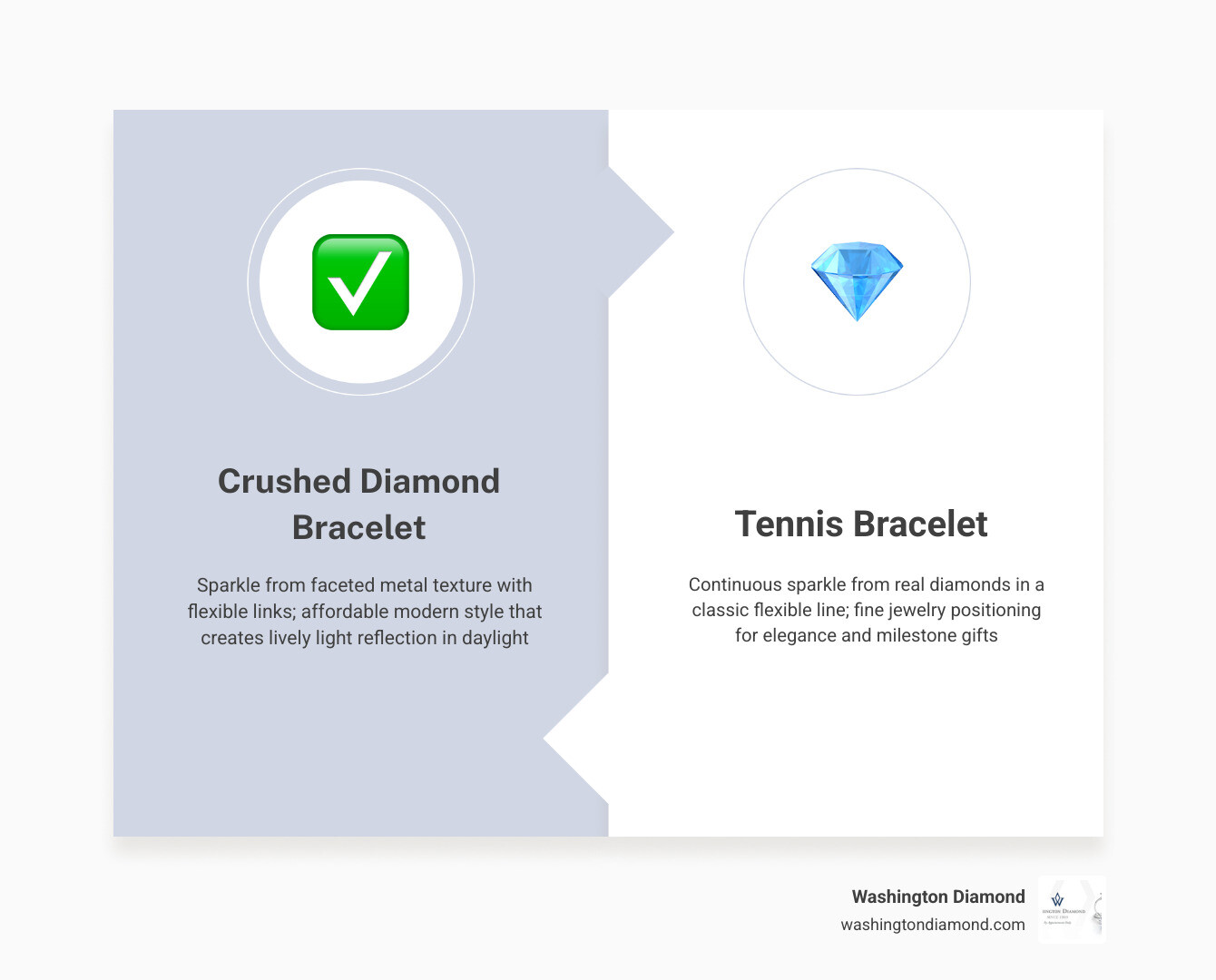
Each bracelet style shines differently, literally and figuratively. Here is the simplest way to compare them.
| Style | Main Visual Effect | Structure | Typical Price Position | Best For |
|---|---|---|---|---|
| Crushed diamond bracelet | Sparkle from faceted metal texture | Flexible links or chain | Budget to luxury | Everyday shine, modern styling |
| Tennis bracelet | Continuous sparkle from real diamonds | Flexible line bracelet | Fine jewelry to luxury | Classic elegance, gifts, milestone pieces |
| Bangle | Clean silhouette, may have texture or diamonds | Rigid circular form | Mid to luxury | Stack styling, dress wear |
| Pavé bracelet | Dense surface sparkle from many small diamonds | Varies | Fine jewelry to luxury | Maximum diamond look, evening wear |
Which style gives the most shine for the price?
If we measure “shine for the price,” the crushed diamond bracelet often wins at entry level.
Why? Because metal texture is much less expensive than setting dozens of high-quality diamonds. A sterling silver crushed-style bracelet can create a strong sparkle effect at a fraction of the cost of a true diamond bracelet.
By contrast:
- Tennis bracelets usually cost more because the value sits in the diamonds
- Pavé bracelets can look very glittery but require intensive stone setting
- Diamond bangles often combine precious metal weight with stone cost, pushing the price higher
For perspective, the pricing in the research spans a wide range:
- Entry-level silver crushed style: 9,300 RSD
- Lab-grown diamond tennis bracelet in 14k gold: $1,929 on sale from $2,756
- Pavé diamond bracelet in gold: from £2,731
- High-carat diamond bracelet: $4,536 on sale from $6,480
- Luxury quilted diamond bracelet: $14,550
So if your goal is the look of brightness without a major diamond investment, crushed styles are compelling. If your goal is actual carat value and heirloom-level diamond content, tennis and pavé styles take the lead.
Best occasions for each bracelet style
Different styles fit different moments.
Crushed diamond bracelet
- Great for everyday wear
- Easy to stack with watches or bangles
- Adds interest to workwear and weekend outfits
- Ideal when you want sparkle without feeling too formal
Tennis bracelet
- Classic for anniversaries, milestone gifts, and evening wear
- Looks polished on its own
- Often chosen for bridal styling and dressier occasions
Bangle
- Strong for stacking
- Good for a tailored or sculptural look
- Can be minimal or bold depending on width and stone coverage
Pavé bracelet
- Best when you want maximum glitter
- Often reads dressier
- Great for events, celebrations, and statement styling
Price, Sizing, and What to Look for Before You Buy
A bracelet can be beautiful, but if it is the wrong size, made with vague materials, or missing key quality markers, the romance fades fast. Usually right around the time it flips upside down on your wrist.
Typical price ranges for a crushed diamond bracelet in 2026
In 2026, here is the general pricing picture:
Budget fashion and silver styles
- Under $100 to a few hundred dollars
- Often sterling silver, plated metal, or simulated sparkle
- Best for trend-driven wear and casual styling
Solid precious metal crushed styles
- Several hundred to a few thousand dollars
- Usually 14k or 18k gold
- Price depends on metal weight, craftsmanship, and brand positioning
Diamond-accent crushed styles
- Around $1,500 to several thousand dollars
- Includes small natural or lab-grown diamonds
- Good middle ground between texture-led design and true diamond content
Luxury quilted diamond bracelets
- Five figures and up
- Premium precious metals, branded design language, real diamonds
- Strong focus on craftsmanship and design prestige
For comparison, the research included a lab-grown diamond bracelet at $1,929, a sale-priced high-carat diamond bracelet at $4,536, and a luxury quilted diamond model at $14,550. That broad range shows why shoppers should separate "diamond-like sparkle" from "diamond value." They are not the same purchase.
Choosing the right bracelet size and fit
Fit matters almost as much as design.
Common sizing formats include:
- Centimeters, such as 17 cm, 19 cm, and 21 cm
- Inches, often from 5 inches to 10 inches in made-to-order styles
A good rule of thumb:
- For a close fit, add about 0.25 to 0.5 inch to your wrist measurement
- For a relaxed drape, add about 0.75 inch
- Structured bangles fit differently from flexible chain bracelets, so always check style-specific guidance
If you are between sizes:
- Size up for chunky or quilted links
- Stay closer to the wrist for tennis-style bracelets so they do not flip too much
- Consider how you plan to stack it
For many people, trying on in person is still the smartest move. In our Northern Virginia appointment-only studio, we can help evaluate wrist shape, preferred drape, and whether a bracelet is meant to sit neatly or move more freely.
Authenticity, ethics, and smart buying tips
Before you buy, check the boring details. They are boring right up until they save you money.
Look for:
- Metal hallmarks such as 925, 14k, or 18k
- Clear material disclosure
- Diamond details if stones are included
- Certification for significant diamond value
- Return policy and warranty terms
- Appraisal or authenticity paperwork for fine jewelry
- Secure clasp construction
- Ethical sourcing information when available
For diamond-set bracelets, lab-grown and natural diamonds are both valid choices. The differences are usually about origin, price, and sometimes buyer preference.
Lab-grown diamonds
- Real diamonds with the same basic physical properties as natural diamonds
- Usually cost less per carat
- Popular with buyers prioritizing value and sustainability
Natural diamonds
- Formed in the earth over geological time
- Often carry traditional rarity appeal
- May be preferred for certain heirloom or collector-minded purchases
If you want a neutral overview of how diamond grading works, the Gemological Institute of America (GIA) is a helpful reference.
Also ask about recycled precious metals, responsible sourcing, and whether the maker provides grading support from labs such as IGI or GIA for larger stones or higher-value pieces.
If you want help navigating those choices, our team also works with custom projects through Custom Jewelry, Custom Jewelry Northern Virginia, and Custom Jewelry Washington DC Guide. For those in the Northern Virginia and DC area, we invite you to schedule a consultation at our private studio to see these styles in person and find the perfect fit for your collection.
How to Care for a Crushed Diamond Bracelet So It Keeps Its Shine
Textured bracelets are wonderful at catching light. They are also very good at catching lotion, soap film, and life in general.
Daily care for sterling silver, gold, and diamond-set styles
The basics go a long way:
- Wipe the bracelet with a soft cloth after wear
- Store it dry and separately from harder jewelry
- Avoid direct contact with perfume, hairspray, and harsh cleaners
- Remove it before swimming, hot tubs, or heavy workouts
- Use mild soap and lukewarm water for occasional cleaning
- Dry thoroughly, especially around links and clasps
Sterling silver needs a little extra attention because it can tarnish. Gold is lower maintenance, but white gold with rhodium plating may eventually need refreshing. Diamond-set versions should be cleaned gently so buildup does not dull the sparkle.
For a deeper dive into maintenance, we recommend The Art of Gemstone Jewelry Care.
When to repair, polish, or restore your bracelet
A bracelet should be checked if you notice:
- A clasp that feels loose or unreliable
- Links that stick, twist, or kink
- Bent sections or loss of shape
- Worn plating or dull finish
- Loose stones in diamond-accent styles
- Scratches that interrupt the reflective pattern
Textured links can sometimes trap residue or show wear at high-contact points, so professional inspection is worth it. If your bracelet needs attention, these resources can help:
- Jewelry Repairs Restoration Guide
- Expert Jewelry Repair Restoration Services in Northern Virginia
- Jewelry Repair McLean VA Guide
- Bracelet Repair Shop
- Fix Broken Bracelet
Frequently Asked Questions About Crushed Diamond Bracelet Styles
Is a crushed diamond bracelet suitable for everyday wear?
Usually, yes. In fact, that is one of the style’s biggest strengths.
A crushed diamond bracelet can be ideal for daily wear because:
- It gives sparkle without always feeling formal
- Textured metal often pairs well with casual outfits
- Many designs are lighter and less precious than full diamond bracelets
- It layers easily with other jewelry
That said, suitability depends on the material. Sterling silver and plated styles are great for occasional everyday wear but may need more maintenance. Solid gold versions are generally better long-term daily choices. Diamond-accent styles can also work beautifully every day if the settings are secure and your lifestyle is not too rough on jewelry.
Are crushed diamond bracelets made with real diamonds?
Sometimes, but not always.
This is one of the most common shopping misunderstandings. The phrase “crushed diamond bracelet” often refers to the appearance of the finish, not a bracelet literally made from crushed diamonds.
You may see three broad categories:
- All-metal textured bracelets that create a diamond-like sparkle
- Bracelets with small natural or lab-grown diamond accents
- Quilted luxury bracelets that combine textured metal with real diamonds
So yes, some include real diamonds, but many rely primarily on faceted metalwork. If real stones matter to you, read the product details carefully and ask for diamond specifics.
Can you customize a crushed diamond bracelet?
Absolutely. Customization is one of the best ways to get this style exactly right.
Possible custom options include:
- Bracelet length
- White, yellow, or rose gold
- Sterling silver or solid gold construction
- Diamond accents, natural or lab-grown
- Engraving
- Link scale and overall width
- Matching necklace, ring, or earrings
If you are considering a bespoke version, our custom design services can help you tailor the look to your wrist, your budget, and your sparkle preferences. Start with Custom Jewelry, or explore Custom Jewelry Virginia Guide for more inspiration.
Conclusion: How to Choose the Right Crushed Diamond Bracelet for Your Style
The best crushed diamond bracelet is the one that matches your priorities.
If you want:
- Maximum sparkle on a smaller budget, look at textured sterling silver or entry-level gold styles
- Fine-jewelry quality with modern design, consider solid 14k or 18k quilted bracelets
- Extra brilliance and ethical flexibility, explore lab-grown diamond accents
- Traditional rarity and heirloom appeal, consider natural diamond versions
- A bracelet that truly fits your wrist and style, consider going custom
We love this category because it offers something many buyers want: visual glamour without forcing every design to be a standard tennis bracelet. It is sculptural, bright, wearable, and just a little bit clever.
At Washington Diamond, we help clients in Northern Virginia compare style, fit, craftsmanship, and diamond options in a private, appointment-only studio setting. That means no rush, no guessing, and no trying to make a major jewelry decision under fluorescent lighting while someone hands you a tiny mirror.
If you are ready to explore quilted, crushed, or custom bracelet designs, our Custom Jewelry page is the perfect place to begin.
From the blog
View all


