

Morganite Gemstone Pricing: What 1ct and 3ct Stones Actually Cost
What Does a 1-Carat Morganite Cost in 2026?
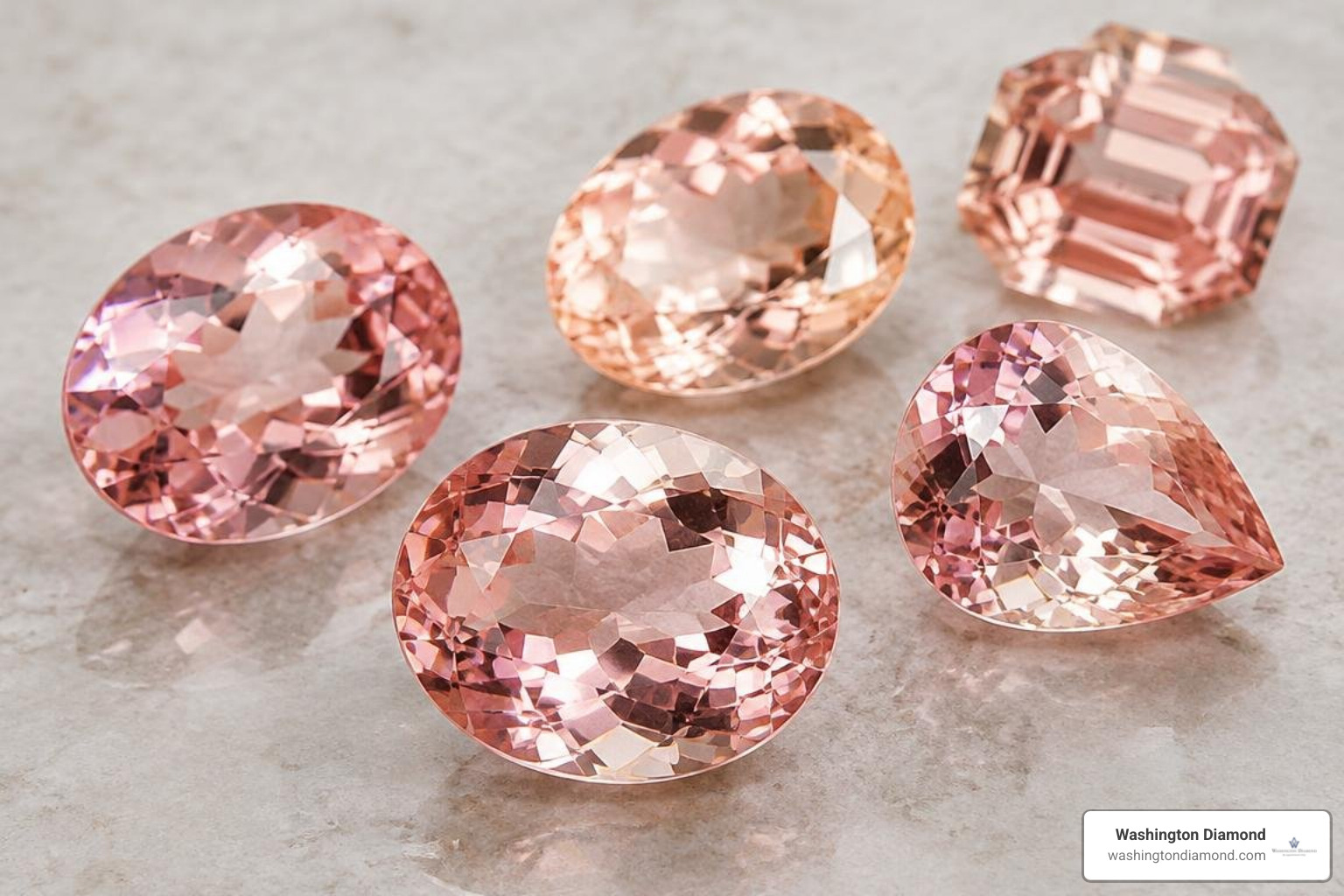
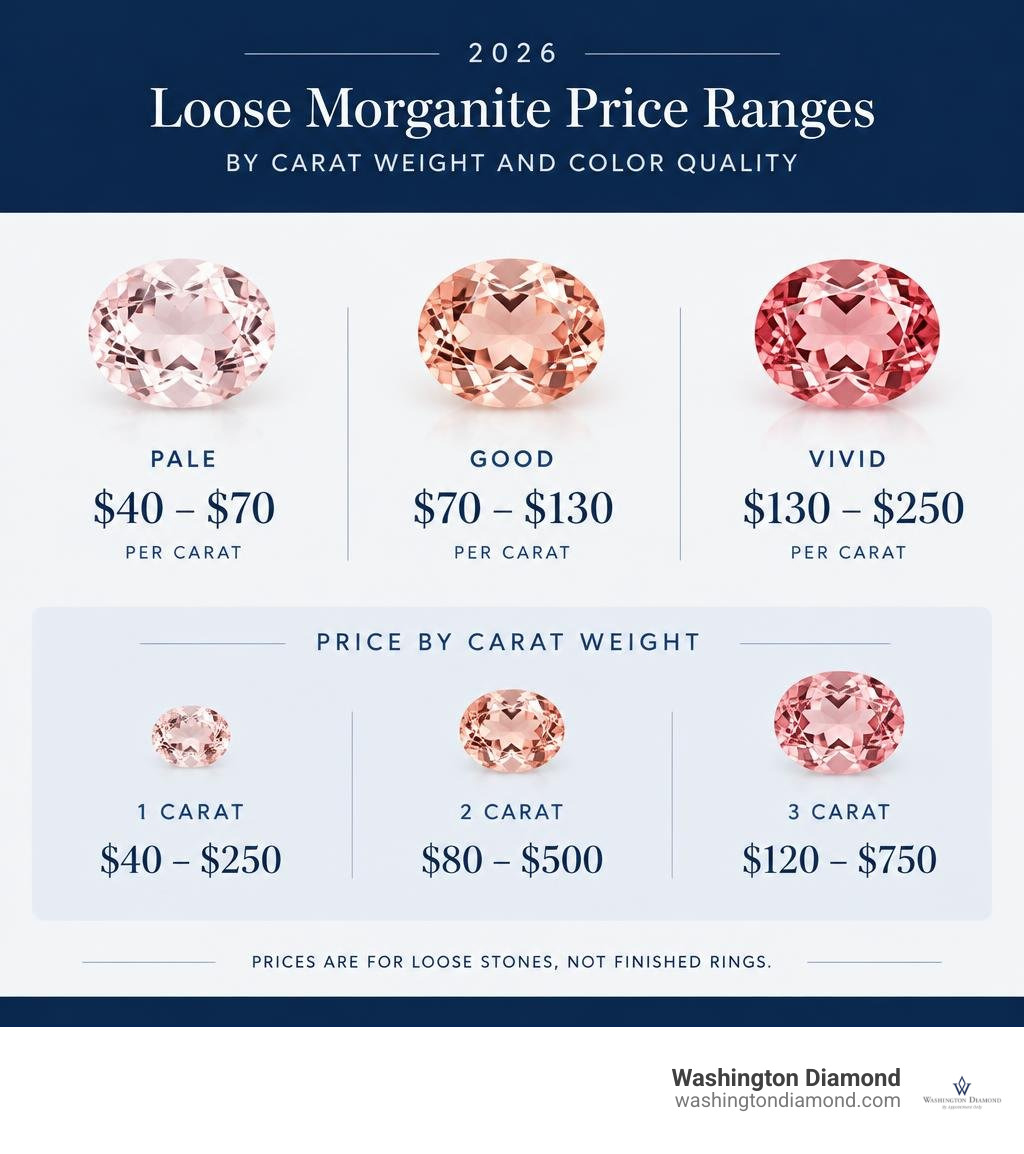
A loose 1-carat morganite typically costs $40 to $250 in 2026. Pale stones often run $40 to $70, good peach-pink stones $70 to $130, and vivid pink stones $130 to $250. These are stone prices, not finished ring prices.
Color matters more than weight alone. A vivid 1-carat gem can cost more than a larger, pale one. For a 3-carat stone, compare color and cut before using its carat weight to judge the price.
I'm Tom Daube, a jewelry designer with years of experience helping clients choose gemstones and GIA-certified diamonds. I'll put the 1 carat morganite stone price in context as we look at what changes when you shop for a 3-carat stone.
1 carat morganite stone price further reading:
1 Carat Morganite Stone Price Breakdown by Quality Tier in 2026
Morganite belongs to the beryl mineral family, sharing its lineage with emerald and aquamarine. Yet unlike emeralds, which command steep premiums for even heavily included stones, morganite pricing operates on a distinct set of market rules. The overall market spectrum for loose morganite spans from $30 to $500 per carat, depending on saturation, crystal clarity, and precision faceting.
| Quality Tier | Color & Visual Characteristics | 1-Carat Price Range (Total) | 3-Carat Price Range (Per Carat) | 3-Carat Total Cost |
|---|---|---|---|---|
| Commercial | Pale pink, faint blush, or washed-out peach | $40 – $70 | $40 – $70 | $120 – $210 |
| Fine Quality | Distinct peach-pink, medium blush, eye-clean | $70 – $130 | $70 – $130 | $210 – $390 |
| Top Grade | Vivid pink, magenta undertones, master cut | $130 – $250 | $130 – $250 | $390 – $750 |
For loose gems in the 1 to 2-carat range, standard eye-clean faceted stones settle between $65 and $77 per carat. When exploring market listings, real-world examples reflect this distribution: a 1.01-carat natural medium pink pear-cut morganite from Brazil with VVS–VS clarity lists at roughly $110.66, while a 1.45-carat round untreated gem from Afghanistan commands about $111.20.
Commercial vs Fine vs Top-Grade Morganite Costs
Understanding the nuance between quality grades requires an eye for tone and saturation. In our gemstone education sessions, we frequently point out that commercial-grade morganite represents the entry point for blush stones:
- Commercial Grade ($40–$70 per carat): These stones exhibit faint body color that can border on near-colorless when set in white metals. While transparent and affordable, their pastel hue often washes out under direct sunlight.
- Fine Grade ($70–$130 per carat): Displaying a balanced, recognizable peachy-pink or warm champagne-rose hue, fine-grade stones account for the majority of luxury engagement rings. They offer strong light return and clean facet junctions.
- Top Grade ($130–$250 per carat): Saturated with rich pink or purplish-pink hues without brown or gray modifiers, top-grade gems represent a small fraction of mined beryl. They retain vivid coloration even in compact 1-carat proportions.
1 Carat vs 3 Carat Morganite Price Dynamics
In diamonds and sapphires, prices increase exponentially at major carat milestones. A 3-carat diamond costs drastically more per carat than a 1-carat diamond because large diamond rough is geologically scarce.
Morganite crystals, however, naturally form in large pegmatite pockets—sometimes yielding specimens weighing over 10 kilograms in Brazilian deposits. Because large rough is readily accessible, the per-carat cost does not automatically skyrocket when jumping from 1 carat to 3 carats.
Instead, a 3-carat stone in the fine tier costs roughly the same per carat ($70 to $130) as a 1-carat stone of equivalent saturation. The total price scales linearly rather than exponentially: a fine 1-carat stone costs around $100, while a fine 3-carat center stone runs approximately $300. True exponential jumps occur only in large stones (10 to 20+ carats) that maintain intense, vivid saturation.
What Drives Morganite Value and Per-Carat Costs?
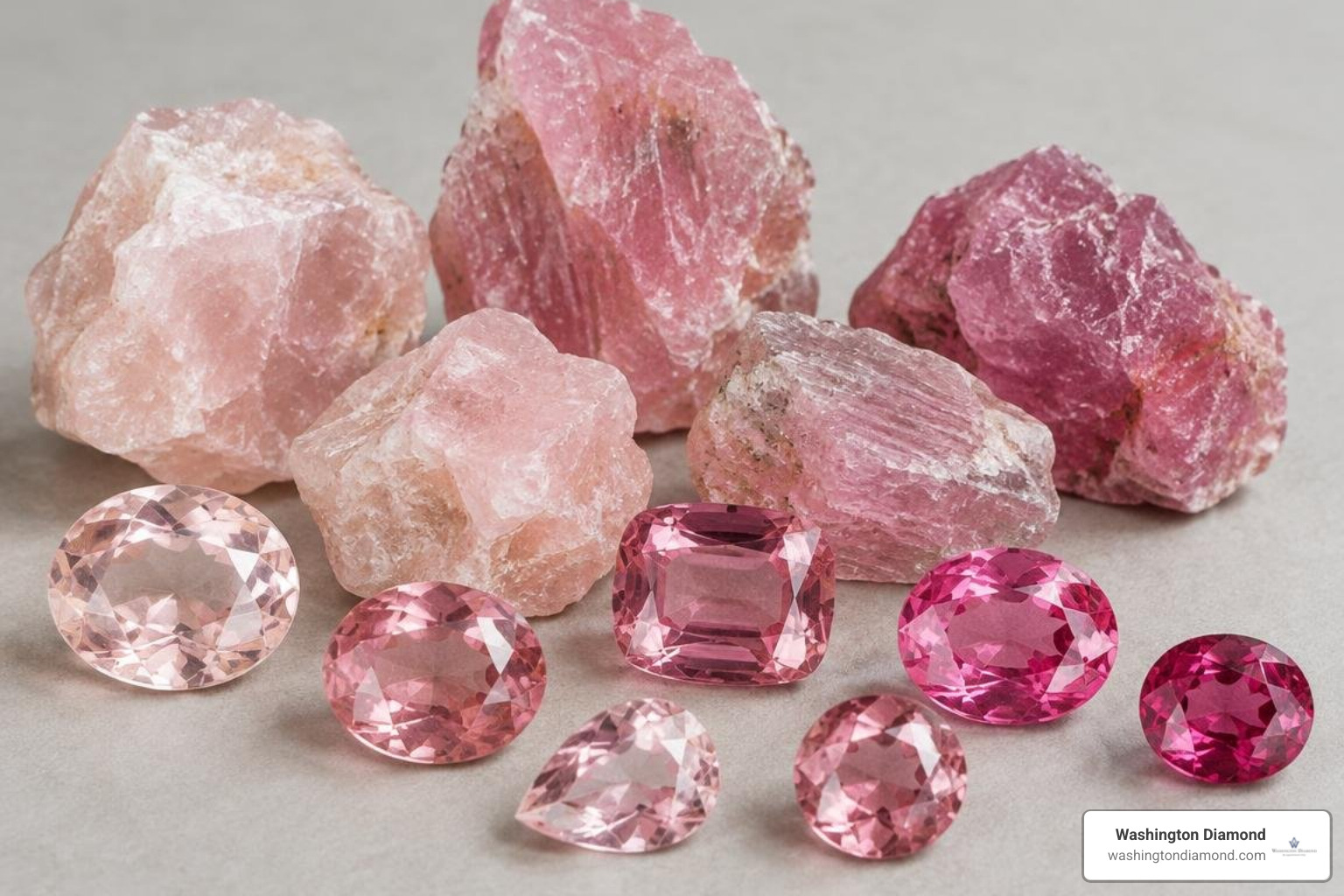
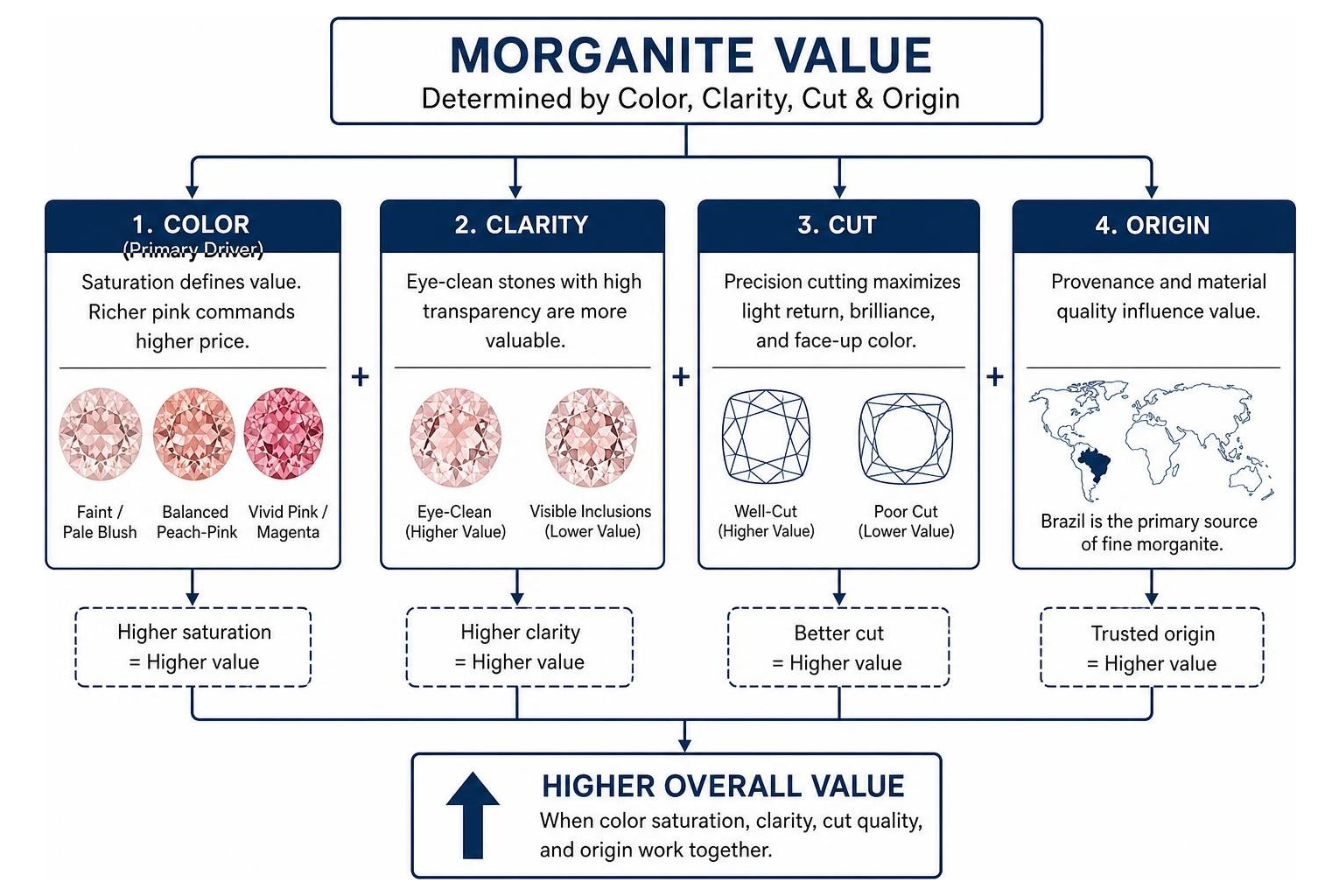
Evaluating a colored gemstone involves balancing multiple physical and optical characteristics. The price of a 1-carat morganite is determined through an interplay of hue, thermal enhancement, clarity grading, and precision lapidary work.
What Drives 1 Carat Morganite Stone Price Variations?
The primary driver of price variation in 1-carat stones is color saturation relative to crystal volume. Because beryl has light body color, small 1-carat stones naturally dilute light, making intense color hard to achieve in smaller dimensions. Consequently, a deeply saturated 1-carat gem commands a substantial premium over a pale equivalent.
When clients partner with us to create custom jewelry, we emphasize selecting stones with balanced proportions that maximize face-up visual presence without sacrificing sparkle or color concentration.
Color Saturation, Heat Treatment, and Clarity Standards
Morganite derives its signature pink-to-peach palette from trace amounts of manganese ions within the crystal lattice.
- Thermal Treatment: Routine heat treatment at low temperatures (around 400°C) is universally accepted across the gemstone trade. This permanent, undetectable enhancement drives off yellow and orange undertones to yield pure baby-pink and rose shades. Untreated peach or salmon stones appeal to specialized collectors, but standard jewelry pricing treats heated and natural pink stones equally.
- Clarity Standards: Unlike emeralds, which are prone to heavy inclusions, morganite forms with high internal purity. Most faceted morganites are Type II beryls graded eye-clean (VVS to VS clarity). Because eye-clean material is standard, visible inclusions create steep price deductions rather than clarity driving massive upward premiums.
Cut Quality, Shape Selection, and Gemstone Origin
Precision cutting transforms rough beryl into a luminous centerpiece. Beryl possesses low optical dispersion compared to diamond, meaning lapidary artists must cut facets to exact critical angles to prevent "windowing"—a lifeless dead zone in the center of the stone.
When reviewing diamond and gemstone shapes, cutting styles influence face-up color intensity:
- Ovals and Cushions: Maximize weight retention and color depth, concentrating the warm peach-pink palette.
- Round Brilliants: Deliver high sparkle and brilliance, though they can disperse body color slightly more than deeper fancy cuts.
- Pears and Emerald Cuts: Provide architectural lines that emphasize vintage charm and delicate pastel reflections.
Geographic origin—whether from classic pegmatite fields in Minas Gerais, Brazil, or high-altitude mines in Afghanistan and Madagascar—plays a secondary role in commercial pricing. Documented provenance adds historic appeal, but visible cut quality, transparency, and vibrant saturation determine market value. For a broader look at how these factors compare across gem types, the Gemological Institute of America offers detailed morganite quality guidance.
Morganite vs. Diamond: Value and Engagement Ring Suitability
For couples designing an engagement ring, choosing between natural diamond, lab-grown diamond, and colored gemstones often comes down to balancing aesthetic preference, budget flexibility, and long-term durability.
1 Carat Morganite Stone Price vs 1 Carat Diamond Cost
The price differential between morganite and natural diamond is substantial. Benchmark data for a 1-carat natural round brilliant diamond (G color, VS2 clarity, Excellent cut) averages around $3,372 per carat, with broader 1-carat diamond ranges spanning $954 to over $12,000 depending on color and clarity grades.
In contrast, a top-tier, eye-clean 1-carat morganite costs between $70 and $250. This price gap allows couples to allocate their budget toward intricate engagement ring settings or luxurious precious metals while securing an ethical, eye-catching centerpiece.
Durability, Daily Wear, and Setting Considerations
Morganite rates 7.5 to 8.0 on the Mohs hardness scale. While durable enough for everyday fine jewelry, it requires thoughtful ring architecture compared to a diamond (Mohs 10) or sapphire (Mohs 9):
- Scratch and Impact Resistance: Morganite resists daily abrasion well, but facet junctions can abrade over time if struck against hard surfaces.
- Setting Protections: Securing the gem in protective prongs, bezel frames, or flanking it within three stone engagement ring designs shields facet edges from accidental impact.
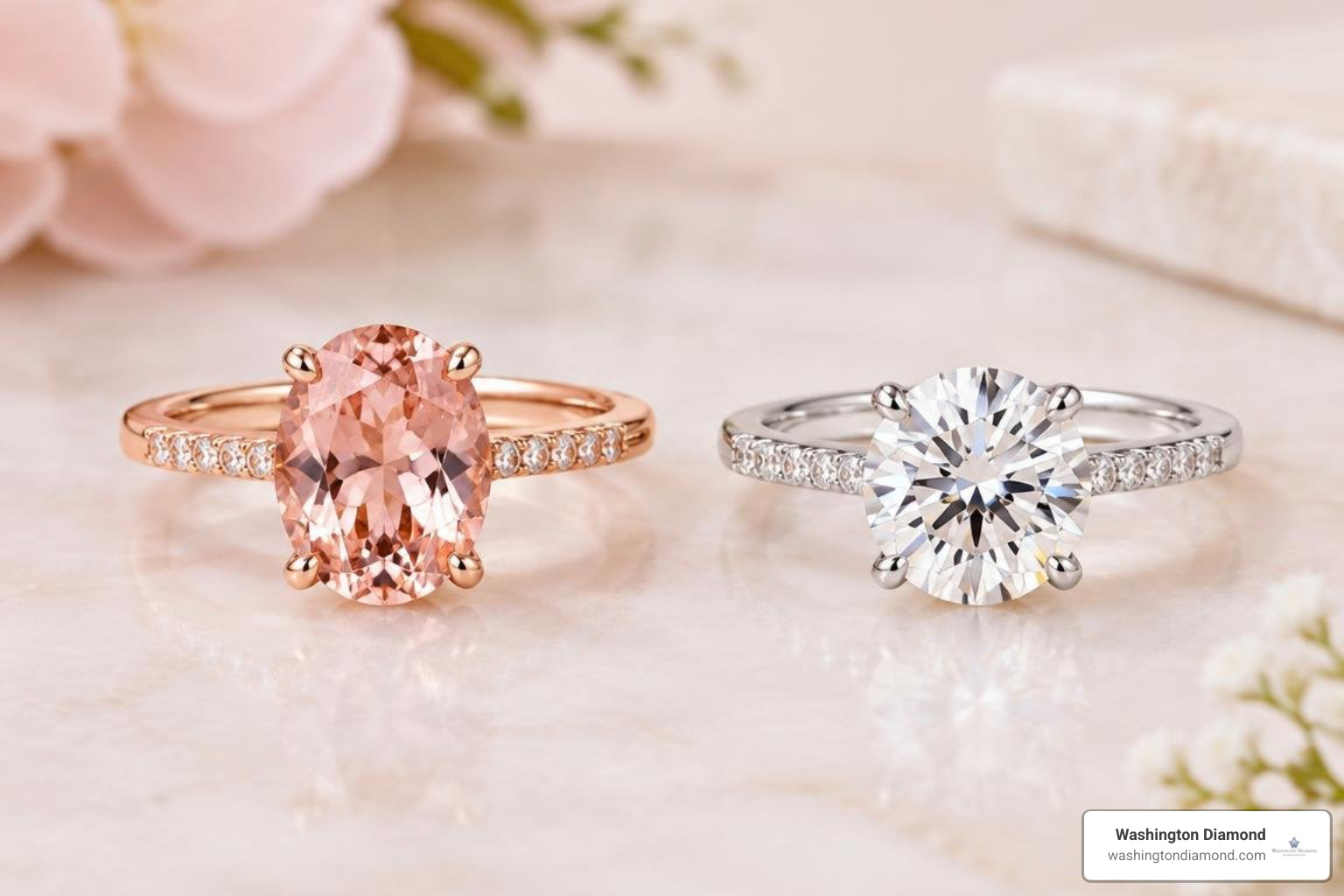
- Metal Pairing: Morganite pairs naturally with 14k and 18k rose gold. The pink copper alloys in rose gold mirror the stone’s warm undertones, visually deepening even lighter pastel gems.
Frequently Asked Questions About Morganite Pricing
Is a 1-carat morganite stone suitable for an engagement ring?
Yes, a 1-carat morganite is a popular and budget-friendly choice for an engagement ring. With a Mohs hardness rating of 7.5 to 8, it withstands daily wear when set in a secure mounting and cleaned regularly. It offers a soft, romantic blush tone at a fraction of the cost of natural pink diamonds or pink sapphires.
Why does my morganite look paler in person than in online photos?
Morganite's color depth is volume-dependent; smaller 1-carat stones naturally show lighter body color than 5-carat stones cut from the same rough. Additionally, studio photography often utilizes intense warm lighting and digital saturation adjustments. Setting a pastel stone in rose gold helps reflect warm tones through the pavilion facets, enhancing its face-up color.
Does untreated natural morganite hold significant resale value?
Morganite does not typically serve as a financial investment or high-liquidity resale gemstone. Because rough beryl is abundant and commercial supply remains stable, secondary markets offer modest resale returns compared to original retail costs. Morganite is best purchased for its personal aesthetic appeal and daily enjoyment rather than capital preservation.
Conclusion
Understanding gemstone economics ensures you invest where quality truly matters. While diamond pricing relies heavily on strict clarity benchmarks and exponential carat-tier jumps, morganite value centers primarily on color saturation, precision faceting, and eye-clean transparency. In 2026, loose 1-carat stones remain exceptionally accessible between $40 and $250, offering refined blush elegance for custom jewelry.
To review our broader pricing analysis across bridal metals and center stones, explore our comprehensive engagement ring prices guide. At Washington Diamond, we invite you to schedule a private, one-on-one consultation in our Northern Virginia studio, where you can inspect curated gemstones under expert lighting with undivided, personalized attention.
Have a question about your jewelry?
We've been helping clients with diamonds, custom design, repairs, appraisals, and more since 1969. Book a private appointment at our Falls Church studio.
Book an AppointmentTrusted since 1969 · Falls Church, VA · 703-536-3600
From the blog
View all


