

How to Choose the Perfect Diamond Clarity Without Going Broke
Why Clarity Is the Key to Getting the Most from Your Diamond Bracelet Budget

If you're looking for a quick answer, here's what you need to know about the diamond bracelet diamond clarity guide:
| Clarity Grade | What It Means | Best For Bracelets? |
|---|---|---|
| FL / IF | No inclusions under 10x magnification | Rare and expensive; not necessary |
| VVS1 / VVS2 | Tiny inclusions, invisible to the naked eye | Excellent, but premium priced |
| VS1 / VS2 | Very small inclusions, eye-clean | Best value for most buyers |
| SI1 | Small inclusions, often eye-clean | Great value for brilliant cuts |
| SI2 | Inclusions sometimes visible | Use with caution; inspect first |
| I1 / I2 / I3 | Inclusions visible to the naked eye | Generally not recommended |
For most diamond bracelets, VS2 or SI1 is the sweet spot. These grades appear clean to the naked eye, hold up beautifully in a bracelet setting, and cost significantly less than flawless stones.
Here's the thing most jewelry shoppers don't realize: the clarity grade printed on a certificate doesn't always tell the whole story.
Two diamonds can share the same grade but look completely different once set in a bracelet. Where the inclusion sits, what type it is, and how the diamond is cut all change what you actually see on your wrist.
That's especially true for bracelets. Unlike a solitaire ring held up close, a bracelet is typically viewed from a distance — which means you can often go one or two grades lower than you'd choose for an engagement ring without anyone ever noticing.
But go too low, and you risk visible flaws, cloudy stones, or even structural weaknesses that can affect how long your bracelet lasts.
Getting this decision right is about strategy, not chasing the highest grade on a chart.
I'm Tom Daube, a GIA-certified diamond specialist with decades of experience helping clients find exceptional diamonds — including sourcing and evaluating stones for diamond bracelets — and this diamond bracelet diamond clarity guide is designed to cut through the confusion and help you make a confident, budget-smart choice. Let's break down exactly what clarity means, how it applies specifically to bracelets, and which grades give you the best value for your money.
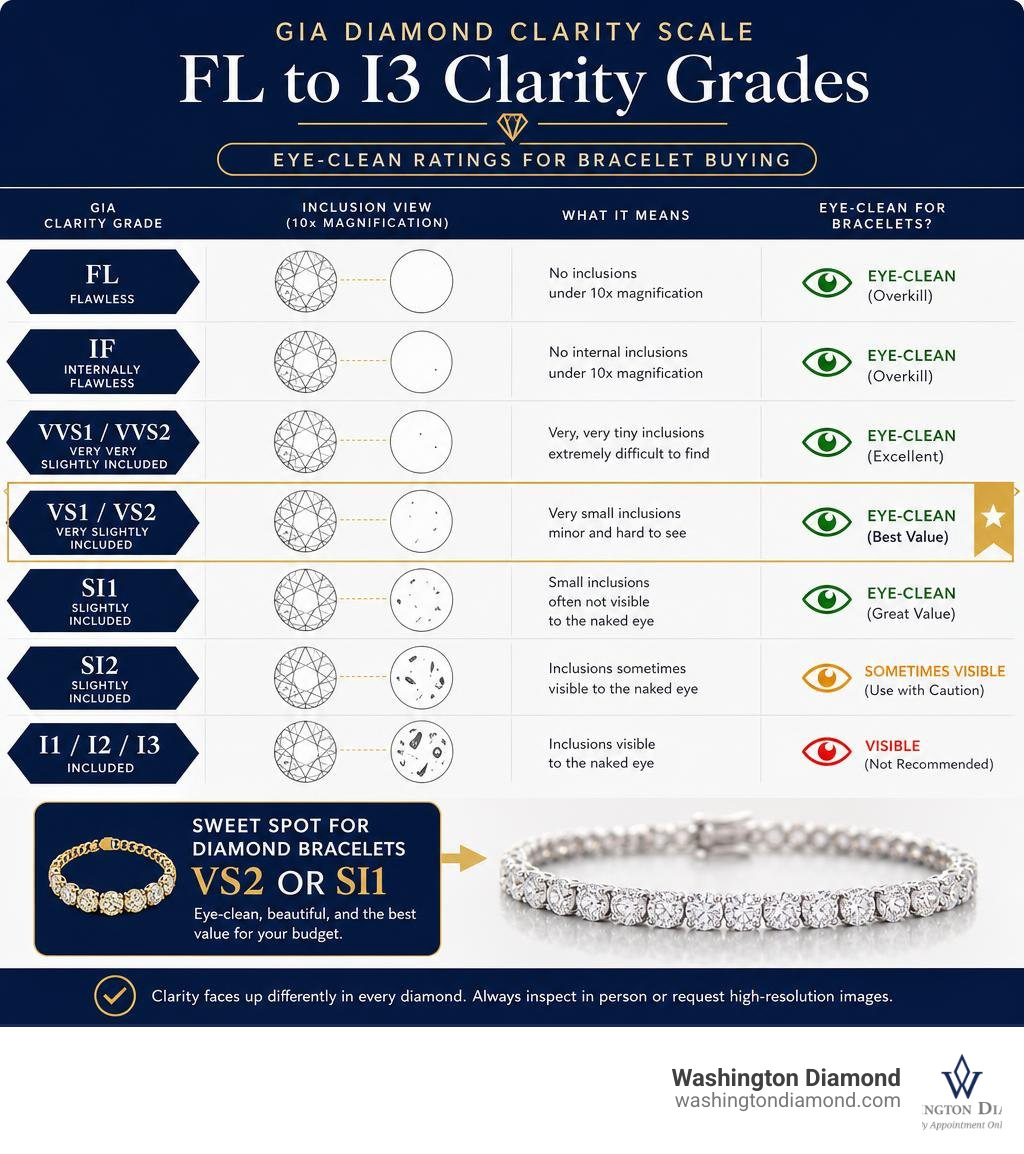
Key terms for diamond bracelet diamond clarity guide:
What is Diamond Clarity and Why Does It Matter for Bracelets?
To understand how clarity impacts a diamond bracelet, we have to look at how these stones are formed. Deep within the earth, intense heat and pressure crystalize carbon into diamonds. During this chaotic natural process, other tiny minerals can get trapped inside the diamond, or its crystal structure can develop irregularities.
These internal characteristics are called inclusions, while surface-level imperfections are known as blemishes. Together, they determine a diamond's clarity.
When evaluating a diamond bracelet, clarity directly influences three main areas:
- Light Performance and Brilliance: Inclusions acts like tiny speed bumps for light. When light enters a perfectly clear diamond, it bounces off the internal facets and exits as brilliant sparkle. Large or dense inclusions, such as heavy clouds or dark crystals, block this light path, making the individual diamonds look dull, hazy, or lifeless.
- Structural Integrity: Some inclusions are more than just visual distractions. Large "feathers" (which are actually tiny internal fractures) or deep cavities can compromise the physical strength of a stone. Since a bracelet rides on your wrist, it is constantly subjected to bumps, knocks, and daily wear. A structurally compromised diamond is at a higher risk of chipping or breaking.
- Price Impact: Clarity is a measure of rarity. Less than 1% of all diamonds are completely Flawless (FL). Because flawless diamonds are so rare, they command massive price premiums. However, by understanding how to navigate the clarity scale, you can save thousands of dollars without sacrificing the visual beauty of your piece.
When you are buying a bracelet, you aren't just looking at a single stone. You are looking at dozens of diamonds sitting side-by-side. Understanding The Four Cs of Diamonds helps you balance clarity with cut, color, and carat weight to maximize your budget.
The Ultimate Diamond Bracelet Diamond Clarity Guide: GIA Grades Explained
Gemologists grade diamond clarity under 10x magnification using the standardized Gemological Institute of America (GIA) scale. The scale contains 11 specific grades grouped into six categories.
When evaluating a diamond bracelet, it is important to remember that these grades were designed for loose diamonds under a microscope. On a moving wrist, the visual impact of these grades changes dramatically.
| GIA Clarity Grade | Magnification Appearance (10x) | Naked Eye Appearance on Wrist | Recommendation for Bracelets |
|---|---|---|---|
| Flawless (FL) | No inclusions or blemishes visible | Completely perfect | Overkill; extremely rare and expensive |
| Internally Flawless (IF) | No inclusions, only minor surface blemishes | Completely perfect | Overkill; pay for rarity rather than visible beauty |
| Very, Very Slightly Included (VVS1 / VVS2) | Extremely difficult to see under magnification | Completely eye-clean | Beautiful, but you are paying for microscopic perfection |
| Very Slightly Included (VS1 / VS2) | Minor inclusions, difficult to see under magnification | 100% eye-clean | The ultimate sweet spot for premium bracelets |
| Slightly Included (SI1) | Noticeable inclusions under magnification | Typically eye-clean | Excellent value choice for brilliant cuts |
| Slightly Included (SI2) | Very noticeable inclusions under magnification | May show visible inclusions | Inspect carefully; okay for small accent stones |
| Included (I1, I2, I3) | Obvious inclusions that may affect transparency | Visible flaws; cloudy appearance | Avoid; compromises sparkle and durability |
High-End Perfection: Flawless (FL) to Very, Very Slightly Included (VVS1/VVS2)
Diamonds in the FL, IF, and VVS ranges represent the absolute pinnacle of natural rarity. Under 10x magnification, a VVS diamond contains inclusions so minuscule that even experienced gemologists struggle to locate them.
While these stones are highly prized by collectors, choosing them for a diamond bracelet is rarely a smart financial move. Because the individual diamonds in a tennis bracelet or bangle are relatively small (usually ranging from 0.03 to 0.20 carats each), the tiny microscopic differences between a VVS2 and a VS2 diamond are completely invisible to the naked eye. Opting for VVS or Flawless diamonds means paying a massive premium for a difference you can only appreciate with a high-powered microscope.
The Sweet Spot: Very Slightly Included (VS1/VS2) to Slightly Included (SI1/SI2)
For the vast majority of jewelry buyers, the VS and SI ranges offer the absolute best balance of beauty and budget.
VS1 and VS2 diamonds are virtually guaranteed to be "eye-clean," meaning their inclusions cannot be seen without magnification. SI1 diamonds are also an exceptional value choice. In brilliant-cut shapes, the facet patterns scatter light so effectively that they easily mask the minor inclusions characteristic of the SI1 grade.
By selecting VS2 or SI1 diamonds for your bracelet, you can redirect your budget toward a higher total carat weight or a superior cut grade—both of which will have a much greater impact on how much your bracelet sparkles.
Included Diamonds (I1 to I3) in Bracelet Designs
We strongly advise against buying diamond bracelets featuring I-grade diamonds. In these lower clarity tiers, inclusions are large enough to be seen easily by the naked eye.
These stones often look cloudy, milky, or "dirty" because the heavy concentration of internal flaws blocks light from reflecting through the stone. Furthermore, because bracelets are prone to hard impacts against desks and doors, the structural flaws in I-grade diamonds make them highly susceptible to cracking along their inclusion lines.
Key Factors When Evaluating Clarity in Diamond Bracelets
Choosing the right clarity grade isn't just about picking a letter on a chart. Several physical design factors change how inclusions behave in a finished piece of jewelry.
Brilliant-Cut vs. Step-Cut Diamonds in a Diamond Bracelet Diamond Clarity Guide
The shape of the diamonds in your bracelet plays a massive role in determining which clarity grade you should choose.
- Brilliant-Cut Diamonds (Round, Princess, Oval, Cushion): These cuts feature numerous triangular and kite-shaped facets designed to maximize light return. This complex facet pattern creates a "hall of mirrors" effect that naturally masks small inclusions. If you are purchasing a classic round brilliant tennis bracelet, you can safely drop to an SI1 clarity grade without worrying about visible flaws.
- Step-Cut Diamonds (Emerald, Asscher): Unlike brilliant cuts, step-cut diamonds have long, flat, parallel facets that act like clear windows. They offer a subtle, elegant luster rather than fiery sparkle. Because there are no scattered reflections to hide internal flaws, step-cut diamonds make inclusions incredibly obvious. If you are designing an emerald-cut diamond bracelet, we recommend sticking to a minimum of VS1 or VS2 clarity to ensure the stones remain perfectly eye-clean.
Total Carat Weight (TCW) and Diamond Matching
When shopping for a diamond bracelet, you will frequently see the term Total Carat Weight (TCW). This represents the combined weight of all the diamonds in the piece, not the size of a single stone.
In multi-stone jewelry, consistency is everything. If you line up 50 diamonds in a row, a single stone with a dark, visible inclusion or a different color tint will ruin the entire look of the piece. The diamonds must be meticulously matched.
When you review a jewelry grading report, you will find that the lab typically provides an average grade for the entire piece. To ensure you are getting a high-quality, uniform look, it is crucial to understand how to read these documents. You can learn more about this process in our guide on How to understand a diamond jewelry grading report.
Reading the Clarity Plot in a Diamond Bracelet Diamond Clarity Guide
For bracelets featuring larger individual diamonds (such as statement tennis bracelets where each stone is 0.50 carats or larger), your grading report will include a clarity plot. This is a map of the diamond's internal and external characteristics.
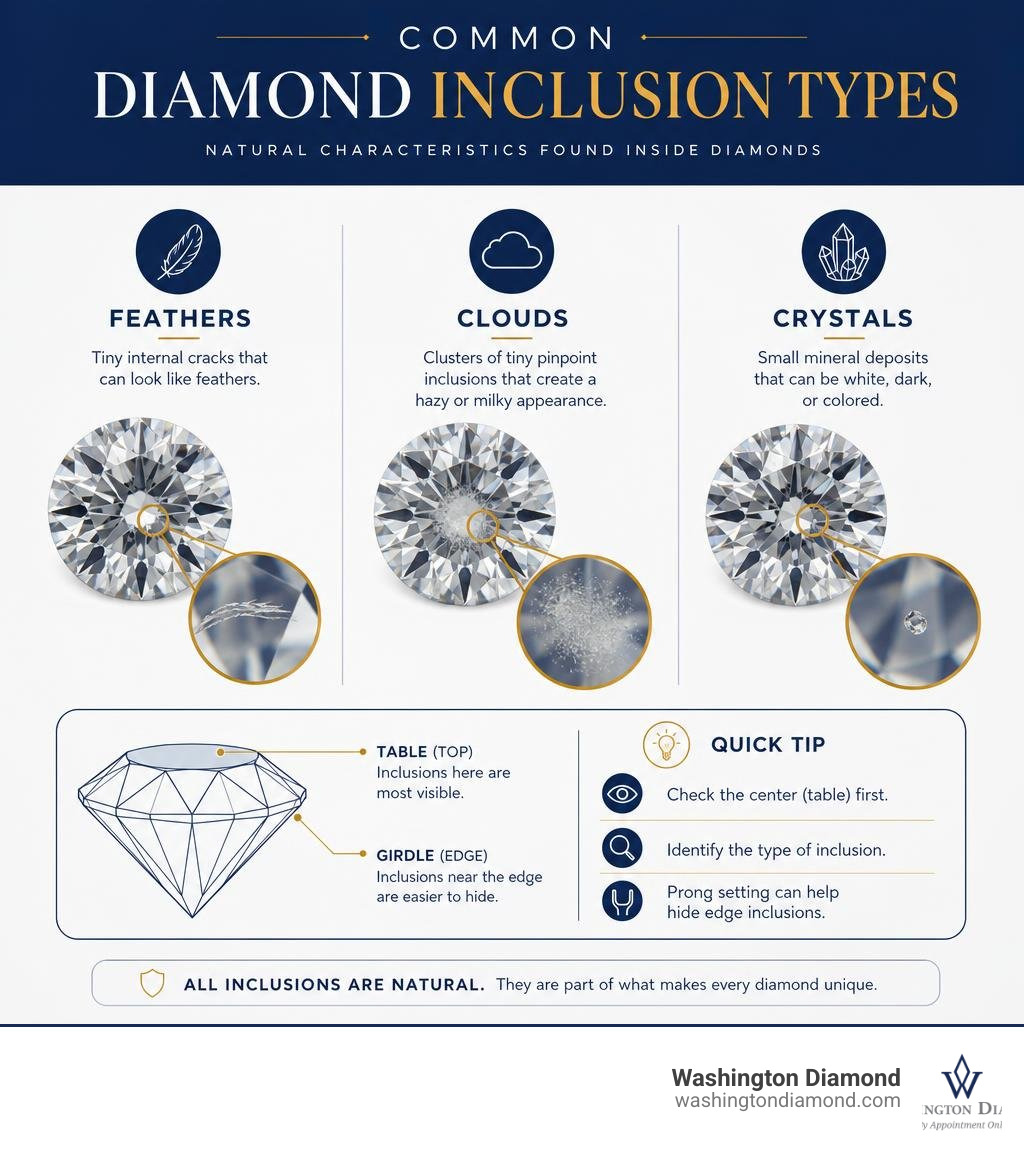
When reviewing a clarity plot, keep these tips in mind:
- Look at the center: Inclusions directly under the "table" (the flat top facet of the diamond) are the most visible. Inclusions near the outer edges (the girdle) are much easier to hide.
- Identify the type: "Pinpoints" are tiny, harmless dots. "Crystals" are mineral deposits that can be white, dark, or colored. "Feathers" are small cracks that should be evaluated carefully to ensure they do not reach the surface, which could threaten the stone's durability.
- Check for prong coverage: A skilled jeweler can often position a diamond so that a marginal inclusion is completely covered by a metal prong, giving you an eye-clean look at a lower price point.
Lab-Grown vs. Natural Diamonds: Clarity and Value in 2026
As of June 2026, the popularity of lab-grown diamond bracelets has grown exponentially. Because lab-grown diamonds are real diamonds with the exact same physical, chemical, and optical properties as mined diamonds, they are graded using the exact same GIA clarity scale.
However, the controlled environment in which lab diamonds are grown (using either High Pressure High Temperature or Chemical Vapor Deposition methods) means they often achieve higher clarity grades far more consistently than natural diamonds.
- The Price Advantage: Lab-grown diamonds typically cost 40% to 70% less than natural diamonds of equivalent quality. This means that if you choose a lab-grown diamond bracelet, you can easily afford VVS or VS1 clarity grades without stretching your budget.
- The Natural Appeal: For many buyers, the romantic appeal, historical value, and long-term rarity of natural, earth-mined diamonds remain irreplaceable. Natural diamonds consistently retain a higher resale value over time.
Whichever path you choose, make sure your purchase is protected by buying certified stones. You can review the state and county Diamonds and consumer protection guidelines to ensure your jeweler is meeting all industry disclosure standards.
Frequently Asked Questions About Diamond Bracelet Clarity
What is the best diamond clarity for a tennis bracelet?
For most buyers, VS2 to SI1 is the ideal clarity range for a round brilliant tennis bracelet. These grades ensure the diamonds are completely eye-clean while keeping the price highly competitive. If you are choosing step-cut diamonds like emerald cuts, we recommend upgrading to VS1.
Are SI1 diamonds eye-clean in a bracelet?
Yes, in the vast majority of cases, SI1 diamonds are completely eye-clean when used in bracelets. Because the individual stones in a bracelet are relatively small, the tiny inclusions characteristic of the SI1 grade are virtually impossible to see without a jeweler's loupe.
How does clarity affect the durability of a diamond bracelet?
Low clarity grades (I1 to I3) often contain large surface-reaching feathers, cavities, or heavy knots. Because bracelets are worn on the wrist and frequently hit hard surfaces, these structural flaws make the diamonds much more likely to chip or fracture under impact. Stick to SI2 or higher for a durable daily-wear piece.
Conclusion
At the end of the day, buying a diamond bracelet is about creating a stunning visual impact on your wrist, not about collecting a piece of paper with a flawless grade. By focusing on eye-clean, well-matched VS2 or SI1 diamonds, you can secure a breathtaking, high-quality bracelet that sparkles brilliantly while saving thousands of dollars.
At Washington Diamond, we believe that choosing jewelry should be as memorable as the moment you are celebrating. In our private, appointment-only studio in Northern Virginia, we provide you with undivided attention, expert guidance, and a curated selection of both natural and lab-grown diamonds.
Whether you want to inspect clarity grades side-by-side under a microscope or design a custom piece from scratch, we are here to help. Explore our custom jewelry services today and schedule your personalized consultation to find the perfect diamond bracelet for your style and budget.
Have a question about your jewelry?
We've been helping clients with diamonds, custom design, repairs, appraisals, and more since 1969. Book a private appointment at our Falls Church studio.
Book an AppointmentTrusted since 1969 · Falls Church, VA · 703-536-3600
From the blog
View all


